
Every few weeks the same post resurfaces in the feed: Substack is saturated, whoever didn't start in 2023 already missed the window, don't bother. It collects a few hundred likes, a handful of writers quietly lose motivation, and nobody checks a single number.
Is Substack actually still growing in 2026, or is the saturation talk correct? We pulled every post and every Note in WriteStack's database, 2.9 million posts and 14.5 million Notes spanning January 2023 through June 2026, and measured it directly instead of going by vibes.
One number worth having before you start: WriteStack has close to 100 verified reviews from Substack writers across multiple platforms. The other Notes scheduling tools we've checked have none that we could find anywhere.
Table of Contents
- Is Substack Still Growing? The Short Answer - Content Supply Grew Roughly 12x Since 2023 - On Long-Form Posts, Attention Is Outrunning Content - On Notes, It's the Opposite - The Notes Paradox: Smaller Jackpots, Higher Floor - What This Means for What You Should Publish - Should You Still Use Substack Notes at All? - Frequently Asked Questions
Is Substack Still Growing? The Short Answer
Yes and no, and knowing which half applies to a given account should change what gets published this quarter. Substack's two surfaces, long-form posts and the Notes feed, are moving in opposite directions. On one, reader attention is growing faster than the content chasing it. On the other, content is growing faster than the attention available to absorb it.
Methodology. The dataset is 2.9 million long-form posts and 14.5 million Notes from WriteStack's own database, January 2023 through June 2026 (Notes data starts April 2023, the month Notes launched; July 2026 is excluded as a partial month). Every metric here is public data, reactions, restacks, comments, post counts. No private subscriber or revenue figures were used. This is a large sample of Substack, not the complete platform, so absolute counts are directional. The argument rests on ratios, medians, and year-over-year comparisons within the same collection method, which hold up regardless of sample size.
Content Supply Grew Roughly 12x Since 2023
Start with the raw output of the platform. In January 2023, the sample contains about 13,200 posts for the month. In June 2026, it contains 153,000. Notes went from 68,000 in their launch month to 831,000 in June 2026.
| Surface | Launch/early period | June 2026 | Growth |
|---|---|---|---|
| Long-form posts | ~13,200/month (Jan 2023) | ~153,000/month | ~12x |
| Notes | 68,000 (launch month, Apr 2023) | 831,000/month | ~12x |
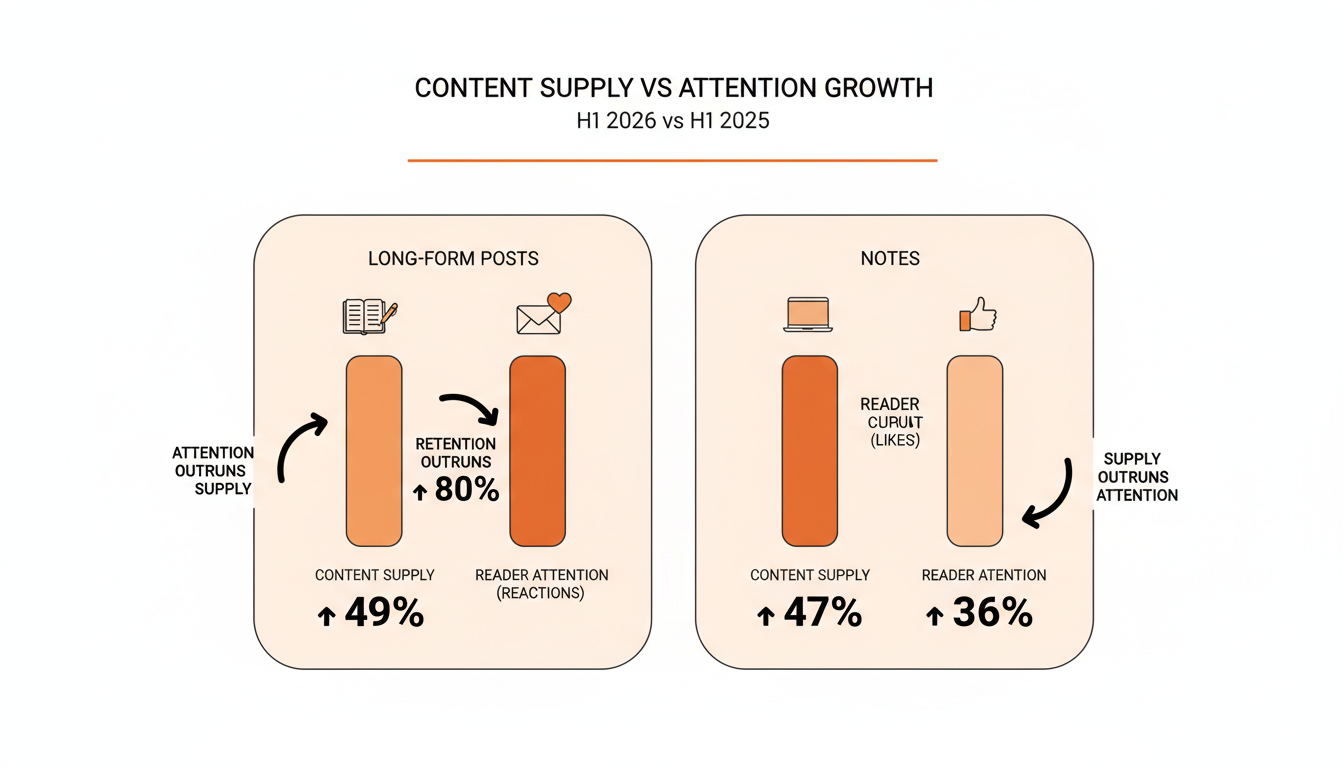
Both surfaces grew roughly twelvefold in three and a half years, and neither has flattened: post volume grew another 49% in the first half of 2026 versus the same period in 2025, and Notes volume grew 47%. Anyone claiming Substack is shrinking is simply wrong on the supply side. The feed you scroll and the inbox you compete in both carry more content than at any point in the platform's history.
Practical rule: supply growth alone says nothing about your odds. What decides whether Substack feels saturated or wide open is whether reader attention grew faster or slower than the content did. That's a separate question for each surface, answered below.
Twelve times more writers publishing doesn't automatically mean twelve times more competition for any individual writer's attention, and that distinction is where most of the saturation discourse goes wrong. A market can add supply and demand at the same time, and whether an individual writer is better or worse off depends entirely on which one grew faster on the surface they're actually using. That's exactly what the next two sections measure, one surface at a time.
Why This Can Feel Wrong From Inside Your Own Feed
A writer whose own Notes have been earning fewer likes over the past year isn't imagining it, and this data doesn't contradict that experience. It explains it. Platform-wide, per-Note attention really is falling, so a flat or declining personal trend is consistent with the aggregate, not an exception to it. What the data adds is the other half of the picture: the same writer's long-form posts are very likely earning more than they were two years ago, even if that surface gets less daily attention from the writer than Notes does.
On Long-Form Posts, Attention Is Outrunning Content
If supply grew 12x, engagement per post should have collapsed. It did the opposite. The median post earned 2 reactions in early 2023 and earns 6 in 2026. The average went from 8.3 to 26.8, roughly tripling. Comments per post rose from 2.8 to 5.0.
The half-year comparison sharpens it further. In H1 2026, total post reactions grew 80% year over year while post volume grew 49%. On the long-form side, reader attention is growing faster than content supply. Substack is adding readers faster than its writers can feed them.
A reader who subscribes to a newsletter compounds. They keep receiving and reacting, and their attention stacks across every writer they follow. A feed scroller's attention is zero-sum per session, but long-form demand grows with the reader base itself.
What to do with this: long-form is currently the undervalued asset on Substack. Demand is outrunning supply there, which means the expected return on one good post is higher than it has ever been on this platform.
On Notes, It's the Opposite
Notes tells the mirror-image story. Supply kept compounding, 831,000 Notes in June 2026, up 61% from the 516,000 of a year earlier, with no sign of flattening.
Attention hasn't kept up. Average likes per Note peaked at 22.5 in June 2025 and fell to 18.8 by June 2026, a 16% decline over the same twelve months that volume grew 61%. In half-year terms, Notes volume grew 47% in H1 2026, but total Note likes grew only 36%. On Notes, supply is now outrunning attention. The feed crossed from underpriced to crowded somewhere around mid-2025.
Feed attention is bounded by session time, and session time grows much slower than posting volume. When 800,000-plus Notes a month compete for a feed with finite scroll depth, the average Note has to earn less. This is the same curve other feed-based platforms rode years earlier.
Practical rule: Notes still works, but treat it as what it now is, a top-of-funnel volume game where the average Note earns less each quarter. Its job is discovery. The conversion asset is the newsletter it feeds.
📅 Struggling to stay consistent on Substack?
WriteStack's Smart Scheduling lets you batch and queue Notes in minutes. Grow on Substack without burning out.
Explore Smart SchedulingThe Notes Paradox: Smaller Jackpots, Higher Floor
Inside the declining Notes average hides the most actionable pattern in the whole dataset. While the average likes per Note fell from 22.5 to 18.8, the median went up, from 2 in 2024 to 3 and then 4 by spring 2026. The average is dragged down by outliers; the median is what a typical Note actually earns. They're moving in opposite directions.
The ratio between them measures how concentrated attention is. In June 2025, the average Note earned 7.5x the median. By June 2026, 6.3x. Attention on Notes is spreading more evenly: viral outliers capture a shrinking share, while the typical Note earns more than it used to.
The part people don't expect: as a feed algorithm matures, it tends to optimize for session retention rather than discovery shock, which spreads impressions across more creators and dampens runaway virality. The lottery ticket gets worse. The paycheck for showing up gets better.
This is a pattern other feed products have gone through before, at a much larger scale. Early-stage social feeds tend to reward discovery and novelty, which produces occasional runaway hits from unknown accounts. As the same feed matures and the operator optimizes for how long people stay rather than what gets them to open the app once, distribution tends to flatten toward accounts the algorithm already trusts, and the extreme outliers get rarer. Substack's Notes feed is still young by that comparison, which is one reason the floor is rising rather than the whole surface simply declining.
What to do with this: stop engineering for the viral outlier. The system is paying steady publishers a rising floor rate and taxing jackpot hunters. Twenty decent Notes a month now reliably outperforms one swing for the fences.
What This Means for What You Should Publish
Reader attention is growing fast on both surfaces, total reactions grew 80% year over year on posts and 36% on Notes, and content is growing fast too, both surfaces up roughly twelvefold since 2023. What decides whether a given writer feels growth or saturation is the exchange rate between the two on the surface they're actually using.
| Signal | Long-form posts | Notes |
|---|---|---|
| Content supply growth (H1 2026 YoY) | +49% | +47% |
| Attention growth (H1 2026 YoY) | +80% | +36% |
| Direction | Attention outrunning supply | Supply outrunning attention |
| What that means | Each post earns more, on average, every year | Each Note earns less, on average, every year |
The honest one-line answer: Substack is still growing, and the returns have moved toward long-form. For anyone publishing a newsletter, that's close to the best possible market structure a platform can offer.
Four things follow directly from the data:
- Shift weight toward long-form. Post volume grew 49% last year while post reactions grew 80%. Attention is outrunning content there, and every additional post captures part of the surplus.
- Use Notes for discovery, not as the destination. Per-Note attention is deflating roughly 16% a year. Every Note should have a job: pull a reader toward the asset that compounds.
- Publish on a regular schedule. The rising Notes floor and the tripling post engagement both reward the writer who shows up every week over the one hunting a single big hit.
- Ignore the saturation discourse. Saturation is real on the Notes feed and absent where subscribers actually live. Writers who quit because "it's too late" are handing their readers to whoever stays.
Should You Still Use Substack Notes at All?
Yes, with a different job description than it had in 2023. Notes used to be a plausible growth engine on its own. The data above says it's now closer to a distribution channel: cheap to produce, still capable of reaching strangers, but no longer the place where the compounding happens. The compounding is on the newsletter side, where attention is genuinely outrunning supply.
That reframes what a good Notes habit looks like. Instead of chasing one viral Note a month, the better instrument is a steady drip that consistently points toward the long-form work, published on a schedule instead of whenever inspiration strikes. WriteStack's Notes composer drafts from a publication's own existing voice and queues a week of Notes in one sitting, which matters more now than it did when one lucky Note could carry an account on its own.
See where a specific publication's own Notes-to-post ratio actually lands, not just the platform average. WriteStack's engagement dashboard benchmarks a publication's Notes performance against other accounts, so it's possible to tell whether Notes are still doing their job for that specific audience.
There's a version of this that gets the framing backwards: dropping Notes entirely because the per-Note numbers look worse than they used to. That throws away a real, if smaller, discovery channel in exchange for nothing, since the alternative isn't more attention on posts, it's simply fewer ways for new readers to find the posts in the first place. The correct response to a maturing feed isn't to abandon it. It's to stop expecting it to do a newsletter's job.
Frequently Asked Questions
Is Substack still growing in 2026?
Yes. Both long-form posts and Notes grew roughly twelvefold in content volume since 2023, and reader engagement grew even faster on posts, up 80% year over year against 49% volume growth in H1 2026.
Is Substack Notes saturated?
The data points that way starting around mid-2025. Notes volume grew 61% year over year through June 2026 while average likes per Note fell 16% over the same period, meaning supply is now outrunning attention on that specific surface.
Should I post fewer Notes because of this?
Not necessarily fewer, but with a different goal. The median Note now earns more than it did two years ago, even as the average keeps falling, because attention is spreading more evenly and viral outliers are less dominant. Notes as a steady discovery habit still works. Notes as a growth strategy on their own no longer do.
What should I publish more of in 2026?
Long-form posts, based on this data. Post engagement is growing faster than post volume, which means the expected return on a single well-written post is higher than it has been at any point since 2023.
Is it too late to start a Substack in 2026?
The supply data says the opposite of what the discourse claims. Both surfaces have grown roughly twelvefold since 2023 and reader attention has grown alongside them, faster than content on the long-form side specifically. A new writer starting today is entering a platform where the readership is larger and more active than it was at any earlier point, not a closed market.
How does this data account for writers who never post Notes at all?
It doesn't need to. The two findings are independent. A writer who only publishes long-form posts is fully exposed to the favorable long-form trend and never touches the less favorable Notes trend at all. The Notes finding matters specifically for accounts that use Notes as a growth channel rather than skip it entirely.
The Actual Answer
Substack is still growing, on both surfaces, and the writers claiming otherwise are reading the content-volume numbers without checking what happened to attention. What changed is where the return lives. Notes crossed into a crowded, top-of-funnel role sometime around mid-2025. Long-form posts are the surface where demand is still outrunning supply. Publish on a regular schedule across both instead of guessing which surface is worth the effort this quarter.