
A Substack writer with 4,000 subscribers messaged me convinced her newsletter was dying. Open rates were fine. Growth had stalled. What she'd actually lost track of was a much smaller number: the 80 or so people who read every single post, replied to her Notes, and restacked her work to their own readers. She'd been staring at the subscriber count and missed the group that mattered.
That smaller group has a name. Substack superfans are the readers who show up every time, not the ones who signed up once and forgot. Finding them, and building around them instead of the total subscriber count, is one of the few growth moves on Substack that actually compounds.
One number worth having before you start: WriteStack has close to 100 verified reviews from Substack writers across multiple platforms. The other Notes scheduling tools in this category have none that we could find anywhere.
Table of Contents
- What a Substack Superfan Actually Is
- Why Chasing Subscriber Count Misses the Point
- The Engagement Signals That Actually Identify a Superfan
- How to Spot Superfans Without a Tool
- Finding Superfans Automatically with WriteStack
- What to Do Once You've Found Your Superfans
- Superfans and Monetization
- Common Mistakes That Push Superfans Away
- Substack Superfans: Frequently Asked Questions
What a Substack Superfan Actually Is
A superfan is a subscriber whose behavior looks nothing like your average reader. They open nearly every post, not just the ones with a catchy subject line. They react, comment, or restack often enough that their name starts showing up repeatedly in your notifications. Most writers can name three or four of these people from memory alone, without checking a single dashboard.
Superfans vs. Regular Subscribers
A regular subscriber signed up once, maybe after seeing a recommendation or a Note that resonated. They might open your emails sometimes. They rarely comment. If they unsubscribe next month, you probably won't notice the specific person, just a small dip in the total count.
A superfan is different, and you can see it in the numbers. They read consistently over months, not weeks. They respond to your Notes instead of just reacting to them. They tell other people about your Substack without being asked, which is the hardest kind of growth to manufacture on purpose.
Practical rule: if you can't name at least five people who read everything you publish, you don't have a superfan problem, you have a visibility problem. They're probably already there.
Why 1,000 True Fans Still Applies
Kevin Kelly's 1,000 True Fans essay argued that a creator doesn't need mass reach to make a living, just a small, committed group willing to buy whatever they make. Substack is close to a working proof of that idea: a paid newsletter with 1,000 true fans at $8 a month clears roughly $96,000 a year, without needing millions of readers or a viral moment.
The math only works if those 1,000 are real fans, not 1,000 names on a list who never open an email. Finding out which is which is the actual work, and it starts with knowing who's already there.
The number also moves with price. At $5 a month, 1,000 true fans is $60,000 a year. At $15 a month, the same 1,000 people clear $180,000. Most writers spend their energy chasing a bigger list instead of asking whether the list they already have would pay more for something worth paying more for. That second question only makes sense once you know which subscribers are actually fans.
Most of this becomes obvious once you can actually see the list. Find your superfans in WriteStack instead of guessing from memory.
Why Chasing Subscriber Count Misses the Point
Total subscriber count is the number every Substack dashboard puts front and center, and it's the number that tells you the least about whether a newsletter is actually working. A writer with 10,000 subscribers and a mostly silent list can be worse off than a writer with 1,200 subscribers where 200 of them read every post and refer friends.
The Power Law of Substack Engagement
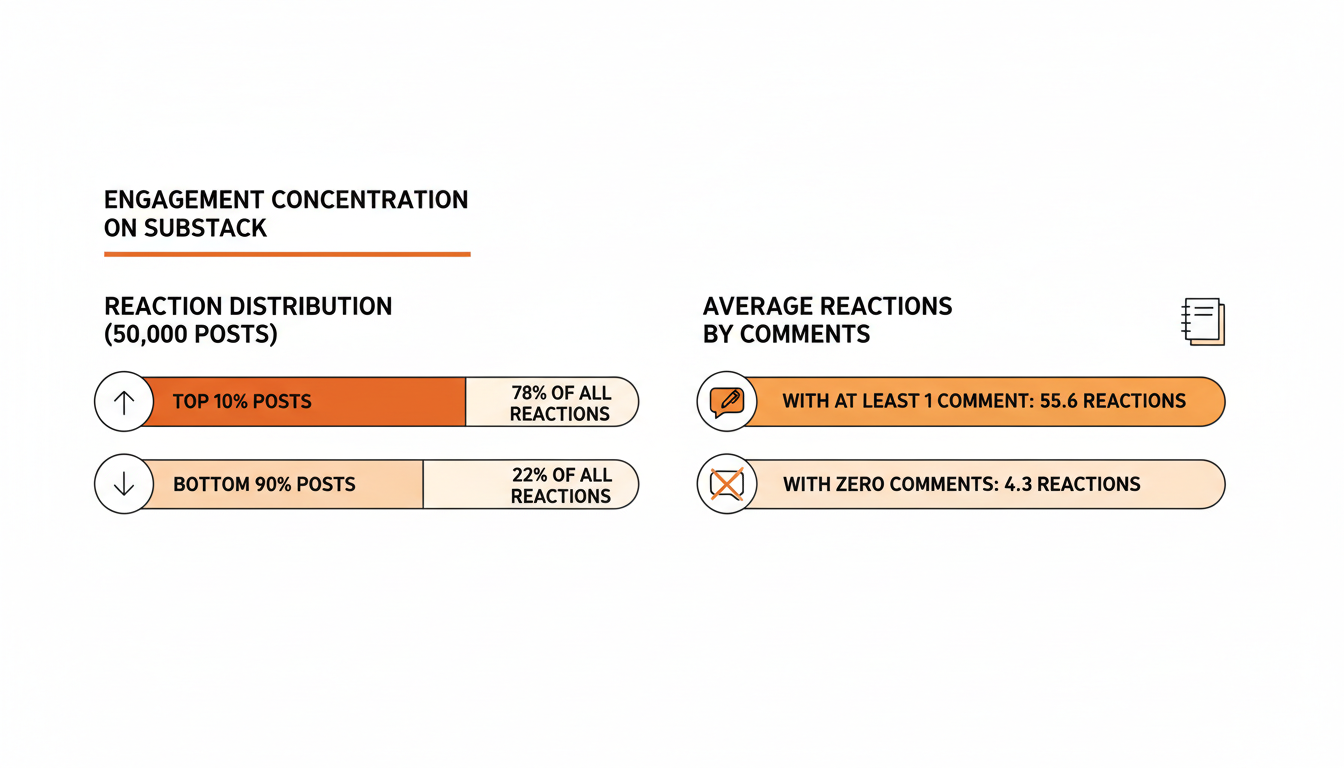
We pulled a sample of 50,000 recent Substack posts and looked at how reactions were actually distributed. The top 10% of posts by reaction count accounted for 78% of all the reactions in the sample. The remaining 90% of posts split the other 22% between them.
Comments told a similar story. Posts that got at least one comment averaged 55.6 reactions. Posts with zero comments averaged 4.3. That's nearly 13 times the engagement on posts where even one reader cared enough to type something back.
That gap is your superfans showing up in the data. A small share of readers, and a small share of posts, generate almost all of the visible engagement on the platform. Optimizing for total subscribers ignores the exact group producing that number.
Practical rule: track reactions-with-comments as a ratio, not comments in isolation. A post with one comment and 60 reactions is being carried by superfans. A post with one comment and 4 reactions probably isn't.
The Engagement Signals That Actually Identify a Superfan
Not every action a subscriber takes tells you the same thing. Substack's own guide to metrics lists opens, reactions, comments, and shares as the core signals it tracks, but they don't carry equal weight when you're trying to identify a superfan rather than measure a single post.
| Signal | What It Actually Proves | Signal Strength |
|---|---|---|
| Open / view | The email arrived and got a glance | Weak |
| Reaction (like) | A couple seconds of attention, low effort | Weak to moderate |
| Click a link inside the post | They wanted more than the headline | Moderate |
| Comment | They spent real effort writing a response | Strong |
| Reply to a Note | Same effort as a comment, rarer and faster | Strong |
| Restack | They staked their own reputation on your work | Strongest |
| Referral signup | They already did your marketing for you | Strongest |
Opens and Click Signals
Opens are the weakest signal worth tracking. They cost the reader nothing, which makes them a poor filter for who actually cares. A click is a better filter: someone who opens a post and clicks through to a linked article, a past post, or a recommendation is telling you the content held their attention past the subject line.
Comments and Replies
A comment or a reply to a Note takes real effort. Substack doesn't make commenting frictionless the way a like button is, so someone doing it once is already unusual. Someone doing it across several posts in a row is a superfan by almost any definition.
Restacks and Referrals
Restacking puts your work in front of someone else's audience under their own name. That's a bigger ask than a like, and readers who do it repeatedly are effectively working as unpaid distribution for your Substack. A referral signup, someone new joining because an existing subscriber told them to, is the clearest superfan signal available, because it requires belief strong enough to act on in public.
Practical rule: weight restacks and referrals well above reactions when you're deciding who counts as a superfan. A hundred likes and zero restacks is a passive audience, not an engaged one.
How to Spot Superfans Without a Tool
You can do a rough version of this manually, and it's worth trying at least once even if you end up automating it later.
📅 Struggling to stay consistent on Substack?
WriteStack's Smart Scheduling lets you batch and queue Notes in minutes. Grow on Substack without burning out.
Explore Smart SchedulingReading Substack's Native Stats
Open your last 10 posts and note who commented on more than one of them. Do the same for your Notes: scroll your recent Notes and note which names keep showing up in replies and restacks. Cross-reference the two lists. Anyone who appears on both is close to a confirmed superfan.
Where Manual Tracking Breaks Down
This works for the first 10 posts. It falls apart at 50, and it's close to impossible at 200, because Substack's own interface doesn't let you sort or filter engagement by subscriber across your full history. You end up with a list based on whoever you happened to remember, which is a recency problem, not a data problem.
Practical rule: if your list of superfans only includes people who commented in the last two weeks, you're measuring recent attention, not loyalty.
Finding Superfans Automatically with WriteStack
This is the part manual tracking can't do. WriteStack's Fans page pulls reactions, comments, and restacks across your entire Substack history and ranks subscribers by how consistently they show up, not just how loudly they showed up once. Open it and instead of scrolling ten posts back by hand, you see the 40 or 60 people who've been reading and responding since your first month, sorted by actual engagement instead of memory.
The part people don't expect: WriteStack also tracks which specific link inside a Note got clicked, going back to your very first Note, not just whether a Note performed well overall. Pair that with the Fans view and you can see whether the same names driving your restacks are also the ones clicking through to your paid tier or your latest post, which tells you who's worth a direct message and who's worth leaving alone.
The Fans list also moves over time instead of sitting still. You can watch whether your core group is growing month over month or quietly shrinking, which is a different question than whether last week's post did well, and it's the one that actually tells you if the newsletter is getting healthier.
Once you know who your real fans are, WriteStack's Note generator can draft a Note built around what actually got your top fans replying last time, instead of starting from a blank prompt and hoping it lands the same way twice.
Six weeks of checking this weekly is enough to stop guessing. You start writing for the 60 people you know are there instead of the 6,000 you're hoping are watching.
See your own ranked list of superfans in about two minutes. Open your WriteStack dashboard and check who actually shows up.
What to Do Once You've Found Your Superfans
Finding the list is the easy part. What you do with it is where the growth actually shows up.
Turn Superfans into Referrals
Substack's built-in referral program rewards subscribers who bring in new readers, but most writers point it at everyone and get ignored by most of them. Message your top 10 to 20 superfans directly, thank them by name for something specific they said in a comment, and ask them to share one post they actually liked. A direct ask to someone already engaged converts at a completely different rate than a generic post about your referral program.
Let Superfans Shape What You Write Next
Look at what your superfans comment on most, not what gets the most total reactions. Those two lists are often different, and the comment-heavy topics are usually the ones worth writing more of, because they're what turns a reader into someone who tells other people about you.
Practical rule: once a month, message five superfans and ask what they want more of. Five honest answers from real readers beat a poll with 200 anonymous votes.
Superfans and Monetization
Superfans convert to paid subscriptions at a far higher rate than the average reader, because they've already proven they'll spend attention on your work for free. A writer sitting on a free list of 3,000 with 150 identifiable superfans is closer to a sustainable paid newsletter than a writer with 8,000 free subscribers and no idea who's actually reading, even though the second number looks better on a screenshot.
When to Ask a Superfan to Upgrade
Substack's founding member tier exists partly for this group: a way to ask your most engaged readers for more without gating your entire newsletter behind a paywall they haven't built trust in yet.
The timing matters. Asking a brand-new subscriber to pay is a cold pitch. Asking someone who's commented on your last six posts is a warm one, and it should read like one, specific to what they've actually gotten from reading you, not a generic upgrade prompt sent to your whole list.
Practical rule: ask for the upgrade in a reply to something they said, not in a broadcast email. "You mentioned wanting the deeper breakdowns, that's what's behind the paywall now" converts better than "upgrade to paid today."
Common Mistakes That Push Superfans Away
Superfans are easier to lose than they look, mostly because writers treat them the same as everyone else on the list.
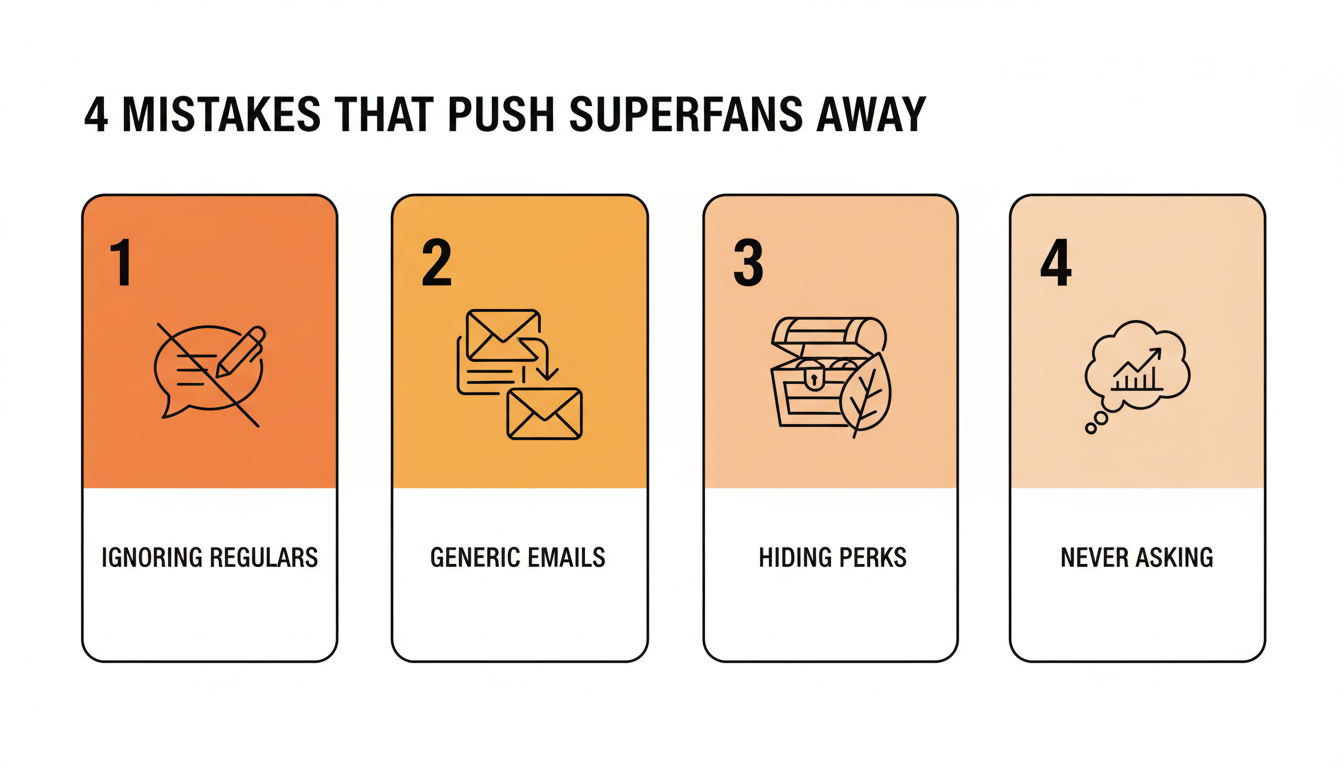
- Ignoring comments from regulars. If the same person comments on five posts in a row and never gets a reply, they notice. Replying costs two minutes and tells them they're not shouting into a void.
- Treating every subscriber identically. A superfan and someone who hasn't opened an email in three months don't need the same message. Segmenting even loosely, engaged versus not, changes how relevant your asks feel.
- Hiding perks superfans would pay for. If you have something worth paying for and never mention it directly to the people most likely to say yes, that's a self-inflicted ceiling on revenue.
- Never asking for anything. Superfans generally want to help. Skipping the ask, a referral, a quick question, an upgrade, feels considerate but it leaves growth on the table that was already available.
Practical rule: audit your last month of replies. If your top 10 commenters got zero responses from you, that's the first thing to fix, before any growth tactic.
Substack Superfans: Frequently Asked Questions
How many superfans does a Substack writer actually need? There's no fixed number, but most working paid newsletters run on a core of somewhere between 50 and 300 genuinely engaged readers, even when the total list runs into the thousands. Kevin Kelly's 1,000 true fans figure is a ceiling worth aiming at over years, not a minimum you need before anything else works.
What's the difference between a superfan and a founding member? A founding member is a billing tier, a subscriber who chose to pay more than the standard price. A superfan is a behavior pattern that shows up whether or not any money has changed hands. Plenty of superfans never upgrade to founding member, and a few founding members barely engage beyond the initial pledge. The overlap is real but it isn't total.
Do superfans matter if my Substack is entirely free? Yes. A free newsletter still depends on superfans for restacks, referrals, and comments that make the publication look alive to a new visitor. A post with zero comments and zero restacks reads as abandoned even if the open rate is fine. Superfans are what makes a free Substack look worth subscribing to in the first place.
How often should I check who my superfans are? Monthly is enough for most writers. Engagement patterns shift slowly, so checking weekly rarely surfaces anything new, and checking only once a year means you miss someone going quiet before it's worth reaching out to ask why.
Most Substack growth advice points at the total subscriber count because it's the easiest number to put on a screenshot. The number that actually predicts whether a newsletter lasts is smaller and quieter: how many people would notice, and say something, if you stopped writing tomorrow. Find that number first. WriteStack's Fans page builds it for you from data you already have, ranked and ready in a couple of minutes.