
How to Turn Substack Notes Into Full Posts
You posted a Note at 7am before coffee. Forty-five minutes later it has 80 reactions, a dozen comments arguing with each other, and three people asking if you've written about this anywhere else. You haven't. It was one paragraph, typed fast, gone from your drafts folder the second you hit publish.
That Note already did the hard part. It found the sentence that made strangers stop scrolling. The question is how to turn a Substack Note into a full post without losing what made it work in the first place.
Most writers either let the Note disappear into the feed or sit down to write a "real" post from scratch, which means starting over on an idea that already proved itself once. Neither is the move. The move is a workflow: a way to spot which Notes are worth the expansion, what to add, what to leave alone, and how to do it often enough that it becomes a habit instead of a one-time save.
Table of Contents
- Why Your Best Substack Notes Are Being Wasted
- Notes vs. Posts: The One Difference That Actually Matters
- How to Spot a Note Worth Expanding
- The Data: Why Short-Form Content Hits a Ceiling
- The Step-by-Step Workflow to Turn Substack Notes Into Full Posts
- What a Post Needs That a Note Didn't
- Three Mistakes That Kill the Expanded Post
- FAQ: Quick Answers
- Make This a Repeatable System, Not a One-Off
Why Your Best Substack Notes Are Being Wasted
A Note that performs is a signal, not a finished product. It tells you, in public, in real time, that a specific idea landed with a specific audience. Most writers read that signal, feel good about it for an hour, and then move on to the next Note. The idea that just proved it had an audience gets no follow-up at all.
That's backwards. A post takes a reader's email address and ten minutes of their attention. A Note takes three seconds of their scroll. The format that actually builds a subscriber base and a paid business is the one getting the least investment, even when the Note already told you exactly which idea deserves it.
Practical rule: Treat every Note above your normal engagement line as a pitch you already sold. Writing the post is just delivering on it.
The writers who grow consistently on Substack aren't the ones with the most ideas. They're the ones who get more mileage out of the same idea, first as a Note to test it, then as a post to cash it in. WriteStack's AI note generator is built around exactly this loop: it drafts from the Notes you've already published instead of a blank prompt, so the post starts in your voice instead of arriving at it after three rounds of edits.
Here's the workflow that gets a Note from "people liked this" to "this is now in someone's inbox."
Notes vs. Posts: The One Difference That Actually Matters
Substack's own help documentation describes Notes as a feature for creators to "publish short-form posts and share ideas with each other." That's the whole design brief in one sentence: short, social, built for the feed. A post is built for an inbox, which means it has to survive without the feed's context, the reply thread, or the three other Notes sitting above and below it on the page.
If you want the longer breakdown of when to use each format, WriteStack's Notes vs. Posts comparison covers that in full. For this workflow, the difference that actually matters is narrower: a Note gets to assume the reader is already in the mood to read. A post has to create that mood itself.
That one difference explains almost every other gap between the two formats. A Note rides on momentum it didn't build: the reader was already in the Notes feed, already scrolling, already primed to react fast and move on. A post arrives cold, usually in an inbox next to work email and three other newsletters, competing for a decision to open it at all. Content that works in the first context can fall completely flat in the second, not because the idea was weak, but because nothing about the format prepared it to survive outside the feed.
What a Note Can Never Do
A Note can test a claim. It can't support one. There's no room inside a few hundred characters for the example, the counterpoint, or the number that makes a reader trust the claim instead of just nodding at it. That gap is exactly what the expansion step has to fill, and it's why copying a Note into a post body and adding a headline doesn't work. The post needs new material, not a longer font size.
How to Spot a Note Worth Expanding
Not every Note that does well deserves forty-five minutes of writing time. Some performed because of timing, a trending reply thread, or a cheap joke that doesn't carry two more paragraphs. The selection step is where most of this workflow's value sits, because expanding the wrong Note wastes the same amount of time as expanding the right one.
The Engagement Threshold That Matters
Set a bar relative to your own account, not an absolute number pulled from someone else's newsletter. A Note that pulls three times your typical reaction count is a real signal. A Note that pulls 20% above average is just a normal good day. The bar only works if you know what normal looks like for your own publication, which is a benchmarking problem more than a counting one. Raw like counts tell you a Note did better than usual. They don't tell you whether "usual" is actually good, which is why comparing your Notes against publications in your size range matters more than watching your own numbers climb or dip in isolation.
Signs in the Comments, Not Just the Like Count
The like count says a Note was agreeable. The comments say whether it was useful. Writers who've gone through their own archives looking for what separates a note that converts from one that just gets liked keep landing on the same pattern: the comment thread turns into people adding their own examples or asking a follow-up question, rather than one-word agreement. One widely-read breakdown of fifty-plus viral Notes found the same thing from the other direction, that the Notes driving the most account growth weren't always the ones with the biggest like counts.
Practical rule: A Note with 40 likes and three people asking "wait, how do you actually do that" is a stronger post candidate than a Note with 200 likes and no comments at all.
Not every spike is a real signal, either. A Note that gets pulled into a trending reply thread, or rides a joke that was funny because of the exact news cycle that week, can post numbers that look like an outlier without actually being one. Ask whether the engagement is about your idea or about the moment. If a stranger read the same Note a month from now with no context, would it still land? If the honest answer is no, the Note did its job as a Note and doesn't owe you a post.
The Data: Why Short-Form Content Hits a Ceiling
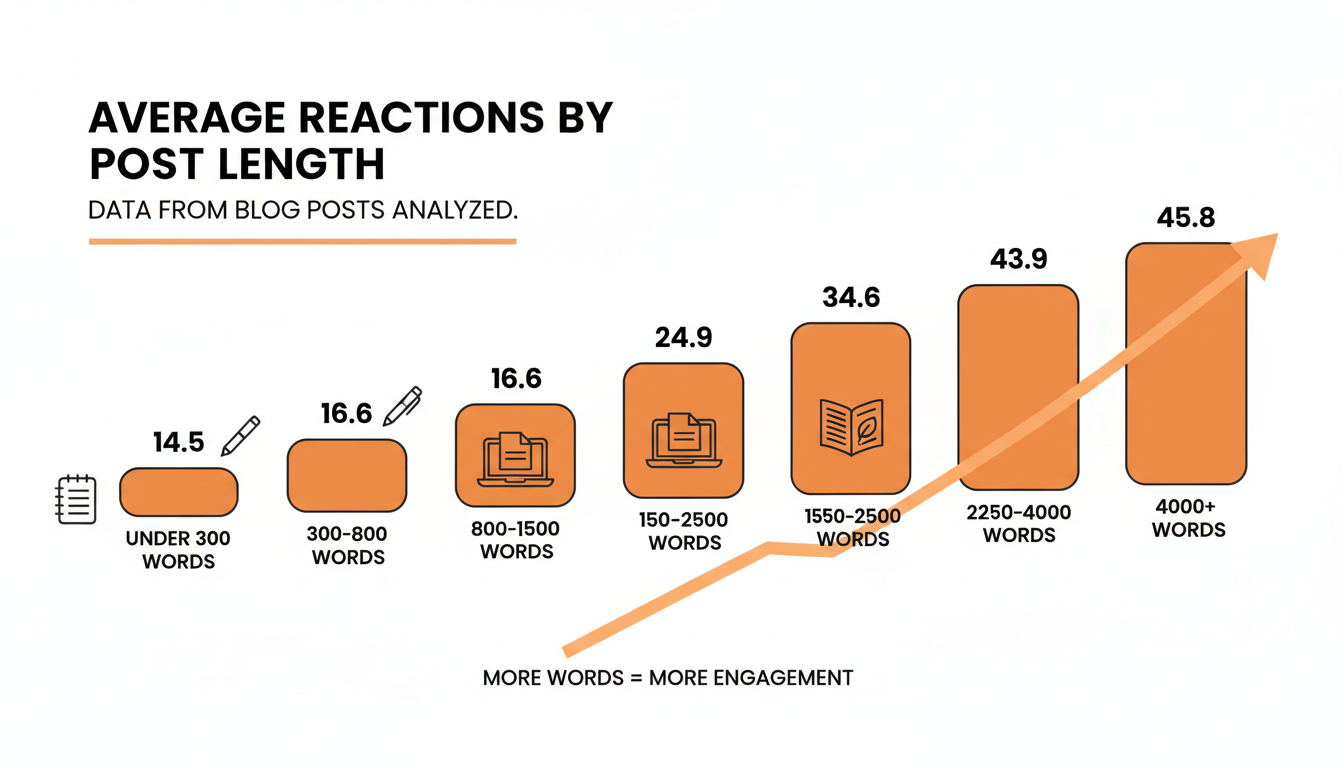
We pulled a random sample of 300,000 posts published across the Substack posts in our dataset since mid-2024 and grouped them by length. The pattern is consistent across the whole range:
| Post length | Avg. reactions | Avg. comments |
|---|---|---|
| Under 300 words (Note-length) | 14.5 | 2.69 |
| 300-800 words | 16.6 | 3.35 |
| 800-1,500 words | 24.9 | 4.79 |
| 1,500-2,500 words | 34.6 | 6.36 |
| 2,500-4,000 words | 43.9 | 7.32 |
| 4,000+ words | 45.8 | 7.34 |
Content capped at Note length averages 14.5 reactions. The moment a piece crosses into full-post territory, 800 to 1,500 words, average reactions jump to 24.9, nearly double. Comments follow the same curve, and they matter more than the reaction count because comments are where subscribers decide you're worth replying to, which is a much stronger growth signal than a tap on a heart icon.
The gains past 2,500 words get smaller per additional word, and the sample size thins out considerably up there too, so treat that end of the curve as directional rather than a reason to pad every post to 4,000 words. The real takeaway sits in the jump between the first two rows and the third: crossing out of Note-length content into an actual post is where the ceiling breaks.
📅 Struggling to stay consistent on Substack?
WriteStack's Smart Scheduling lets you batch and queue Notes in minutes. Grow on Substack without burning out.
Explore Smart SchedulingPractical rule: If a Note is good enough to post, it's already past the hardest part. The data says the next 500 to 1,000 words are where the real return shows up, not the next clever one-liner.
The Step-by-Step Workflow to Turn Substack Notes Into Full Posts
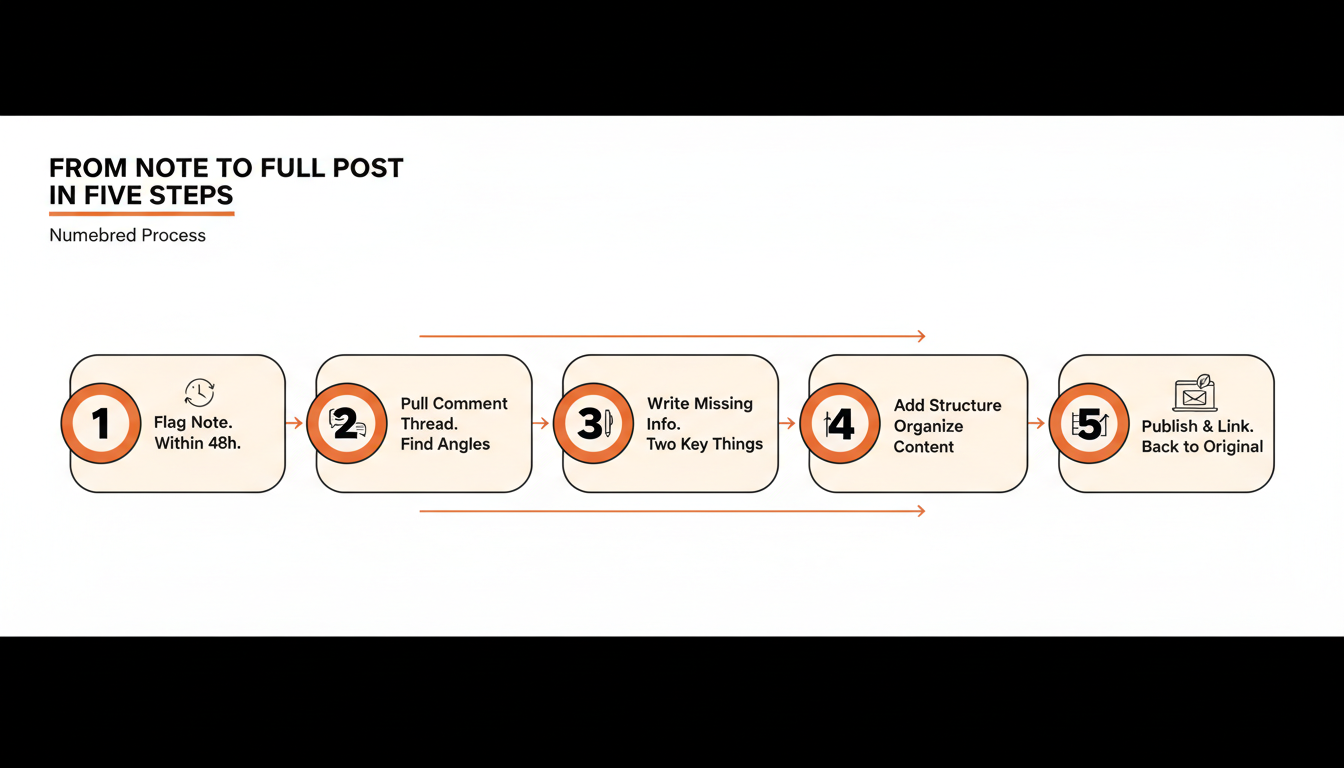
Step-by-Step Breakdown
- Flag the Note within 48 hours. Engagement on Notes front-loads hard. By day two you know whether it's a real outlier, and the idea is still fresh enough that writing about it doesn't feel like homework.
- Pull the comment thread for angles. Read every reply before writing a word. Readers usually hand you the counterargument, the missing example, or the exact follow-up question the post should answer, for free.
- Write the two things the Note couldn't fit. Pick one concrete example and one piece of reasoning or evidence. A Note can assert something. A post has to show it.
- Add a structure the Note never had. A Note is one thought. A post needs an opening that earns the next paragraph, at least one subhead if it runs past 600 words, and a close that does something other than trail off.
- Publish and link back to the original Note. This closes the loop for the readers who liked the Note in the first place and tells Substack's own system that the two pieces of content are connected.
Most of the time this five-step process takes less than an hour once the Note has already done the work of proving the idea. That's the whole trade: an hour of writing against a post that already has a built-in audience of people who told you, in public, that they wanted to read it. Try drafting your next one straight from a published Note instead of a blank page and see how much of that hour disappears.
What a Post Needs That a Note Didn't
Side by side, the gap between the two formats is mostly about what the content can assume versus what it has to build itself.
| Element | Note | Expanded post |
|---|---|---|
| Context | Assumes the reader just saw related Notes | Has to stand alone with no feed around it |
| Evidence | A claim, maybe a stat with no source | At least one real example or linked source |
| Structure | One block of text | Opening, body, subheads past 600 words, a close |
| Reader's next step | Scroll past, maybe reply | Read to the end, maybe subscribe or reply by email |
| Shelf life | Hours, replaced by the next Note in the feed | Months, found later through search or an archive link |
That last row is the one writers underrate. A Note's audience is whoever happened to be scrolling that hour. A post's audience includes everyone who searches the topic for the next two years, which is the entire argument for doing this expansion in the first place instead of just posting more Notes.
Three Mistakes That Kill the Expanded Post
Padding instead of adding. Restating the same point in three different sentences gets you to 800 words without actually giving the reader anything new. The data above rewards length that comes from more substance, not more sentences around the same substance.
Waiting too long. An idea that was sharp on Monday reads like old news by the following Monday, both to you and to the readers who already saw the Note. The window where expanding a Note still feels urgent instead of dutiful is short. Treat it that way.
Skipping the comment thread. The fastest way to write a flat, generic version of a good Note is to sit down and expand it from memory instead of rereading what people actually said about it. The thread usually contains a sharper angle than the one you started with.
Burying the original point. It's tempting to build a bigger argument around the Note and let the specific sentence that made it work get lost somewhere in paragraph four. Readers who clicked through from the Note, or who remember it from the feed, are looking for that exact idea. Keep it near the top and build outward from it, instead of circling toward it.
FAQ: Quick Answers
How soon after a Note should I publish the expanded post?
Within a week if possible, and within 48 hours of flagging it is ideal. The idea is still current and you still remember the context that made it worth expanding in the first place.
Can I just copy the Note's text into the post and build around it?
Yes, as an opening, not as the whole post. Use the Note's original wording as the first paragraph or two, since it already proved it hooks readers, then add the example, evidence, and structure a Note can't hold.
Does every well-performing Note need to become a post?
No. Some Notes work because they're small and self-contained. Expand the ones that raise a question, make a claim, or describe a process that a reader would want explained further, not every Note that happens to do well.
Should the post mention that it started as a Note?
It's optional, but linking back to the original Note gives readers who saw it a reason to click through, and it's a small, honest way to show your process.
Make This a Repeatable System, Not a One-Off
Doing this once, for one great Note, is a nice afternoon. Doing it every week is a content calendar that writes most of itself, because you're never starting from a blank page. The Notes you've already published are a running list of validated ideas, which is a much better starting point than an empty draft and a deadline.
The part people don't expect: WriteStack doesn't just schedule the Note in the first place, it reads back through everything you've already published and drafts the expanded post from that material, in your own phrasing, not a generic AI voice. It also tracks which specific links inside a Note got clicked, going back to your very first one, so you can tell a Note that actually drove readers somewhere from one that just looked good.
Where WriteStack Fits
Three places in this workflow are where a tool either saves the habit or lets it quietly die.
Spotting the outlier Note is the first one. WriteStack's heatmap benchmarks your Notes against your own history and against other publications in your range, which answers "is this actually good" instead of just "is this better than last week," the question a raw analytics tab can't answer on its own.
Writing the expansion is the second. WriteStack's note-to-post generator drafts the full post from the Note you flag, pulling from your own published voice instead of a generic prompt, so the first draft needs editing, not rewriting from scratch.
Staying consistent is the third, and it's the one that actually determines whether this becomes a habit or a one-time experiment. A workflow that depends on remembering to check your Notes every single week doesn't survive a busy month. One built into a tool you already open does.
Pull up your last twenty Notes this week. At least two or three of them are already a post. The idea work is done. All that's left is giving it the extra 800 words it was always worth.
Start turning your best Notes into posts with WriteStack before next week's good idea disappears into the feed with the rest of them.