
A writer with 40,000 free subscribers messages a friend: "I finally hit 40K. Should I turn on paid subscriptions?" The friend, three years into a Substack that nets about $1,400 a month after fees, doesn't answer right away.
That gap between subscriber count and actual income is where most Substack income advice falls apart. How much do Substack writers actually make? The honest answer: most make close to nothing, a smaller group makes a modest side income, and a very small group makes more than most salaried jobs. All three groups are real, and knowing which one a given writer is likely to land in takes real numbers, not vibes or screenshots of someone else's best month.
This piece uses Substack's own disclosed figures, a third-party financial estimate built from investor data, and the platform's published fee schedule to answer the question plainly, subscriber count by subscriber count, so the number a writer ends up with is one they can defend.
One number worth having before you start: WriteStack has close to 100 verified reviews from Substack writers across multiple platforms. The scheduling tools built specifically for Substack that we could find have none.
Table of Contents
- How Much Do Substack Writers Make? The Honest Number
- What Substack's Own Numbers Actually Show
- Realistic Income by Subscriber Count
- Who's Actually Making Real Money on Substack
- Why Most Substack Publications Never Charge a Cent
- The Churn Problem Nobody Budgets For
- What Actually Moves the Income Needle
- Should You Even Try to Monetize on Substack?
How Much Do Substack Writers Make? The Honest Number
Substack doesn't publish a per-writer income breakdown, so most "how much do Substack writers make" articles either quote the handful of writers earning seven figures or throw out an unsourced average that means nothing on its own. Neither is useful if you're actually deciding whether to start one, or whether to keep going with the one you have.
What's actually knowable comes from three places: what Substack itself has disclosed about total writer earnings, what a research firm that tracks Substack's financials estimates from subscriber growth and revenue data, and Substack's own published fee schedule, which lets anyone calculate exactly what a given subscriber count pays out after fees.
Put those three together and the picture is consistent, if not exactly encouraging for a writer picturing a full-time income by month three. Substack income is heavily concentrated at the top, most paid newsletters bring in a part-time-job amount of money at best, and getting to a full-time income takes a subscriber base most writers badly underestimate when they're setting expectations.
Practical rule: if a Substack income claim doesn't come with a subscriber count and a price attached to it, treat it as marketing, not data.
The subscriber counts in this article assume steady, consistent posting, since that's what the underlying revenue data is built from. Try WriteStack for 7 days and see what a week of scheduled Notes does for a publication that's been posting on and off instead of on a real schedule.
What Substack's Own Numbers Actually Show
Platform-Wide Earnings and Growth
Research firm Sacra, which tracks Substack's financials using investor and company disclosures, puts Substack's 2025 annualized revenue at $45 million, built on roughly $450 million in gross writer earnings by March 2025, with paid subscriptions crossing 5 million that same month. Substack keeps 10% of every dollar a reader pays a writer, so its own revenue works as a direct proxy for how much money is actually moving through the platform to writers, not just how many people signed up.
Backlinko's Substack statistics page, last updated in December 2025, reports the platform has more than 20 million monthly active subscribers, of which more than 5 million are paid subscriptions, and that more than 17,000 writers currently get paid for their newsletters. Divide those numbers and the paid-writer population is a small fraction of everyone publishing on Substack. Most people running a Substack never turn payments on at all, a point worth sitting with before assuming the "average" writer is even trying to monetize.
The Cut Substack (and Stripe) Take
Substack's fee structure is public and simple enough to apply to any income estimate directly. Substack takes 10% of subscription revenue. Payment processor Stripe takes an additional 2.9% plus 30 cents per transaction, plus 0.5% on recurring charges, a structure documented alongside Substack's own usage statistics. Combined, a writer keeps roughly 87% of what a reader pays before income tax, which the writer is still responsible for separately.
That math changes what a "revenue" headline actually means. A newsletter charging $10 a month and reporting "$10,000 a month in revenue" is not the same as a writer with $10,000 landing in a bank account. After Substack's cut and Stripe's fees, that figure lands closer to $8,700, and that's before the writer's own tax bill, which varies by country and business structure and isn't something a platform fee calculation can account for.
It's also worth naming the alternative model here, since it changes how a writer should think about price. Ghost and Beehiiv charge a flat monthly software fee instead of a revenue cut, which means a writer with a large paid base keeps a bigger share of each dollar on those platforms, while a writer just starting out pays a fixed cost regardless of whether anyone subscribes. Substack's model is the opposite bet: nothing up front, a growing cut as revenue grows. Neither is free money. Both are worth understanding before picking where a paid Substack lives long-term.
Realistic Income by Subscriber Count
Here's what different paid-subscriber counts actually convert to, using a common $8/month price point and Substack's published fee structure applied directly.
| Paid subscribers | Gross monthly revenue | After Substack + Stripe fees | Annual take-home (approx.) |
|---|---|---|---|
| 50 | $400 | ~$348 | ~$4,180 |
| 250 | $2,000 | ~$1,740 | ~$20,880 |
| 900 | $7,200 | ~$6,264 | ~$75,170 |
| 2,500 | $20,000 | ~$17,400 | ~$208,800 |
The 900-subscriber row isn't arbitrary. It comes directly from a widely cited estimate of what it takes to clear $50,000 a year at an $8/month price once fees and churn are priced in, covered in detail below. Most writers who ask "how much can I realistically make on Substack" are picturing the right-hand columns of this table before they've built the audience the left-hand column actually requires, and that mismatch is where most disappointment with the platform comes from.
Price point changes this math more than most writers assume. A $5/month newsletter needs almost double the subscriber count of an $8/month one to hit the same take-home number, while a $15 or $20/month niche publication (common in finance, legal, or specialist trade newsletters) can clear the 900-subscriber row's income with a few hundred subscribers instead. Pricing is a growth decision as much as a revenue one: a lower price converts more free readers into paying ones, a higher price needs fewer of them to hit the same number.
Who's Actually Making Real Money on Substack
The Top 10
The top 10 earning authors on Substack collectively make more than $40 million a year, based on figures Substack gave the Wall Street Journal and reported by Backlinko. That's up from $25 million in October 2022 and $20 million in October 2021, roughly doubling in three years even as the broader platform kept adding writers below them. The single highest-earning newsletter tracked in that data, Letters from an American, brings in an estimated $5 million annually on its own, more than the next several newsletters on the list combined.
📅 Struggling to stay consistent on Substack?
WriteStack's Smart Scheduling lets you batch and queue Notes in minutes. Grow on Substack without burning out.
Explore Smart SchedulingThe Half-Million Club
Below the top 10, a wider tier exists but it's still small relative to the platform as a whole. Press Gazette's tracking, cited by Backlinko, counts 52 newsletters earning at least $500,000 a year in subscription revenue, worth a combined minimum of roughly $40 million across all of them. Separately, Substack's own leadership has said more than 50 writers now earn over $1 million annually through paid subscriptions alone, a number that has grown from a much smaller group just a few years earlier.
That's still a tiny slice of the platform. Out of more than 17,000 paid writers, a few dozen are in the million-dollar tier and a few hundred more are in the six-figure range. Everyone else is somewhere on the curve below that, and that group, not the newsletter with 5 million dollars a year, is who this article is actually written for.
Practical rule: if a Substack income story doesn't name a subscriber count, assume it's describing the top 1% and not the median writer.
Why Most Substack Publications Never Charge a Cent
The gap between "17,000+ paid writers" and the total number of newsletters running on Substack is enormous, because turning on paid subscriptions is optional and most writers never do it. Some are building an audience first and plan to charge later, once growth slows down and a paywall stops competing with reach. Some write for distribution, not revenue, and monetize through a day job, a book deal, or speaking work instead. Some tried a paywall, watched it slow their subscriber growth, and quietly turned it back off within a few months.
None of those are wrong choices. But they explain why "average Substack income" is close to meaningless as a headline number. Most publications report zero paid revenue, not because the platform doesn't work financially, but because most writers on it aren't trying to get paid in the first place, and folding them into an average drags the number toward zero regardless of how well the paid minority is doing.
For writers who are trying to monetize, the deciding factor isn't the platform's ceiling, it's whether the free-to-paid conversion they've built is worth protecting once it starts working, which is where the picture gets less comfortable.
The Churn Problem Nobody Budgets For
Every income projection in the table above assumes a subscriber count that holds steady. It doesn't. Sacra's analysis of Substack's retention data puts typical paid-subscriber churn at roughly 50% a year, meaning a writer charging $8/month needs about 900 paid subscribers to earn $50,000 annually, and has to add roughly 31 new paid subscribers every single month just to stay even, before counting any net growth at all.
That reframes the whole question. "How much do Substack writers make" isn't really about hitting a subscriber number once and coasting. It's about whether a writer can keep replacing the quarter or so of paying subscribers who lapse every year, indefinitely, without burning out on what amounts to a permanent acquisition treadmill.
Churn happens for reasons that have little to do with writing quality: a reader's budget tightens, the newsletter's topic stops feeling urgent once a news cycle passes, or a subscriber simply forgets why they subscribed six months after a low-engagement stretch. The writers who hold onto paid subscribers longest tend to be the ones who stay visible between the posts that convert, not just the ones who write the single best essay of the year.
This is a good moment to say plainly what protects against that: writers who never let a slow week turn into a missed month tend to hold their number, and the ones who go quiet for three weeks tend to see it slip. Load a week of Notes into WriteStack in twenty minutes and the visibility that offsets churn keeps running even on the weeks writing feels impossible.
What Actually Moves the Income Needle
Subscriber growth and subscriber retention both come down to the same underlying behavior: showing up consistently enough that readers keep opening, replying, and eventually deciding a paid subscription is worth it. Substack Notes is the fastest lever most writers have for building that habit in public, and the data on what performs there is specific enough to act on instead of guessing.
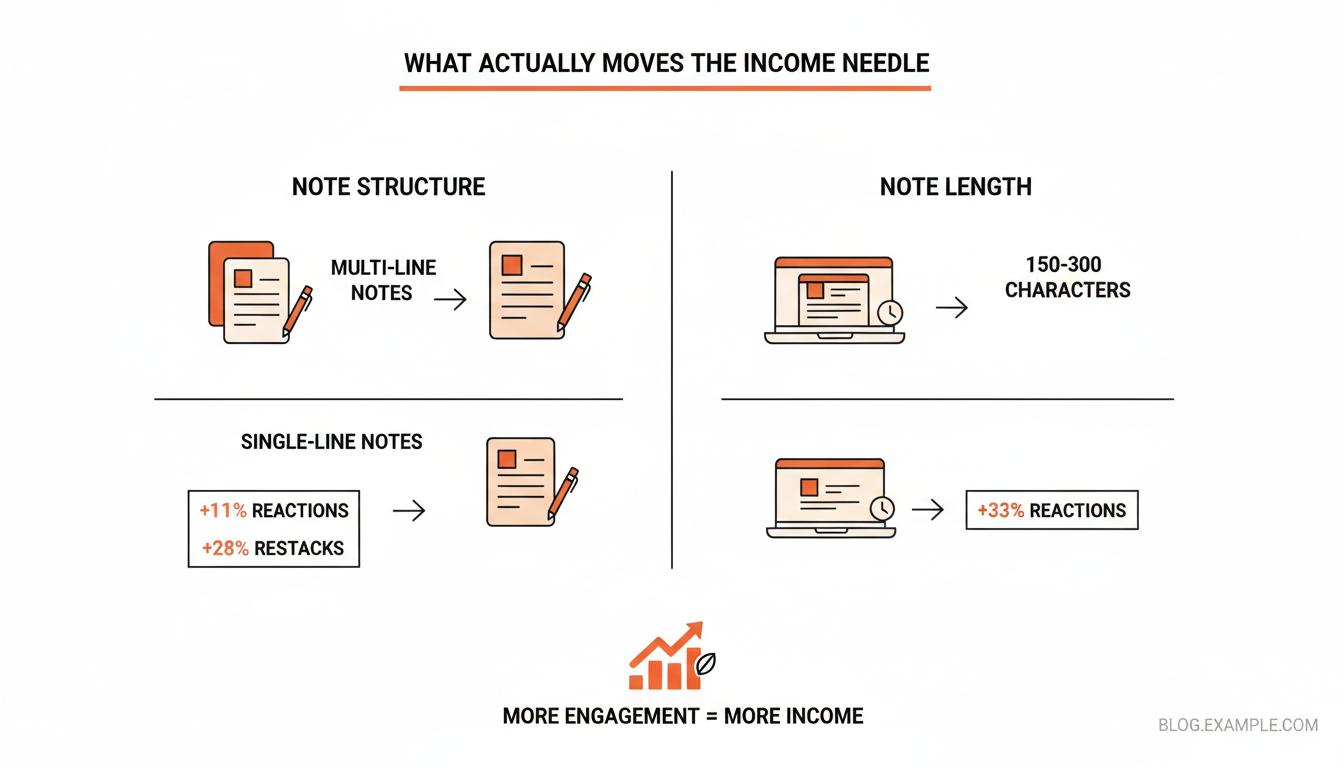
Across a sample of 20,000 recent Notes, multi-line Notes averaged about 11% more reactions and 28% more restacks than single-line ones, and Notes between 150 and 300 characters outperformed Notes under 50 characters by roughly a third on reactions, and by more on restacks. Neither difference is dramatic on a single Note. Compounded across a year of posting several times a week, it's the difference between a Notes habit that quietly builds a paid audience and one that plateaus.
What people don't expect: the writers actually hitting the subscriber counts in the table above usually aren't the ones with the cleverest individual hooks. They're the ones who never had a three-week gap in posting, who can see their restack rate benchmarked against other publications instead of guessing whether "pretty good" is actually good, and whose Notes get drafted from what they already published instead of starting from a blank prompt every single time.
That's the part a subscriber-count table can't show on its own. WriteStack's heatmap shows exactly when a writer's specific audience is actually online, instead of a generic "best time to post" guess that ignores who's actually subscribed. The Notes generator drafts new Notes from a writer's own published posts, so the voice reads like the writer instead of a template pulled from a prompt. And writers checking their fans dashboard to see which readers are engaging most, and which ones are quietly going cold, catch churn early instead of discovering it as a revenue dip a month later.
Should You Even Try to Monetize on Substack?
Do you need a huge audience to make any money on Substack? No. Even a few hundred paid subscribers at a modest price is real income, and the table above shows the math scales in a straight line from there. The 40,000-free-subscriber writer from the opening isn't guaranteed anything Substack's own numbers don't already show. Free reach and paid income are related, but they're not the same number, and plenty of writers with modest free lists out-earn writers with much larger ones.
How many free subscribers does it typically take to convert one paying subscriber? Substack doesn't publish an official conversion rate, and it varies enormously by niche, price, and how directly the free content signals what the paid tier adds. Treat any specific percentage quoted online as unverified unless the source also publishes their own subscriber and revenue numbers alongside it.
Is it too late to start a paid Substack in 2026? The $450 million in gross writer earnings and the 5 million-plus paid subscriptions are both larger than they were a year earlier, which means the pool of readers willing to pay for a newsletter is still growing, not shrinking. Later than 2020, yes. Too late is a different claim, and the growth numbers don't support it.
What actually separates a $50,000-a-year Substack from one earning nothing? Almost always consistency over raw writing quality. A writer who publishes reliably for two years with average writing tends to out-earn one who publishes brilliantly and unpredictably for six months, because the first writer is still building trust and reach while the second one has gone quiet.
The honest version of "how much do Substack writers make" is this: it depends entirely on whether a writer builds and keeps a subscriber base large enough to clear Substack's fees, Stripe's fees, and a roughly 50% annual churn rate, and that depends far more on showing up every week than on any single growth trick. Start scheduling a full week of Notes on WriteStack and put the one variable that's actually in a writer's control on autopilot.