
Substack 1099-K Taxes: What Writers Actually Owe
Somewhere around your first $500 month, a new feeling shows up next to the excitement: does the IRS know about this? If you write on Substack and readers pay you, the honest answer is yes, they expect to, whether or not a tax form ever lands in your inbox.
That last part trips up more writers than anything else. Substack doesn't send you a 1099 directly. Stripe does, and only past a specific dollar and transaction threshold. Below that line, plenty of paid writers assume no form means no obligation. It doesn't work that way, and the gap between what people assume and what the IRS actually requires is where most of the stress at tax time comes from.
This piece walks through how the Substack 1099-K threshold works right now, why the number on that form is never what you actually earned, how to report the income correctly, what you can deduct, and how to build a record system so none of this is a scramble every February.
Table of Contents
- Do You Actually Owe Taxes on Substack Income?
- How the Substack 1099-K Threshold Works
- Why Your 1099-K Doesn't Match What You Actually Earned
- Reporting Substack Income: Schedule C and Self-Employment Tax
- Quarterly Estimated Taxes: What Triggers Them
- What You Can Actually Deduct as a Substack Writer
- The Hobby-vs-Business Test, and Why 2026 Raised the Stakes
- Building a Tax-Ready Record With WriteStack's Analytics
- Common Mistakes That Get Substack Writers in Trouble
Do You Actually Owe Taxes on Substack Income?
Yes, and the rule is simpler than the paperwork around it makes it look. If a reader pays you on a recurring basis for your writing, that money is taxable income the moment it lands in your account. It doesn't matter if the newsletter is your full-time job, a side project next to a day job, or something you started for fun that happened to take off. It doesn't matter if you've made $400 or $40,000. It doesn't matter if you ever receive a 1099 form.
The confusion almost always comes from mixing up two separate things: whether you owe tax on the income, and whether a payment processor is required to report that income to the IRS on your behalf. Those are different thresholds entirely, and only one of them is a fixed dollar amount.
Practical rule: report every dollar of subscription revenue you receive, regardless of whether a 1099-K ever shows up. The form is a reporting convenience for the IRS, not the trigger for your obligation.
How the Substack 1099-K Threshold Works
Substack itself doesn't issue your tax forms. Stripe does, because Stripe is the payment processor handling the actual subscription charges behind the scenes. According to Substack's own help center, you manage and download your 1099 directly from your Stripe dashboard, not from Substack.
The federal threshold for that form has moved around a lot in the last few years, which is a big part of why so many writers are confused about it. The American Rescue Plan originally dropped the threshold to just $600 starting with the 2022 tax year. The IRS delayed that repeatedly, then began phasing it in at $5,000 for 2024 and a planned $2,500 for 2025. Then Congress changed course again: the One Big Beautiful Bill Act restored the threshold to $20,000 in payments and 200 transactions for 2025 and beyond, retroactive to prior years.
Practically, that means most individual Substack writers, even solidly profitable ones, will not cross the federal reporting threshold and will never receive a 1099-K at all.
State Thresholds Are Lower Than Federal
A handful of states set their own, lower thresholds that override the federal number for state reporting purposes. If you live in one of them, Stripe may issue you a form even though you're nowhere near the federal $20,000 mark.
| State | 1099-K reporting threshold |
|---|---|
| Federal (most states) | $20,000 and 200 transactions |
| Massachusetts | $600, no transaction minimum |
| Maryland | $600, no transaction minimum |
| New Jersey | $1,000, no transaction minimum |
Practical rule: check your state's threshold specifically if you live in Massachusetts, Maryland, New Jersey, or Vermont. State rules change independently of federal ones, so don't assume the $20,000 number applies to you just because it's the headline figure everyone talks about.
What Happens If You Never Get One
Nothing changes about what you owe. The 1099-K is Stripe telling the IRS what it processed on your behalf, and its absence just means the IRS is relying on you to self-report accurately, which you're required to do either way. Writers who treat "no form, no problem" as their tax strategy are the ones who get an unpleasant letter two or three years later when a bank deposit pattern doesn't match a filed return.
Why Your 1099-K Doesn't Match What You Actually Earned
This is the part that catches even writers who know the threshold rules cold. If you do receive a 1099-K, the number on it is your gross processed volume, not your take-home pay, and definitely not the number you should copy directly onto a tax return without adjustment.
Substack takes a flat 10% cut of gross subscription revenue, a fee structure that's been unchanged since the platform launched in 2017. On top of that, Stripe charges its own processing fee, typically around 2.9% plus $0.30 per charge, plus a 0.7% recurring-billing fee that Stripe added in 2024 for subscription transactions specifically. Stack all three together and the effective cost of running paid subscriptions lands somewhere around 13-19% of the sticker price, depending on your plan size and how many small transactions you process versus larger annual ones.
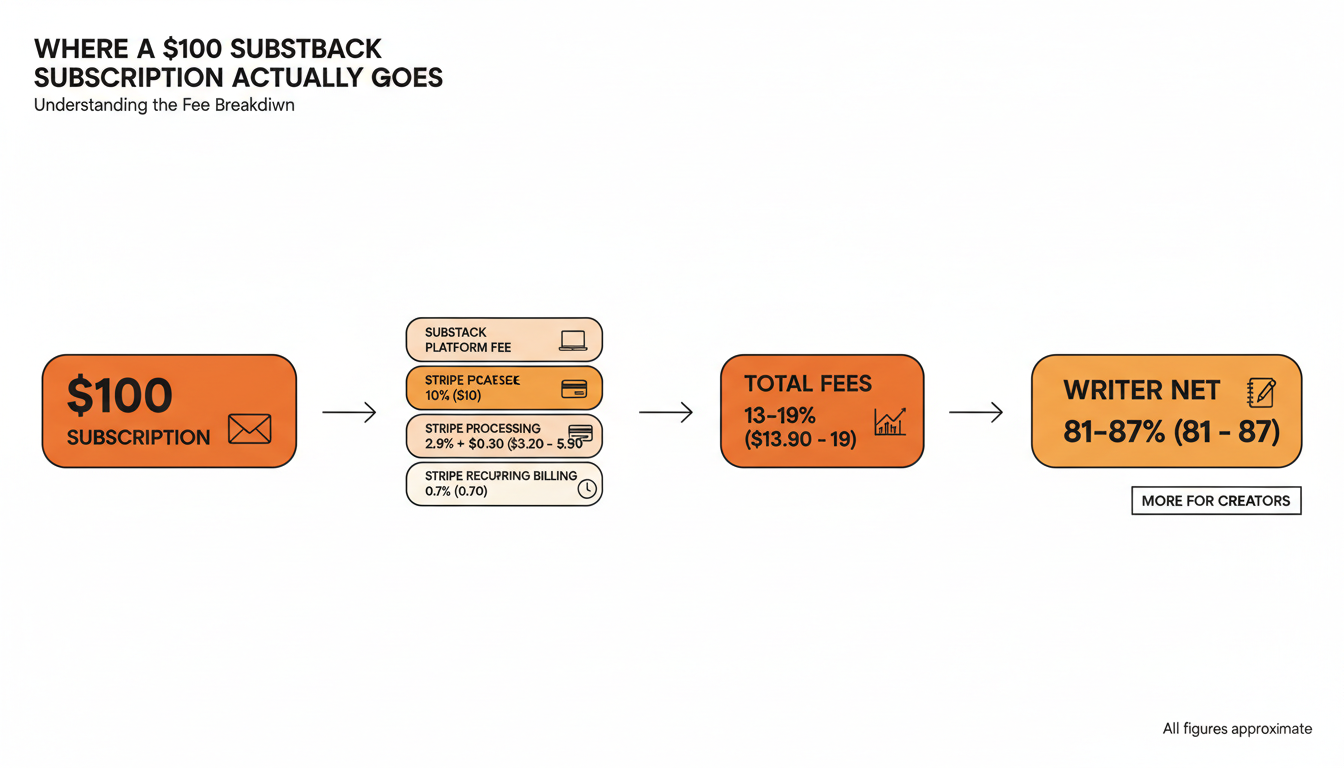
The reason this matters for your taxes specifically: your 1099-K, if you get one, and your Stripe payout reports generally reflect net deposits after some or all of these fees, but the IRS wants you reporting gross subscription revenue as income and then claiming the platform and processing fees separately as business expenses. Netting them together yourself understates your gross receipts on paper, which can look inconsistent against whatever Stripe actually reports, and it makes it much harder to tell later whether a pricing change genuinely improved your margin.
Practical rule: record the full subscription price a reader pays as revenue, and record Substack's 10% and Stripe's processing fees as separate line-item expenses. Never net them together in your own books, even though the deposit that hits your bank account already has.
Reporting Substack Income: Schedule C and Self-Employment Tax
For the large majority of individual writers, Substack income gets reported on Schedule C (Form 1040), Profit or Loss from Business, as a sole proprietor. Net profit from that Schedule C then flows to Schedule SE, where you calculate self-employment tax, currently 15.3%, covering Social Security and Medicare. That's in addition to ordinary federal and state income tax on the same profit.
This is the number that surprises first-time paid-subscription writers most. A $30,000-a-year newsletter isn't taxed like $30,000 of W-2 salary. It's taxed like self-employment income, which means roughly 15.3% in SE tax stacked on top of your regular income tax bracket, though half of the self-employment tax is deductible above the line when you file.
📅 Struggling to stay consistent on Substack?
WriteStack's Smart Scheduling lets you batch and queue Notes in minutes. Grow on Substack without burning out.
Explore Smart SchedulingDo You Need an LLC?
For most writers, no, at least not for tax reasons. An LLC is primarily a liability-protection and branding decision, not a tax one; as a sole proprietor you generally get the same deductions without the extra paperwork, and you don't need an EIN at all since your Social Security number works fine for filing. An S-Corp election can reduce your self-employment tax by splitting income into salary and distributions, but the added payroll administration and accounting cost typically only pays for itself once net income is consistently in the $60,000-$70,000+ range. Below that, the complexity usually costs more than it saves.
Quarterly Estimated Taxes: What Triggers Them
If you expect to owe $1,000 or more in tax for the year from your Substack income, the IRS doesn't want to wait until April for all of it. It wants quarterly estimated payments made throughout the year using Form 1040-ES.
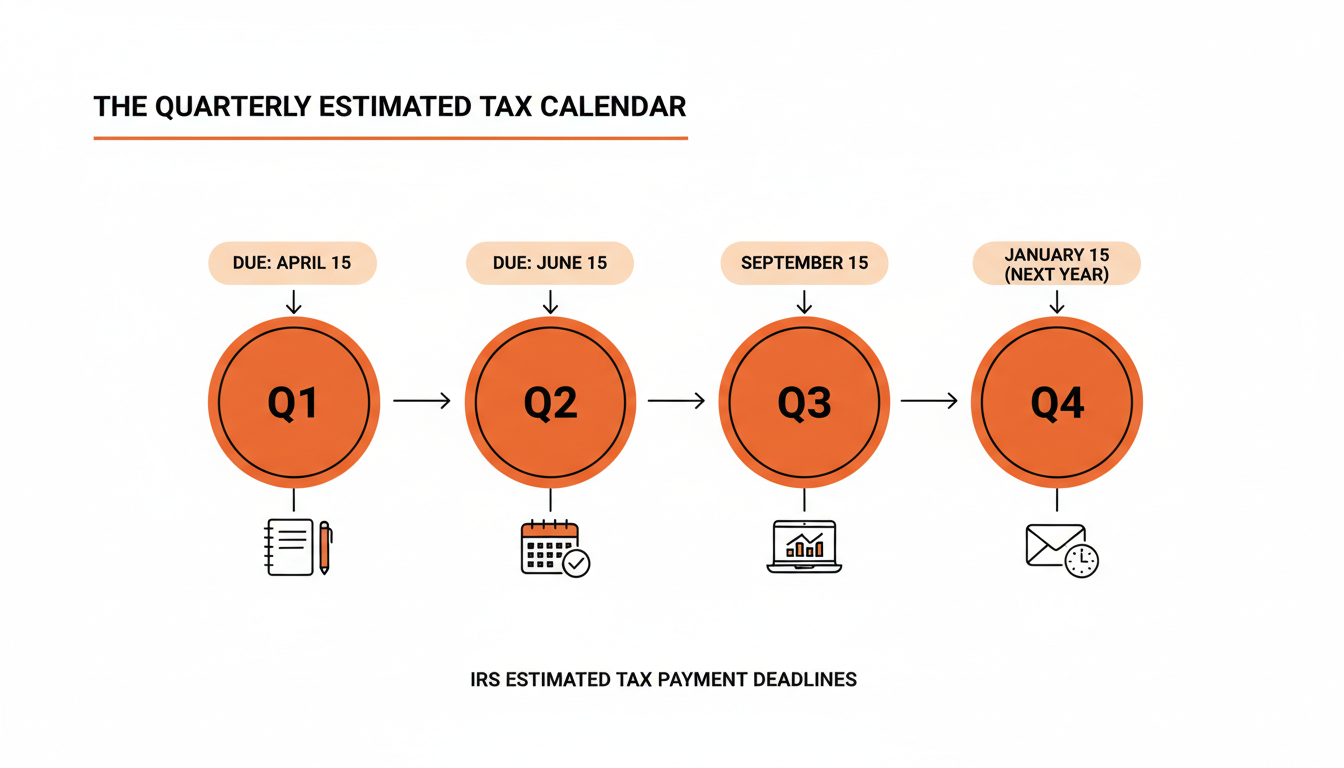
Newsletter revenue is rarely smooth. A launch spike, a single post that goes wide and pulls in a wave of annual subscribers, or a seasonal dip in renewals can all make one quarter look nothing like the next. Dividing last year's tax bill by four and paying that flat amount each quarter is the easiest approach, but it can leave you underpaying badly in a growth quarter or overpaying in a slow one. A better habit is revisiting your estimate each quarter based on actual revenue booked so far, rather than a static number set once in January.
Practical rule: if a single post or launch pulls in a meaningfully larger batch of paid subscribers than usual, recalculate your next quarterly estimate before the deadline instead of carrying the old number forward.
What You Can Actually Deduct as a Substack Writer
Every legitimate business expense you deduct reduces your Schedule C net income before self-employment tax applies, so this list is worth getting right twice over, once for income tax and once for SE tax.
Clearly Deductible Expenses
| Category | Examples |
|---|---|
| Platform and tooling | Substack fees, Stripe processing fees, scheduling and analytics tools, transcription software |
| Research | Other newsletters, trade publications, books, and reports that directly inform your writing |
| Home office | A proportional share of rent or mortgage interest, utilities, and internet for space used regularly and exclusively for the newsletter |
| Business meals | 50% of the cost when discussing the business with a source, collaborator, or contractor |
| Travel | Airfare, lodging, and registration when the trip's primary purpose is the newsletter |
| Contractors | Editors, illustrators, virtual assistants (issue a 1099-NEC to anyone paid $600 or more in a year) |
What Doesn't Count
Purely personal expenses that happen to later inspire an essay don't qualify, and neither do entertainment venues or personal trips you retroactively frame as research. The test the IRS applies isn't "did this end up in a post," it's whether the expense was ordinary and necessary for running the newsletter at the time you incurred it.
Practical rule: if you can't explain the business purpose of an expense in one sentence without reaching, don't deduct it.
The Hobby-vs-Business Test, and Why 2026 Raised the Stakes
The IRS doesn't automatically treat every paid newsletter as a business. It applies a nine-factor facts-and-circumstances test covering things like how businesslike your recordkeeping is, your relevant expertise, time invested, and your history of profit versus loss. No single factor decides it, but a track record of profit in three of the last five years creates a presumption in your favor.
Getting classified as a hobby used to mainly cost you deductions. Under the One Big Beautiful Bill Act's 2026 changes, hobby-expense deductions are now capped at 90% of hobby income, a real ceiling a genuine business doesn't face. You still have to report 100% of the income either way, so the downside of a hobby classification just got more expensive.
For a newsletter, clearing the business bar is straightforward: keep a dedicated business bank account, track subscriber growth and revenue against a plan, pay contractors properly with 1099-NECs, and treat pricing and platform decisions as choices made to improve margin, not just vibes. Writers who consistently track their numbers and iterate on what converts free readers into paid ones rarely have trouble here. The writers who get reclassified are usually the ones with no records at all.
Building a Tax-Ready Record With WriteStack's Analytics
The single habit that saves the most stress every February is the one most writers skip in year one: don't let subscription revenue, fees, and personal spending blur together. Reconciling your books monthly against your actual payout and subscriber data turns "what did I make this year" from a scramble into a five-minute lookup, and it's also the exact kind of consistent, businesslike record-keeping that helps you clear the hobby-vs-business test above.
WriteStack's Fans dashboard gives you a running view of paying subscriber counts and growth trends, which is the source data you need before you can reconcile anything against Stripe's payout reports. Pair that with WriteStack's engagement heatmap to see which specific posts and Notes are driving your paid growth, since that's also useful documentation if you ever need to demonstrate the "aimed at improving profitability" factor in the hobby-vs-business test. If you're publishing consistently enough that a growing subscriber base is turning into real revenue, WriteStack is built around exactly that stage of the business.
Common Mistakes That Get Substack Writers in Trouble
The most common error isn't fraud, it's assumption. Writers assume no 1099-K means no obligation, assume the number on a form they did receive is their actual income, or assume last year's tax bill divided by four is a safe quarterly estimate every year going forward. Each of those assumptions is wrong often enough to cause real problems.
The second most common error is netting fees against revenue in personal records instead of tracking them as separate line items, which makes it impossible to later prove your numbers reconcile cleanly if anything is ever questioned.
Practical rule: treat your Substack income like any other self-employment income from day one, gross revenue, itemized deductions, and quarterly estimates, rather than waiting until you cross a reporting threshold to start taking it seriously.
None of this replaces a conversation with a qualified tax professional who knows your full financial picture and your state's specific rules. But going into that conversation already knowing your gross subscription revenue, your fee breakdown, and your growth trend saves real time and real money, and it's exactly the kind of record a scheduling and analytics tool built for Substack writers can help you keep without extra manual work. If you're ready to put your growth data on a real foundation, WriteStack is where to start.