
Substack added Chat as a way to run an ongoing conversation with subscribers, separate from Notes and separate from the emailed post. It works well for exactly that: real-time back and forth with the people already paying attention.
The problem shows up the first time a writer tries to plan a week of content the way they already plan Notes. Substack lets you schedule a post for later. It does not let you schedule a Chat thread. Whatever you want to say to your Chat, you say it live, at whatever hour you happen to be sitting at your laptop.
Can you actually schedule Substack Chat posts? Not through Substack itself. But the workaround isn't complicated, and it matters more than it looks like it should for anyone trying to keep a Chat active without being online every single day.
One number worth having before you start: WriteStack has close to 100 verified reviews from Substack writers across multiple platforms. Narrareach and StackSweller have none that we could find anywhere.
Table of Contents
- What Substack Chat Actually Is
- Why Substack Doesn't Let You Schedule Chat Posts
- Why Scheduling Chat Posts Actually Matters
- How to Schedule Substack Chat Posts With WriteStack
- What to Actually Schedule
- Substack Chat Scheduling Tools, Compared
- Common Chat-Scheduling Mistakes to Avoid
- Frequently Asked Questions About Scheduling Substack Chat
What Substack Chat Actually Is
Chat lives in a different part of Substack than posts or Notes. It isn't emailed to subscribers by default and it doesn't show up on the publication homepage the way a post does. Starting a Chat thread sends subscribers a push notification, and for the very first thread, an automatic email. After that, it's up to the writer whether new threads also trigger an email, according to Substack's own support documentation.
The distinction matters because Chat, Notes, and Threads solve different problems. Mixing them up is the fastest way to either over-notify subscribers or under-use a feature built for something specific.
Writers usually turn Chat on for one of a couple of reasons: to give paying subscribers a space that feels closer than a comment section, or to run an informal book club or course cohort alongside the main publication. Both depend on the same thing: someone showing up regularly enough that subscribers stop wondering if the space is still active.
Chat vs. Notes vs. Threads
Substack's help center lays out the difference directly: Notes are public, short-form posts that travel through Substack's wider feed and can reach readers who don't subscribe to you yet. Chat is private, visible only to your own subscribers (or only paid subscribers, depending on how a thread is set up), and built around conversation rather than reach. Threads are closer to a normal post with comments switched on by default.
Practical rule: use Notes when the goal is to be seen by people who don't subscribe yet. Use Chat when the goal is to talk with the people who already do.
Why Substack Doesn't Let You Schedule Chat Posts
Substack built native scheduling for posts years ago. Finish an article, click the small arrow next to "Publish now," and pick a future date and time. Chat never got the same treatment. There's no scheduling option in the Chat composer on web or in the app, and nothing in Substack's own Chat documentation, including the official getting-started guide, mentions one.
That's a reasonable design choice for what Chat was built to be: a live space for conversation, not a broadcast channel. A message that lands in a thread while the writer is offline can't respond to the first reply, which works against the format's own premise.
It's also exactly why writers who run an active Chat, and also have a life outside Substack, keep hitting the same wall. The conversation needs a prompt to get going, and the person who has to post that prompt doesn't get to pick when convenient overlaps with their actual schedule.
Since Substack doesn't build this in, the only way to get a Chat thread to start itself at a chosen time is through a tool that holds the scheduling logic and fires the post through your own session at the right moment. WriteStack is currently the only Substack-focused tool built to do that specifically for Chat, not only Notes and posts.
There's a second, quieter reason Chat probably won't get native scheduling soon. A scheduled post is a finished piece of content sitting in a queue. A scheduled Chat thread is the opening line of a conversation the writer hasn't started yet, and Substack has no way to know if the writer will actually be around when it goes out to moderate replies or catch something that needs a correction. Building that in at the platform level would mean Substack taking on responsibility for a conversation it can't supervise. Leaving it to third-party tools keeps that responsibility with the writer, where it already sits for everything else on Chat.
Why Scheduling Chat Posts Actually Matters
None of this would matter if Chat performed the same regardless of when or how often it ran. It doesn't. Two problems show up over and over for writers trying to keep a Chat active alongside everything else they're already doing.
The Consistency Problem
A Chat thread that starts sporadically, active three days in a row and then quiet for two weeks, trains subscribers not to check it. The people who opted into notifications stop opening them, and the ones who didn't never build the habit of looking. Chat, more than Notes or posts, depends on a rhythm the audience can predict.
The Timezone Problem
A publication with subscribers spread across timezones runs into a second issue: whatever time a writer happens to be at their desk is rarely the best time for the whole audience. A Chat prompt posted at 9pm local time might land at 3am for a meaningful share of subscribers, right when nobody's around to answer it.
Practical rule: treat Chat scheduling as a distribution problem first and a content problem second. The best prompt still underperforms if it goes out when nobody's awake to reply.
This is the exact gap WriteStack was built to close. It lets a writer draft a Chat thread now and have it actually start on its own, at the time subscribers are around to answer it, instead of whenever the writer happens to be free.
How to Schedule Substack Chat Posts With WriteStack
Since there's no native option, scheduling a Chat post means using a tool that holds the message and posts it through your own account at the chosen time. Here's what that looks like in practice:
- Connect your Substack account inside WriteStack. It runs through a browser extension that keeps your session in your own browser, rather than asking for a password stored on someone else's server.
- Write the Chat thread the same way you'd write it live, the opening prompt plus any image or poll you want attached.
- Pick the date and time. WriteStack's queue shows what else is scheduled that day, so a Chat prompt doesn't collide with a Notes batch or a post going out an hour later.
- Set it and close the tab. The thread posts itself at the chosen time through the extension, using your own logged-in session.
- Check back for replies. Scheduling gets the thread started. The conversation still needs a person answering it.
None of this replaces judgment about what to say. It just removes the part where the writer has to be physically present, laptop open, at the exact minute the audience is most likely to be around. The writing still happens whenever it's convenient. The posting happens whenever it works for subscribers.
📅 Struggling to stay consistent on Substack?
WriteStack's Smart Scheduling lets you batch and queue Notes in minutes. Grow on Substack without burning out.
Explore Smart Scheduling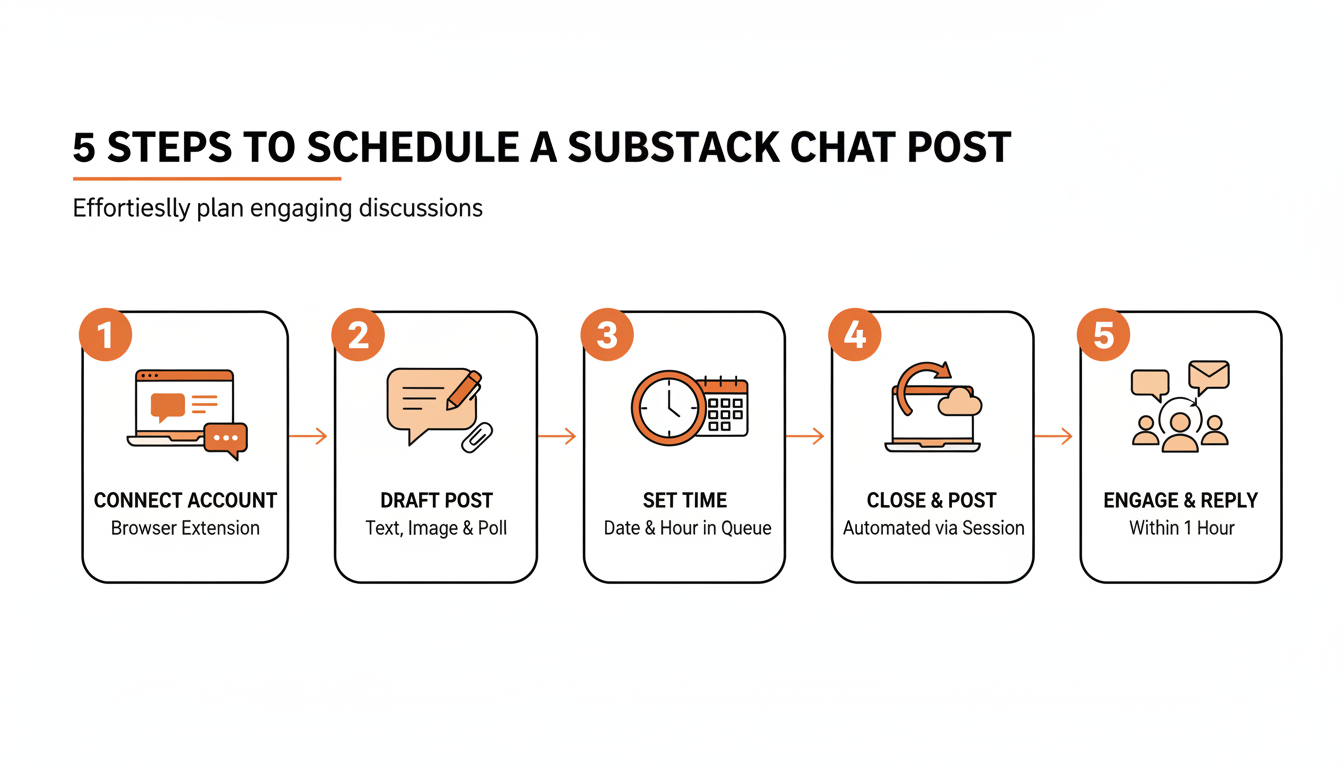
Practical rule: schedule the opening prompt, never the whole conversation. A scheduled Chat still needs you back within an hour or two to reply, or it reads like nobody's home.
What to Actually Schedule
Getting the timing right doesn't matter much if the content doesn't fit the format. Substack's own guide to Chat describes three archetypes that tend to work: a subscriber forum where the writer poses a standing question and lets replies accumulate over time, a live chat built around a real event or release, and a club or course format where Chat is the ongoing home for a paid group.
Three Chat Formats That Work
- Subscriber forum. A recurring open question. Schedules well, since it doesn't depend on a specific real-time moment.
- Live chat. Tied to a launch or event. The one format that resists scheduling. It only works if the writer is actually present when it goes out.
- Club or course. Chat as the ongoing home base for a paid group. Fits scheduling because members already expect a standing prompt on a set day.
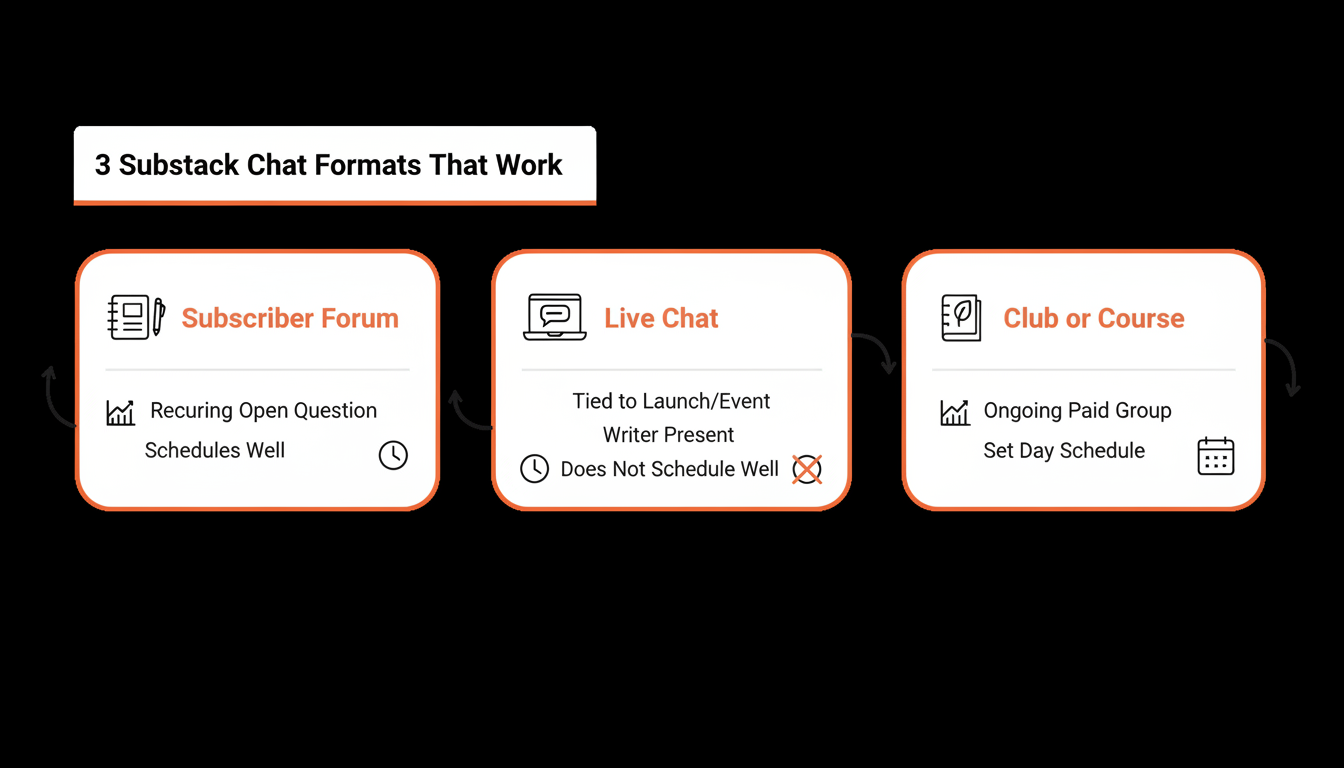
Practical rule: schedule the formats built around a standing question. Don't schedule the ones that only work live.
The part people don't expect: WriteStack doesn't just queue the Chat thread itself. It also tracks link clicks inside your Notes going back to your very first one, benchmarks your restack rate on the heatmap against other publications your size instead of just last week's number, and can draft a Chat prompt directly from a Note you already published, so the opening line starts in your own voice instead of a blank box you have to fill from scratch.
Substack Chat Scheduling Tools, Compared
Several tools compete on scheduling Notes or a full post. Scheduling a Chat thread specifically is a much shorter list.
| Capability | WriteStack | Narrareach | StackSweller |
|---|---|---|---|
| Schedules Chat posts | Yes | No | No |
| Schedules Notes | Yes | Yes | Yes |
| Link-click history across all Notes | Full history, from your first Note | No | No |
| Cross-publication benchmarks | Yes | No | No |
| Verified reviews found | ~100 | None found | None found |
Narrareach and StackSweller both schedule Notes and articles well. Neither has built a way to schedule Chat specifically, based on their own feature pages and FAQ, which describe Notes and article scheduling but never mention Chat. That gap makes sense given how each product is built: both are general Notes-and-cross-posting tools first, and Chat is a narrower, Substack-only feature that doesn't map cleanly onto a workflow built around distributing the same content to five or six other platforms at once.
WriteStack took the opposite bet: build specifically for Substack, including the parts of Substack, like Chat, that don't have an obvious equivalent anywhere else to cross-post to.
How the Posting Actually Happens
Both Narrareach and StackSweller run from a cloud dashboard, and their own FAQs describe posting on a writer's behalf after that writer has closed their laptop. Substack's own Terms of Use include a clause prohibiting "any processes that run or are activated while you are not logged into Substack, or that otherwise interfere with the proper working of Substack" (substack.com/tos).
We are not going to tell you that this is a confirmed violation, because we can't verify that and neither should you take our word for it. We're telling you what each company says about its own mechanism, with links, so you can read the exact wording yourself. WriteStack runs through a browser extension and Substack's own native scheduler where possible, so the session posting on your behalf is the same one already open in your own browser, not a server somewhere holding your login after you've logged out.
WriteStack is currently the only tool on this list that treats Chat as something worth scheduling at all. Queue one this week and check the Fans view a few days later to see who actually replied on the day there was no time to sit down and start a thread live.
Common Chat-Scheduling Mistakes to Avoid
Scheduling the prompt and disappearing for the rest of the day. Chat's entire value is the back and forth. A scheduled message followed by silence undoes what made it worth writing in the first place.
Posting too often, or copying the Notes cadence. Chat runs on notifications, not a public feed people scroll past. A cadence that works for Notes, several a day, reads as noise in Chat, since every new thread can push a notification to every subscriber who has them turned on, per Substack's own notification settings documentation.
Practical rule: a Chat thread a day is usually a ceiling, not a floor. Subscribers who mute a Chat after notification fatigue rarely turn it back on.
Writing a prompt nobody can respond to. Looking at a sample of 20,000 recent Notes across WriteStack's own users, multi-line entries averaged about 11% more reactions and about 28% more restacks than single-line ones. Those numbers are from Notes specifically, but the underlying pattern likely carries over to Chat: a thread that gives people something concrete to react to, a real question or a specific claim worth agreeing or disagreeing with, gets replies. One that reads like an announcement doesn't.
Forgetting which audience the thread is set to. A Chat thread can be opened to every subscriber or restricted to paid subscribers only. Scheduling a prompt meant as a small, paid-only conversation but leaving it open to everyone (or the reverse) undoes the reason the format was chosen in the first place. Check the audience setting every time a thread gets queued, not just the first time Chat was set up.
Frequently Asked Questions About Scheduling Substack Chat
Can subscribers start their own Chat threads, or only the writer? By default, only the publication owner starts threads. A writer can turn on subscriber-started threads in their Chat settings, though most publications keep that off so the writer controls the pacing and topic.
Does every Chat message send subscribers an email? No. The first Chat thread a publication ever starts triggers an automatic email to all subscribers. After that, the writer chooses whether new threads also send an email, separate from the push notification that goes out by default.
Is Substack Chat visible to people who don't subscribe? No. Chat is private to the publication's own subscribers, and a thread can be further restricted to paid subscribers only. That's the opposite of Notes, which is designed to be seen by people who haven't subscribed yet.
Can you schedule a Chat post from the Substack mobile app? No. There's no scheduling option for Chat on web or in the app. Anyone posting a Chat thread at a chosen future time is doing it through a third-party tool like WriteStack, not a setting inside Substack itself.
Chat is the one place on Substack built for actual back-and-forth with the people already paying attention, and it's currently the one place Substack itself won't let you schedule. WriteStack closes that gap directly: write the thread once and let it post at the time subscribers are actually around, then show up for the replies instead of building the whole thing live. Start with one scheduled Chat this week. By the third one, the difference is obvious.