
How the Substack Bestseller List Actually Works
You've seen the badges. White, orange, purple, sitting next to a writer's name at the top of a Substack post. You've probably wondered whether the list ranking those writers rewards good writing, good luck, or something else entirely. It doesn't reward writing quality directly, and it isn't one list. It's three, and they measure completely different things.
If you're trying to figure out how the Substack bestseller list works, whether it's worth chasing, and what actually moves a publication up it, this covers all three systems, what triggers a badge, and what the data says about what really correlates with climbing.
Load your Notes queue for the week while you read this and check WriteStack against your own account afterward. It only takes a few minutes to see where you actually stand.
Table of Contents
- What the Bestseller List Actually Ranks - Bestseller Badges vs. Bestseller Leaderboards - Rising vs. Top Bestseller vs. New Bestsellers - Why Rising Feels Chaotic - Who's Actually Eligible - What Actually Moves You Up the List - The Posting-Frequency Data - Does Any of This Actually Matter for Growth? - A Practical Plan for Climbing the Rankings - Mistakes Writers Make Chasing the List - How Long It Actually Takes
What the Bestseller List Actually Ranks
Start with what it isn't measuring: readers, opens, likes, comments, or how good the writing is. The Substack Bestseller system is entirely a paid-subscription and revenue mechanism. Every badge and every leaderboard placement traces back to one of two things: how many paying subscribers you have, or how much annual recurring revenue your paid subscriptions generate.
That single fact resolves most of the confusion writers have about the system. A publication with 40,000 free subscribers and zero paid ones has no badge and appears on no leaderboard, while a niche newsletter with 120 paying subscribers at $10 a month can carry a white bestseller badge. Substack's own explanation of leaderboards confirms this directly: the boards are category-specific rankings built from paid subscription data, not engagement data.
Practical rule: if paid subscriptions are off, nothing else here applies to you yet. Free-only publications don't have a badge to earn, and no amount of Notes activity changes that.
Bestseller Badges vs. Bestseller Leaderboards
These get conflated constantly, and they're not the same system. A badge is personal and permanent once earned. A leaderboard placement is comparative and can disappear the next day if someone else's numbers move.
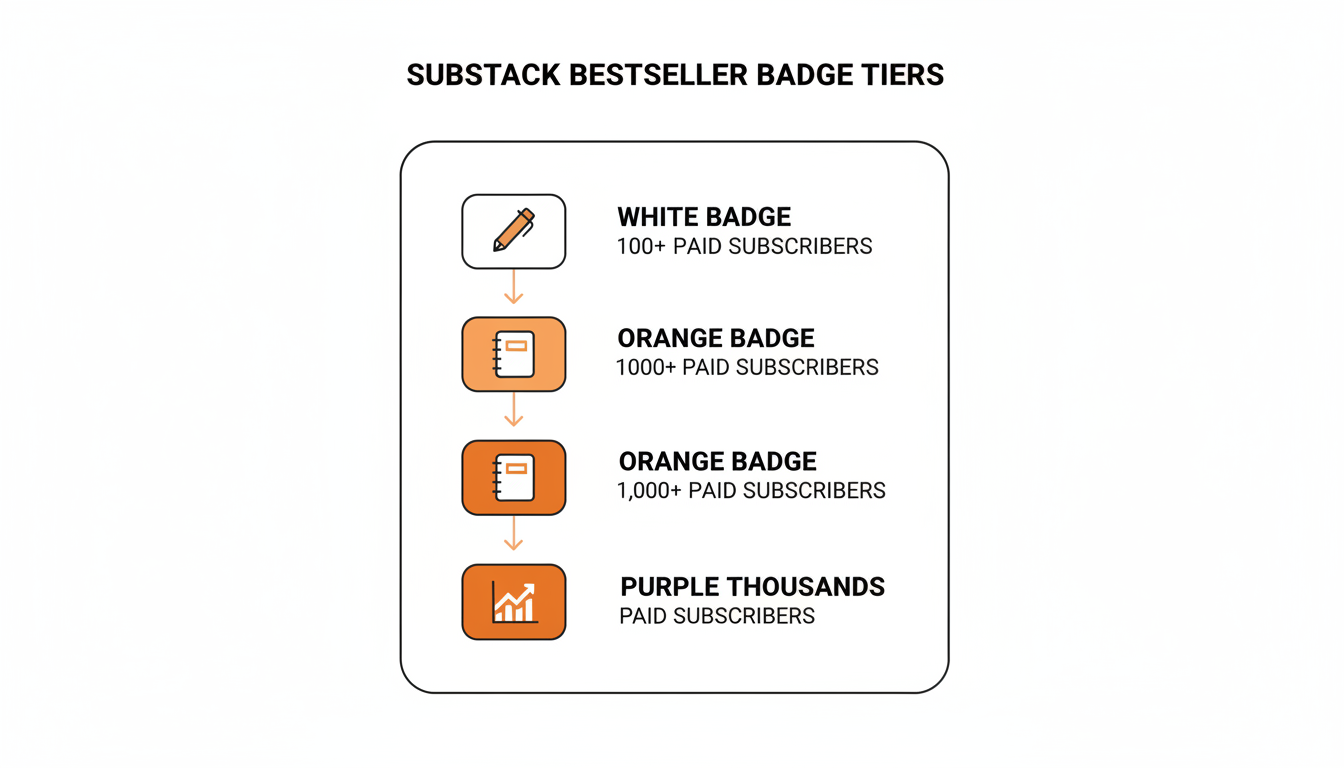
Substack's badge documentation lays out three tiers, based purely on paid subscriber count:
| Badge | Paid subscriber threshold | What it signals |
|---|---|---|
| White | 100+ paid subscribers | You've crossed the first real monetization line |
| Orange | 1,000+ paid subscribers | Recognized as an established paid publication |
| Purple | Tens of thousands of paid subscribers | Among Substack's largest paid publications |
Free trials and comped subscriptions don't count toward any of these thresholds, only subscribers who are actually paying. Once you cross a threshold, the badge is yours; it isn't revoked if your paid count dips slightly the following month the way a leaderboard rank would be. This is the part most writers get wrong first: they assume a bad month costs them a badge. It doesn't. It can cost you a leaderboard spot.
Leaderboards, on the other hand, are entirely relative. You can hold a white badge and still never appear on your category's Top Bestseller leaderboard, because that list only surfaces the top 100 publications in each category, ranked by revenue, not by badge tier. A badge tells a reader you've hit a milestone. A leaderboard spot tells them you're currently near the top of a specific, narrow comparison.
Rising vs. Top Bestseller vs. New Bestsellers
This is where most of the "how do I get on the list" confusion comes from, because these boards answer completely different questions and update on completely different schedules.
Top Bestseller ranks publications in a category by annual recurring revenue, refreshed daily. It's a snapshot of who currently earns the most from paid subscriptions in that category, and because it's driven by revenue rather than raw subscriber counts, pricing strategy directly affects rank. A publication charging $12 a month can outrank one with more subscribers paying $5 a month.
Rising ranks by paid-subscription growth momentum, refreshed every few hours. This is the board newer and smaller publications actually have a realistic shot at, because it rewards the rate of paid growth relative to your own baseline, not your absolute size against the entire category.
New Bestsellers is the quieter third list, and arguably the most meaningful one for a writer just starting to monetize. It surfaces publications that earned their first bestseller badge within the past 30 days. Unlike Rising, it isn't volatile. It's a one-time recognition tied to a real milestone: crossing 100 paid subscribers for the first time.
Why Rising Feels Chaotic
Because Rising updates every few hours off a comparatively small, volatile signal, new paid conversions, a publication can appear on it after one good week and vanish the next. That volatility isn't a bug. A publication converting 15 new paid subscribers in a week looks completely different on Rising depending on whether its baseline paid count was 50 or 5,000. Small, fast-growing publications get outsized visibility here precisely because the board measures rate of change, not scale. If you check Rising once and don't see yourself, checking again in six hours is a genuinely different query, not a repeat of the same one.
Who's Actually Eligible
Eligibility is binary and has nothing to do with post frequency, subscriber count, or account age beyond having the feature enabled:
Practical rule: paid subscriptions must be turned on for your publication to appear anywhere in the bestseller system, badges or leaderboards. A publication that hasn't enabled payments is invisible to the entire system regardless of how large its free list is.
Beyond that gate, category selection matters more than most writers assume. Leaderboards are calculated within categories, so a finance newsletter competes against other finance newsletters, not against the entire platform. Picking, or later changing, your category directly changes the size and strength of the field you're ranked against. A genuinely under-served category with fewer strong paid publications is a real, if unglamorous, lever, and it's worth checking your category page occasionally to see who you're actually being measured against.
Struggling to stay consistent on Substack?
Batch and queue your Substack Notes in minutes, track which Notes convert subscribers, and grow without burning out.
What Actually Moves You Up the List
Since all three boards are downstream of paid subscription growth and revenue, the honest answer to "how do I climb" is "convert more readers to paid, and do it faster than others in your category." That's true, and also not actionable on its own, so it's worth looking at what actually correlates with the kind of consistent output that tends to precede paid growth.
The Posting-Frequency Data
We pulled a sample of Substack publications with at least 20 published posts from WriteStack's own analytics dataset, grouped them by total posts published, and looked at average reader reactions per post across each group:
| Total posts published | Publications in sample | Avg. reactions per post |
|---|---|---|
| 20-29 posts | 1,652 | 21.3 |
| 30-59 posts | 4,560 | 13.9 |
| 60-119 posts | 12,849 | 15.2 |
| 120+ posts | 939 | 32.9 |
The publications that had published 120 or more times averaged more than double the reactions per post of the mid-range groups, and well above the smaller, newer publications too. That's not proof that volume alone drives paid conversion; engagement and paid subscriptions are different metrics. But it's a real signal that the publications building the kind of sustained reader relationship that eventually supports a paid ask are the ones still showing up consistently well past their first year. Most publications never make it to 120 posts. The ones that do see the reward compound, not decay.
Practical rule: treat 120 published posts as a rough threshold where an audience starts responding differently, not as a magic number, but as evidence that consistency is doing real work long before any leaderboard notices you.
This pattern is exactly the kind of thing that's invisible from inside a single Substack dashboard, because your own account only ever shows you your own numbers in isolation. There's no way to know from your own analytics tab whether 15 reactions on a post is strong or weak for a publication your size and age. WriteStack's benchmarking tool exists specifically to answer that, by comparing your posting rhythm and engagement against other publications in your category instead of leaving you to guess.
Does Any of This Actually Matter for Growth?
Reasonable writers land on different sides of this, and it's worth being direct about both.
The case for caring: a bestseller badge is a visible, checkable trust signal the moment a new reader lands on your page. It answers "does this publication actually make money" before they've read a single post, which shortens the trust-building work every paid pitch has to do. Leaderboard placement in your category also drives real discovery traffic. Substack surfaces category leaderboards to browsing readers, so Rising placement in particular can put a small publication in front of people who'd never have found it through search or recommendations.
The case for not obsessing: neither leaderboard is something you control directly. You can't target "get on Rising" the way you can target "publish every Tuesday" or "pitch three sponsors this month." Chasing leaderboard placement as a primary goal means optimizing for a metric that's one layer removed from what actually builds a sustainable publication: a base of readers who trust you enough to pay and stay.
The part people don't expect: the fastest way to influence Rising isn't a growth hack aimed at the leaderboard at all. It's fixing whatever is quietly capping your paid conversion rate right now, because Rising is just paid growth rate with a spotlight on it. Writers who go looking specifically for "Substack leaderboard tricks" are almost always solving the wrong problem, and the writers who find their way onto Rising by accident are usually the ones who stopped looking for a trick months earlier.
A Practical Plan for Climbing the Rankings
Given that all three boards are just paid-subscription math wearing a leaderboard costume, the actual plan is less exotic than it sounds:
- Enable paid subscriptions if you haven't. Nothing below matters until this is on.
- Pick your category deliberately, and revisit it if your content shifts. A crowded category with strong incumbents is a harder Top Bestseller climb than a focused, less-contested one.
- Build a consistent publishing rhythm before you push a paid pitch. The data above suggests the writers still showing up past 100+ posts see meaningfully different reader response than those who stall out earlier.
- Track what's actually converting, not just what's getting reactions. A Note that gets restacked heavily but drives no paid conversions is a different problem than one that converts well but reaches few people. WriteStack's Notes analytics break out link clicks per Note, not just raw engagement, specifically to separate those two things.
- Watch Rising as a lagging indicator, not a goal. If your paid growth rate is genuinely accelerating, Rising will reflect it within hours. If it isn't moving, that's diagnostic information about your conversion funnel, not a sign to chase the board harder.
If you're serious about steps three and four, guessing your way through them with no comparison point is slower than it needs to be. WriteStack benchmarks your posting frequency, reactions, and click-through data against other publications in your category, so "am I posting enough" and "is this Note actually working" get real answers instead of gut checks. The Fans dashboard goes a step further and shows exactly which readers are your most engaged, the ones worth a direct, personal paid pitch instead of a blanket one.
Mistakes Writers Make Chasing the List
A few patterns show up repeatedly among writers fixated on badges and leaderboard rank:
Switching categories every few weeks looking for a weaker field. This resets whatever relative standing you'd built and confuses readers about what your publication actually covers. Pick a category that matches your content and stay in it.
Discounting aggressively to inflate paid subscriber count for badge thresholds. The badge tiers count paid subscribers, not revenue, so this can technically work for a badge, but it directly hurts Top Bestseller placement, which is revenue-based, and it trains your audience to wait for discounts rather than pay full price.
Treating a badge as the finish line instead of a checkpoint. A white badge at 100 paid subscribers is a real milestone, but writers who stop iterating on their offer once they hit it tend to plateau there for a long time. The publications that keep climbing keep treating each threshold as the new baseline, not the goal.
Ignoring the free-to-paid funnel that actually produces the numbers these boards reward. Time spent studying Substack's leaderboard mechanics is time not spent on the welcome sequence, pricing test, or content cadence that would move paid subscriptions in the first place.
None of these mistakes are fatal, but they share the same root cause: treating the bestseller system as the thing to optimize instead of the readout of something else you should be optimizing. Fix the underlying paid-conversion engine, and the badges and leaderboard placement follow as a side effect rather than a goal that has to be chased directly.
How Long It Actually Takes
There's no fixed timeline Substack publishes for reaching a white badge, and any specific number of weeks or months you see quoted elsewhere is one publication's experience, not a platform average. What is consistent, based on the posting-frequency pattern above, is that the publications that reach a first badge quickly tend to have already built a real publishing habit before they turned paid subscriptions on. The badge isn't usually the first milestone; it's a lagging confirmation of habits that were already working.
That's the practical reframe worth ending on: don't build your publishing plan around the badge. Build the habit, watch your own numbers against real comparisons instead of platform folklore, and let the badge show up as confirmation rather than chase it as a goal.
If you're ready to see exactly where your publication stands against others in your category, right now, WriteStack puts that comparison in front of you instead of leaving you to guess from inside your own dashboard.