
How to Get Featured on Substack's Discover Page
Getting pulled into Substack's Discover page feels like winning a small lottery. One day your publication sits at a few hundred subscribers, the next you're fielding a spike of new readers you didn't do anything that morning to earn. Except you did earn it, usually weeks earlier, through a set of signals that have almost nothing to do with luck.
The core question most writers ask is some version of "what do I actually have to do to show up there?" The honest answer is that Substack isn't optimizing to show readers the most popular writers. It's optimizing to match a reader's current reading momentum to a writer who fits it, right now, not to their static long-term taste profile. That distinction changes what you should spend your time on.
This piece breaks down what actually feeds that matching system, where most writers waste effort chasing the wrong signal, and a concrete plan for putting yourself in a better position without changing who you are as a writer.
Table of Contents
- What the Substack Discover Page Actually Is
- How Substack Decides What to Feature
- Why Most Writers Never Get Featured
- The Consistency Signal, Quantified
- Notes: The Fastest Lever Most Writers Ignore
- Categorization: Picking a Niche Substack Can Actually Place You In
- What a Real Discover Feature Looks Like
- A 30-Day Plan to Make Yourself Featurable
- Getting Ready Before Discover Finds You
What the Substack Discover Page Actually Is
Discover is Substack's built-in distribution surface: a feed of publications and posts shown to readers based on what they already read, what they clicked recently, and who they follow. It sits alongside two other discovery mechanisms that matter just as much, Notes and creator recommendations, and current estimates put internal network features like these behind roughly 60% of platform growth, more than search or social sharing combined.
That number matters because it tells you where to put your effort. Discover placement isn't a separate campaign you run. It's a byproduct of behavior Substack already tracks: how often you publish, how your readers interact with your posts, and whether other writers in your niche are willing to point their own audience at you.
It also explains why so much generic "growth hacking" advice fails on this platform. Substack isn't a feed you can game with a catchy headline and a burst of posting the week before a launch. The system is built around ongoing behavior measured over weeks, not a single viral moment measured over hours. A post that spikes once and then goes quiet teaches the algorithm almost nothing useful about your publication, while a publication that shows a steady, readable pattern gives the model something real to match readers against.
Practical rule: treat Discover as a lagging indicator, not a target. Optimize the inputs (publishing rhythm, Notes activity, recommendation reciprocity) and the placement follows on its own timeline.
How Substack Decides What to Feature
Reading Momentum, Not Static Preference
Substack's ranking approach leans on sequential modeling, which predicts what a reader is likely to open next based on their most recent reading session rather than a fixed profile built from their entire history. If someone just spent ten minutes in three personal-essay newsletters, the algorithm nudges a fourth personal essay into their feed, even if that reader also subscribes to five finance newsletters they haven't opened in a month.
For a writer, this means your best shot at Discover isn't building a broad appeal. It's writing something that fits cleanly into a reading session someone is already having, which is exactly why niche clarity outperforms range.
Think about what this looks like from the reader's side. Someone opens Substack, reads a piece about freelance pricing, restacks a Note about invoicing, and clicks into a second business newsletter. In that ten-minute window, they've told the model exactly what kind of reading session they're in. A publication about freelance business strategy is a strong candidate to slot into that session. A general "life advice" newsletter that occasionally touches freelancing is a much weaker match, even if the writing quality is identical, because it doesn't fit the specific momentum the reader just built.
Recommendations and Notes Overlap
The second major signal is overlap: how much your audience already reads publications similar to yours, and how many of those writers recommend each other. Notes plays directly into this because every restack, reply, and quote is a small, explicit "these two audiences belong together" signal that a recommendation link alone doesn't send as often.
Fresh, first-person analysis of how the restack mechanic feeds the algorithm backs this up: writers who saw a jump in discovery traced it consistently to a small number of restacks from accounts with active, engaged followings, not to raw follower count.
This is a meaningful shift from how most people still think about social platforms. On a follower-count platform, the biggest account that mentions you produces the biggest spike. On Substack, a restack from a mid-sized writer whose audience genuinely reads and engages tends to outperform a mention from a much larger account whose followers scroll past everything. The overlap has to be real, not just large.
Why Most Writers Never Get Featured
Three patterns show up over and over in writers who've been publishing for months without a single Discover impression worth mentioning:
They post in bursts. Three posts in a week, then three weeks of silence. The algorithm can't build a reading-momentum pattern around you if there's nothing recent to attach to.
They're miscategorized. A memoir writer tagged under "Culture" instead of "Personal Essays" gets shown to readers whose recent sessions don't match, so engagement looks weak even when the writing is strong.
They never use Notes, or use it like a second Twitter feed instead of a place to actually engage with other writers' work. Both of those choices remove the exact overlap signal Discover leans on.
A fourth, quieter pattern shows up in writers who've been on the platform for over a year: they got a small taste of Discover traffic early on, didn't have a plan to keep those readers around, and assumed the algorithm had simply moved on from them. In most cases nothing changed on Substack's side. What changed is that their publishing cadence slipped after the initial excitement wore off, and the momentum signal that got them noticed the first time quietly decayed.
Practical rule: before touching your content strategy, audit these three things first. Fixing distribution mechanics is faster than writing your way out of a visibility problem.
The Consistency Signal, Quantified
"Be consistent" is vague advice on its own, so here's what it means mechanically. Substack's ranking rewards recent, regular activity because it needs fresh signal to keep predicting what you'll publish next and who wants it. A publication posting weekly for eight straight weeks builds a stronger, cleaner momentum pattern than one that posted eight times in one week and then went dark.
| Publishing Pattern | Discover Signal Strength | Why |
|---|---|---|
| Weekly, 8+ consecutive weeks | Strong | Consistent recency window, predictable pattern to match readers against |
| Daily for 2 weeks, then silence | Weak, decaying | Momentum spikes then has nothing to reinforce it |
| Irregular, 1-4x/month | Very weak | No reliable pattern for the model to learn |
| Multiple Notes/week + weekly post | Strongest | Combines post cadence with the higher-frequency Notes signal |
The practical implication: if you can only commit to one thing this month, commit to a cadence you can actually hold for two months straight, even if that means posting less often than you'd like.
📅 Struggling to stay consistent on Substack?
WriteStack's Smart Scheduling lets you batch and queue Notes in minutes. Grow on Substack without burning out.
Explore Smart SchedulingThis is also where a lot of writers sabotage themselves without realizing it. A weekly newsletter that occasionally slips to every ten days doesn't look "mostly consistent" to a ranking system built around recent windows, it looks unpredictable. Two missed weeks in a row does more damage to your momentum pattern than a slightly slower but rock-solid every-other-week schedule. If your current cadence isn't sustainable, lower it before you break it, since a smaller commitment kept reliably beats a bigger one abandoned halfway through the month.
Notes: The Fastest Lever Most Writers Ignore
Notes moves faster than long-form posts because it's cheaper to produce and cheaper for Substack to use as a signal. A five-minute Note can generate the same kind of engagement data that used to take a full essay to produce. If you're trying to build Discover-relevant momentum without slowing your writing schedule, this is the lever to pull first.
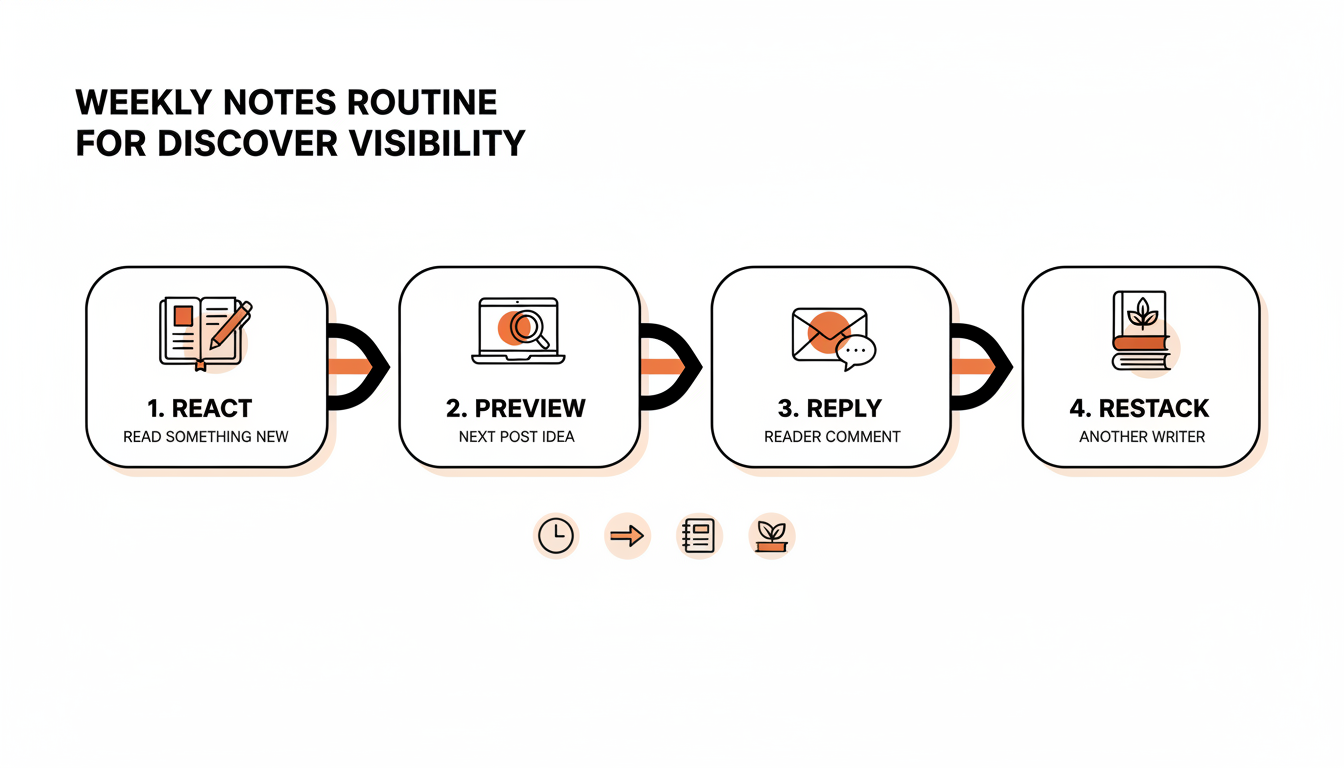
A simple weekly routine:
- One Note reacting to something you genuinely read that week, tagging or naming the writer where it fits naturally.
- One Note previewing a line or idea from your next post, published a day or two before it goes out.
- One Note replying directly to a reader's comment, turning a private exchange into public engagement.
- One restack of another writer in your niche whose work you'd actually recommend, which is the single most direct overlap signal available to you.
None of these need to take more than a few minutes each, and none of them require you to write a full post. That's the point. The Notes system is built for low-effort, high-frequency signal, and it rewards writers who show up in it consistently over writers who post one long note occasionally.
Consistency scheduling makes this realistic to sustain. WriteStack's Notes tool can queue a week of Notes in one sitting instead of you remembering to log in daily, which is usually where this habit breaks down. Writers who batch a week of Notes upfront tend to actually hit all four steps in the routine above, while writers relying on memory alone tend to drop the restack step first, since it requires reading someone else's work in the moment rather than just posting your own thought.
Categorization: Picking a Niche Substack Can Actually Place You In
Substack's ranking treats category and tags as a filter before it ever gets to engagement signal. If you're tagged in a broad category, you're competing against every writer in that category for a reader's attention, and the model has less confidence about what specific slice of that audience actually wants your work. A narrower, more accurate category means fewer readers see you, but a much higher share of the ones who do are the right fit, which is what actually drives the engagement metrics that earn you a second look.
Practical rule: pick the most specific category available even if it feels smaller. A tightly-matched 200 readers outperforms a loosely-matched 2,000 on every engagement metric that matters for Discover.
Check your current tags against your last five posts. If a stranger read only the tags, would they guess the actual subject matter of those posts? If not, you're diluting your own signal.
Category drift is easy to miss because it happens gradually. A writer starts a publication about personal finance, then slowly starts writing more general life essays as their interests shift, but never goes back and updates the category or tags. Six months later they're tagged as a finance writer publishing lifestyle content, and every metric Substack uses to judge fit looks worse than it should, not because the writing got weaker, but because the labels stopped matching reality.
What a Real Discover Feature Looks Like
It helps to see what the actual outcome of a feature looks like instead of guessing. One creator tracked their numbers directly after landing a Discover feature and found a gain of 682 subscribers over four days of visibility, a spike that faded once the feature rotated out but left a meaningfully higher subscriber baseline than before.
Two things stand out in that kind of case study. First, the bump is real but temporary, the feature itself doesn't compound unless you're ready to convert the traffic it sends. Second, the writers who benefit most from a feature are the ones who already had a clear, working "next step" for a new reader, whether that's a strong welcome sequence, a clear archive to browse, or an obvious reason to subscribe rather than just read once and leave.
Practical rule: treat every piece of unearned traffic as a test of your onboarding, not just your writing. A feature you can't convert is a missed opportunity, not a win.
Preparing for that moment before it happens matters more than most writers assume. If your welcome email is a single generic line and your archive page is a wall of undifferentiated titles, a new reader dropped in by Discover has no clear next step and quietly drifts away. Writers who convert best from a feature usually have three things ready in advance: a welcome email that points to one or two specific posts worth starting with, an archive that's easy to skim by topic, and at least one clear call to subscribe that isn't buried at the bottom of a long post.
A 30-Day Plan to Make Yourself Featurable
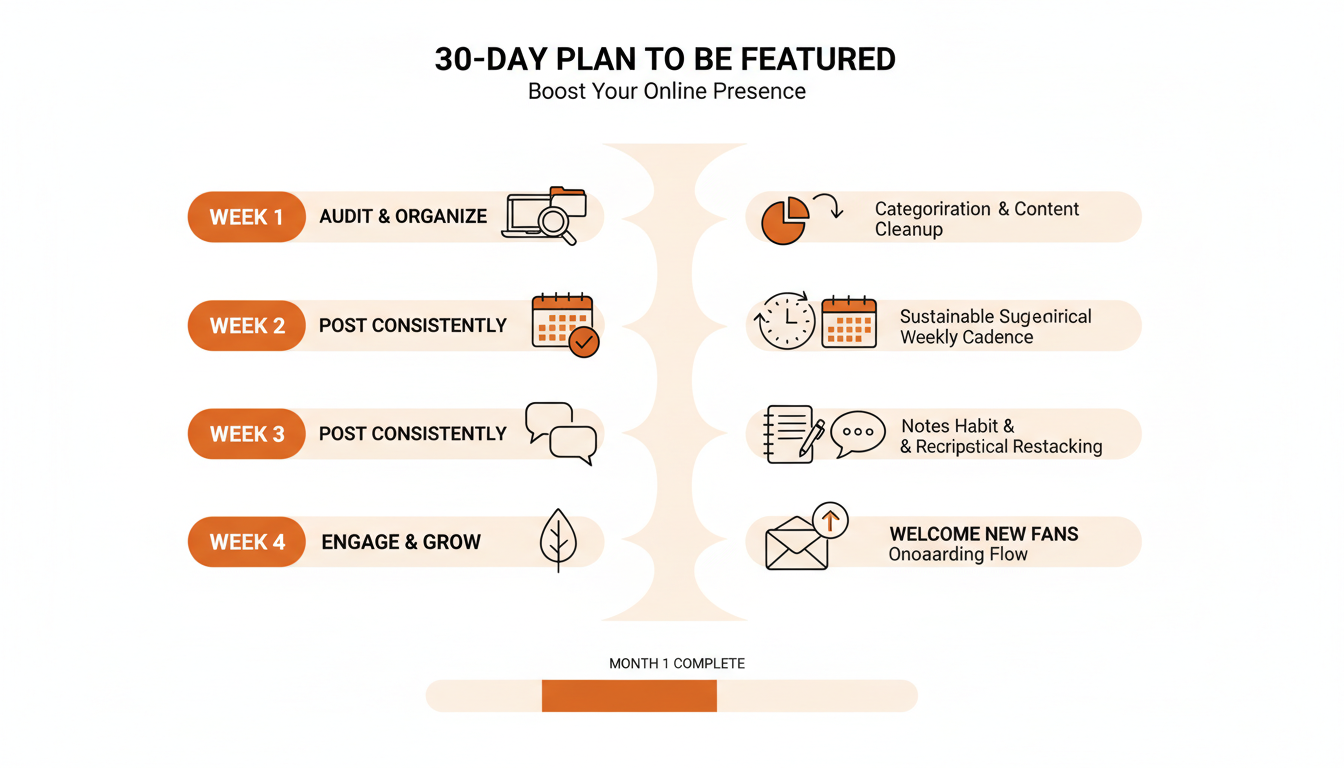
Week 1: Audit your category and tags against your actual content. Fix anything that's misleading. Read your last five posts as if you were a stranger and note whether the subject matter matches what the tags promise.
Week 2: Set a publishing cadence you can hold for eight straight weeks, not just this month. Write it down somewhere you'll actually see it, and treat missing it as a real failure, not a minor slip.
Week 3: Build the Notes habit from the four-step routine above. Focus especially on the restack, since that's the most direct overlap signal you control.
Week 4: Fix your onboarding. Make sure a brand-new subscriber has an obvious next post to read, a clear sense of what your publication is about within the first thirty seconds, and a reason to stick around past the first email.
None of these four weeks guarantee a Discover feature. What they do is put every input Substack's model actually uses in a healthier state, which is the only lever available to you since the feature decision itself isn't something any writer controls directly.
Getting Ready Before Discover Finds You
Discover placement rewards writers who were already doing the boring, consistent work before the algorithm noticed. Cadence you can hold, tags that actually match your content, and a Notes habit that builds real reciprocity with other writers in your niche will move the needle more reliably than chasing the feature directly.
If keeping that cadence and Notes habit consistent is the part that keeps slipping, that's the exact gap WriteStack is built to close, queue a week of Notes and posts in one sitting, see engagement patterns in your heatmap, and know which readers are worth double-tapping via Fans before you ever need Discover to send you new ones.