
Substack Notes Strategy: How to Turn Notes Into Growth
I spent my first four months on Substack treating Notes like an afterthought. I'd publish a post, maybe drop one Note linking to it, and go back to writing. My subscriber count barely moved. Then I watched a handful of writers with smaller archives than mine outgrow me in weeks, and the common thread wasn't better essays. It was that they showed up on Notes every single day with something worth restacking.
Notes is Substack's short-form feed, and it behaves less like a newsletter feature and more like a discovery engine bolted onto your publication. Long-form posts mostly reach people who already subscribe. Notes reaches strangers. If you're trying to grow past the small circle of people who already know you, Notes is where that happens.
This piece is the strategy I wish someone had handed me on day one: what Notes actually is, how to turn one long-form post into a week of Notes without it feeling like a second job, which formats get restacked, how often to post, and the mistakes that quietly cap your reach.
Table of Contents
- What Substack Notes Actually Does For Growth
- The Repurposing Engine: Turning One Post Into a Week of Notes
- How Often to Post Notes (and When)
- Note Formats That Actually Get Restacked
- Building Relationships Through Notes, Not Just Broadcasting
- Common Notes Mistakes That Quietly Kill Reach
- Measuring What's Working: A Weekly Notes Review
- A 30-Day Notes Plan to Build Momentum
- Notes Is a Distribution Habit, Not a Personality Trait
What Substack Notes Actually Does For Growth
Substack has two audiences you're building at once: the readers who already subscribe and the readers who've never heard of you. Long-form posts serve the first group. Notes is how you reach the second.
When you publish an essay, it lands in the inboxes of people who opted in. It doesn't put you in front of anyone new unless someone restacks it. Notes works differently: it's a public feed, similar in shape to a social timeline, where anyone on Substack can see your post if it gets picked up, replied to, or restacked by someone with an audience you don't have yet.
That's the mechanic worth internalizing. Notes isn't a place to summarize your newsletter. It's a place to say the specific, quotable, sometimes unfinished thoughts that don't warrant a full post but are exactly the kind of thing a stranger stops scrolling for.
Practical rule: if a thought needs a headline, subheads, and 1,500 words to make sense, it's a post. If it makes sense in two sentences, it's a Note. Don't force either into the wrong format.
Writers who treat their long-form work as the "trust engine" and Notes as the "discovery engine" tend to compound faster than writers doing only one or the other, according to growth breakdowns from creators who've scaled past 40,000 subscribers on the platform (Write · Build · Scale's 2026 growth roadmap lays this out well). The trust engine keeps existing subscribers. The discovery engine finds new ones. Skip Notes and you're only running half the system.
This is a hard adjustment for anyone who came to Substack from a blogging background. Blog platforms rewarded polish: you wrote a piece, edited it for a week, published it, and moved on. Notes rewards frequency and specificity instead. A rough, honest, two-sentence thought posted today does more for your discovery than a beautifully edited essay that sits unread in an inbox. That doesn't mean lower the bar on your actual writing, it means recognize that Notes and posts are different jobs with different success metrics, and judging your Notes by long-form standards is why most writers give up on them within a month.
The other adjustment is patience with the feedback loop. A single Note rarely changes your trajectory. What changes it is thirty Notes over thirty days, most of which will get modest engagement, a few of which will get restacked into a much bigger audience than you currently have. You can't predict which ones in advance, which is exactly why volume and consistency matter more than trying to engineer a single viral post.
The Repurposing Engine: Turning One Post Into a Week of Notes
The reason most writers stop posting Notes after a week or two isn't laziness. It's that they're trying to come up with fresh ideas from scratch every single day, and that's genuinely exhausting on top of writing the actual newsletter.
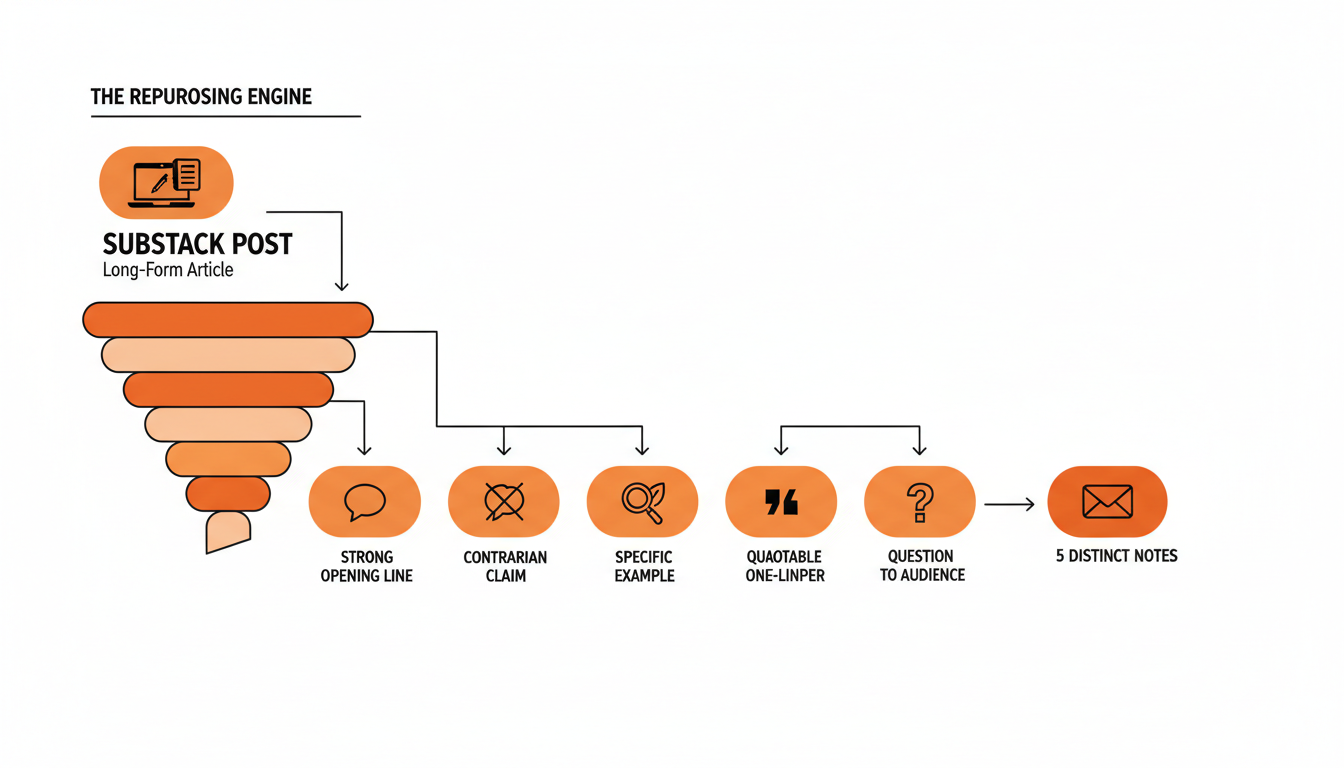
The fix is to stop treating Notes as new writing and start treating it as redistribution. Every long-form post you've already published is a stockpile of Notes waiting to be pulled out. You already did the thinking. Notes is just the packaging.
Where to mine your own posts for Notes
Go back through your last three published posts and pull out:
- The single sentence that made you pause while writing it
- Any claim you made that a reasonable person could disagree with
- A specific number, example, or before/after from the piece
- The question you asked (or should have asked) in your intro
- A one-line summary of the piece's core argument, written as if you were explaining it to a friend at a bar
Each of those is a standalone Note. None of them need the full context of the article to land. That's the point.
A simple weekly rhythm
| Day | Note type | Source |
|---|---|---|
| Monday | Contrarian claim from last week's post | Repurposed |
| Tuesday | Reply to 3-5 Notes in your niche | New (relationship-building) |
| Wednesday | Quotable one-liner + question | Repurposed |
| Thursday | Behind-the-scenes observation from your week | New |
| Friday | Restack someone else's Note with your take added | Curated |
| Weekend | One unscripted thought, no polish | New |
This isn't a rigid schedule to follow forever, it's a starting rhythm that gets you posting daily without staring at a blank box wondering what to say. WriteStack's Note Generator turns a published post into a batch of ready-to-schedule Notes automatically, which is the fastest way to fill this table without starting from a blank page every week.
How Often to Post Notes (and When)
There's no single correct number, but the pattern across writers who've grown quickly is consistent: multiple Notes per day, spaced out, beats one Note per day, which beats sporadic bursts.
Practical rule: if you're posting more than once a day, leave at least two hours between Notes. Back-to-back posts compete with each other for the same slice of the feed instead of getting separate chances to be seen.
A rough cadence that works for most writers starting from zero:
- Weeks 1-2: one Note per day, focused entirely on repurposing existing posts. The goal is consistency, not volume.
- Weeks 3-6: two to three Notes per day, mixing repurposed content with replies and restacks of other writers.
- Ongoing: three to five Notes per day once it stops feeling effortful, with at least one long-form post per week to keep the trust engine running.
Timing matters less than people assume. What matters more is showing up at roughly the same windows daily so the people who do see your Notes start to expect them. Early morning and early evening in your primary audience's timezone are reasonable defaults if you have no other data to go on. Once you have a few weeks of posts behind you, WriteStack's heatmap tool will show you exactly when your specific audience is most active, which tells you more than any generic advice can.
Note Formats That Actually Get Restacked
Not all Notes are equal. Some formats consistently pull more replies and restacks than others, and it's worth building your rotation around the ones that work rather than posting whatever comes to mind.
📅 Struggling to stay consistent on Substack?
WriteStack's Smart Scheduling lets you batch and queue Notes in minutes. Grow on Substack without burning out.
Explore Smart Scheduling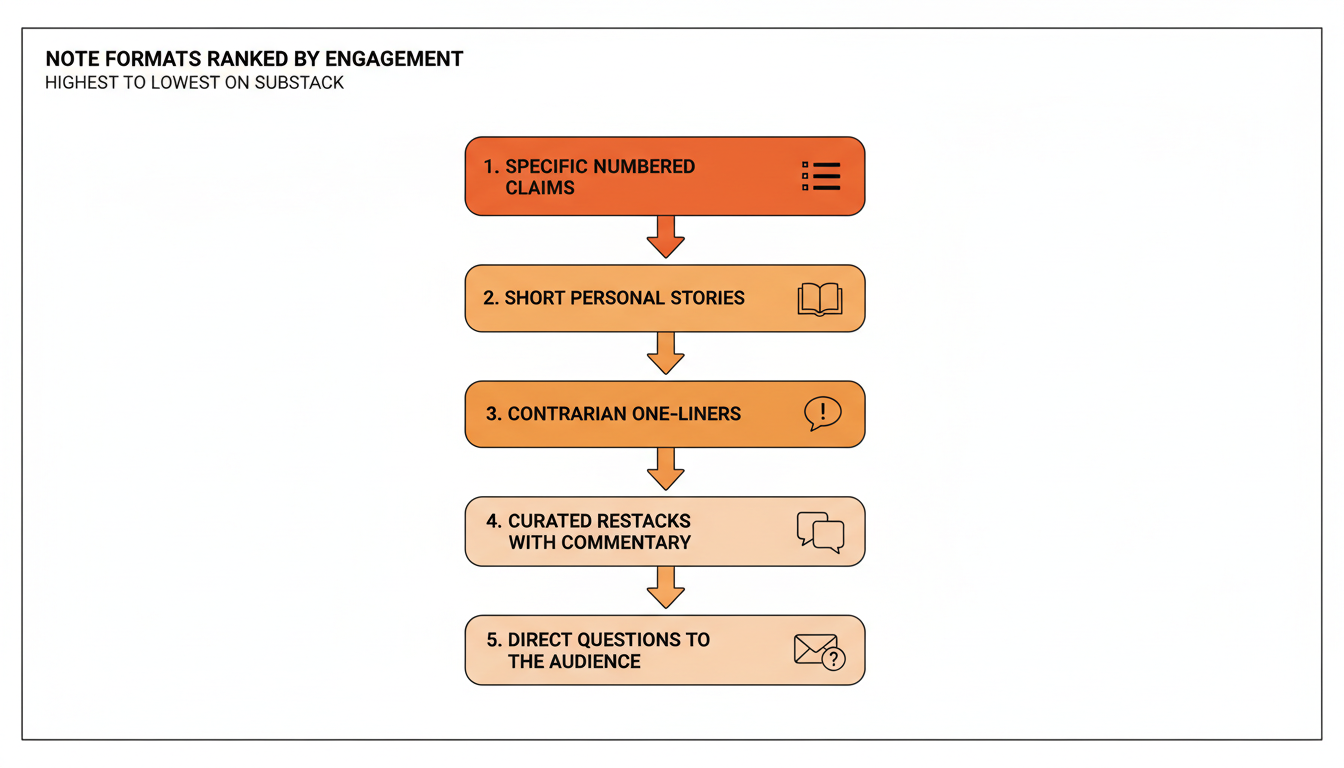
In roughly descending order of how often they get restacked:
- A specific, numbered claim. "I looked at 50 of my own posts and the ones under 800 words got half the reactions of longer ones" travels further than "shorter isn't always better." Specificity is what makes something worth restacking, because the person restacking it wants credit for sharing something concrete.
- A short personal story with a clear turn. One paragraph, one moment, one lesson. No setup required.
- A contrarian one-liner. Something that pushes against common advice in your niche, stated plainly, without hedging.
- A curated restack with your own commentary added. Restacking someone else's Note and adding even one sentence of your own perspective performs better than a bare restack, and it puts you in front of that writer's audience too.
- A direct question to your audience. These work, but only when they're specific ("what's the one Substack growth tactic you tried that flopped?") rather than generic ("thoughts?").
Looking at posting patterns across the wider Substack corpus, longer-form writing consistently pulls more engagement than short writing (posts over 800 words in a general substack-related sample averaged 53 reactions versus 32 for posts under 800 words, based on our own review of published Substack posts). The same specificity principle holds for Notes: detail beats brevity when the detail is doing real work.
Building Relationships Through Notes, Not Just Broadcasting
The writers who grow fastest on Notes aren't the ones posting the most, they're the ones replying the most. Notes is a feed people scroll, not a billboard people read. Treating it purely as a place to publish your own thoughts and never engaging with anyone else's is the fastest way to plateau.
Before you ever ask a bigger writer for a cross-promotion or a shoutout, show up in their comments and Notes replies for a few weeks with genuinely useful additions, not just "great post!" People remember names that show up consistently and add something real.
Practical rule: spend at least as much time replying to other people's Notes as you spend posting your own. A day where you leave five thoughtful replies and post zero original Notes is not a wasted day.
Restacking with commentary does double duty here. It puts your name and take in front of the original writer's followers, and it signals to the algorithm that you're an active, engaged account rather than a broadcast-only one.
Common Notes Mistakes That Quietly Kill Reach
A few patterns show up again and again in writers who feel like Notes "doesn't work" for them:
Posting only links. A Note that's just "New post is up, link in bio" gives a stranger nothing to react to. Pull the actual idea out and let the Note stand on its own; link the post in the first comment or reply instead if you want to drive clicks.
Disappearing after a good week. One viral Note followed by two weeks of silence resets whatever momentum you built. Consistency compounds; spikes don't.
Writing Notes like mini-essays. If a Note needs three paragraphs and a structure to make its point, it should probably be a post. Notes work best short, direct, and a little unfinished.
Never replying to your own comments. When someone responds to your Note, replying back (even briefly) keeps the thread alive in the feed longer and shows real people are behind the account.
Ignoring what already worked. If a Note about a specific topic or format got real engagement, revisit that angle again in two or three weeks with a fresh take instead of moving on and never returning to it.
Treating every Note as equally important. Not every Note needs to be a keeper. Some are meant to be small, forgettable, low-stakes reps that keep you visible between the ones that actually land. Writers who agonize over every single Note before posting tend to post far less often, and volume is a bigger lever here than any individual post's polish. Give yourself permission to post something mediocre on a Tuesday so you're still in the habit when Thursday's good idea shows up.
Copying someone else's voice instead of finding your own. It's tempting to study a writer who's growing fast and mimic their exact phrasing, structure, and topics. That can work short-term, but readers on Notes are unusually good at spotting a copy, and restacks tend to go to whoever said the specific version first. Use other writers' Notes to learn what formats work, not what words to borrow.
Measuring What's Working: A Weekly Notes Review
You don't need a dashboard full of metrics to know if your Notes strategy is working. Once a week, look at three things:
| Metric | What it tells you |
|---|---|
| Which Notes got the most restacks | What topics or formats are worth repeating |
| Which Notes got replies vs. silent likes | Whether you're sparking conversation or just being scrolled past |
| New subscribers in the days after your best Note | Whether Notes are actually converting strangers, not just entertaining existing followers |
If nothing from the week stands out, that's useful information too: it usually means the Notes were too safe, too vague, or too similar to everyone else's. The fix is almost always more specificity, not more polish.
A 30-Day Notes Plan to Build Momentum
If you're starting from zero, here's a plan that doesn't require new ideas every single day:
- Days 1-7: Post one repurposed Note daily from your existing archive. Reply to five other Notes per day in your niche.
- Days 8-14: Add a second daily Note, mixing in one original thought (not repurposed) every other day. Restack one Note per day with commentary added.
- Days 15-21: Review your best performers from the first two weeks and revisit those topics with a new angle. Push to three Notes per day.
- Days 22-30: Settle into whatever cadence felt sustainable, not exhausting, from the first three weeks. Publish at least one long-form post that pulls directly from the Notes that performed best, closing the loop between discovery and trust.
By day 30 you should have a rough sense of which formats work for your specific audience, which is worth more than any generic playbook, including this one.
Notes Is a Distribution Habit, Not a Personality Trait
None of this requires becoming a different kind of writer. It requires treating the thinking you're already doing in your long-form work as raw material instead of a finished, one-time product. The writers who win on Notes aren't naturally more extroverted or more online, they've just built a repeatable system for turning one piece of writing into a week of smaller ones.
That system is exactly what gets tedious to run by hand, and exactly where a tool built for this earns its keep. WriteStack pulls Notes drafts out of your published posts automatically, its Note Generator turns a single piece into a week's worth of scheduled Notes in your own voice, and its fan tracking dashboard shows you which readers are engaging most so you know exactly who to reply to first. If you're weighing WriteStack against other scheduling tools, the WriteStack vs Substackulous comparison breaks down where each one actually helps.
Start with one post you've already published. Pull five Notes out of it using the list above. Schedule them across the week. That's the whole strategy, repeated until it's a habit instead of a task.