

A writer we know posted the same short update to Substack Notes and Bluesky on the same morning. The Note pulled eleven restacks and two new subscribers by lunch. The Bluesky post pulled forty-three likes and zero subscribers, because Bluesky has no subscribe button to click. Same words, same photo, same ten seconds of effort, completely different outcome.
That gap is the whole story of Substack Notes vs. Bluesky, and it's worth understanding before you decide where to spend your posting time this month. One platform is built to convert attention into paying readers. The other is built to be a good public square. Neither is wrong to use. Picking the one that matches what you're actually trying to do, or running both without doubling your workload, is the part most writers get stuck on.
One number worth having before you start: WriteStack has close to 100 verified reviews from Substack writers across multiple platforms. The scheduling tools built specifically for Bluesky have none that we could find anywhere.
Table of Contents
- What Substack Notes and Bluesky Actually Are
- Audience and Reach: Who You Actually Find There
- Algorithm and Discovery: How Each Platform Decides What You See
- Content Style: What Actually Performs on Each Platform
- Monetization: Which Platform Actually Pays You
- Cross-Posting: Running Both Without Doing Double Work
- What We Found Scanning Real Substack Posts About Bluesky
- Which One Should You Actually Use
- Quick Answers: Substack Notes vs. Bluesky FAQ
What Substack Notes and Bluesky Actually Are
They get compared constantly because they both look like a short-post feed with a reply button. Underneath, they're built for different jobs.
How Notes Works Inside Substack
Notes lives inside Substack itself. Substack's own launch post for the feature describes it as a way for writers to "post short-form content and share ideas with each other and their readers," and it explicitly runs on the same subscription model as the newsletters themselves rather than on advertising. That single detail changes everything about how Notes behaves: restacks and replies exist to move a reader from "saw your Note" to "subscribed to your publication," because that's how the writer and Substack both get paid.
A Note can be text, an image, a quote, or a link, and every one of them can carry a subscribe prompt a click away. It's the only short-form format built by the same company that hosts your actual newsletter, so there's no account-linking or API bridge involved.
How Bluesky Works as a Standalone Network
Bluesky is a separate company and a separate app, structurally closer to the Twitter that existed before 2022 than to Substack. Posts are short, the feed is reverse-chronological by default with optional algorithmic feeds you can turn on, and there is no built-in mechanism to sell a subscription. If someone likes your Bluesky post, the furthest that relationship goes on-platform is a follow. Getting them onto your actual mailing list means sending them somewhere else, on purpose, in the post itself.
That's not a knock on Bluesky. It's a genuinely pleasant public square, and a growing number of writers who left Twitter have landed there. It's just a different tool than Notes, built by a company with no financial stake in whether you ever get paid for what you write.
Bluesky also runs on an open protocol (the AT Protocol), which means your account and your followers aren't locked to Bluesky's own servers the way a Substack Notes account is locked to Substack. In practice that mostly matters to people who care about platform ownership on principle. For a writer deciding where to spend an hour this week, the day-to-day experience of posting, replying, and getting reposted matters a lot more than the protocol underneath it.
Practical rule: if a platform has no subscribe button anywhere in the interaction, treat every post there as top-of-funnel, not as the funnel.
Deciding where to focus is easier once you can see the numbers side by side. WriteStack schedules Notes ahead of time and, through Buffer, pushes the same update out to Bluesky and ten other networks the moment it's due, so testing both costs you one extra minute per post instead of two accounts to babysit. Try WriteStack free.
Audience and Reach: Who You Actually Find There
Bluesky's Growth Numbers
Bluesky crossed 40.2 million registered users by November 2025, according to Backlinko's tracked statistics, which also puts daily active users at roughly 3.5 million, about 9% of the registered total. That 9% figure matters more than the headline number. A lot of those 40 million accounts were created during a migration wave and never opened again. The daily number is the one that tells you how many real eyeballs are actually scrolling on a given Tuesday.
Substack doesn't publish a comparable public feed-size number, because Notes isn't a single global feed the same way. What it has instead is smaller and more targeted: readers who already subscribe to newsletters in your niche, browsing a Notes feed built from people they already chose to follow for a reason.
Substack's Built-In Reader Intent
This is the part that gets missed in most side-by-side comparisons. A Bluesky user might follow you because your post was funny. A Substack reader who follows you through Notes has, at minimum, shown they're willing to read long-form writing and open an email, which is a much closer match to "will eventually pay for a subscription" than "liked a joke."
Reach and intent aren't the same thing, and a smaller audience with the right intent regularly outperforms a bigger one without it.
Algorithm and Discovery: How Each Platform Decides What You See
Bluesky's default timeline is chronological, and it stays that way unless you deliberately switch to one of the custom algorithmic feeds users have built (there are feeds for tech news, for specific hashtags, for regional communities, and dozens more). Discovery mostly happens through those custom feeds, through Starter Packs (ready-made follow lists other users build and share), and through what your existing follows repost into your timeline.
Getting added to a popular Starter Pack or a well-followed custom feed does more for your Bluesky reach in a week than months of solo posting, and there's no equivalent mechanism inside Notes. The tradeoff is that you don't control when or whether that happens, the same way you can't control whether a bigger newsletter decides to recommend you.
Notes discovery works differently. Restacks are the main growth lever: when someone restacks your Note, it shows up in their followers' feed with their endorsement attached, which is a much stronger signal than a Bluesky repost because the restacker's readers already trust their taste in writing. Substack also surfaces Notes based on engagement within the app's own recommendation layer, similar to how the main Discover page recommends publications.
Neither system rewards volume for its own sake. Both reward getting restacked or reposted by someone whose audience overlaps with the people you actually want reading your newsletter.
Content Style: What Actually Performs on Each Platform
The two platforms reward slightly different things, and writing the exact same post for both usually means it does fine on one and flat on the other.
| Substack Notes | Bluesky | |
|---|---|---|
| Best format | Short takes, quotes from your own posts, behind-the-scenes process | Conversational takes, threads, links with commentary |
| Length that performs | Multi-line posts, 150-300 characters, tend to outperform one-liners | Shorter, punchier single posts; longer threads when a topic needs more room |
| Posting frequency norm | Once or twice a day keeps you visible without fatiguing followers | Multiple short posts a day is normal Bluesky culture, closer to old Twitter |
| Native monetization | Yes, built-in subscribe flow | None; links out required |
| Discovery mechanism | Restacks + in-app recommendations | Custom feeds, Starter Packs, reposts |
| Ideal use | Converting readers into subscribers | Building public reach and community |
| Scheduling support | Native Substack scheduling for posts; third-party tools for Notes | Native scheduling in the Bluesky app is limited; third-party tools required |
Practical rule: write for the subscribe click on Notes and for the reply/repost on Bluesky. Optimizing a single post for both usually optimizes it for neither.
📅 Struggling to stay consistent on Substack?
WriteStack's Smart Scheduling lets you batch and queue Notes in minutes. Grow on Substack without burning out.
Explore Smart SchedulingNotes carries a small home-field advantage worth naming directly: multi-line Notes averaged roughly 11% more reactions and 28% more restacks than single-line Notes across a sample of 20,000 recent Notes we pulled for a different piece of research, and Notes between 150 and 300 characters outperformed anything under 50 characters by close to a third on reactions, more on restacks. That pattern doesn't automatically transfer to Bluesky's shorter, punchier culture, so treat it as a Notes-specific rule, not a universal one.
Monetization: Which Platform Actually Pays You
This is the least ambiguous section in the whole comparison. Substack Notes exists inside a platform whose entire business model is paid subscriptions, and every Note carries a path back to your publication and its subscribe button. Bluesky has no subscription product of its own for writers. Whatever income you generate from a Bluesky post comes from someone clicking a link in your bio or in the post itself and going somewhere that can actually take their money or their email address.
Neither approach is wrong, but only one of them was built to get you paid without an extra click. If your goal this quarter is subscriber growth or revenue, Notes should be doing more of the daily work, and Bluesky should be a source of new people who then get pointed at your Substack.
The part people don't expect: you can see which specific link inside which specific Note actually converted, going back through your entire posting history, not just the last week. Most writers find out that one throwaway line from three months ago is quietly still bringing in subscribers, and they never would have known to repeat it without looking.
Cross-Posting: Running Both Without Doing Double Work
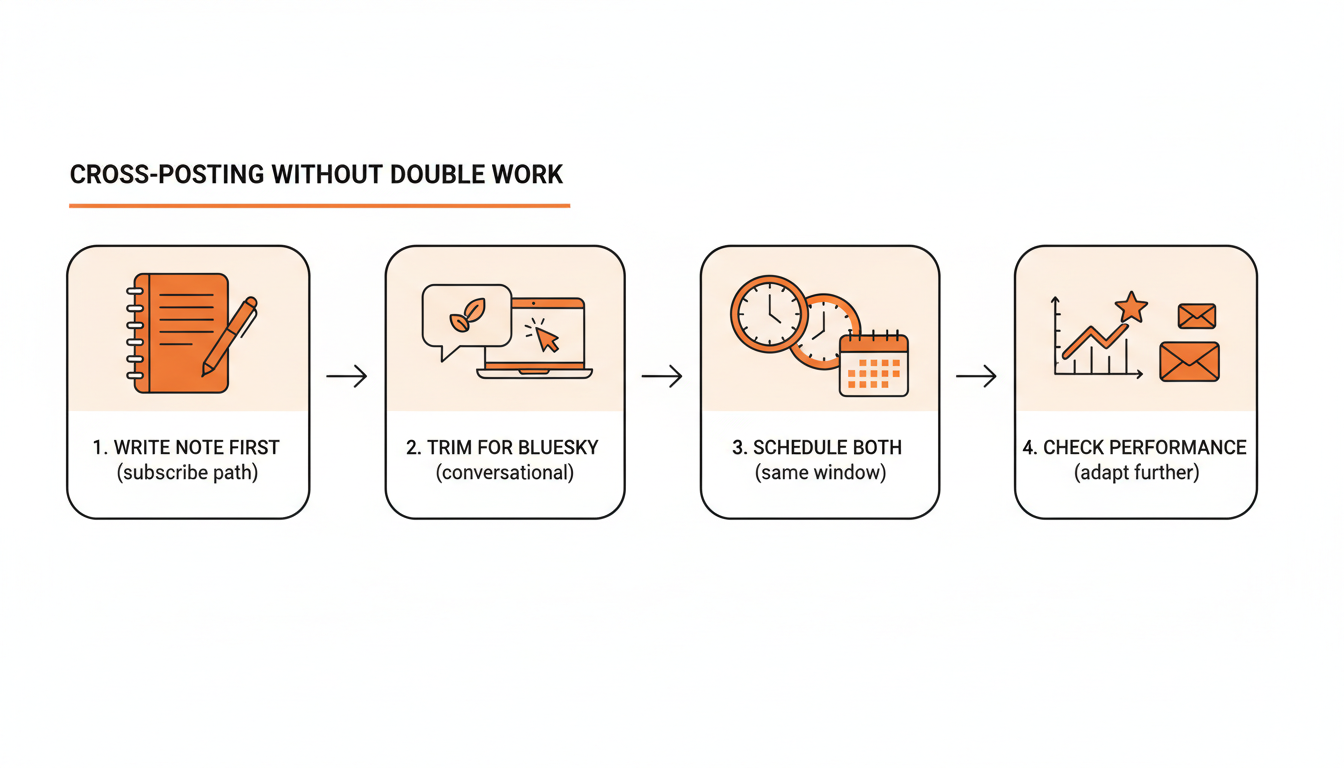
Running both platforms well doesn't have to mean writing everything twice. The workflow that actually holds up looks like this:
- Write the Note first, since it carries the subscribe path and matters more for revenue.
- Trim it for Bluesky's shorter, more conversational tone rather than posting it verbatim.
- Schedule both for the same window instead of posting live, so you're not opening two apps every time you have something to say.
- Check which platform the post actually performed on before deciding whether it was worth adapting further.
This is where scheduling tools earn their keep. Buffer added native Bluesky scheduling to its platform list, and WriteStack uses that same Buffer connection to push a scheduled Note out to Bluesky and ten other networks at the same time, without you re-typing or re-opening anything. Substack's own native scheduling covers full posts well; Notes and cross-posting are where a third-party layer like WriteStack's Notes generator actually saves the time, because it drafts from what you've already published instead of starting from a blank box.
Load a week of Notes into WriteStack on a Monday, mark which ones should also go to Bluesky, and let the schedule run. You get to the following Monday having posted every day without opening either app in between.
What We Found Scanning Real Substack Posts About Bluesky
We scanned a dataset of roughly 3.5 million Substack posts for direct mentions of "Bluesky" and, separately, "Threads," Meta's competing short-form app that launched around the same time Bluesky opened up publicly. Bluesky came up in 304 posts. Threads came up in 1,479, close to five times as often.
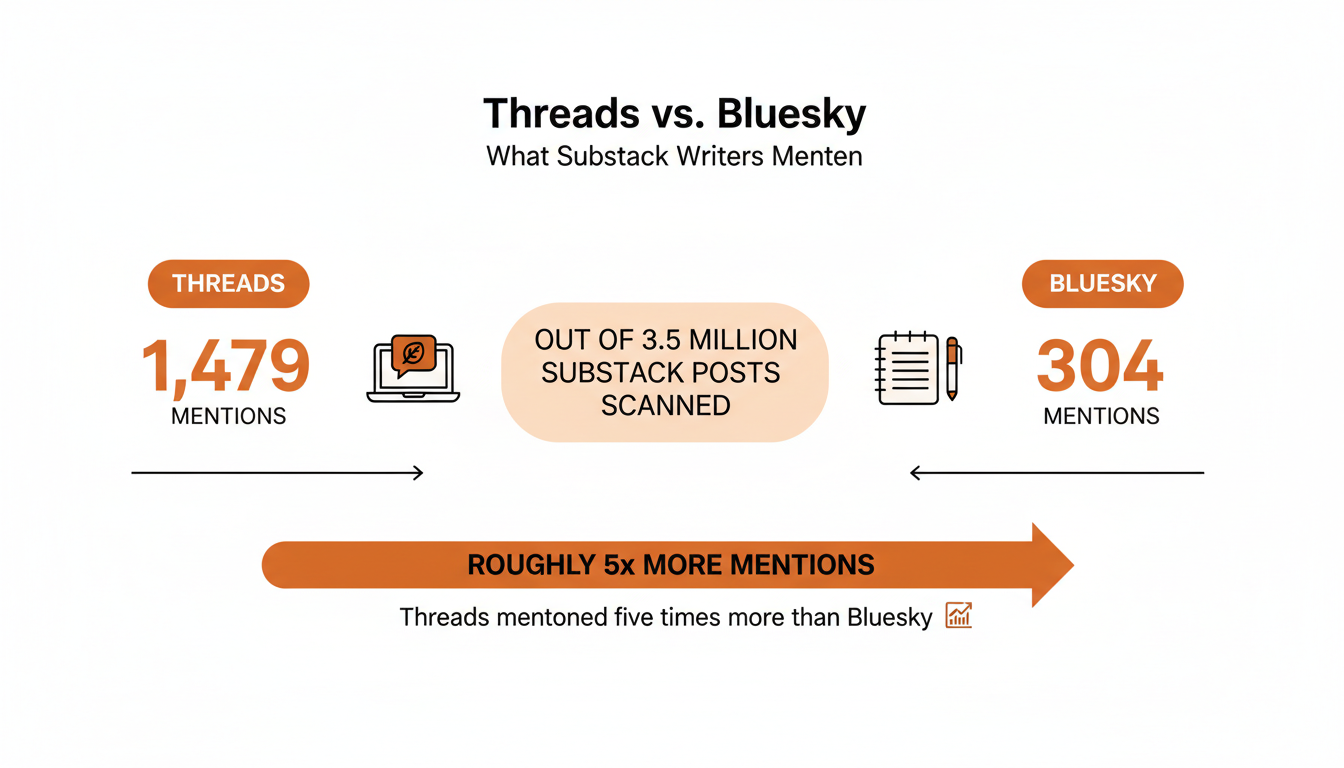
That's a mention count, not a usage count, so it doesn't prove Substack writers are on Threads five times more than Bluesky day to day. What it does suggest is that Bluesky, despite the bigger headline user numbers, still hasn't become the default second platform that Substack writers write about, compare notes on, or recommend to each other nearly as often as Threads has. If you're deciding where to spend a limited amount of cross-posting effort, that gap is worth knowing about before you assume Bluesky is the obvious second home for your Substack audience.
Which One Should You Actually Use
Use Notes as the platform you post to every single day, because it's the one directly wired to your subscriber count and your revenue. Use Bluesky as a secondary channel for reaching people who haven't found your Substack yet, especially if your audience skews toward the specific communities (tech, politics, media criticism, academia) where Bluesky's culture is strongest right now.
For most Substack writers, that means Notes gets the majority of your posting energy and Bluesky gets the leftover five minutes, not the other way around. Writers who try to run Bluesky as their primary channel and treat Notes as an afterthought are optimizing for a platform that structurally can't convert that attention into anything durable.
The split looks different depending on what you write. A politics or media-criticism newsletter benefits more from Bluesky's culture and current audience skew than a fiction or personal-essay newsletter does, so it's worth weighting Bluesky slightly heavier if that's your beat. A cooking, parenting, or personal-finance newsletter will generally get more return from doubling down on Notes and Substack's own Discover page, since that audience hasn't concentrated on Bluesky the way tech and politics writers have. Test both for a month, look at which one actually drove subscriptions rather than likes, and adjust from there instead of guessing upfront.
WriteStack schedules Notes and cross-posts the ones worth reaching wider to Bluesky and ten other platforms through one Buffer connection, so following this advice doesn't mean managing two separate calendars. Start scheduling for free.
Quick Answers: Substack Notes vs. Bluesky FAQ
Can I cross-post from Substack Notes to Bluesky automatically?
Yes, through a third-party scheduler connected to Buffer's Bluesky integration. Substack doesn't offer a native one-click cross-post between the two, so the connection runs through a tool like WriteStack rather than a built-in setting.
Is Bluesky replacing Twitter for writers?
For a meaningful slice of writers who left Twitter/X after 2022, yes, Bluesky is where they landed. It hasn't replaced Twitter's overall scale, and our scan above suggests it also hasn't become the dominant second platform among Substack writers specifically, at least not yet.
Do I need to pick one platform?
No. The two solve different problems (subscriber conversion versus public reach) well enough that most writers are better off running both, with Notes doing the daily heavy lifting and Bluesky picking up the overflow.
How often should I post on Bluesky compared to Notes?
There's no fixed ratio, but a reasonable starting point is one Note for every one to two Bluesky posts, since Bluesky's posting culture runs faster and more conversational than Notes. Watch your own numbers for a few weeks using WriteStack's posting-time heatmap to see when your specific audience is actually online, and adjust the ratio toward whichever platform is actually converting into subscribers or meaningful replies, not just whichever one has the higher view count.
Notes and Bluesky aren't really competing for the same job. One turns attention into subscribers, the other builds the kind of public presence that feeds people into the first one. Post to both, but know which one is actually paying your bills, and schedule the whole thing so it stops eating your morning. Set up your first scheduled week with WriteStack.