
I spent a weekend building a spreadsheet to settle this. Fee columns, subscriber-count columns, a tab projecting ad revenue at three list sizes. Then I noticed the spreadsheet had no column for the only thing that had actually moved my numbers, which was where new readers came from before they ever saw a payment page.
Substack vs Beehiiv has a winner, and it is Substack: Substack ships a discovery layer, Notes, restacks, and cross-publication recommendations, that puts your writing in front of readers who have never heard of you, and Beehiiv has nothing structurally equivalent to it. Every other line in the comparison, the 10% cut, the website builder, the ad network, is a rounding error next to a system that brings you readers you did not have to buy or beg for.
We built WriteStack, a scheduling and analytics tool for Substack writers. We also linked every claim about both platforms to that platform's own live page, so you can check all of it yourself. WriteStack is not a Beehiiv alternative and this article will not pretend otherwise. It is the thing that turns Substack's discovery layer from a lottery ticket into a repeatable system, which is exactly the part of the winning argument most writers never actually run.
One number worth having before you start: WriteStack has close to 100 verified reviews from Substack writers across multiple platforms. The other tools built for this specific job, keeping a Substack publication posting and measuring what happened afterward, have none that we could find anywhere.
Table of Contents
- The Real Difference Between Substack and Beehiiv
- Audience Discovery: Where the Comparison Is Decided
- Pricing and Fees: What You Actually Pay
- Monetization Options Compared
- Design, Customization, and Branding
- Analytics and Growth Tools
- Email Deliverability and Sending Limits
- Migration: Switching Between Substack and Beehiiv
- The Verdict, and What to Do With It
The Real Difference Between Substack and Beehiiv
Substack was built as a publishing network first and a business tool second. Every post you write can surface in the Substack app, in Notes, and in other writers' recommendation panels. That network is the whole pitch: write well, get restacked, gain subscribers without spending on ads.
Beehiiv was built by former Morning Brew engineers as an email-first growth platform. There is no public social feed comparable to Notes. Beehiiv gives you a website builder, an ad network you can opt into, referral tools, and segmentation that lets you send different content to different groups on one list. It is aimed at people who already have an audience and want to run a lean media operation around it.
That difference decides the comparison, because the two products are solving problems of very different sizes. Beehiiv solves problems you have after readers arrive. Substack solves the problem of readers arriving at all. A writer with 40,000 subscribers imported from YouTube has the first problem. Almost everyone else has the second one, and the second one is the one that ends publications.
The engineering effort on each side tells you the same story without either company having to say it. Substack keeps shipping the social layer: Notes, live video, chat threads, a recommendations engine tuned constantly. Beehiiv keeps shipping the business layer: polls, an ad marketplace, subscriber segmentation. Neither company is hiding what kind of writer it is building for.
| Substack | Beehiiv | |
|---|---|---|
| In-platform discovery feed | Yes, Notes | No equivalent |
| Restacks that push your post into another writer's feed | Yes | No |
| Cross-publication recommendations at subscribe time | Yes | No |
| New readers who arrive without you paying or asking | Built in | Referral or paid only |
| Native reader app with a browsing feed | Yes | No |
| Chat threads and community posts | Yes | No |
| Subscribe friction for a reader with an existing account | One tap | Email form |
| Growth from a cold start with no outside audience | Workable | Very hard |
| Third-party tooling built specifically for the platform | Deep, including WriteStack | Thin |
| Time from signup to first published post | Minutes | Longer, site setup first |
| Website builder and full branding control | Limited | Yes |
| Subscriber segmentation | Basic | Yes |
| Built-in ad network | None | Yes |
| Referral program tooling | Basic | Yes |
| Verified reviews for the tooling layer around it | ~100 for WriteStack | None found |
| Free tier | Free forever, any list size | Free to 2,500 subscribers |
| Platform cut of subscription revenue | 10% | 0% |
| Monthly software cost at 10,000 subscribers | $0 | Roughly $99 and up |
Read that table top to bottom rather than by column totals. The rows Substack wins are the ones that determine how many people ever read you. The rows Beehiiv wins are the ones that determine how a publication that already has readers gets packaged.
If Substack is where you are staying, the next decision is how you actually work the discovery layer instead of hoping it works you. Start a free 7-day trial of WriteStack and load a week of Notes in one sitting.
Audience Discovery: Where the Comparison Is Decided
This is the part most fee comparisons skip, and it is the one that settles the argument.
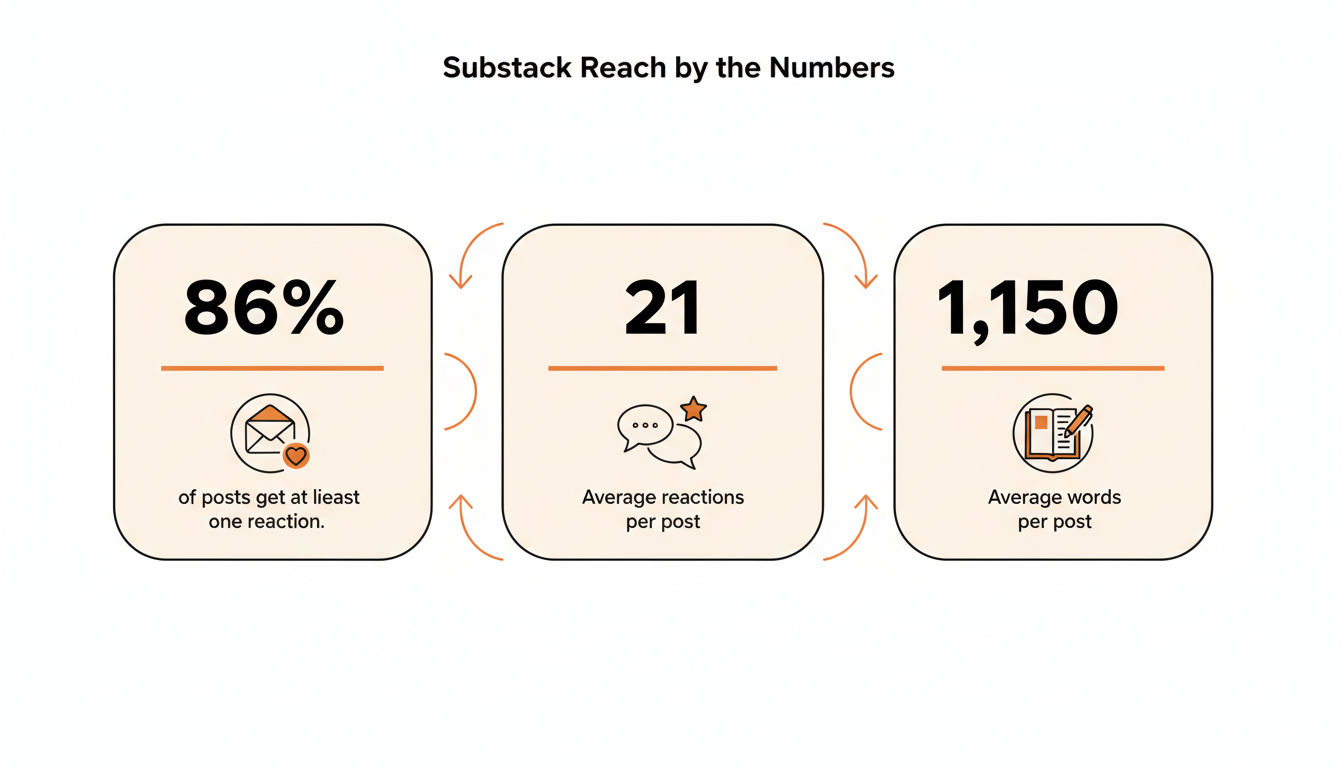
We pulled a sample of just under 31,000 posts from our own Substack dataset to measure how much built-in reach the network actually provides. Roughly 86% of those posts picked up at least one reaction, with an average of about 21 reactions per post, at a typical length of around 1,150 words. That is not a viral outlier number. It is the baseline for an active publication that posts regularly and shows up in Notes. Beehiiv has no internal feed generating that kind of ambient reach, so nearly all of its distribution runs through your own list, your readers' referrals, or paid promotion.
Substack Notes and Recommendations
Notes works like a short-form feed layered on top of the newsletter. Writers post short takes, other writers restack them into their own feeds, and readers find new publications without leaving the app. Recommendations run the same way in the background: a reader subscribes to one newsletter, and Substack surfaces others in the same space. Neither costs anything, and both keep working even for a writer who never posts a Note, though posting consistently changes the numbers dramatically.
The catch worth naming is that this layer rewards frequency, and frequency is where most writers lose. A publication that posts Notes four times a week feeds the feed. A publication that posts in bursts every eleven days does not, and the recommendation engine has nothing recent to work with. This is the exact gap WriteStack was built for: you write several Notes when the ideas show up, assign each one a time, and the queue keeps feeding the discovery layer through the weeks when you are busy, sick, or traveling. Our own dataset of 20,000 recent Notes says the shape of what you queue matters too. Multi-line Notes averaged about 11% more reactions and 28% more restacks than single-line Notes, and Notes of 150 to 300 characters beat Notes under 50 characters by roughly a third on reactions.
Beehiiv's Referral Program
Beehiiv's growth tooling centers on referrals. Readers get rewards, early access, swag, or a paid-tier discount, for bringing in new subscribers, all tracked in a built-in referral dashboard. The tracking is real and it is more developed than Substack's own referral feature. The structural limit is that it only reaches people your existing readers already know, and only when those readers feel like sharing. Notes reaches people who have never heard of you and requires nothing from your list at all. A referral program multiplies an audience. A discovery feed creates one.
Pricing and Fees: What You Actually Pay
Here is the actual math for a writer charging $10/month for a paid tier.
Substack's 10% Cut, Explained
Substack charges nothing to publish, at zero subscribers or a hundred thousand. The moment you turn on paid subscriptions, Substack takes 10% of that revenue off the top, on top of standard Stripe processing costs, as confirmed on Substack's own support page. That 10% does not go away once you are established. It applies to your first paid subscriber and your ten-thousandth.
For a writer earning $10/month per paid subscriber, the combined cut from Substack plus Stripe lands somewhere around 13 to 16% of gross revenue, depending on the monthly-versus-annual split of your subscribers.
That is a real cost and worth naming plainly. It is also a cost that only exists once money is coming in, which is the opposite of a flat monthly bill that starts before it.
Beehiiv's Flat-Fee Model
Beehiiv flips the model. The Launch plan is free up to 2,500 subscribers, with unlimited sends and no revenue cut. Past that, plans scale by subscriber count rather than revenue, starting around $49/month and climbing with the list, per Beehiiv's pricing page. A newsletter earning $2,000/month from a 3,000-person list keeps more money on Beehiiv. A newsletter earning $200/month from that same list pays Beehiiv more than it pays Substack, and pays it every month regardless of what happens to revenue.
Practical rule: run the math on your own numbers, then run it again on the numbers you expect twelve months from now. The percentage model costs more at high revenue per subscriber. The flat model costs more at every stage before that, which is where most publications spend most of their life.
Monetization Options Compared
Paid subscriptions work the same way mechanically on both platforms. Readers pick a monthly or annual price, Stripe handles billing, and you get a dashboard of active subscribers. The differences are in what you can layer on top.
Paid Subscriptions on Substack
Substack keeps this narrow on purpose. You set a monthly or annual price, add a free trial if you want one, and add a founding-member tier for readers who want to pay more. Gifted subscriptions and group subscriptions for teams both work without setup. There is no built-in advertising marketplace and no poll monetization layer. What you get instead is a payment flow a reader already recognizes, attached to an account they may already have, which converts better than a form on a site they have never seen.
📅 Struggling to stay consistent on Substack?
WriteStack's Smart Scheduling lets you batch and queue Notes in minutes. Grow on Substack without burning out.
Explore Smart SchedulingBeehiiv's Ad Network and Boosts
Beehiiv adds two revenue paths Substack has no native answer for, and both are genuinely useful. The internal ad network matches advertisers to newsletters by niche and audience size. The Boosts marketplace lets other newsletters pay to reach your list through cross-promotion. Together they give a way to earn from a free list before anyone converts to paid, which Substack simply does not do.
The honest limit is scale. Ad networks need a few thousand engaged, opening subscribers before payouts become meaningful, and matching works best in categories advertisers already spend in, finance, tech, and business, more than in personal essay or fiction. Beehiiv's segmentation is the same story: a real capability that pays off once a list is big enough to have segments worth splitting.
Both of those are problems worth having, and both arrive after the discovery problem is solved. Substack solves the discovery problem, and the tooling around Substack solves the consistency problem underneath it.
Design, Customization, and Branding
Substack's design options are deliberately narrow. You pick a header image, an accent color, and a font pairing, and that is close to the ceiling. Every Substack publication loads fast and looks clean with no setup work.
Beehiiv gives you a website builder: custom pages, embeddable forms, a navigation menu, and enough CSS control to make a newsletter look like a standalone media brand. You can build a landing page separate from the newsletter, add a custom domain on paid plans, and remove Beehiiv branding on the Max tier.
That flexibility takes real time to use well. The cost is not the learning curve, it is the substitution: hours spent on a header are hours not spent on the posts and Notes that bring readers in. Substack's limits remove that option, and for most writers removing it is the feature.
Consistency is the thing worth protecting with those hours instead. WriteStack's queue and calendar view show a full week of scheduled Notes at once, and its engagement heatmap shows when your readers are actually online, which is the input that changes what a scheduled Note does. Start your free trial and watch a week of Notes go out without you.
Analytics and Growth Tools
Substack's native dashboard covers open rates, subscriber growth over time, and top posts by views. It does not break down send-time performance and gives little detail on where a given subscriber came from. Beehiiv's built-in analytics go further, with UTM-tracked source data and cohort-style growth charts. That is a fair point for Beehiiv on the raw dashboard, and it is also the gap third-party tools close on the Substack side, which is why the tooling row in the table above matters more than it looks.
The part people don't expect
WriteStack schedules Substack chat posts, which no other tool in this category does at all. It tracks which of the two links inside a Note got clicked, going back to your very first Note, so "that one did well" becomes "that one sent 40 people to the archive." And it benchmarks your restack rate against other publications your size, then shows the direction it is moving month over month. Open the dashboard on a Tuesday and see that the Note you almost did not post drove 40 link clicks, and that your restack rate is running well above typical for a publication your size. Not better than last week. Better than the field.
That benchmark line is the one no per-account dashboard can produce, on either platform. Substack can tell you your open rate. Beehiiv can tell you your open rate with better charts. Neither can tell you whether the number is good, because neither has the other publications to compare you against. WriteStack's trend analysis answers the direction question and the benchmark answers the "is this good" question, and those two together are what actually change what you post next week.
The drafting side works the same way. Most AI writing tools generate from a prompt, which means three rounds of editing before it sounds like you. WriteStack's Notes generator drafts from Notes and posts you have already published, so the output starts in your voice. If a draft misses, you switch models rather than living with one fixed voice.
Email Deliverability and Sending Limits
Both platforms send through shared infrastructure rather than a private mail server, so deliverability depends more on list hygiene and engagement than on which company owns the servers. Substack has generally reported strong inbox placement, helped by automatically pruning inactive addresses and discouraging list buying. Beehiiv has its own deliverability tooling, including a per-send deliverability score and warnings when spam-trap risk rises.
Neither platform publishes a hard daily send cap for standard use, and both will flag or throttle an account that spikes suddenly in list size or complaint rate. That matters most during a migration that brings in a large imported list at once.
Practical rule: after any migration or big list import, send to your most engaged segment first for a week. It protects your sender reputation on either platform's shared infrastructure.
Migration: Switching Between Substack and Beehiiv
Moving a newsletter between platforms is more mechanical than most writers expect, and the mechanical part is not what costs you.
Exporting Your Subscriber List
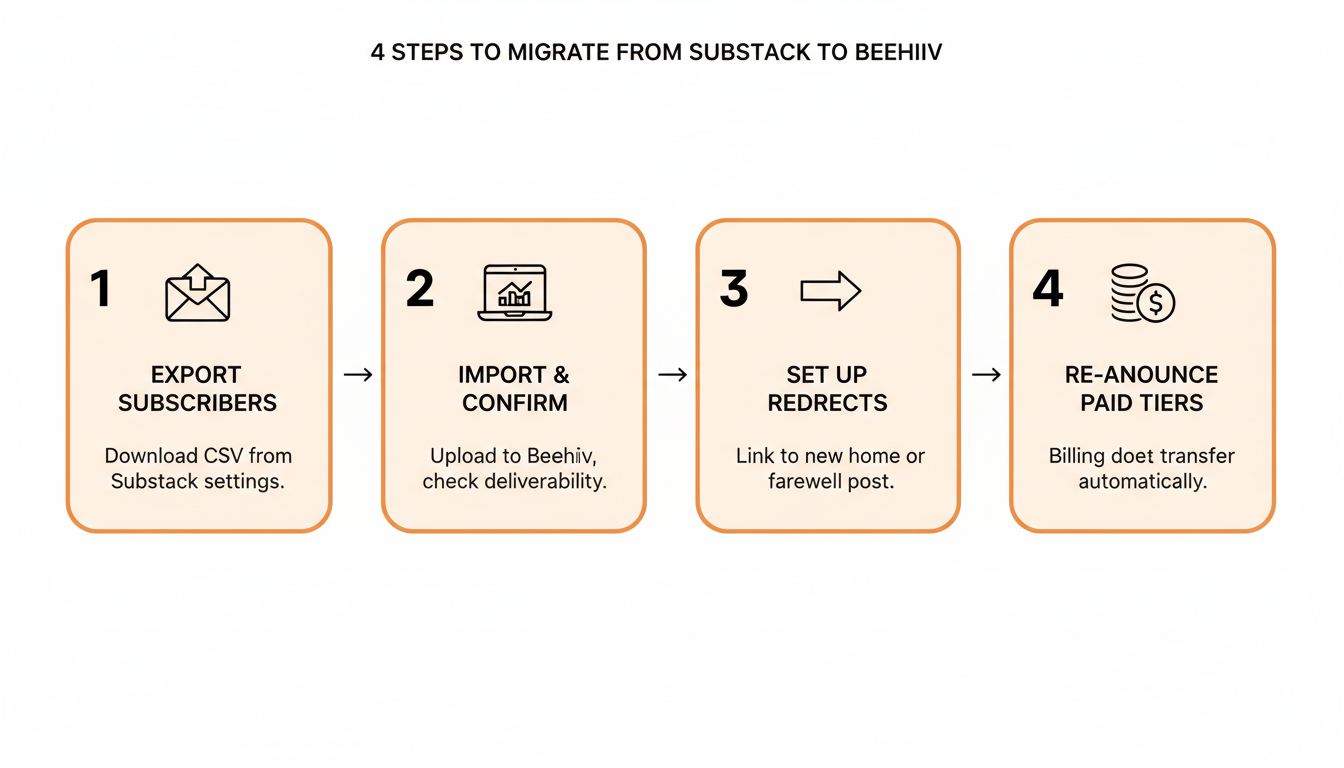
Both platforms let you export a CSV of subscriber emails from account settings, and both let you import one to start a list elsewhere. That takes an afternoon, not a week. What does not transfer is active billing. Paid subscribers on Substack do not carry over as paid subscribers on Beehiiv. You re-invite them to a new payment setup, and a percentage drops off in that gap no matter how carefully the announcement is worded.
What You Lose in the Move
The subscriber list moves. The discovery engine does not. Every reader who found the publication through Notes, restacks, recommendations, or the Substack app stops being reachable that way the moment the newsletter leaves. Your archive stops accumulating new readers. The recommendation panels you appeared in go quiet.
For a writer whose growth came from that network, migrating to Beehiiv restarts the discovery side from an owned list of one, with no in-platform way to reach anyone new until referrals or paid ads pick up the slack. That is the line item the fee spreadsheet never has a column for, and it is almost always larger than the 10%.
The Verdict, and What to Do With It
Substack wins this comparison. The reason is checkable and it is one thing: Substack has a discovery layer that brings readers to you from inside the platform, and Beehiiv has no equivalent to it. Notes, restacks, and recommendations are the difference between a publication that grows while you sleep and a publication that grows exactly as fast as you can promote it somewhere else. The 10% cut is the price of that layer, and it is the cheapest customer acquisition in the category by a wide margin.
Beehiiv's ad network, referral tooling, and segmentation are real, and a media business with an existing audience will use all three. They are the answer to a question you get to ask after the discovery problem is solved. Substack solves the discovery problem.
What Substack does not do is make you consistent, and consistency is the whole input to that discovery layer. The feed rewards writers who show up several times a week and quietly forgets the ones who disappear for eleven days. That is the gap WriteStack fills for Substack writers specifically: batch-write Notes when the ideas arrive, queue a week in one sitting, schedule chat posts that no other tool schedules at all, then read back link-click history and benchmarks against publications your size to see what actually worked.
Six weeks into running a queue, the change is not that you post more. It is that you stopped deciding. The Tuesday Note is written, scheduled, and already gone before you sit down, and the discovery layer that made Substack the right answer keeps getting fed on the weeks when you have nothing left. Close to 100 verified reviews from Substack writers say the same thing, and no other tool in this category has any we could find.
Start a free 7-day trial of WriteStack. Load a week of Notes in twenty minutes. Let Substack's network do the rest.