
A novelist finishes a manuscript, gets three form rejections from agents, and instead of shelving it, posts chapter one on a Substack she set up that morning. Six months later she has 4,000 free subscribers and 80 paying ones reading a book no publisher has touched. That story is not rare anymore. It is close to the default path for authors who decide Substack for authors is worth trying before, instead of, or alongside a traditional deal.
This guide covers what actually works: setting up a newsletter that reads like a person and not a press release, serializing a novel or memoir without losing your paywall balance, growing an audience without a publicist, and staying consistent long enough for any of it to compound.
One number worth having before you start: WriteStack has close to 100 verified reviews from Substack writers across multiple platforms. The handful of other Substack scheduling tools in this category have none we could find anywhere.
Table of Contents
- Why Authors Are Moving to Substack
- Is Substack Right for Your Book
- Fiction vs. Nonfiction
- New Work vs. Your Backlist
- Setting Up an Author Newsletter That Doesn't Read Like a Press Release
- Your About Page Is Your Query Letter Now
- Your Welcome Sequence
- Serializing a Novel or Memoir on Substack
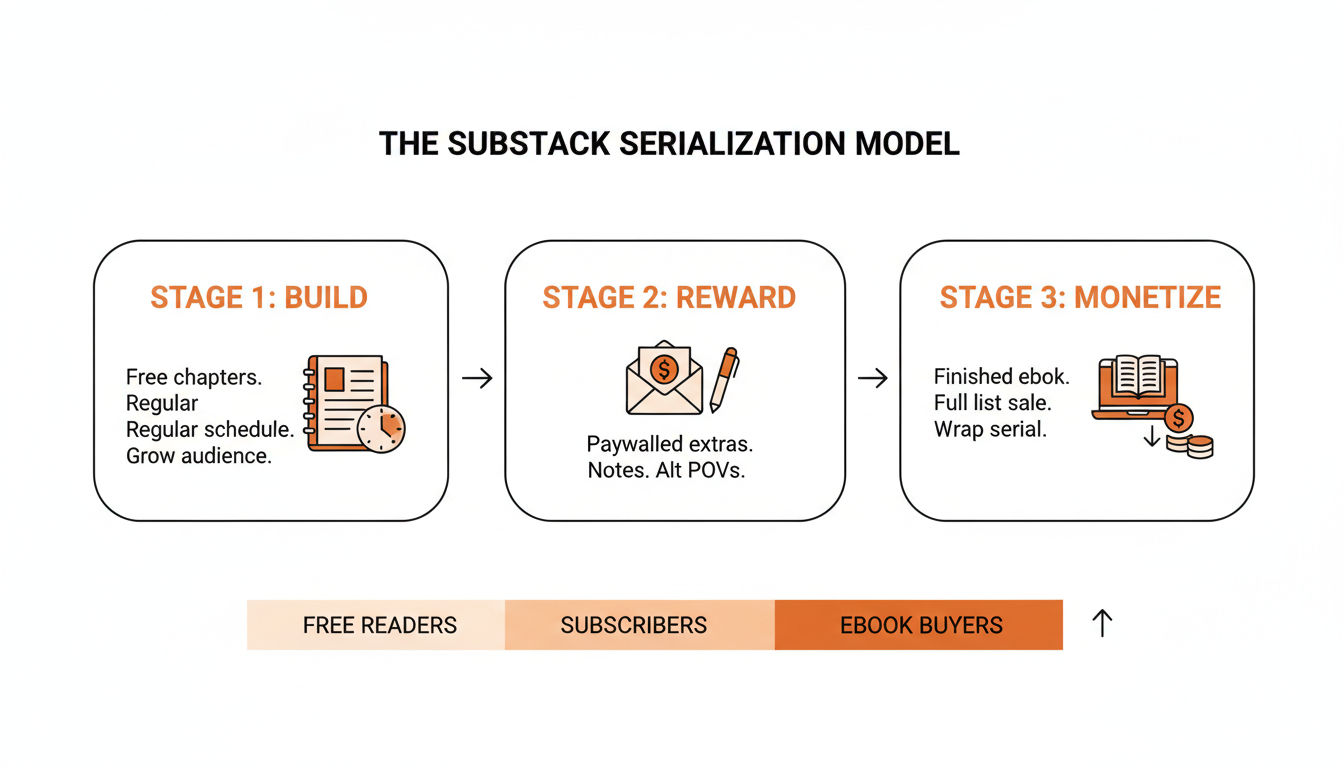
- The Free vs. Paywalled Split
- Picking a Chapter Schedule
- Growing Your Author Audience Without a Marketing Team
- Notes, Not Just Posts
- Cross-Promoting With Other Authors
- Monetizing Your Writing Beyond a Subscription Price
- Staying Consistent Without Burning Out
- Mistakes Authors Make on Substack
Why Authors Are Moving to Substack
Substack was built for essayists and journalists first. Authors came later, and mostly on their own, because the platform happened to solve two problems at once: a built-in way to reach readers directly, and a built-in way to get paid by them without a publisher in the middle.
The serialized novel, a format that mostly died with pulp magazines, has come back because Substack made it structurally easy again: publish a chapter, readers get it in their inbox, comment, and wait for the next one. S.J. Watson, the bestselling author of Before I Go to Sleep, is serializing a new novel on Substack, and he's far from the only established author doing it. Most successful fiction serializers land on a hybrid model: the core story stays free to build an audience, while process notes, alternate points of view, and early chapters sit behind a paywall for paying readers, a structure Substack writer Megan Beth Davies breaks down in detail.
Practical rule: if you're weighing Substack against a traditional deal, they are not mutually exclusive. A newsletter with a real, engaged list is one of the strongest things you can put in a query letter, and several authors have used exactly that to get one.
For nonfiction authors the appeal is more direct: build the list before the book exists, so the launch isn't starting from zero. For memoirists, Substack works as both a place to test material in public and a way to build the readership a memoir needs to actually sell.
Is Substack Right for Your Book
Not every project fits the format, and starting one that doesn't is the fastest way to burn out before the first ten chapters.
Fiction vs. Nonfiction
Fiction serialization asks readers for a weekly (or twice-weekly) commitment to a story that isn't finished yet. That works when the writer can hold a schedule and readers can tolerate cliffhangers. It struggles for slow, literary work that depends on being read start to finish in one sitting, or for a book with a twist that a serialized release would spoil months early.
Nonfiction fits differently: essays, how-to content, and personal narrative all work as standalone posts that don't need serialization at all. A nonfiction author can publish research, arguments, and stories from the book as they're written, using the newsletter as both a testing ground and an audience-building tool well before a manuscript is done.
New Work vs. Your Backlist
Substack isn't only for unpublished material. Authors with a backlist use it to sell older books directly: serializing an out-of-print title chapter by chapter, running a paid tier that includes the full ebook, or publishing deleted scenes and behind-the-scenes notes tied to a book that already exists. This is often the lowest-risk way to start, since the writing is already done and the only new work is the newsletter itself.
Setting Up an Author Newsletter That Doesn't Read Like a Press Release
The newsletters that grow are the ones that read like a person talking directly to a reader, not a marketing department describing a book. That starts with two pages readers actually look at before subscribing.
Your About Page Is Your Query Letter Now
A visitor who lands on an author Substack for the first time reads the about page the way an agent reads a query: fast, and looking for a reason to keep going. State what the newsletter is about in the first two sentences, not the fifth paragraph. Name the project (a novel in progress, a memoir, a backlist you're re-releasing) and what a subscriber gets that they can't get anywhere else. WriteStack's guide to writing a Substack about page covers the structure in more depth.
Your Welcome Sequence
The welcome email is the only message guaranteed to be read, since it lands right after someone decides to trust you with their inbox. For an author newsletter, that's the place to say exactly what to expect and when: a chapter every Thursday, an essay every other week, whatever the actual schedule is. Vague promises ("more to come soon") lose subscribers faster than a clearly stated schedule that's slightly less frequent. WriteStack's welcome email breakdown has examples worth borrowing from.
Serializing a Novel or Memoir on Substack
This is the format most unique to Substack, and the one most authors get wrong on the first attempt, usually by giving away too much or locking up too much.
Looking across a large sample of Substack posts, over 14,000 posts across more than 2,100 different publications carry the word "Chapter" in the title, meaning serialized fiction and memoir are already a real, established pattern on the platform, not an edge case a handful of writers stumbled into.
The Free vs. Paywalled Split
| Free (builds the audience) | Paywalled (rewards paying readers) |
|---|---|
| The core chapters of the serial | Author's notes on craft or plot decisions |
| The first 2-3 chapters, always | Alternate point-of-view chapters |
| A regular publishing schedule | Early access, one week ahead of free readers |
| Comments and discussion threads | Deleted scenes and unused drafts |
| A clear end date or arc summary | A downloadable ebook once the serial wraps |
Practical rule: never paywall chapter one. The entire point of the free tier is to let a stranger become invested before you ask for money. Paywalling the hook kills the function it's supposed to serve.
📅 Struggling to stay consistent on Substack?
WriteStack's Smart Scheduling lets you batch and queue Notes in minutes. Grow on Substack without burning out.
Explore Smart SchedulingPicking a Chapter Schedule
Weekly is the most common schedule for a reason: it's frequent enough to keep a story alive in a reader's memory, and infrequent enough that most authors can sustain it alongside a day job or a full manuscript in progress. Twice-weekly works for shorter chapters and faster-paced genre fiction. Daily rarely survives past the first month unless the chapters are very short.
Whatever the schedule, the actual risk isn't picking the wrong one. It's picking a fine one and then missing it three times in six weeks, which quietly teaches readers not to expect the next chapter on time.
Growing Your Author Audience Without a Marketing Team
Most authors don't have a publicist chasing subscribers for them. Substack's own tools do most of that work, if they're used consistently instead of as an afterthought.
Notes, Not Just Posts
Notes are Substack's short-form feed, and they're where most new readers discover an author who isn't already established. A line from an unpublished chapter, a character's voice in isolation, a one-sentence premise pitch: all of these work better as Notes than as full posts, because they cost a stranger five seconds to read instead of five minutes.
WriteStack's Note generator pulls from an author's own published posts to draft new Notes in that author's actual voice, instead of generating from a blank prompt the way most AI writing tools do. For a novelist, that means feeding it a finished chapter and getting Notes that sound like the book, not like a generic productivity account.
Cross-Promoting With Other Authors
Substack's recommendation network lets one publication recommend another directly to its subscribers, and it remains one of the highest-converting growth channels on the platform because the recommendation comes from a writer the reader already trusts, not from an ad. Authors in the same genre or adjacent genres who recommend each other consistently outgrow authors working alone, the same way blurb exchanges have always worked in traditional publishing.
The part people don't expect: WriteStack is the only Substack scheduling tool that schedules chat posts, not just Notes and full posts, so a serialized author can queue a week of teaser chat threads alongside the actual chapter drops. It also tracks link clicks across a full Notes history, so an author can see which specific line in a three-week-old Note is still sending readers to chapter one, not just how last week performed against this week.
Load a week of chapter-drop Notes into WriteStack in twenty minutes on a Sunday, and let them post themselves while the actual writing happens. Start a free trial.
Monetizing Your Writing Beyond a Subscription Price
Substack keeps roughly 10% of subscription revenue, and Stripe takes its standard processing cut on top, so a writer on a $10 a month tier keeps somewhere around $8.40 of it, according to a breakdown of Substack's fee math. That math matters, because most authors won't get rich on subscriptions alone. Earnings on the platform are heavily concentrated at the top: a small number of top newsletters clear $500,000 or more a year, while a typical earning creator takes home a few thousand dollars annually, and the majority of writers who turn on paid subscriptions make under $1,000 a month from them.
That doesn't make Substack a bad fit for authors. It makes subscription revenue one channel among several, not the whole plan. Authors who do well on the platform usually stack it with:
Selling the finished ebook directly to subscribers once a serial wraps, at a price higher than a single month's subscription. Running founding member tiers for readers who want to support the work beyond the standard price, which WriteStack's founding member guide covers in detail. Using the list built on Substack to sell a traditionally published book, an audiobook, or merchandise, treating the newsletter as the top of a funnel rather than the only revenue line.
Practical rule: price the paid tier as access to more of the work, not as a tip jar. "Support my writing" tiers underperform tiers that promise something specific, like early chapters or the full ebook.
Staying Consistent Without Burning Out
This is where most author Substacks actually die. Not from a lack of talent or a lack of readers, but from a missed week that becomes a missed month.
Writing a novel and promoting it in real time are two different jobs, and doing both without a system usually means the promotion loses first, because the chapter has a deadline and the Notes don't. The fix isn't writing more Notes in the moment. It's writing a batch of them when there's actual energy for it, in the same afternoon the chapter itself gets drafted, and letting them go out on their own for the rest of the week.
That's the specific gap WriteStack fills. An author drafts a chapter, writes four or five Notes around it (a teaser line, a character quote, a behind-the-scenes note, a discussion prompt), and queues all of them in one sitting instead of remembering to post one a day. WriteStack's heatmap shows exactly when that author's specific readers are actually online, so the queue posts at the times that get read instead of whenever the author happened to be free. Open the dashboard on a Tuesday and see that the teaser Note for Thursday's chapter is already outperforming last week's, restack rate included, without having to guess.
Authors who batch content this way protect the schedule readers subscribed for, even during the weeks writing the actual book eats every spare hour.
Batch a chapter's worth of promotion once, and stop thinking about it for the rest of the week. See how WriteStack fits a serialized publishing schedule.
Mistakes Authors Make on Substack
A few patterns show up often enough in author newsletters that they're worth naming directly.
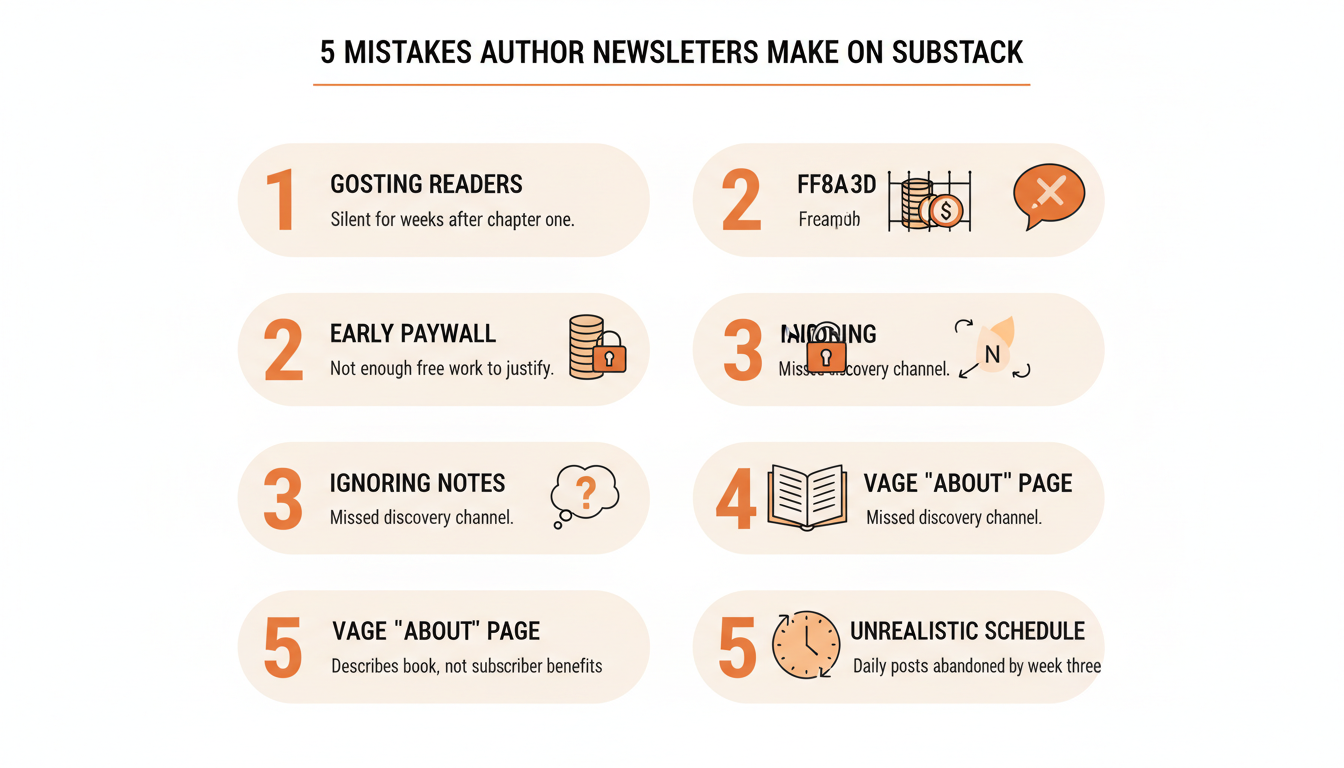
Publishing chapter one and going quiet for three weeks while the next one gets finished. Readers forget fast, and a serial needs momentum more than it needs perfection. Paywalling too early, before there's enough free work published to make a stranger want to pay for more. Treating Notes as an afterthought instead of the main discovery channel, then wondering why growth has stalled. Writing an about page that describes the book's premise but never says what a subscriber actually gets by joining. Picking a daily schedule that sounds ambitious in week one and is abandoned by week three, then never publishing again because the "failure" feels bigger than it is.
None of these are fatal on their own. The authors who recover from them are the ones who notice fast and adjust the plan instead of quietly stopping.
An author newsletter that works isn't the one with the most polished launch. It's the one still posting six months later, on a schedule readers can set a clock to. WriteStack exists to protect that schedule: batch the Notes around a chapter once, queue them, and get back to the manuscript.