I get asked some version of this question every few weeks: should I put my newsletter on LinkedIn, on Substack, or both? The honest answer is that they're not really competing for the same job. One is a distribution channel you're borrowing. The other is an owned asset you're building. Mixing those up is how people end up with a newsletter that looks busy but has nothing underneath it.
Here's the table of contents so you can jump to the part you actually need.
- The real difference: distribution vs. ownership
- What a LinkedIn newsletter actually gives you
- What Substack actually gives you
- The numbers, side by side
- Where each platform wins
- The both-platforms playbook
- Mistakes people make switching or cross-posting
- Where WriteStack fits in
- So which one should you pick
The real difference: distribution vs. ownership
Every comparison of these two platforms eventually collapses into one sentence: LinkedIn gives you reach, Substack gives you a list. That's not a slogan, it's the actual mechanical difference. A LinkedIn newsletter publishes to your existing connections and followers inside LinkedIn's app. You never see an email address. You never get a CSV. If your account gets restricted or the algorithm changes how newsletters get surfaced, your subscriber count is still whatever LinkedIn says it is, and you have no way to reach those people outside the platform.
Substack works the other way around. When someone subscribes, you get their email address the moment they confirm. You can export the full list at any time from the Subscribers page, and that list is yours whether Substack is thriving in five years or has been replaced by something else entirely.
Practical rule: if you can't export the list, you don't own the audience. You're renting distribution.
Neither of those facts makes one platform "better." They make the platforms suited to different jobs, which is the whole point of this article.
Think about it in terms of what happens if you stopped paying attention to the platform for a year. A LinkedIn newsletter you abandon quietly loses whatever momentum the algorithm was giving it, and you can't message the people who used to read it to tell them you're back. A Substack you abandon still has every subscriber's email sitting in an exportable list, ready to be reactivated with a single email whenever you decide to return. That asymmetry, what happens when you stop actively working the channel, is usually the clearest way to see which platform is actually building something durable and which one is just borrowing attention for as long as you keep showing up.
What a LinkedIn newsletter actually gives you
Reach without an audience
The single biggest advantage of a LinkedIn newsletter is that you don't need to build anything first. Publish an edition, and it goes out to your existing connections and followers, plus anyone LinkedIn decides to surface it to through its feed and notification system. If you already have a professional network of a few thousand people, a LinkedIn newsletter is the fastest way to put content in front of them with zero setup cost. There's no domain to configure, no email service to authenticate, no design decisions to make.
That built-in discoverability is real. LinkedIn company newsletters average around a 40% "open" rate, though LinkedIn measures this as clicks-to-read rather than a traditional email open, so it isn't a clean apples-to-apples number against email platforms (Newsletter Open Rate Benchmarks: The 2026 Data).
There's also a subtler advantage that gets overlooked: LinkedIn newsletters get pushed as notifications directly to a subscriber's phone, the same way a new post from a connection would. Email has to survive spam filters, promotions tabs, and an inbox someone might not open for days. A LinkedIn notification shows up the moment you publish. For time-sensitive announcements, that immediacy is genuinely useful, even if it comes at the cost of everything else on this list.
The ownership gap
The tradeoff is total dependency on LinkedIn's infrastructure. You cannot export subscriber emails. You cannot email your list from Mailchimp, Kit, or anywhere else. You cannot run a paywall, sell a subscription, or run a referral program that pays out in the way Substack's does. If LinkedIn changes its algorithm, buries newsletters in favor of short-form posts, or the platform simply falls out of favor the way plenty of platforms have before it, the audience you built stays exactly where it is: inside LinkedIn, inaccessible to you.
This isn't a hypothetical risk. LinkedIn has changed how it surfaces newsletters more than once, and creators who built their entire following inside the newsletter feature have had no recourse when reach dropped. Compare that to a platform outage or algorithm change on Substack: your subscriber list is unaffected, because it lives in your account as exportable data, not as a follower count controlled entirely by someone else's product decisions. The newsletter format on LinkedIn is a feature the platform is choosing to support today. There's no guarantee it looks the same, or exists at all, in three years.
What Substack actually gives you
A list you can take with you
Substack is closer to a backend email platform wearing a publishing interface. Every subscriber is a real email address you can export, segment, and message directly, independent of whether they ever open the Substack app again. That's the entire value proposition of "owned audience": if the platform disappeared tomorrow, you'd still have the list and could move it to any other email tool in an afternoon.
A business model, not just a feed
Substack also ships the infrastructure to actually run a subscription business on top of that list: paid tiers, a built-in payment processor, a referral program, and increasingly, tools for live video, chat threads, and Notes for short-form distribution inside Substack's own network. LinkedIn newsletters have none of this. They're a content format, not a monetization platform.
That difference compounds over time. A writer who starts on Substack from day one is, whether they realize it or not, building toward a point where turning on paid subscriptions is a settings change, not a migration project. A writer who spends two years building a LinkedIn newsletter following and then decides to monetize has to start the audience-building process over on a different platform, because none of that LinkedIn following can be moved or billed directly. The cost of switching later is almost always higher than the cost of starting on the right platform now.
Practical rule: if monetizing the list is even a possibility in the next 12 months, that alone settles the decision in Substack's favor, because LinkedIn has no path to paid subscriptions on a newsletter.
📅 Struggling to stay consistent on Substack?
WriteStack's Smart Scheduling lets you batch and queue Notes in minutes. Grow on Substack without burning out.
Explore Smart SchedulingThe numbers, side by side
| LinkedIn Newsletter | Substack | |
|---|---|---|
| Subscriber emails | Not visible to you | Fully visible and exportable |
| List portability | None | Full CSV export |
| Setup required | None, publish to existing network | Domain, design, initial subscriber base |
| Distribution mechanism | LinkedIn feed and notifications | Email inbox, Substack app, Notes, Discover |
| Paid subscriptions | Not supported | Built in, with built-in payments |
| Typical engagement metric | ~40% click-to-read rate (source) | Platform-reported open rate, typically 30-50% depending on niche |
| Cross-posting to short-form | No native equivalent | Notes (Substack's short-form feed) |
| Best suited for | Warming up an existing professional network | Building a durable, exportable, monetizable list |
Where each platform wins
When LinkedIn is the right call
A LinkedIn newsletter makes sense when you already have a sizable, relevant network on the platform and you want a low-effort way to keep showing up in front of them. It's also a reasonable first move if you're testing whether a topic has an audience at all before investing in a full Substack setup. Consultants, B2B founders, and recruiters building personal brand inside their industry tend to get outsized value here, because the audience is already professionally pre-qualified.
It's also a solid fit for anyone whose goal is visibility rather than a mailing list. If the outcome you actually want is more inbound client conversations, more speaking invitations, or more recognition inside a specific industry, LinkedIn's built-in professional context does work that a generic email list can't replicate on its own. The newsletter format there is really just a recurring excuse to stay in front of people who already have a reason to care what you think.
When Substack is the right call
Substack is the right call the moment you want the relationship with readers to survive outside any one platform, or the moment monetization becomes a real goal rather than a someday idea. It's also the better fit if your content benefits from a dedicated space rather than living inside a professional feed: longer essays, serialized writing, interviews, anything that reads better as a publication than a status update.
The both-platforms playbook
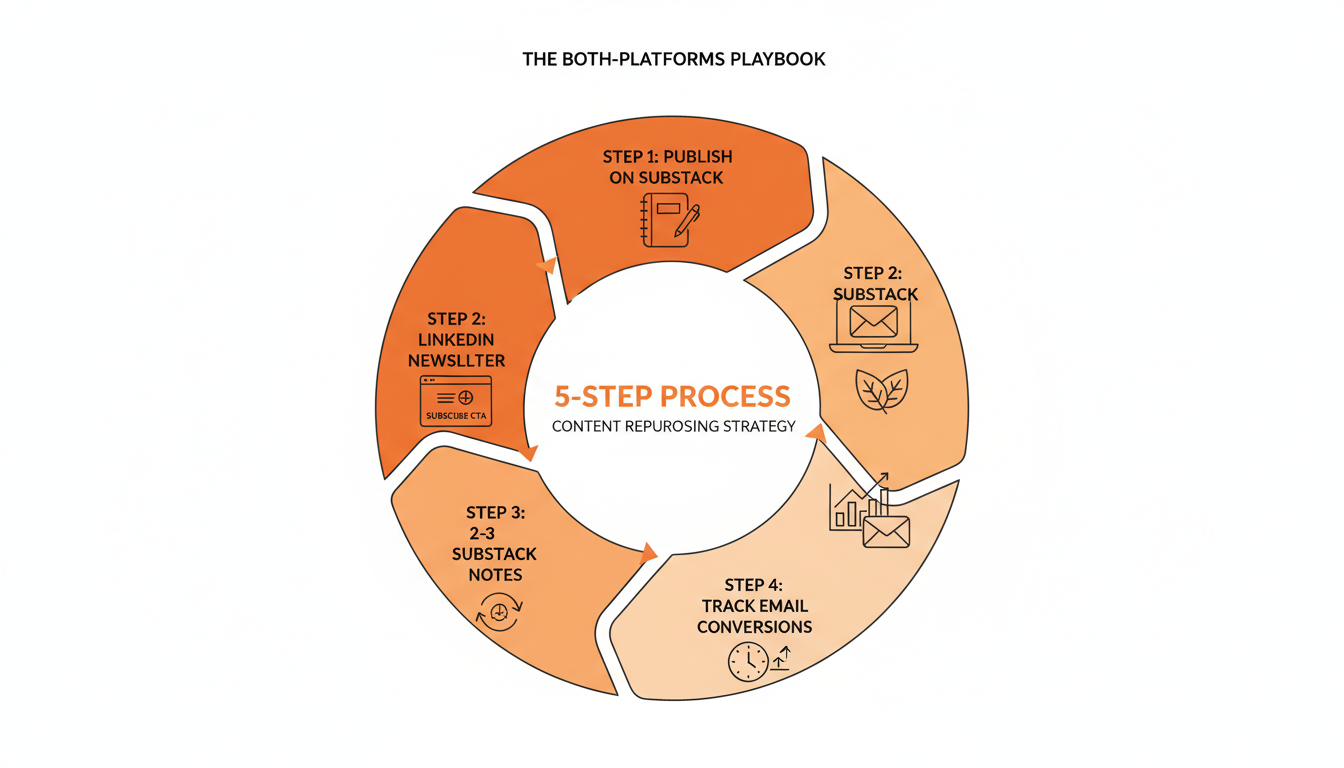
The strongest version of this isn't either/or. It's a deliberate sequence:
- Publish the full piece on Substack first, where the canonical, ownable version of the content lives.
- Post a trimmed, LinkedIn-native version of the same piece as a LinkedIn newsletter edition, with a clear line inviting readers to subscribe to the full version.
- Turn the core idea into two or three short-form Notes on Substack to extend reach inside Substack's own discovery surfaces.
- Track which channel actually converts to email subscribers, not just which one gets more views, and weight your time toward that channel over the next month.
- Re-run the loop with the next piece, adjusting the LinkedIn trim length and the Notes angle based on what worked.
Practical rule: treat LinkedIn as the top of the funnel and Substack as the destination. The conversion event that matters is a LinkedIn reader becoming a Substack subscriber, not a LinkedIn like.
Mistakes people make switching or cross-posting
The most common mistake is publishing the exact same piece, word for word, in both places at the same time. LinkedIn's algorithm and Substack's Discover surface both tend to deprioritize content that reads as duplicate, and readers who follow you in both places notice immediately. Trim and adapt the LinkedIn version instead of copy-pasting it.
A related version of this mistake is using the exact same headline in both places. LinkedIn readers respond to a more direct, professional framing, while Substack readers, especially ones finding you through Discover or Notes, respond better to a headline with more personality and specificity. Writing two headlines for the same idea takes an extra five minutes and noticeably changes how each platform's algorithm treats the post.
The second mistake is treating LinkedIn subscriber counts as a proxy for business health. A LinkedIn newsletter with ten thousand subscribers converts to zero dollars of revenue on its own, because there's no payment infrastructure attached to it. Track Substack subscriber and paid-conversion numbers as the real scoreboard.
The third mistake is waiting too long to start the Substack side. Founders who build a LinkedIn audience for a year before ever starting a Substack often discover that LinkedIn's own subscribe-and-invite tools make it slow and manual to migrate that audience over. Starting the Substack list early, even small, means you're building the owned asset in parallel instead of racing to catch up later.
The fourth mistake is inconsistent posting frequency across the two platforms. It's common to see writers publish weekly on Substack but only remember the LinkedIn newsletter every six weeks, or the reverse. Readers on both platforms build a habit around your cadence, and an erratic schedule on either one quietly trains people to stop expecting your next post, which shows up later as declining opens on both channels at once, not just the neglected one.
Where WriteStack fits in
If you're running both channels, the bottleneck is almost never ideas, it's the repetitive work of adapting one piece into multiple formats and getting each version scheduled at the right time. Most people who try running the playbook above by hand quit after a few weeks, not because the strategy is wrong, but because doing it manually means rewriting the same idea three or four times and then remembering to schedule each version at a different time on a different platform. WriteStack handles the Substack side of that: turning a long post into a batch of Notes automatically with WriteStack's note generator, scheduling everything for the times your specific audience is actually active using WriteStack's posting heatmap, and showing you which readers are engaging enough to be worth a direct outreach with WriteStack's fan tracking. None of that replaces the writing. It just removes the manual busywork of the playbook above so you can run it every week instead of once a quarter.
So which one should you pick
If you have zero existing audience anywhere and want the fastest possible validation of an idea, start with a LinkedIn newsletter aimed at your existing network. If you already know you want a durable, exportable, potentially monetizable list, start on Substack even if your first hundred subscribers take a month to get. And if you have any real professional network on LinkedIn already, don't choose. Run the playbook above and let Substack be where the relationship actually lives.
One more practical test, if you're still torn: imagine explaining your newsletter to someone in a year and being asked how many subscribers you have and what percentage pay you. On LinkedIn, you can answer the first half of that question and not the second, because there's no billing layer attached to the follower count. On Substack, both halves are answerable from your own dashboard, in numbers you control and can act on directly. If being able to answer both questions matters to you, that's a strong signal about where the real newsletter should live, even if LinkedIn remains a useful amplifier alongside it.
There's no wrong answer that locks you in forever. Plenty of writers start on LinkedIn, prove the topic has legs, and move the real energy to Substack six months later once monetization becomes worth the setup. Others start on Substack from day one because they already know they want a subscription business and treat LinkedIn purely as a top-of-funnel amplifier. What matters is making the choice on purpose, based on what you actually want the newsletter to do for you, instead of defaulting to whichever platform you happened to open first.
Ready to stop manually repurposing every post into Notes and guessing at posting times? Start with WriteStack and put the cross-posting workflow on autopilot.