
A writer with a finished draft has two very different places to hit publish. One puts the piece in front of Medium's existing readers within minutes. The other puts it in front of nobody, until you build a list of your own.
That trade-off is the whole story. Substack vs Medium comes down to whether you want reach now or ownership later, and the two rarely arrive together. This piece walks through discovery, fees, design, SEO, and what happens to your list if you ever want to leave, using real numbers from each platform's own documentation instead of vague pros-and-cons lists.
One number worth having before you start: WriteStack has close to 100 verified reviews from Substack writers across multiple platforms. Medium scheduling and Notes tooling isn't really a category, because Medium doesn't have a Notes-equivalent feature at all.
Table of Contents
- The Core Difference Between Substack and Medium
- Getting Discovered: Built-In Traffic vs. Built From Scratch
- Monetization and Fees: What You Actually Keep
- Content Ownership and Your Email List
- SEO and Google Traffic
- Writing Tools, Design, and Customization
- Community and Engagement Features
- Migrating Between the Two, or Running Both
- Which One Should You Actually Choose
The Core Difference Between Substack and Medium
Medium is a shared platform. You publish into a pool of writers, and Medium's algorithm decides how many of its own readers see your story, based on read time, claps, and topic matching. Substack is a publishing tool. You bring your own list, or build one from scratch, and every post goes straight to inboxes you control.
Neither model is wrong. They're built for different outcomes. Medium optimizes for reach inside its own network of readers. Substack optimizes for a direct, durable relationship with people who chose to hear from you specifically, and who you can reach again even if Substack itself changed tomorrow.
The two platforms also started from different premises. Medium launched as a place where anyone could publish and the platform itself handled distribution. Substack launched around email, betting that writers would rather own a smaller, more committed list than compete for attention inside someone else's feed. Nine years later, that founding bet still explains most of the differences below.
Who Actually Owns the Audience
On Medium, your "audience" is really Medium's audience that happens to be reading you this week. Stop publishing and the relationship mostly disappears, because there's no exported list of the people who read your work. On Substack, subscribers are attached to your publication with an email address you can export at any time. That difference decides almost everything else in this comparison.
Practical rule: if losing platform access tomorrow would also mean losing your readers, you don't actually have an audience yet. You have distribution.
Get a week of Notes scheduled on Substack in twenty minutes with WriteStack's Notes generator, so building that owned list doesn't compete with the time you spend writing.
Getting Discovered: Built-In Traffic vs. Built From Scratch
This is where Medium genuinely wins for a specific kind of writer. A brand-new Medium story can get read by strangers on day one, because Medium routes traffic to stories its algorithm rates well, regardless of whether the writer has a single follower. A brand-new Substack gets read by exactly the people the writer personally invited, and nobody else, until real growth work starts.
Substack's Growth Levers
Substack's growth tools work through the people you already have, not a central algorithm. Notes function like a public feed where short posts can get restacked into other readers' networks. Recommendations let other publications put your newsletter in front of their subscribers at the exact moment those readers just decided to subscribe to something. Substack's own announcement of the feature describes recommendations from a trusted writer as one of the strongest signals a new reader can get, which is exactly why they convert so much better than a cold link.
None of that runs on its own. Consistent Notes posting is the input that makes restacks and recommendations worth anything, and that's the part most new Substack writers drop first when life gets busy. WriteStack's heatmap shows exactly which days and times your specific audience engages, instead of guessing at a generic "best time to post" number.
Medium's Curation and Algorithm
Medium's distribution runs through Curators who tag strong stories into topic feeds, plus an algorithm weighted toward read time and member engagement. A well-tagged story in a popular topic can pull thousands of reads from people who've never heard of the writer. The tradeoff is that the writer doesn't control it. A story can underperform for reasons that have nothing to do with quality, and there's no direct line to the reader the way an email subscriber list provides.
Practical rule: Medium can hand you readers you didn't earn a relationship with yet. Substack only hands you readers you already convinced. Plan your growth work around which one you're actually trying to build.
Monetization and Fees: What You Actually Keep
This is the least ambiguous part of the comparison, because both platforms publish exactly how the money moves.
Substack's Fee Structure
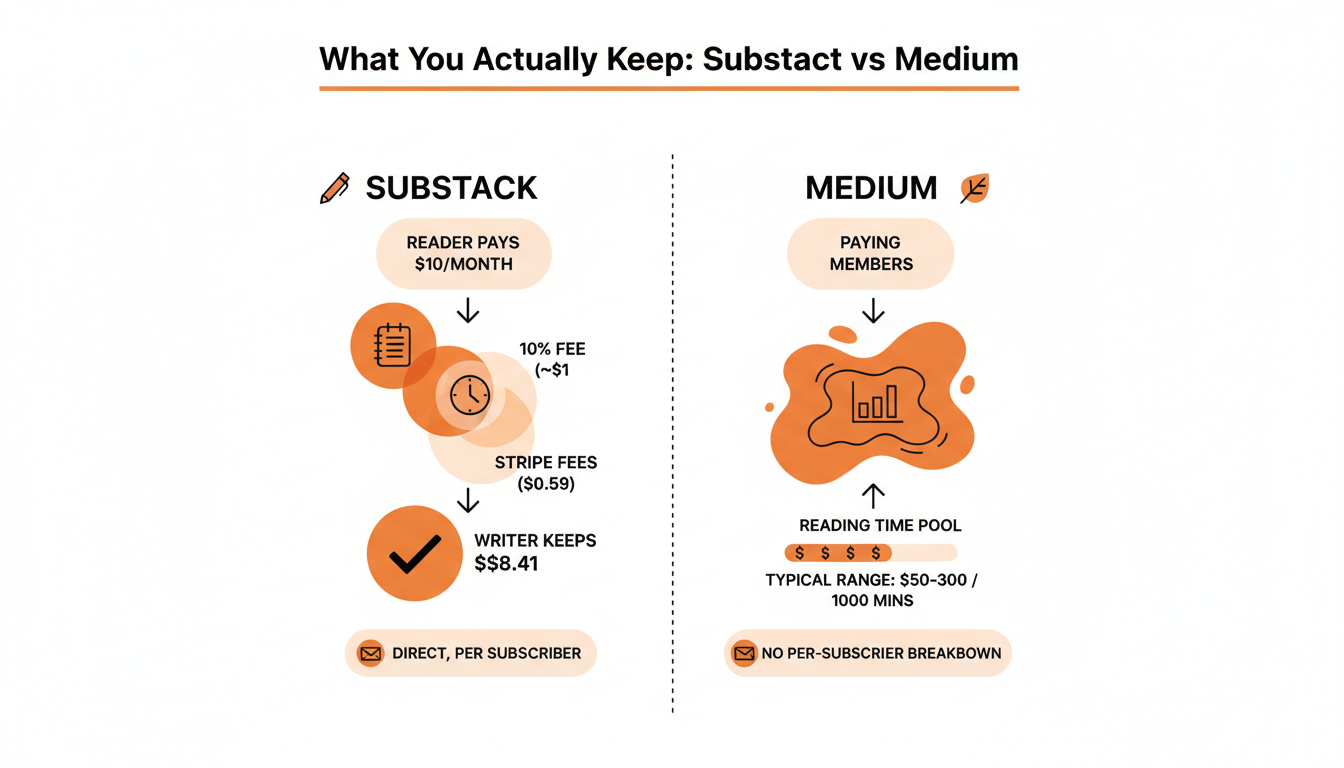
Substack takes 10% of each paid subscription transaction. On top of that, Stripe charges its standard processing fee (2.9% + $0.30 per transaction, plus a small recurring billing fee), and publishing itself is free no matter how large the list gets, according to Substack's own support documentation. On a $10/month subscription, that's roughly $1 to Substack and under $0.60 to Stripe, leaving the writer with the rest, paid directly and transparently per subscriber.
Medium's Partner Program
Medium doesn't run a subscription model for individual writers at all. It pays through the Partner Program, which splits Medium members' subscription fees among writers based on how long members spend reading their stories, not a fixed rate per view. Reporting on the program puts typical monthly ranges for engaged writers somewhere between roughly $50 and $300 per 1,000 minutes of member reading time, with bonuses layered on for followers and standout stories. Medium doesn't publish an aggregate breakdown of what the typical writer earns, so the accurate way to describe it is: your income depends on a formula you don't fully see, pooled across every other writer competing for the same reading minutes.
| Substack | Medium | |
|---|---|---|
| Who sets the price | The writer | Medium (via Partner Program pool) |
| Platform cut | 10% of subscription revenue | Not a fixed cut, reading-time based split |
| Payment processor fee | ~2.9% + $0.30 (Stripe) | Included in Medium's internal calculation |
| Publishing cost | Free, no matter the list size | Free to publish, membership optional to read |
| Earnings visibility | Per subscriber, in your dashboard | Aggregate reading-time formula, not fully transparent |
| Who owns the payer relationship | The writer | Medium |
Practical rule: if you can't predict this month's income from last month's numbers, you don't control your monetization. Substack's model is boring in the best way here. What a subscriber pays is what shows up.
Content Ownership and Your Email List
A Substack publication comes with a real email list from the first subscriber. Every post gets emailed directly, the list is exportable in CSV form, and if a writer ever moved to another provider, the relationship travels with them because it was never dependent on the platform's own inbox.
Medium has no email list in that sense. Followers get notified inside Medium's own app and site, not through an email address the writer owns. If Medium changed its algorithm, its pricing, or shut down a feature tomorrow, there's no list to take elsewhere, because there was never a list to begin with.
📅 Struggling to stay consistent on Substack?
WriteStack's Smart Scheduling lets you batch and queue Notes in minutes. Grow on Substack without burning out.
Explore Smart SchedulingThis is also why post permanence works differently. A Substack post stays reachable through the archive and through search, tied to a publication readers already trust. A Medium story's long-term visibility depends more on whether Medium's own curation still favors it months or years later, which is out of the writer's hands.
Practical rule: ask what happens to your readers the day the platform makes a decision you disagree with. On Substack, you export a CSV and move. On Medium, you start over.
SEO and Google Traffic
Both platforms can rank in Google, but they behave differently once they do. Medium's domain authority is enormous, which can help a new story rank faster than a brand-new Substack would for the same keyword. The tradeoff shows up over time: Medium stories compete inside Medium's own internal linking and topic structure, and a writer has limited control over metadata, internal links, or how the story is positioned against thousands of other stories targeting similar terms.
Substack gives each publication its own domain (or a custom domain), full control over the post's title and description as they appear in search, and posts that keep accumulating search traffic for years without competing against other authors' content on the same site. This is a slower start and a better compounding curve. WriteStack's own blog runs entirely on this model, which is part of why a piece like this one can rank on its own terms instead of getting buried in someone else's topic feed.
Practical rule: a fast start on borrowed authority and a slow start on owned authority solve different problems. Pick Medium if the goal is traffic this month. Pick Substack if the goal is traffic that's still arriving in three years without new work.
There's a practical middle ground too. A writer can publish the full piece on Substack for the SEO and ownership benefits, then post a shorter, differently-framed version on Medium purely as a discovery play. That way the compounding search asset stays on the platform the writer actually controls, while Medium still does what it's good at.
Ready to grow with a real list behind you instead of a rented one? WriteStack's Notes generator turns a backlog of published posts into a week of ready-to-schedule Notes in minutes, so the writing that's already done keeps working for search and for growth at the same time.
Writing Tools, Design, and Customization
Medium's Minimal Editor
Medium's editor is deliberately minimal. There's very little to configure, which is a genuine advantage for someone who wants to write and hit publish without touching a settings menu. Every Medium story looks like a Medium story: same fonts, same layout, same reading experience, and that consistency is part of what makes the platform feel trustworthy to readers browsing between authors.
Substack's Configurable Design
Substack gives more control. Custom domains, a configurable homepage, an About page, sections, and a "look" that's distinct from every other publication on the platform. That flexibility means more setup work up front. It also means a Substack publication can look and feel like a real, standalone brand instead of one more story in an infinite scroll.
Practical rule: pick minimal tooling if writing consistency matters more than brand identity. Pick configurable tooling if the newsletter is meant to become a recognizable, standalone thing over time.
The podcast and audio side splits along the same line. Substack lets a writer attach audio or video directly to a post and run it as a podcast feed under the same publication, so a newsletter and a show can share one subscriber base. Medium has no equivalent, since it was built around text-first stories from the start. For a writer who wants to eventually add a voice component without spinning up a separate hosting account, that's a real gap between the two, not a small one.
Community and Engagement Features
Medium's engagement signals are claps, highlights, and responses, all built around individual stories. They're lightweight and fast for a reader to give, but they don't create an ongoing relationship the way a subscriber list does.
Substack's engagement runs through Notes, comments, and restacks, which behave more like a social feed layered on top of the newsletter itself. A comment thread under a Substack post tends to read like a conversation between people who already know each other's names, because most of them are subscribers, not strangers passing through.
The part people don't expect: WriteStack tracks which specific links inside a Note got clicked, going back through a publication's entire Notes history, not just the last few posts. It benchmarks a restack rate against other publications of similar size, so a writer can tell if this week was actually good instead of just "better than last week." And its AI drafts new Notes by reading what a writer has already published, so the first draft starts in their voice instead of arriving at it after three rounds of editing a generic prompt output. None of that exists as a workflow on Medium, because Medium has no Notes-equivalent surface to schedule, track, or benchmark in the first place.
Migrating Between the Two, or Running Both
Plenty of writers use both, deliberately. Medium works as a discovery layer: publish a piece there to catch readers who've never heard of the writer, then link back to the Substack for anyone who wants more. Substack works as the home base where the actual relationship and the actual revenue live.
Moving fully from Medium to Substack is straightforward, since there's no subscriber list to migrate; the writer simply starts building one. Moving from Substack elsewhere is a CSV export and an import, which is a very different kind of migration than trying to recreate an audience from nothing.
Practical rule: if cross-posting, publish the full piece on Substack first, since that's where the email and the ownership live, then adapt an excerpt or a different framing for Medium rather than duplicating it word for word.
Duplicating the exact same text on both platforms creates a real risk too: Google can treat the second copy as duplicate content and decline to rank it, which quietly wastes the Medium post. A short, rewritten excerpt with a link back to the full piece on Substack avoids that problem and still gives Medium's readers a reason to click through.
Timing matters as much as the split itself. Publish on Substack first, let the email go out and the first wave of comments and restacks happen, then post the Medium version a day or two later. That order keeps the owned list as the primary audience and treats Medium as the amplifier it's actually good at being.
Which One Should You Actually Choose
For a writer building toward paid subscriptions, a real list, and a publication that compounds instead of resetting with every algorithm change, Substack is the right platform. The fee structure is transparent, the audience is exportable, and growth work through Notes and recommendations keeps paying off for years instead of resetting every time a new story goes up. Medium is a reasonable discovery layer alongside it, not a replacement for it.
The Narrow Exception
The exception is narrow and worth naming honestly. A writer who wants zero setup, has no interest in ever charging for their writing, and is fine with the relationship living entirely inside someone else's app can get real, fast reads on Medium without touching a settings menu. That's a legitimate choice for a hobbyist. It stops being the right choice the moment monetization, a real list, or a publication that outlasts a single platform's roadmap enters the picture.
Choosing Substack is the easy part. Running it consistently is where most writers actually lose momentum, not from a lack of ideas but from the daily friction of drafting Notes, finding a consistent posting rhythm, and knowing whether any of it is working. That's the exact gap WriteStack was built to close: Notes drafted from a writer's own published voice, a schedule that runs itself, and analytics that show what's actually working instead of a guess. Start a free trial and load a week of Notes in twenty minutes. Watch them go out without babysitting the queue.