
You finish chapter three, hit publish, and check the numbers an hour later. Forty subscribers. Twelve opens. One comment, from your sister. You start doing the math on how long this takes if it never gets bigger than this, and the math is not encouraging.
That moment is where most fiction serials on Substack die, and it has nothing to do with the writing. How do you serialize a novel on Substack in a way that keeps readers coming back chapter after chapter instead of drifting off after episode four? The mechanics of posting are the easy part. The hard part is structure, pacing, and a schedule that survives a bad week.
This guide covers all of it: how to break a novel into chapters people actually wait for, where to put the paywall, how often to post based on what active fiction Substacks actually do, and how to use Notes to keep readers engaged between installments.
One number worth having before you start: WriteStack has close to 100 verified reviews from Substack writers across multiple platforms. No other Substack scheduling tool we could find comes close.
Table of Contents
- Why Fiction Writers Are Moving to Substack
- Should You Serialize a Finished Novel or Write It Live
- Structuring Your Novel Into Chapters Readers Return For
- Building a Posting Schedule You Can Actually Keep
- Writing Cliffhangers That Carry Readers to the Next Chapter
- Growing Readers Between Chapters With Notes
- Turning Free Readers Into Paying Subscribers
- Formatting, Covers, and Presentation for Serialized Fiction
- Staying Consistent Without Burning Out
Why Fiction Writers Are Moving to Substack
Serial fiction is not new. Dickens sold novels a chapter at a time in Victorian magazines. Web serials have run on forums and blogs since the early internet, and The Spot, a "cyber-soap opera," was doing this in the 1990s. What changed is distribution.
Substack turned into something closer to a social platform in 2023, when it added Notes and a mobile app on top of the newsletter product, according to Compact Magazine's account of the serial novel's return. Substack now has roughly 5.5 million monthly active users and 1.5 million daily active users on Bloomberg's reporting, cited in that same piece. That matters for fiction specifically because discovery used to depend almost entirely on an author's existing audience. Now a chapter can get picked up and restacked by readers who have never heard of the writer.
The clearest example is John Pistelli's novel Major Arcana, serialized through 2023 and 2024 and later picked up by Belt Publishing in 2025. Pistelli didn't have a large following going in. The novel found readers through Substack's own network of writers restacking each other, one restack and one comment section at a time.
Practical rule: don't wait to have an audience before you start serializing. On Substack, a good chapter one can build the audience, not just serve it.
The other side of that coin is real. Elle Griffin serialized a novel called Obscurity before the 2023 Notes pivot, and by her own account, none of her 45 paid subscribers preferred the fiction to her nonfiction writing. Timing and distribution features changed the odds since then, but they didn't remove the need for the fundamentals covered in the rest of this guide.
Set up your chapter schedule in WriteStack before you post chapter one. Ten minutes now saves you from the exact gap that kills most serials by chapter six.
Should You Serialize a Finished Novel or Write It Live
There are two ways to run this, and writers argue about it constantly.
The Tradeoff Between a Finished Draft and Drafting in Public
Posting a novel you've already finished and revised means every chapter has been through your full editing process. You know how it ends. You can seed foreshadowing in chapter two because you already wrote chapter thirty. The schedule risk is low because the backlog exists before you post anything.
Drafting in public, posting chapters close to when you write them, is a different kind of pressure. Readers see the story develop in something close to real time, comment on plot choices, and occasionally influence where you take it. Jörgen Löwenfeldt built an entire format around this, letting subscribers vote weekly on which plot direction his story takes next.
The honest tradeoff: drafting in public creates more reader involvement and a stronger sense of being part of something. It also means your posting schedule depends on your first-draft speed, which is the least predictable part of writing. A finished draft removes that risk entirely.
Practical rule: if you've never finished a serialized project before, write at least eight to ten chapters ahead of what you post. That buffer is what keeps a bad writing week from becoming a missed week.
Most writers land somewhere in the middle: several chapters banked before launch, then writing to stay a fixed number ahead rather than fully finishing before posting a word.
Structuring Your Novel Into Chapters Readers Return For
A novel manuscript and a serialized novel are not laid out the same way, even if the underlying story is identical. Chapter breaks that work fine in a bound book can leave a Substack reader with nothing to look forward to for a week.
Ideal Chapter Length and Pacing
Across active fiction Substacks in a sample of ~2,000 fiction-tagged posts we pulled from our own dataset of Substack publications, the average chapter runs about 1,256 words. That's shorter than a typical print chapter, and it fits the format: a Substack post is read in one sitting, usually on a phone, often over coffee or a commute. Long chapters get saved for later, and "later" is where serialized readers slip away.
Aim for something a reader finishes in one sitting without a scroll break, and end on a beat that raises a question rather than resolves one. That's the actual craft skill serialization tests: pacing a novel-length story into units that each feel complete enough to satisfy and open enough to pull the reader forward.
Where to Put Your Paywall Split
Substack lets you paywall an entire post or split a single post so free subscribers see a preview and paid subscribers see the rest, using the platform's free preview feature for paid posts. For serialized fiction, three models cover almost every real setup:
| Model | How it works | Best for | Tradeoff |
|---|---|---|---|
| Fully free | Every chapter goes out to everyone | Building an audience from zero, or fiction as a lead magnet for other work | No direct revenue from the story itself |
| Freemium split | First few chapters free, later chapters or a "book two" go behind the paywall | Writers with an established free base ready to convert | Requires a strong enough free run to earn the ask |
| Paid from chapter one | Everything behind the paywall, sometimes with occasional free samples | Writers with an existing paid audience from other work | Slower subscriber growth, since there's no free hook |
Practical rule: don't put the paywall behind chapter one. Give readers enough free story to get emotionally invested before you ask them to pay for the rest.
Building a Posting Schedule You Can Actually Keep
This is where most serials actually fail, and it's rarely about the writing quality.
📅 Struggling to stay consistent on Substack?
WriteStack's Smart Scheduling lets you batch and queue Notes in minutes. Grow on Substack without burning out.
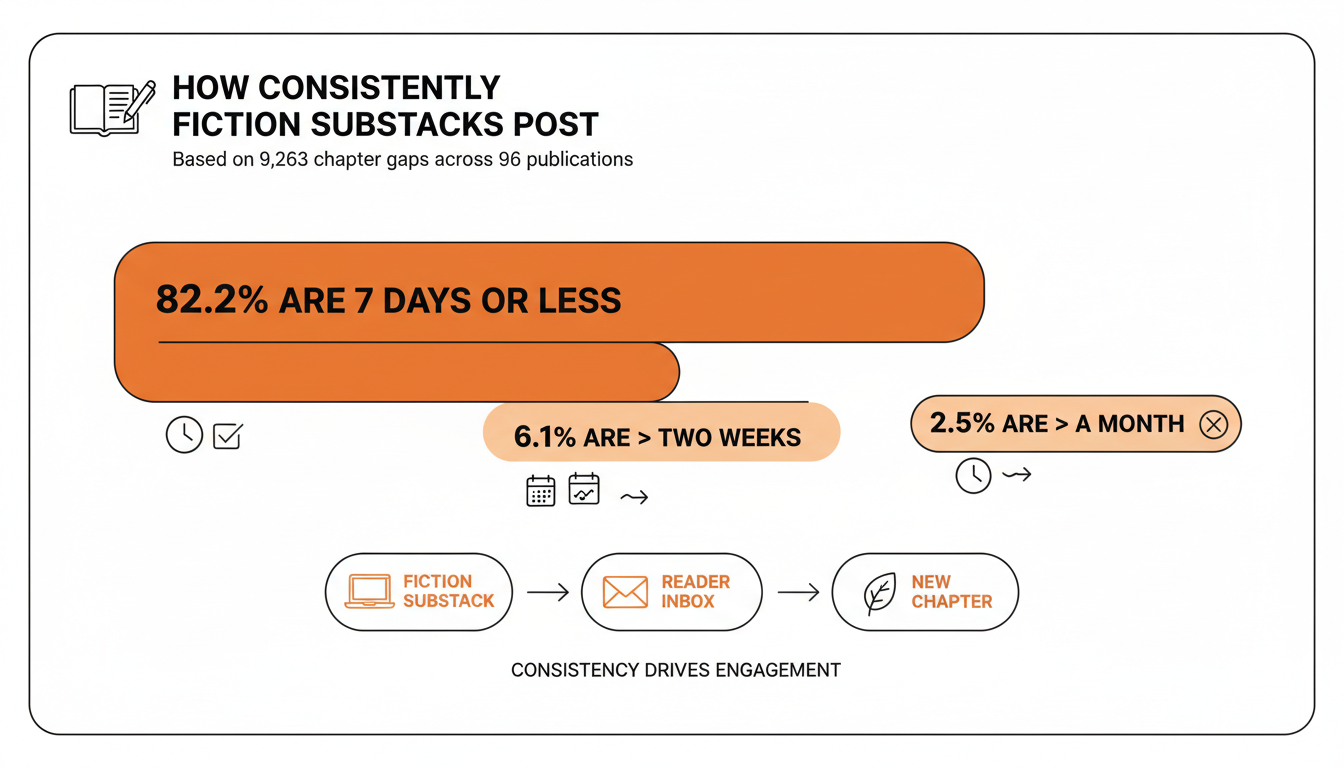
Explore Smart SchedulingWe looked at posting gaps across 96 active fiction-tagged Substack publications in our own dataset, each with at least eight posts, covering 9,263 chapter-to-chapter intervals. 82.2% of those gaps were a week or less. Only 2.5% stretched past a month. The median gap was under three days, which tells you the writers who stick with this post more often than once a week when they're active at all. The average gap, at six days, gets pulled up by a smaller group who fell off schedule entirely.
The takeaway isn't "post every three days." It's that the writers who maintain a serial long enough to build an audience are disproportionately the ones who never let a gap stretch past two weeks. Momentum compounds. A missed chapter doesn't just cost you that week's readers, it makes the next chapter harder to write and easier to skip too.
This is the actual mechanical problem WriteStack solves for fiction writers. You write chapters four through nine in one weekend when you're in a groove, load them into WriteStack's queue with a release date attached to each one, and they go out on schedule whether or not you feel like opening Substack that particular Tuesday. Checking WriteStack's best-time-to-post data for your own publication before setting the schedule tells you when your specific readers are actually online, instead of guessing at a generic "Tuesday morning" rule that might not apply to your audience.
Write six chapters on a good weekend. Queue them in an afternoon. Spend the next six weeks writing instead of remembering to hit publish.
Practical rule: pick a schedule you can hit on your worst week, not your best one. Twice a week sustained for a year beats daily for a month followed by silence.
Writing Cliffhangers That Carry Readers to the Next Chapter
A cliffhanger that works is a specific, answerable question, not a vague sense of dread. "Will things get worse?" isn't a cliffhanger. "Who was standing behind the door when she turned around?" is.
The strongest chapter endings in serialized fiction tend to do one of a few things: reveal new information that recontextualizes what just happened, put a character in a decision they have to make with no good options, or cut away right before an answer the reader was promised. Genre matters here. Thrillers can lean on plot-level cliffhangers almost every chapter. Literary fiction usually gets more mileage from ending on an emotional turn, a line of dialogue that lands wrong, or a small detail the character notices that the reader understands but they don't yet.
Practical rule: read your last paragraph out loud and ask whether you'd click "next chapter" if you'd just read it as a stranger. If the honest answer is "maybe later," rewrite the ending, not the chapter.
Growing Readers Between Chapters With Notes
The gap between chapters is where most serials lose momentum, and it's also the part of the format most writers under-use. A newsletter post is a one-way broadcast. Notes are where the actual back-and-forth with readers happens.
Teasing the Next Chapter Without Giving It Away
A single line from the upcoming chapter, posted as a Note two or three days before it goes out, does more for retention than most writers expect. It reminds lapsed readers the story is still running, gives active readers something to react to, and shows up in Notes feeds outside your existing subscriber base, which is one of the main ways new readers discover a serial they'd never have searched for directly.
Writing five or six of these teaser Notes for chapters you've already drafted takes fifteen minutes if you do it in a batch instead of remembering to post one every few days. WriteStack's Notes tool reads what you've already written, including the chapter itself, and drafts Notes in your own voice rather than generating from a blank prompt, which is the difference between a teaser that sounds like you and one you have to rewrite before it's usable.
Practical rule: never tease a plot twist you haven't written yet. Tease atmosphere, a character's decision, or a line of dialogue instead, so a slower writing week doesn't turn a Note into a promise you can't keep.
Turning Free Readers Into Paying Subscribers
Free readers are not the same as paying ones, and treating every reader identically means missing the ones most likely to convert.
When to Introduce the Paywall
The honest answer is later than most writers want to hear. A common pattern among successful serials is running the first arc, roughly ten to fifteen chapters, entirely free, then paywalling the second arc or the second book once readers are already invested in the characters and can't walk away without knowing what happens.
Part of what makes this workable is knowing which readers to focus on before you ask for money. Not every subscriber is equally invested, and the ones who comment on every chapter, restack your Notes, and reply to your teasers are a different audience than the ones who opened one email three months ago. WriteStack's superfan tracking surfaces exactly that group, so you know who to thank personally, who to ask for a review, and who's actually likely to convert when the paywall arrives, instead of pitching every subscriber the same way.
Practical rule: message your most engaged free readers directly when the paid tier launches. A personal note to twenty people who already love the story converts better than a broadcast to two thousand who barely remember subscribing.
Formatting, Covers, and Presentation for Serialized Fiction
Presentation matters more for serialized fiction than for a standard newsletter, because a reader has to recognize a new chapter as part of an ongoing story at a glance, in a crowded inbox or feed.
A consistent cover image across every chapter, the same one you'd use for the whole novel, does more for brand recognition than a new image each time. Put a running numbering system directly in the title: "Chapter 12: The Long Way Back" rather than just "The Long Way Back," since new readers landing on chapter twelve need to immediately understand there are eleven chapters before it. A short "previously on" line at the top of each chapter, two or three sentences recapping the last one, costs you almost nothing and meaningfully lowers the barrier for a reader who missed the previous installment or is joining mid-story.
Practical rule: put a link to chapter one at both the top and bottom of every chapter after the first. New readers arrive mid-story more often than you'd expect, and a broken path back to the beginning loses almost all of them.
Staying Consistent Without Burning Out
Here's the part people don't expect going into this: the writing usually isn't what burns writers out of serialization. It's the operational load of remembering to post, format, tag, and promote every single chapter on top of the writing itself, week after week, for a story that might run a year or longer.
That operational load is exactly what a scheduling workflow is supposed to remove. WriteStack queues chapters, formats them, and posts them on the day and time you picked, so a heavy writing week doesn't turn into a missed one. It's also the only Substack tool that schedules Chat posts, which matters if you're running reader polls or discussion threads alongside your chapters, not just the chapters themselves. And because it tracks link clicks and engagement across your full Notes history rather than just the last few days, you can see months in whether your teaser Notes are actually driving chapter opens or just getting reactions that don't convert to reads.
Six months into a serial, the writers still posting aren't the ones who never had a bad week. They're the ones whose bad weeks didn't show up on the publishing schedule, because the schedule was never sitting only in their own memory to begin with.
If you're about to start serializing a novel on Substack, set up your first few chapters in WriteStack before you publish chapter one, not after chapter six when the gaps have already started. Load a month of chapters into the queue, pick your teaser Notes schedule, and let the queue carry the weeks the writing doesn't cooperate.