
A video creator with 400,000 YouTube subscribers messaged me last year asking why her income had flatlined even as her view count kept climbing. The answer wasn't her content. It was her business model. YouTube pays for attention, and attention is cheap. Substack pays for a relationship, and a relationship is worth more per person, even with a fraction of the audience.
That's the actual question buried under "Substack vs YouTube": not which platform is bigger, but which one turns the audience you already have into money you can predict next month. The two platforms answer that question so differently that most creators comparing them are really comparing two separate businesses wearing the same word, "creator."
Table of Contents
- The Core Difference: Attention vs Ownership
- How Each Platform Actually Pays You
- Discovery: YouTube's Search Engine vs Substack's Notes Network
- The Real Numbers: 1,000 True Fans vs 1.2 Million Views
- What You Give Up on Each Platform
- The Repurposing Playbook: Turning One Video Into a Week of Substack Content
- Why Most Successful Creators Run Both
- How to Decide Which Platform to Build First
- Common Mistakes When Running Both Platforms
The Core Difference: Attention vs Ownership
One number worth having before you start: WriteStack has close to 100 verified reviews from Substack writers across multiple platforms. The scheduling tools built for YouTube-first creators trying to run a newsletter on the side have none that we could find anywhere.
YouTube sells your attention to advertisers and hands you a cut. Substack sells your writing directly to readers and lets you keep most of it. That single difference explains almost everything else on this page: how much you earn per audience member, how fragile your income is, and who actually owns the relationship with the person on the other end.
On YouTube, the platform controls distribution. The algorithm decides who sees your video, and when it changes (which it does, often without warning) your reach can drop by half overnight with nothing you did differently. On Substack, once someone subscribes with their email address, that list is yours. You can email it, export it, or move it to another platform entirely. Substack can shut down tomorrow and you would still have every subscriber's contact information.
Neither model is wrong. They're built for different things. YouTube is built to grow watch time across a platform with over 2.5 billion monthly logged-in users. Substack is built to grow the number of people who trust one writer enough to pay them monthly.
Practical rule: if your content depends on being seen, optimize for YouTube first. If your content depends on being trusted, optimize for Substack first. Most creators eventually need both, just not in that order.
How Each Platform Actually Pays You
The take rate is the first place the two platforms diverge, and it's bigger than most creators assume going in.
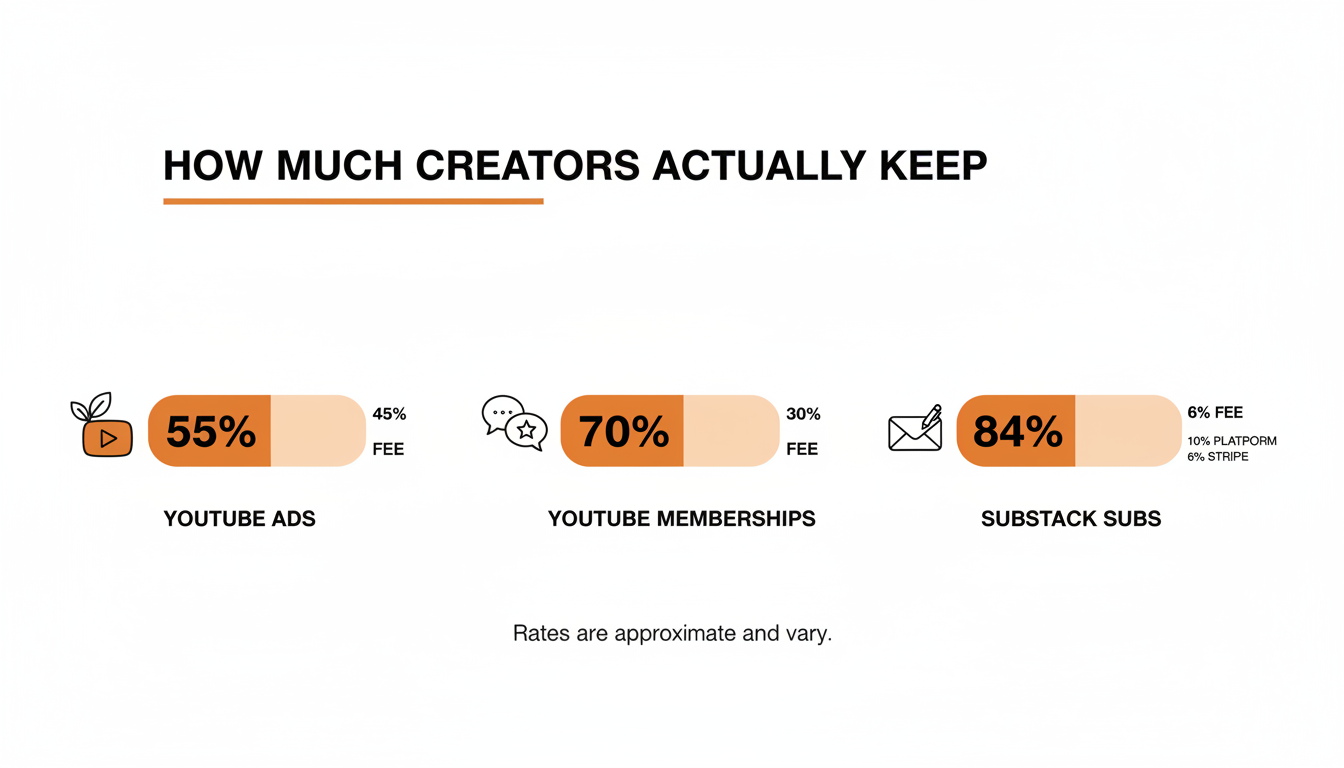
YouTube's ad revenue split is fixed and public: creators keep 55% of ad revenue on long-form videos, and YouTube keeps the other 45%, according to YouTube's own partner earnings overview. Channel memberships work differently. There, YouTube keeps 30% and creators keep 70%, similar to an app-store cut.
Substack's fee is a flat 10% of subscription revenue, confirmed directly on Substack's own support page, plus standard Stripe payment processing on top (roughly 2.9% plus $0.30 per transaction). On a $10 monthly subscriber, a writer nets around $8.40 after both fees.
| YouTube (ads) | YouTube (memberships) | Substack (paid subs) | |
|---|---|---|---|
| Platform cut | 45% | 30% | 10% |
| Payment processing | Included | Included | ~3% + $0.30/transaction |
| Approximate creator take-home | 55% | 70% | ~84% |
| Payout depends on | Views and CPM, which fluctuate by niche and season | Active paying members | Active paying subscribers |
| Income predictability | Low, resets every month | Moderate | High, recurring by design |
Ad revenue is also inherently unstable. CPMs shift with advertiser demand, seasonality, and the topic of the video itself. A finance channel earns a wildly different rate per thousand views than a gaming channel. Subscription revenue doesn't have that problem. A subscriber who pays $8/month pays roughly the same amount whether it's January or July, whether the news cycle is quiet or chaotic.
Why CPMs Swing So Much
CPM (cost per thousand views) is set by advertiser demand for a given audience and topic, not by the platform. Personal finance, software, and business content routinely commands a higher CPM than gaming, reaction content, or general vlogging, because advertisers in those categories pay more to reach that specific viewer. A creator can double their subscriber count and still see flat or falling income if their topic drifts into a lower-CPM category, or if Q1 advertiser budgets simply haven't reset yet. None of that volatility touches a Substack subscription price. The person paying $8/month agreed to $8/month, full stop, regardless of what advertisers are doing that quarter.
Discovery: YouTube's Search Engine vs Substack's Notes Network
Here's where YouTube wins outright, and it would be dishonest to pretend otherwise. YouTube is the second-largest search engine on the internet. A well-optimized video can keep pulling in new viewers for years off search alone, long after the creator stopped thinking about it. Substack has no comparable search surface. Discovery inside Substack runs almost entirely through Notes, the recommendation network, and other writers choosing to feature you, not through people typing queries into a search bar.
That's a real, structural gap, and it's the reason almost every creator who tries Substack-only growth eventually hits a ceiling. Substack's own recommendation network helps, and Notes function something like a public feed where a well-timed post can reach people who've never heard of you. But neither replaces the passive, compounding discovery that a search-indexed video library provides.
Practical rule: don't try to make Substack do what YouTube does. Use YouTube (or search generally) to find readers, and use Substack to keep the ones worth keeping.
The two systems complement each other more than they compete. A video answers a question a stranger searched for. A Substack subscription is the thing that stranger opts into after deciding they like how you think, not just what you know.
What Substack's Recommendation Network Actually Does
When a reader subscribes to a publication, Substack shows them a list of other publications the author recommends, and a share of readers who see that list subscribe to at least one of them. It's a real growth channel, and one of the few places on Substack where discovery happens somewhat passively. But it only works once someone has already found you through some other door, a Note, a mention, a link from another writer, a video description. It amplifies existing momentum. It doesn't create it from nothing the way a search-indexed video can.
The Real Numbers: 1,000 True Fans vs 1.2 Million Views
This is the comparison that actually changes how creators plan their year.
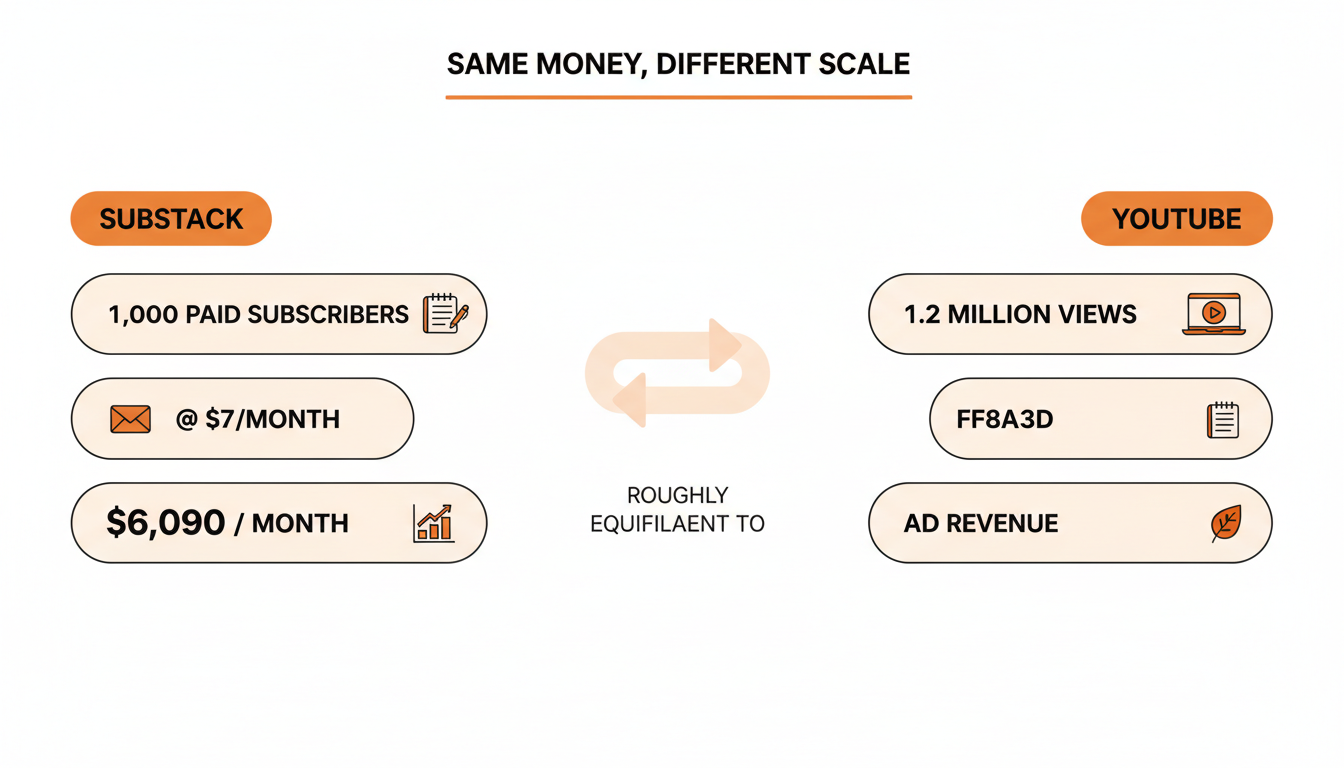
1,000 paid Substack subscribers at $7/month generates roughly $6,090 per month after fees, a figure multiple 2026 creator-economy analyses have converged on independently. To earn a comparable amount from YouTube ad revenue alone, at typical CPMs, a creator needs somewhere around 1.2 million monthly views. That's not a knock on YouTube's math, it's just what a 55% cut of a few dollars per thousand impressions works out to.
Put differently: a newsletter with an audience the size of a mid-sized Discord server can out-earn a channel with a stadium's worth of monthly viewers, as long as the newsletter converts a meaningful slice of readers into paying subscribers. One recent breakdown of creator revenue flows puts it plainly: video pays poorly per viewer, subscriptions pay well per subscriber, and the platforms that convert best are the ones built around a direct relationship rather than a feed.
📅 Struggling to stay consistent on Substack?
WriteStack's Smart Scheduling lets you batch and queue Notes in minutes. Grow on Substack without burning out.
Explore Smart SchedulingThat doesn't mean Substack is "better." It means the two platforms measure success in different units. YouTube rewards reach. Substack rewards depth. A creator chasing views should go where views convert to money fastest. A creator with something worth paying for monthly should go where a smaller, closer audience pays the most per person.
What You Give Up on Each Platform
Every platform extracts a price beyond the percentage cut, and it's worth naming both honestly.
On YouTube, you give up control. Demonetization can happen without warning for reasons that have nothing to do with quality. The algorithm can quietly stop recommending your videos to new viewers, and there's no appeal process that reliably fixes it. You're building on land you don't own, and the landlord changes the rules on their own schedule.
On Substack, you give up reach. There's no ad revenue if nobody's watching, and there's no search engine surfacing your archive to strangers who've never heard your name. Growth is slower and more manual, driven by word of mouth, Notes, and other writers recommending you, not by an algorithm doing the discovery work for you.
The part people don't expect: the biggest risk on either platform isn't the take rate, it's writing consistently enough for either model to compound. A YouTube channel that posts once a month doesn't build a search moat. A Substack that publishes once a quarter doesn't build a subscriber habit. WriteStack exists specifically for the second problem: it drafts new Substack Notes from what you've already published, so a slow writing week doesn't mean an empty feed, and it schedules chat posts, the one Substack format no other scheduling tool touches at all.
The Repurposing Playbook: Turning One Video Into a Week of Substack Content
The creators who do best long-term don't choose one platform, they sequence them. Film or write once, then break that single piece of work into everything a Substack presence needs for a week: a Note quoting the sharpest line, a follow-up Note responding to the top comment, a short recap post linking back to the full video, and a chat thread asking readers what they'd want covered next.
This is the exact workflow WriteStack's Note generator is built for. Paste in a video transcript or a finished post, and it drafts a batch of Notes in your existing voice instead of starting from a blank prompt, because it reads what you've already published rather than guessing at your tone from scratch. Queue the batch for the week in one sitting through WriteStack's scheduling, and the newsletter side of your business keeps running even during the week you're heads-down editing a video.
The repurposing habit matters more than any single piece of content. A creator who treats every video as five pieces of Substack material builds a newsletter audience roughly five times faster than one treating Substack as an afterthought.
Practical rule: repurpose before you publish something new. A backlog of unused video and podcast material is the single fastest way to fill a month of Notes without writing anything from scratch.
Why Most Successful Creators Run Both
The framing of "Substack vs YouTube" as a single choice mostly comes from creators early in their careers who only have time for one platform. Past a certain size, almost nobody actually chooses. The pattern that keeps showing up across 2026 creator-economy reporting is the same: YouTube for discovery, because nothing else on the internet finds new readers at that scale for free, and Substack for the recurring revenue that discovery eventually converts into.
Run WriteStack's heatmap against your own Notes and you'll typically see the pattern show up in your own numbers within a month or two: a spike in new Substack subscribers a few days after a video does unusually well, then a slower climb in paid conversions over the following weeks as those readers warm up. YouTube brings the crowd. Substack decides who in that crowd becomes a customer.
Neither platform is a phase to grow out of. They're two different jobs, discovery and retention, and trying to make one platform do both jobs usually means doing both worse.
How to Decide Which Platform to Build First
The right starting point depends less on preference and more on what you already have.
If You Already Have an Audience Somewhere Else
If you already have a YouTube channel, a TikTok following, or a podcast, start the Substack on day one rather than waiting until the video channel "feels big enough." Every video you publish is also free advertising for a newsletter that doesn't exist yet if you haven't started it. The subscriber who would have converted this month doesn't wait around for you to launch six months later. A newsletter with 200 subscribers earning real per-subscriber revenue beats a newsletter that doesn't exist yet, every time.
If You're Starting From Zero
With no existing audience anywhere, YouTube is usually the faster place to find the first readers, because it's the platform actively surfacing new content to strangers through search. Publish there first, but publish with the newsletter link in the description from video one, not video fifty. The mistake isn't choosing YouTube first, it's treating the newsletter as a someday project instead of building the habit of collecting email addresses from the very start.
Practical rule: whichever platform you start on, start collecting email addresses immediately. An audience you can only reach through a platform's algorithm is an audience you don't fully own yet.
Common Mistakes When Running Both Platforms
The failure mode isn't picking the "wrong" platform, it's running both badly at the same time. A few patterns show up again and again in creators who try to split their attention between the two.
The first is treating the newsletter as an afterthought, a link dropped in a video description that never gets its own promotion. A Substack that only exists as a footnote rarely grows past a trickle of subscribers, because nothing is actively pointing people toward it beyond a single line of text they may not even read.
The second is letting video production eat every hour, so the newsletter goes quiet for weeks at a time between videos. Subscribers who signed up expecting regular writing unsubscribe faster than viewers who skip a video they weren't going to watch anyway. A newsletter needs its own cadence, independent of the video schedule, even if that cadence is short Notes rather than full posts every week.
The third is publishing the same content in the same format on both platforms, word for word. A newsletter that's just a video transcript pasted into an email gives a subscriber no reason to read it if they already watched the video. The newsletter earns its subscription by adding something the video didn't: the reasoning behind a decision, a follow-up thought, a reader question answered in more depth than a comment section allows.
Substack and YouTube aren't really competing for the same dollar, they're solving two different problems in the same business. If you already have the audience and the content, the missing piece is usually the newsletter side staying consistent without eating every remaining hour in your week. Load a week of Notes into WriteStack in twenty minutes and watch the Substack side of the business run on its own while you go back to making the next video.