
Ninety percent of your Notes are getting 15 or more likes, even the throwaway ones. Your posts went from 2-5 likes to 20-40. People are actually talking to each other in your comments, not just past each other.
How do you actually build that on Substack, instead of just accumulating subscribers who never engage? This isn't a growth guide. It's what changes once growth turns into a publication people feel like they belong to.
One number worth having before you start: WriteStack has close to 100 verified reviews from Substack writers across multiple platforms. The other Notes scheduling tools we've checked have none that we could find anywhere.
Table of Contents
- Why "Community" Is the Wrong First Question - Step 1: Post Daily to Build Trust - Step 2: Start Real Conversations, Not Broadcasts - Step 3: Use Discussion Threads as a Shared Activity - Step 4: Show Up in Your Own Comments - Step 5: Save the Vulnerability for Posts, Not Notes - What This Looks Like Week to Week - Frequently Asked Questions
Why "Community" Is the Wrong First Question
Substack ran a community-building workshop for its own Fellowship program, led by Bailey Richardson, who helped shape the communities around Instagram, IDEO, and Pop-Up Magazine. The core takeaway from that workshop is that community-building tends to jump straight to tactics, publish a post, start a thread, host an event, before answering two questions first: who are you actually bringing together, and why do they want to come together at all.
Bailey's framing was to describe the audience by shared perspective rather than demographics. Not "35-44 year old urban professionals," but something closer to a shared passion or frustration, the kind of description where a stranger reads it and immediately knows whether they're in or out. The useful exercise is filling in one sentence: this community brings together [who] so we can [why]. Everything else, the notes, the threads, the comments, is just the mechanism for delivering on that sentence repeatedly.
Practical rule: don't start with "how do I get more engagement." Start with who this specific publication is for and what they'd actually want to do together. The tactics below only work once that's answered, because a discussion thread with no shared "why" behind it is just an empty comment box.
Bailey's workshop also pointed at a specific test for whether a shared activity is worth building around: it should be purposeful, participatory, and repeatable. Purposeful means it actually connects to the "why" from the one-sentence exercise above, not just an activity for its own sake. Participatory means readers do real work in it, not just consume something the writer made. Repeatable means it happens on a rhythm readers can learn to expect, closer to running a small recurring gathering than launching a one-time campaign. The five steps below are one version of that mechanism in practice.
Step 1: Post Daily to Build Trust
Posting daily Notes gives an audience more than reach. It gives them confidence that a writer is actually there. Consistency builds authority in a way that a single great post can't, because it demonstrates, repeatedly, that the writer shows up.
People generally dislike unpredictability. They want to know that a publication will still be there next week, publishing at roughly the pace it always has. A writer who shows up daily, even with a small Note, gets more credit for that reliability than most writers assume, because the alternative they're implicitly being compared against is every publication that started strong and went quiet after six weeks.
This doesn't mean posting anything just to hit a number. It means treating consistency itself as part of what's being built, not just a growth tactic separate from community.
Load a week of daily Notes in one sitting, so consistency doesn't depend on remembering every morning. WriteStack's batch scheduling queues a week's worth in about twenty minutes, which matters more for this specific goal than for growth alone, since a missed week doesn't just cost reach, it costs the trust that daily presence was building.
Step 2: Start Real Conversations, Not Broadcasts
Publishing consistently is the baseline. What turns an audience into something that feels like a community is direct, one-to-one contact with the people who actually show up.
Send a message to the people who engage with a Note or a post. Say hello, acknowledge specifically that they engaged, ask how they're doing. This doesn't need to be elaborate, and it doesn't need to happen with everyone every day, but doing it consistently with the people who keep showing up produces some of the most valuable relationships a publication builds, and they compound in a way a single popular Note never does.
Don't worry about this feeling like too much outreach. Reaching out to someone who already chose to engage with your writing isn't spam, it's acknowledging that a real person took the time to react to something. Most writers never do this, which is exactly why it stands out to the people who receive it.
This is also the step most writers skip entirely, because it doesn't scale the way a Note does and it doesn't show up in any analytics dashboard as a growth number. A single good direct message rarely produces a subscriber count anyone can point to. What it produces instead is a reader who now feels individually recognized inside a publication with hundreds or thousands of other subscribers, and that recognition is what gets repeated back when the same reader eventually recommends the publication to someone else.
Practical rule: the message doesn't need a pitch. "Saw you liked the piece on X, curious what made it land for you" does more for a relationship than any promotional note ever will.
Step 3: Use Discussion Threads as a Shared Activity
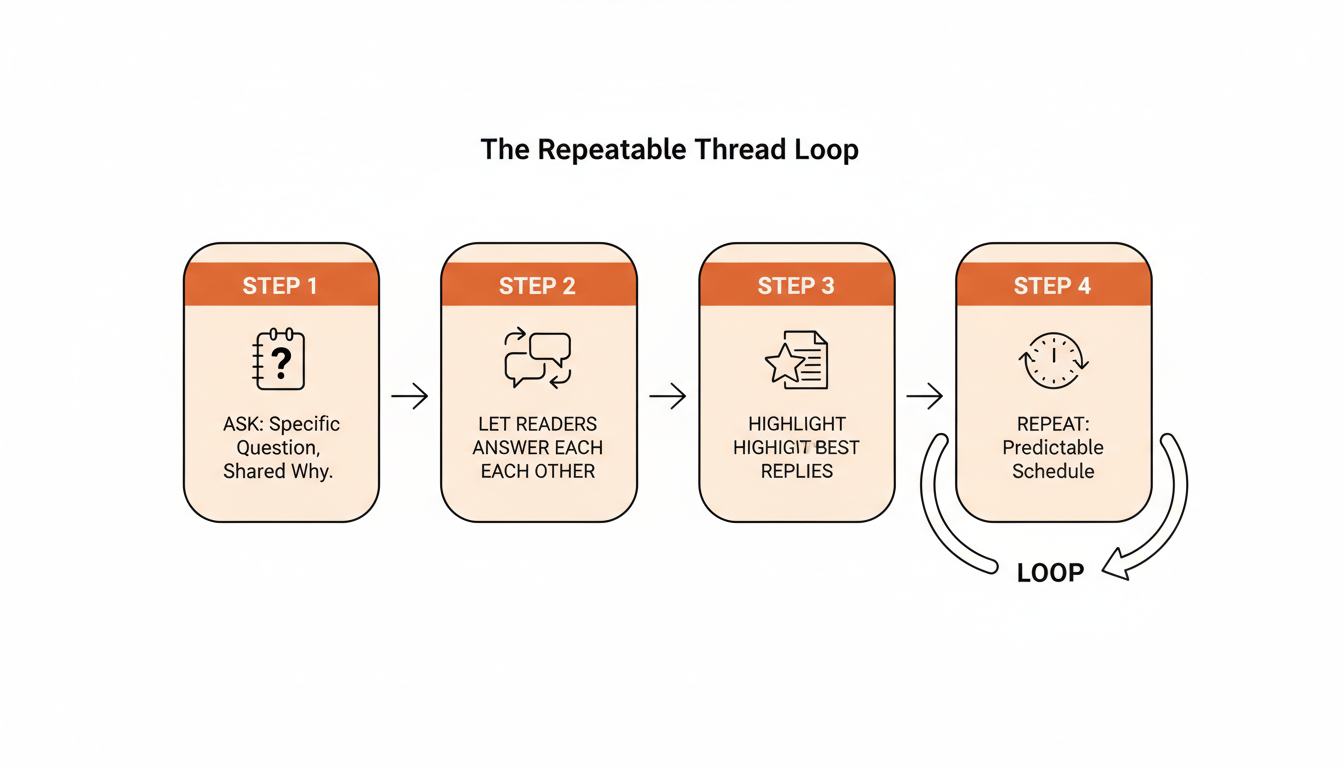
Substack's own community workshop landed on a specific mechanism for this: discussion threads. The logic is that people come together to do something that's better in a group, teaching each other, supporting each other, or simply meeting up around a shared moment, and a thread is the lowest-friction way to create that shared activity inside a publication readers already subscribe to.
Applying the purposeful, participatory, repeatable test from earlier, three formats consistently hold up:
- A recurring open thread. A regular "what are you working on this week" or "what's on your mind" thread that readers learn to expect, the way a regular meetup becomes a habit.
- A teaching thread. Ask readers to share something specific they know, a recommendation, a tip, a resource, so the value in the thread comes from the readers, not just the writer.
- A support thread. Pose a question that readers are more likely to answer honestly to peers than to a writer directly, and let the replies build on each other.
📅 Struggling to stay consistent on Substack?
WriteStack's Smart Scheduling lets you batch and queue Notes in minutes. Grow on Substack without burning out.
Explore Smart SchedulingStep 4: Show Up in Your Own Comments
What tends to separate Substack from platforms built around advertising is that people are there to be part of something, not primarily to be sold to. That doesn't mean a writer shouldn't sell anything, selling is one legitimate way of being useful with a specific skill, but it does mean the baseline expectation is presence, not promotion.
Like the Notes worth liking. Comment when there's something real to add. Offer help when a reader asks for it directly. None of this needs to be constant, but it needs to be genuine and it needs to be visible, because readers can tell the difference between a writer who occasionally shows up in their own comment section and one who never does.
There's a version of this that gets overdone, replying to every single comment with a generic thank-you regardless of what was said. That's closer to broadcasting than presence, and readers notice the difference just as quickly as they notice absence. The comments worth replying to are the ones that actually say something, a disagreement, a follow-up question, a personal story the reader added. Those replies are what signal that the writer read the comment rather than just acknowledged it exists.
See which readers are engaging the most, so the outreach in Step 2 goes to the right people first. WriteStack's Fans view surfaces a publication's most engaged readers across Notes and posts, instead of relying on memory for who keeps showing up.
Step 5: Save the Vulnerability for Posts, Not Notes
Posts are where real trust gets built, not Notes. This is the place to open up, share the experience that didn't go well, lay out the detailed process, demonstrate the actual expertise behind the publication. A post should combine a personal narrative with something genuinely useful, not one or the other.
Doing this on a predictable weekly rhythm builds trust and anticipation in a way that sporadic long posts never manage, because each post starts to build on the ones before it, creating something closer to a body of work than a scattered feed. Quality wins over quantity here specifically. A publication is better served by one strong post every week or two than by three rushed ones.
This is also where the "who" and "why" from the first step come back around. A post that opens up about a real experience only builds community if it's a real experience the specific audience actually cares about, not just personal disclosure for its own sake. The vulnerability has to connect to the shared reason readers are there in the first place, or it reads as oversharing rather than trust-building.
The part people don't expect: the writers who build the most durable communities aren't the ones who post the most. They're the ones whose readers can predict, roughly, what a new post from them is going to feel like, because the writer has been consistent about what they're actually willing to say.
What This Looks Like Week to Week
Put together, a realistic week looks something like this: daily Notes to stay present, a handful of direct messages to readers who engaged that week, one recurring discussion thread that readers now expect, ongoing replies in the comments as they come in, and one well-built post that goes deeper than any Note could.
None of these steps individually feels like "building a community." Together, repeated for a few months, they produce exactly that. The mechanism is closer to running a small, recurring gathering than executing a growth campaign, and it rewards showing up over any single clever tactic.
The publication described at the start of this piece, 90% of Notes earning 15 or more likes, post engagement climbing from single digits to 20-40, didn't get there through a single viral moment. It got there by running roughly this rhythm for months, long enough that regular readers started replying to each other in threads without being prompted, and long enough that direct messages sent to engaged readers turned into actual ongoing conversations rather than one-off pleasantries. That timeline is normal. Communities are built on repetition, not on any individual post or Note landing exceptionally well.
Run this rhythm without it eating the whole week. WriteStack queues the daily Notes, tracks which readers are worth reaching out to, and keeps the Activity Center in one place instead of five browser tabs, so the actual writing and replying gets the time instead of the logistics around it.
Frequently Asked Questions
What's the fastest way to build a community on Substack?
There isn't a fast version, based on this approach. The fastest thing that resembles it, a viral Note, produces subscribers, not community. Community comes from repeated, direct contact with the same people over time, which by definition takes time.
Do I need paid subscribers to have a real community?
No. The mechanisms here, daily presence, direct outreach, discussion threads, showing up in comments, work identically for a free list. Paid subscriptions are a monetization decision, separate from whether readers feel like part of something.
How often should I post to build community, versus just to grow?
Growth tolerates inconsistency better than community does. A publication can go viral once and gain subscribers from a single Note. Community depends on readers being able to predict that a writer will be there, which requires actual consistency, not a single spike.
What if my niche is too small for a real community?
A small, specific "who" and "why" tends to work better for this than a broad one. Substack's own guidance points at exactly this: a publication that can be described in one precise sentence gives readers a clear reason to feel like insiders, which a broad, generic publication rarely manages.
What's the single highest-impact step if I only have time for one?
Direct outreach to readers who already engaged. Posting daily and running threads both depend on an audience that's already paying attention, but the message to someone who liked a Note is the step that turns a passive reader into someone who feels like they know the writer, and that's the actual definition of community rather than reach.
The Actual Difference
A publication with subscribers and a publication with a community produce the same subscriber count on paper and feel completely different to run. The difference isn't a growth tactic, it's whether readers know who else is there, what they're all doing together, and whether the writer actually shows up. Keep the daily presence and the direct outreach running without it consuming every morning, and the rest tends to follow from there.