
I get asked some version of this question almost every week: how long should a Substack post actually be? Most of the answers floating around are opinions dressed up as rules. 800 words. No, 1,500. No, whatever the idea needs.
Instead of adding another opinion, I pulled wordcount and engagement data from 2.6 million Substack posts published since the start of 2024 and looked at what happens to reactions and comments as posts get longer. How long should a Substack post be? For most posts, 800 to 2,000 words, with quick updates sitting under 500 and essays running past 2,000 when the argument earns the room. Reactions climb steadily with length all the way to about 3,000 words and then flatten, which means the flat "800 to 1,200 words" number you will find on most blogs sits near the bottom of that climb rather than at the top of it.
This piece walks through what the numbers show, where the tradeoffs are, and how to pick a length for each type of post you write. It also covers Notes, where the answer is much tighter and where we have our own data: a 20,000-Note sample that puts a real number on how long a Note should run.
I run into this same question running WriteStack's own publishing schedule. Some weeks the idea is a two-paragraph observation. Other weeks it's a full breakdown that needs room to build an argument. Treating both as if they had to hit the same word count was the mistake, not the length itself.
One number worth having before you start: WriteStack has close to 100 verified reviews from Substack writers across multiple platforms. The other tools writers use to plan and schedule Substack content have none that we could find anywhere. Every length number below comes from a dataset we can point at, and so does every claim about the product.
Table of Contents
- How Long Should a Substack Post Be? What 2.6 Million Posts Show
- The Sweet Spot Is Wider Than Most Advice Admits
- Short Posts Win on Efficiency, Long Posts Win on Reach
- When to Write Short (Under 800 Words)
- When to Write Long (Over 2,000 Words)
- How Long Should a Substack Note Be? 20,000 Notes, One Answer
- The Gmail Truncation Limit You Need to Know About
- Matching Length to Post Type: A Quick Reference
- What a Long Post Is Worth After You Publish It
- Is Your Post Too Long or Too Short? How to Tell
- Build a Length Habit Without Burning Out
How Long Should a Substack Post Be? What 2.6 Million Posts Show
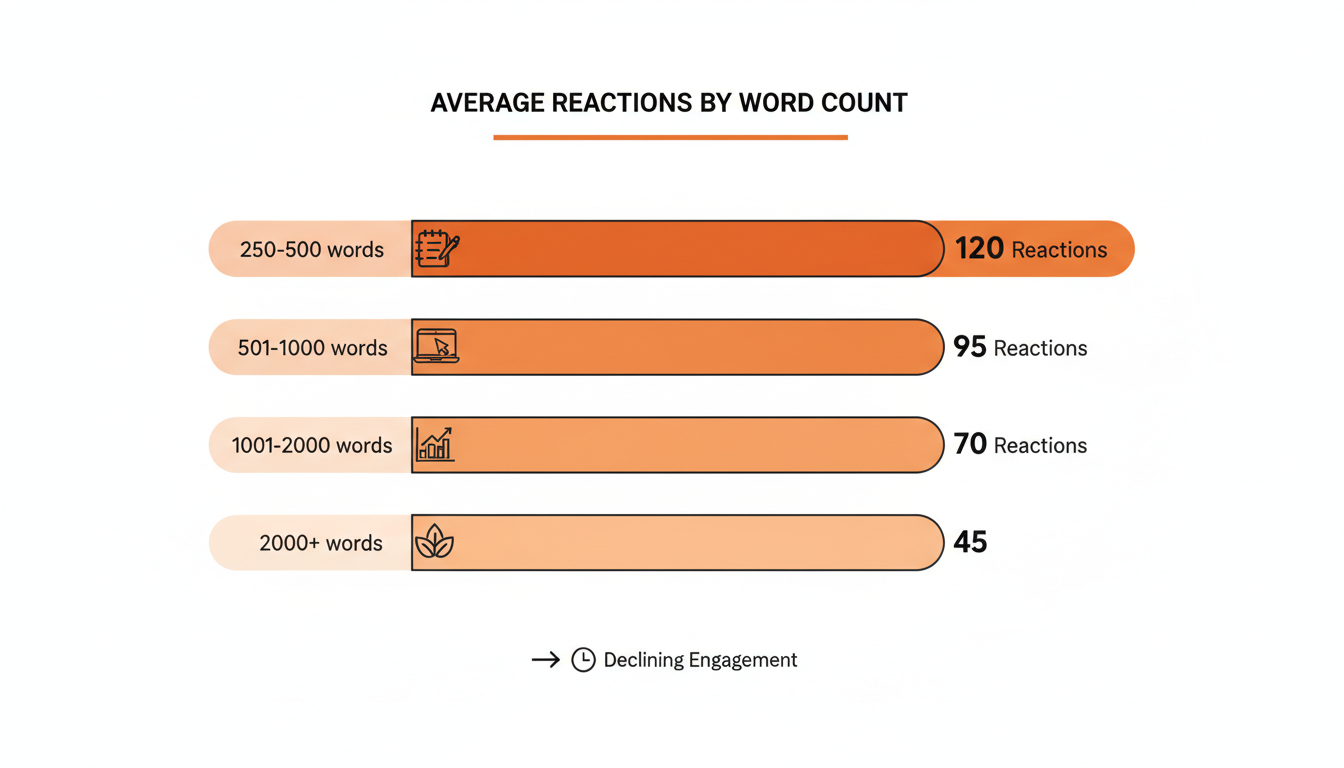
We pulled wordcount, reaction counts, and comment counts for 2,671,379 Substack posts published from January 2024 onward and grouped them into six length buckets. The average post in this set runs 1,140 words. The median is 868, which tells you the distribution is skewed by a smaller number of very long posts pulling the average up.
Here's what average engagement looks like by bucket:
| Word count | Posts in sample | Avg. reactions | Avg. comments |
|---|---|---|---|
| Under 500 | 761,224 | 13.9 | 2.8 |
| 500–799 | 470,495 | 16.7 | 3.4 |
| 800–1,199 | 537,146 | 21.3 | 4.3 |
| 1,200–1,999 | 548,995 | 27.4 | 5.3 |
| 2,000–2,999 | 217,296 | 32.3 | 6.6 |
| 3,000+ | 136,222 | 33.4 | 6.8 |
Practical rule: raw engagement climbs steadily with length through the 2,000–2,999 word range, then flattens. Going from 3,000+ words back down to under 500 costs you more than half your average reaction count.
This lines up with an independent analysis of 94,391 Substack posts by Write Build Scale, which found long-form posts (2,000+ words) win on raw reactions while posts under 500 words win on reactions per word written, with the 1,000-to-2,000-word range acting as the workhorse zone for most newsletter writers.
Where This Data Comes From
The sample pulls from a corpus of roughly 3 million scraped Substack posts across about 62,000 publications, filtered here to posts published from January 2024 onward with a recorded wordcount and reaction count. Reaction and comment counts are public Substack metrics, visible on any post, so this is aggregate behavior across a wide mix of niches, publication sizes, and posting frequencies, not a single writer's experience. That breadth is the point: a benchmark built from a handful of newsletters can be skewed by one or two outliers, while a few million posts averages that noise out.
Two things this data does not measure. Reactions and comments come from people who already opened the email, so open rate sits outside the sample. Paid conversion sits outside it too. Length almost certainly moves both numbers, just not in a way this particular dataset can show directly. Everything below that says "the data shows" is talking about reactions and comments, and nothing else.
That same gap is the reason I stopped guessing on my own publication. WriteStack tracks how your posts and Notes performed over time and compares your restack rate against other publications your size, so the platform-wide averages above become a floor to measure yourself against rather than a rule to obey. Start a free 7-day trial and see your own length pattern in an afternoon.
The Sweet Spot Is Wider Than Most Advice Admits
Most "ideal Substack length" advice lands on a single number: 800 words, or maybe 1,200. Looking at nearly three million posts, there isn't one number. There's a range, and it's wider than the advice columns suggest: 800 to 2,000 words consistently outperforms both shorter and much longer posts on a reactions-per-post basis without asking a reader to commit to a 15-minute read.
Below 800 words, a post reads as a quick take. Above 2,000, it reads as an essay a reader has to set aside time for. Both work. What performs worse is writing in the 500-to-800 range out of habit when the topic actually needed more room, or padding a 600-word idea out to 1,500 because somewhere you read that longer performs better.
Practical rule: pick a length by asking what the idea needs first, then check it against the 800-to-2,000-word range as a sanity check, not the other way around.
The range also shifts a little by niche. Publications built around fast commentary on current events tend to cluster shorter and still perform well, because the format itself trains readers to expect a quick take. Publications built around research, personal essays, or long-form reporting cluster longer, because readers who subscribe to that kind of newsletter came for depth. The 800-to-2,000-word range is a platform-wide average, not a ceiling or a floor for every publication.
Short Posts Win on Efficiency, Long Posts Win on Reach
There are two different questions hiding inside "how long should my post be." One is which length gets the most total engagement. The other is which length gets the most engagement per word you actually wrote. They have different answers.
Dividing average reactions by the midpoint word count of each bucket gives a rough efficiency score. Posts under 500 words generate roughly 0.056 reactions per word. Posts in the 800-to-1,199 range generate about 0.021 reactions per word. Posts over 3,000 words generate about 0.010 reactions per word. Short posts are a dramatically more efficient use of your writing time on a per-word basis, even though they generate less total engagement than a long post.
Put another way: a writer publishing four 400-word updates a month spends roughly 1,600 words to reach an audience, while a writer publishing one 2,500-word essay a month spends more words and collects fewer reactions per word invested. Short posts pay you back per word. Long posts pay you back per post. Both patterns build a newsletter, and the mistake is ending up in one of them by accident instead of picking it.
That distinction matters for how you plan a week of writing. A 400-word update takes twenty minutes and still pulls solid engagement for the effort. A 2,500-word essay takes hours and pulls more total engagement, at a much lower return per word. Different tools for different weeks.
Treat it as a budget question rather than a quality question. If you write three posts a week, a mix of one short update and two medium posts usually beats three attempts at 2,000-word essays, because the essays start competing with each other for your best ideas and your limited drafting time. Save the long format for the weeks an idea genuinely earns it. The mix is easier to hold when the week is visible in front of you, which is what WriteStack's queue and calendar view are for: you assign the Thursday essay its slot and fill the gaps with short pieces instead of discovering on Wednesday night that you owe yourself two thousand words.
When to Write Short (Under 800 Words)
Short posts earn their place in a Substack when the content genuinely doesn't need more room. Padding a short idea to hit a length target is the fastest way to lose a reader halfway through, and it shows up in the data as posts that get plenty of opens but a thin trickle of comments, because there wasn't enough there to respond to.
Quick Updates and Link Roundups
Status updates, "here's what I'm reading," and quick announcements all belong in the under-500-word bucket, which is also the bucket with the best reactions-per-word ratio in the data above. Readers open these expecting a fast read, and a fast read is what keeps the open habit intact.
Behind-the-Scenes Notes
Personal, process-oriented posts (what you're working on, a small decision you made, a lesson from the week) tend to sit in the 500-to-800 range. These posts trade depth for immediacy, and immediacy is the point.
When to Write Long (Over 2,000 Words)
Long posts earn their length when the topic has enough real substance to fill it. The data shows readers reward this, but only when the extra length is doing work. The tell is usually in the drafting process itself: if cutting a paragraph would leave a hole in the argument, the post has earned its length. If cutting a paragraph makes the post read tighter, it hadn't.
Deep-Dive Essays
Arguments, analysis, and personal essays that build to a conclusion belong in the 1,500-to-3,000 range. These are the posts most likely to get restacked and to bring in new subscribers, because they give a reader who's never seen your work before a full picture of how you think in one sitting.
This is also the format most worth linking to from social platforms and other publications, since a short post rarely gives a new reader enough to decide whether to subscribe. A long essay does that work for you: someone who lands on it from a restack or a link on Notes can read the whole argument and get a real sense of your voice before they ever see a second post.
📅 Struggling to stay consistent on Substack?
WriteStack's Smart Scheduling lets you batch and queue Notes in minutes. Grow on Substack without burning out.
Explore Smart SchedulingGuides and Resource Posts
How-to content, resource roundups, and reference posts (the kind a reader bookmarks and comes back to) regularly run 2,000 to 3,500 words and still perform well, because the reader isn't reading it in one sitting. They're scanning for the section that answers their question.
Practical rule: before writing past 2,500 words, check whether the post is actually one long idea or two medium ones stapled together. Two focused 1,200-word posts usually beat one unfocused 2,800-word post.
How Long Should a Substack Note Be? 20,000 Notes, One Answer
Post length is a range. Note length is close to a number, and this is the half of the question where the advice online is weakest, because almost nobody publishing length advice has the Notes data to check it against.
We do. From a sample of 20,000 recent Notes:
- Notes of 150 to 300 characters beat Notes under 50 characters by roughly a third on reactions, and by more than that on restacks.
- Multi-line Notes averaged about 11% more reactions and about 28% more restacks than single-line Notes. The restack gap is the one that compounds, because restacks are how a Note reaches people who have never heard of you.
150 to 300 characters is roughly two to four sentences, which lands as a complete thought with a line break in the middle rather than a one-liner fired off from a phone. The one-liner is the format most writers default to, and it's the format the data likes least. A Note under 50 characters gives a reader nothing to react to and nothing to restack into their own feed, so it collects a few likes from people who already follow you and then stops moving.
The practical version: write the Note as two short paragraphs. Open with the claim, break the line, then land the specific detail or the number underneath it. That shape hits 150 to 300 characters almost automatically, and it's the shape that carried both the reaction and the restack gap in the sample.
| What you want to know about length | Substack's own dashboard | WriteStack |
|---|---|---|
| Which Note length actually earns restacks for you | No | Yes, benchmarked against a 20,000-Note sample |
| Which link inside a Note got the click | No | Yes, per link, back to your first Note |
| How your restack rate compares to publications your size | No | Yes |
| Whether engagement is climbing or sliding month over month | No | Yes, trend view over time |
| Turn lines from a published post into drafted Notes | No | Yes, drafted from your own published work |
| Schedule a Substack chat post | No | Yes, and no other tool in the category does it |
| See a full week of scheduled Notes at once | Drafts list only | Queue and calendar view |
| Verified reviews from Substack writers | Not applicable | ~100 across multiple platforms |
WriteStack's Notes generator drafts in that 150-to-300 character shape by default, and drafts it from Notes and posts you have already published, so the output starts in your voice instead of arriving at it after three rounds of editing. Start your free trial and load a week of Notes in twenty minutes.
The Gmail Truncation Limit You Need to Know About
There's a technical ceiling that has nothing to do with reader preference. According to Substack's own help documentation, there's no hard word count limit on a Substack post, but email providers like Gmail will truncate messages that exceed 102KB. Substack's post editor shows a warning once a draft crosses that size, and readers who get a clipped email have to click "View entire message" to see the rest.
102KB of formatted HTML usually works out to somewhere around 5,000 to 8,000 words depending on how many images and links are in the post, so most writers never hit it. Only 136,222 posts in the entire 2024-onward sample, about 5% of the total, cross the 3,000-word mark, and the truncation limit sits well past even that group for most posts. If you're publishing a long research piece, a full interview transcript, or a big list post with lots of embedded links and images (each of which adds to that 102KB total), check the editor for that warning before you hit publish.
Practical rule: if the editor flags truncation, either trim the post or split it into a two-part series. A clipped ending is a worse reader experience than a shorter post.
A two-part series has a scheduling problem attached to it, since part two needs to land while part one is still in a reader's head. WriteStack handles that by letting you set both dates in one sitting and queue the Notes that point at each part alongside them, so the series ships on the rhythm you planned rather than whenever you next remember it.
Matching Length to Post Type: A Quick Reference
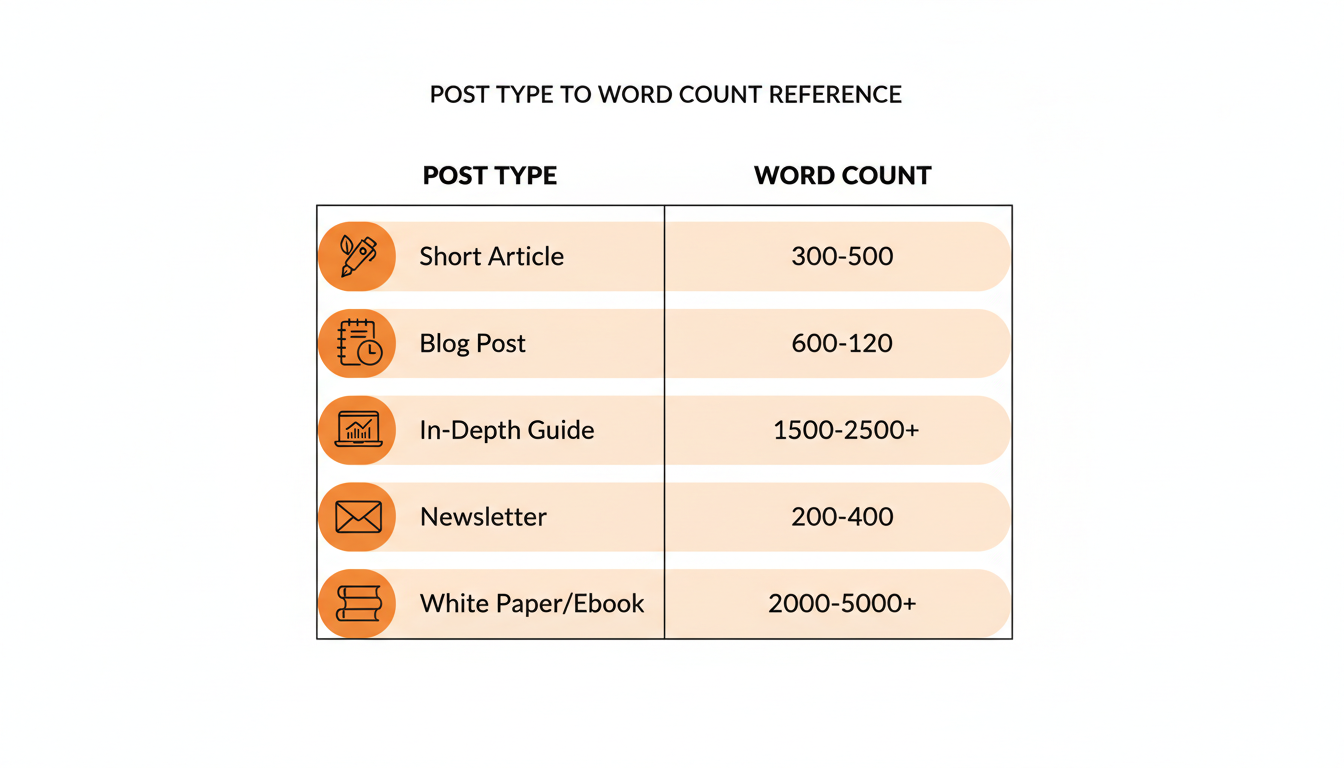
| Post type | Typical length | Why |
|---|---|---|
| Substack Note | 150–300 characters, multi-line | Beat sub-50-character Notes by ~a third on reactions in a 20,000-Note sample |
| Quick update or link roundup | Under 500 words | Best reactions-per-word; readers expect a fast read |
| Personal note or behind-the-scenes | 500–800 words | Immediacy over depth |
| Standard weekly post | 800–1,200 words | Matches the median post length on the platform |
| Long essay | 1,500–3,000 words | Highest total engagement in the data; best for new-subscriber conversion |
| Guide or resource post | 2,000–3,500 words | Scanned, not read start to finish; length supports usefulness |
This table is a starting point, not a rulebook. A publication with a tight, consistent niche can often run shorter across the board and still perform well, because readers already know what they're getting. A publication that mixes formats week to week (a quick Monday update, a long Thursday essay) can use the table to decide which bucket each post should aim for before drafting starts, rather than deciding length after the draft is already written.
Formatting also changes how long a post feels, independent of the actual word count. A 2,000-word post broken into short sections with subheadings and the occasional list reads faster than a 1,200-word post written as one dense block of text. Before cutting words to hit a shorter target, try breaking the existing draft into smaller chunks first. Often the length was fine and the formatting was the actual problem.
What a Long Post Is Worth After You Publish It
The whole length debate assumes a post is worth whatever it earns on publish day. That assumption is why long posts feel expensive. Three thousand words, hours of drafting, one send, one spike of reactions, then the archive.
A long post is worth far more when its best lines get pulled back out as Notes over the following weeks. A 3,000-word essay usually contains eight or ten sentences that stand on their own: the claim, the number, the counterintuitive bit in the middle, the line you almost cut. Each of those is a 150-to-300 character Note, which is exactly the length the sample above says performs. The essay stops being one publish day and becomes a month of feed presence pointing back at itself.
Doing that by hand is the part people quietly skip, because rereading your own 3,000-word post to mine it for Notes is a chore nobody schedules. WriteStack's AI drafts from your published posts, so the essay becomes a week of Notes in your own voice rather than generic AI phrasing you rewrite three times. If a draft misses, you switch models instead of living with one fixed voice.
The part people don't expect
WriteStack's link-click tracking runs across your full Notes history, per link inside each Note, going back to your first one. So after you pull ten lines out of a long essay and queue them as Notes, you can see which of those lines actually sent readers back to the full post, and which ones just collected likes. That turns "long posts get more reactions" into "this specific paragraph drove 40 people into the archive." It also schedules Substack chat posts, which no other tool in this category does at all, and it benchmarks your restack rate against other publications your size and shows the direction it's moving month over month. Not better than last week. Better than the field.
Once you can see which pulled lines drove clicks, the length question changes shape. A 3,000-word essay that yields six high-performing Notes is worth writing again next month. A 3,000-word essay that yields nothing quotable was two medium posts in a trench coat, and now you have the receipt.
Is Your Post Too Long or Too Short? How to Tell
The aggregate data is useful for planning, and the real answer for your own newsletter is in your own post history alongside it.
Signs a Post Ran Long
Open rate holds steady but click-through and comments drop off partway through a post, or you notice the second half of long posts consistently underperforms the first half. That's a sign the length isn't earning its keep for that particular topic.
Signs a Post Ran Short
Comments regularly ask a question the post could have answered directly, or readers reply asking for more detail on a specific section. That's a sign the post cut itself short before finishing the thought.
The only way to see these patterns is to look at how your own past posts performed by length and topic. A newsletter with 500 subscribers and a newsletter with 50,000 subscribers can have completely different length patterns even in the same niche, because the audience that stuck around got there for different reasons. WriteStack's heatmap shows which of your posts and Notes drove opens and engagement over time, so you can read your own length pattern instead of applying someone else's. Most writers also overestimate how consistent they've been until they see the gaps laid out.
Practical rule: review your last ten posts by length and engagement before changing your default word count. Your own data usually overrides the general trend.
Build a Length Habit Without Burning Out
The biggest risk with any of this isn't picking the wrong length once. It's trying to hit a specific word count every single week regardless of what the post actually needs, which is a fast way to start dreading the blank page. Writers who quit Substack rarely quit because a post ran short. They quit because writing started to feel like homework, and a rigid length target is one of the easiest ways to make that happen.
A better habit is deciding the post type before you start writing, not the word count. A quick update gets twenty minutes and stays under 500 words. A long essay gets blocked time on the calendar and runs as long as the argument needs, usually landing in the 1,500-to-3,000 range from the data above. Notes get two short paragraphs and 150 to 300 characters. Planning the type in advance, rather than staring at a blank draft trying to guess how long today's post should be, is what keeps a publishing schedule alive past the first few months.
Six weeks into running that way, the change isn't that you write longer or shorter. It's that you stopped renegotiating the target every Monday. The Note is already queued at 200 characters because that's the shape the generator drafts in. The essay is on the calendar for Thursday. The ten lines worth pulling out of last month's long post are already scheduled across the next two weeks, and the click data tells you which of them earned their slot. Length stops being a decision you make under pressure and becomes a setting you chose once.
That's the whole layer dedicated tooling exists for: WriteStack drafts Notes at the length the data supports, in your voice, from the posts you already published, then tracks the link clicks, the restack rate against publications your size, and the direction both are moving. Close to 100 verified reviews from Substack writers back that up, and no other tool doing this work has any we could find.
Start a free 7-day trial. Turn your next long post into a month of Notes, and let the click data tell you which lines were worth the word count.