
You post a Note. Fourteen people like it. Nobody says anything back.
That silence is the normal outcome on Substack, not the exception. How do you actually get replies on Substack Notes, instead of just likes? We pulled 655,056 Notes published in July 2026 and measured exactly what separates a Note that starts a conversation from one that just collects hearts.
One number worth having before you start: WriteStack has close to 100 verified reviews from Substack writers across multiple platforms. The other Notes scheduling tools we've checked have none that we could find anywhere.
Table of Contents
- Why Most Notes Get Zero Replies - Does Asking a Question Actually Work? - Where the Question Goes Matters More Than Whether You Ask One - What Kind of Question Actually Earns a Reply - The Link Tax: Why URLs Kill Replies - Do Replies Actually Grow Your Subscriber Count? - Six Closing Lines That Pull Replies - Writing Notes That Earn a Reply, Not Just a Like - Frequently Asked Questions
Why Most Notes Get Zero Replies
Of the 655,056 Substack Notes published in July 2026 with body text, 405,147 finished with zero replies. That's 61.8%. The median Note in that silent group collected two likes and one conversation with nobody, according to our full analysis of the dataset.
Most advice about fixing this comes down to "ask a question." That's fine, except 18.1% of English Notes in the sample already contain a question mark, and only 38% of all Notes get even one reply. If asking a question were enough on its own, those two numbers would be closer together. They aren't, which means the advice is underspecified rather than wrong.
Practical rule: a question mark doesn't earn a reply on its own. What matters is where the question sits, what it asks for, and whether the reader can answer it without leaving the app.
It's worth being clear about what a "reply" actually is here, since it's easy to conflate with likes or restacks. A like costs the reader nothing beyond a tap. A restack shares the Note to their own audience without requiring them to add anything. A reply is the only one of the three that asks the reader to produce original text, which is why it's both the rarest action and the one that signals real attention rather than a passing glance.
Does Asking a Question Actually Work?
Across the full 655,056 Notes, question openers average 2.41 replies against 1.36 for every other kind of opener. That gap could be explained by reach alone, so we controlled for it directly: inside every single like bin, question-opening Notes still pull between 1.8 and 2.6 times the replies of Notes with the identical number of likes. Pooled and weighted across bins, question openers average 10.83 replies against 5.57 for everything else, at matched reach. A lift of 1.94.
The consistency is what makes this a real effect rather than a fluke. A confound would have to inflate replies by roughly the same factor at 3 likes and at 500 likes, which isn't how reach artifacts behave.
Why a Question Works Mechanically
A like is a one-tap exit. A reply requires the reader to compose something, which means the Note has to hand them a sentence they already half know how to write. A question at the top of a Note starts that composition before the reader has decided whether to keep scrolling.
Where the Question Goes Matters More Than Whether You Ask One
Splitting question-containing Notes by where the question actually sits changes the whole picture. The opener isn't the strongest position.
| Question position | Avg. replies at matched likes |
|---|---|
| Closes on a question | 11.38 |
| Opens on a question, closes on something else | 9.96 |
| Question buried in the middle | 7.33 |
| No question at all | 5.24 |
Restricting to multi-line Notes only, so position is genuinely a choice rather than an accident of length, closing on a question beats putting it anywhere earlier by 1.46 times. Only 4.6% of English Notes in the sample end on a question mark, which makes this one of the cheapest unclaimed moves on the platform right now.
Practical rule: if a Note is going to contain a question, save it for the last line. The last line is the one the reader is holding when their thumb reaches the reply box.
The mechanism explains why. A question at the top has to survive the whole body before it gets acted on, and by the last paragraph the reader has usually replaced it with whatever the Note actually argued. Ending on the question removes the gap between the prompt and the reply box.
What Kind of Question Actually Earns a Reply
This is the part of the advice that "ask a question" always skips: not every question is equally answerable.
Questions that address the reader directly, using "you" or "your," average 10.88 replies at matched like counts against 7.92 for abstract questions with no "you" in them. A lift of 1.37. The harder version of a question does close to nothing: questions opening with "why" or "how" average 0.94 times the replies of other questions at matched reach, which is no lift at all, and at 100 likes and above they run slightly behind.
Narrowed further, questions in the closing line that ask for a specific, retrievable item ("what's your," "which," "name one," "what are you") run at 1.84 times the matched baseline.
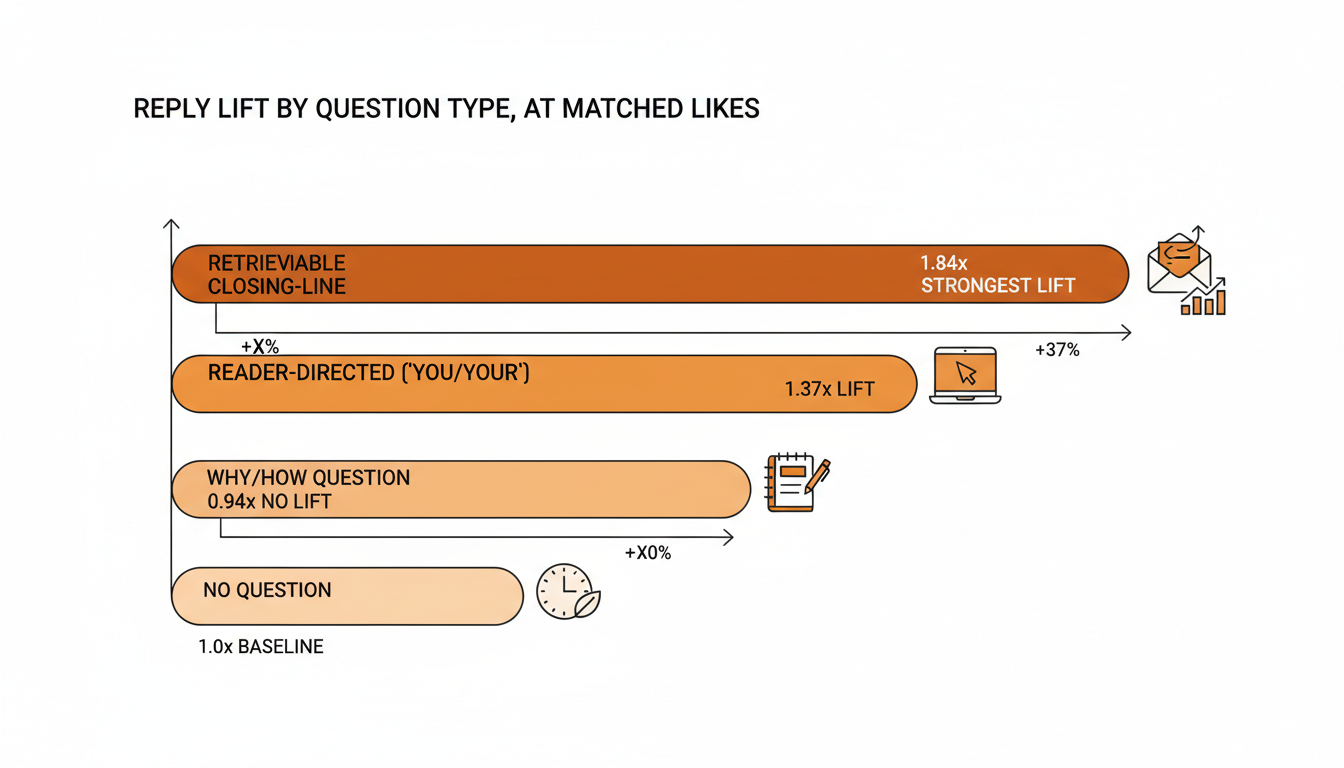
The part people don't expect: "Which novels made you want to write fiction" and "how do we fix publishing" both look like questions. Only one of them has an answer sitting in the reader's head already. The second one asks for an essay, and the reader correctly decides they don't have time to write an essay in a comment box, so they like it and move on. The gap has to be the size of a sentence the reader has already said out loud before.
The Link Tax: Why URLs Kill Replies
English Notes containing a URL average 5.07 replies at matched like counts against 6.95 for Notes without one. A lift of 0.73, meaning a real loss. The penalty shows up in nine of nine like bins, from 0.52 at zero likes to 0.84 at 50-99 likes. Narrowed to the closing line specifically, Notes whose last line is a link or a subscribe pitch run at 0.81 of the matched baseline.
A link converts the Note from a place to say something into a doorway to somewhere else, and the reader who taps it is no longer in the feed to reply. It also changes what the last line is asking for: a closing URL asks for a click, and a reader gives the platform exactly one action per Note.
📅 Struggling to stay consistent on Substack?
WriteStack's Smart Scheduling lets you batch and queue Notes in minutes. Grow on Substack without burning out.
Explore Smart SchedulingWant the full breakdown of link placement, including the exact character count that recovers most of the lost reach? WriteStack's Notes composer flags this while you draft, before the Note goes out, not after it underperforms.
Do Replies Actually Grow Your Subscriber Count?
Binning Notes by likes and splitting each bin at its median reply count, high-reply Notes acquired 26.0 subscribers per 100 Notes against 21.7 for low-reply Notes with the identical number of likes. A lift of 1.20. A permutation test that shuffles reply counts within like bins puts that at p = 0.031, unlikely to be noise, though not a landslide either. Clicks moved by the same factor.
Two honest caveats worth stating plainly. The lift is consistent in direction across every bin measured, but it shrinks as reach grows, from 1.93 in the 1-to-2-like bin down to roughly parity above 100 likes. And a reply half isn't a randomized treatment, so some of this is simply that better Notes get both more replies and more subscribers. The useful reading is modest: at the reach most writers actually have, a Note that starts a conversation is worth about a fifth more than one that doesn't.
There's a real cost on the other side, too. Question openers earn fewer likes overall, 14.6 against 18.4 for the "other" category. But the median question Note and the median non-question Note both get exactly 3 likes. The gap only opens at the 90th percentile, 22 likes against 28, and widens from there into the averages. Question Notes aren't disliked. They're less likely to produce a viral outlier.
Practical rule: if the goal is one Note that reaches 40,000 people, a question opener is the wrong instrument, because the ceiling is lower. If the goal is a Note that produces conversations you can convert, the median outcome is unchanged and the reply count roughly doubles. Most writers under 5,000 subscribers were never competing for that tail anyway.
Six Closing Lines That Pull Replies
Each of these is a template abstracted from Notes in the dataset that outperformed their like-matched peers. Swap the bracketed part for the actual subject.
- The constrained retrieval. "In one sentence, what's your [thing] about?" A word limit removes the reason not to answer. Retrieval asks in the closing line run 1.84x matched baseline.
- The lookup. "Which [book / song / mistake] made you [outcome]?" "Which" outperforms "why" because the answer is a noun, not an argument.
- The small specific. "What are your favorite [very small everyday thing]?" The smaller the category, the more people have an answer ready.
- The solidarity check. "Anyone else, or is it just me?" The reply it invites is one word long.
- The direct ask. "Tell me yours below." Explicit ask verbs are worth 1.44x matched baseline, and this is the version that works when a Note has no natural question in it.
- The narrowing follow-up. Ask a broad question, then a narrower one underneath it. Notes with two or more question marks earn 1.66x matched baseline, because the second question tells the reader what shape of answer was meant.
A Before-and-After Example
Take a Note that's already fine but not built to convert into a conversation:
"Just shipped a new feature. Really proud of how this turned out. Check it out here: [link]"
Nothing wrong with it, and it will probably collect a handful of likes. But it opens with the writer's own excitement, buries the interesting part, and closes on a link, which the data above puts at roughly 0.81 times the reply rate of a Note with no link at all.
Rewritten around what the data says actually works:
"Spent three weeks on a feature almost nobody asked for. Turned out to be the one people use most. What's the last thing you built that surprised you?"
Same underlying update, no link, and it closes on a reader-directed, retrievable question. Based on the matched-reach figures above, that single change, moving the ask to the end and making it about the reader instead of the writer, is worth somewhere close to double the replies at the same reach.
Writing Notes That Earn a Reply, Not Just a Like
None of this is complicated to apply once, and hard to apply consistently across a week of Notes without a system. WriteStack's AI note generator drafts from a publication's own published voice rather than a blank prompt, so a closing question can be part of the draft from the start instead of a step that gets skipped when there's no time left.
The engagement dashboard tracks reply counts alongside likes and restacks across a publication's full Notes history, so it's possible to see which closing lines actually pulled replies for a specific audience, not just which ones performed well in a dataset of 655,000 strangers. That distinction matters. The templates above are population averages, and a specific audience can behave differently, skew younger, skew more technical, respond better to humor than to a direct ask. Benchmarking a publication's own reply rate against the platform average, rather than guessing from a general list, is the difference between applying a rule of thumb and actually knowing what this specific audience responds to.
Load a week of Notes with a real closing question in each one, in twenty minutes. Set it up once and stop guessing whether tonight's Note is going to sit there in silence.
Frequently Asked Questions
Does asking a question always increase replies on a Substack Note?
Only certain kinds. Reader-directed, retrievable questions in the closing line perform best, at 1.84 times matched baseline. Abstract "why" or "how" questions produce no measurable lift at all.
Where should the question go in a Note?
The last line. Notes that close on a question average 11.38 replies at matched like counts, against 9.96 for Notes that open with one, and 5.24 for Notes with no question.
Does a link hurt replies the same way it hurts likes?
Yes, and slightly worse in relative terms. Notes with a URL average 0.73 times the replies of Notes without one at matched reach, and a closing-line link runs at 0.81 of baseline.
Do more replies actually translate into more subscribers?
At matched reach, Notes with more replies converted at 26.0 subscribers per 100 Notes against 21.7 for lower-reply Notes with the same likes, a 1.20x lift that's statistically distinguishable from noise (p = 0.031).
Will asking a question in every Note eventually annoy readers?
The dataset doesn't measure fatigue directly, but the within-author check is a reasonable proxy: among 344 authors who published at least two question-opening Notes and five others in July, the median author's question Notes earned 0.99 times their own median likes and 1.46 times their own median replies. Roughly half saw no like penalty on their own feed at all, which suggests a closing question is closer to a default habit than a device readers get tired of.
The Short Version
A question mark alone doesn't get you a reply. A reader-directed, retrievable question, placed in the last line, does, at close to double the rate of a Note without one. Links do the opposite, cutting replies by about a quarter no matter where they sit. Draft and schedule Notes built around what actually earns a reply instead of finding out after the fact that tonight's Note landed in silence.