
The likes climb. The restacks roll in. The notification icon won't sit still. For a few minutes, it feels like the thing finally clicked.
Then you check your subscriber count two days later and nothing moved. Why don't viral Substack Notes actually grow your subscriber count? We pulled every Note in WriteStack's system from November 2025 through April 2026, 243,483 of them, filtered down to the top 8.2% by likes or restacks, and measured what the 20,066 viral Notes in that group actually converted.
One number worth having before you start: WriteStack has close to 100 verified reviews from Substack writers across multiple platforms. The other Notes scheduling tools we've checked have none that we could find anywhere.
Table of Contents
- The 40% Problem: Viral Notes That Convert Nobody - Why 94% of Viral Notes Have No Link At All - When Viral Notes Do Have Links, They Convert 2x to 9x Better - Converters Write 65% More Words - The Five Types of Notes Living on the Cliff - Sleeper Hits: The Inverse of the Cliff - How to Write a Note That Converts, Not Just Trends - Frequently Asked Questions
The 40% Problem: Viral Notes That Convert Nobody
What "viral" means here. The top 8.2% of all Notes by likes start at 46 likes. The top 8.2% by restacks start at 3 restacks. A Note that crosses either bar lands in the viral cohort measured in our full analysis, 20,066 Notes, averaging 126 likes, 13 restacks, and 368 clicks each. These aren't toy-viral. These are the Notes Substack's own algorithm actually picked up and pushed. The metric that matters here is free subscribers gained, not likes, since likes are public and easy to chase while subscriber counts are the number that actually compounds.
Of the 20,066 viral Notes, 8,135 got zero subscribers. Not one. The Note went off, the likes piled up, the restacks distributed it across other people's feeds, and the author's subscriber count sat exactly where it started. Another 4,373 viral Notes got exactly one subscriber. 62% of viral Notes converted one person or fewer.
| Like range | Zero-subscriber rate |
|---|---|
| 50-99 likes | 36% |
| 100-249 likes | 21% |
| 1,000-2,499 likes | 9% |
Push the threshold higher and the cliff softens, but it never disappears. Even at 1,000 to 2,499 likes, close to 1 in 11 Notes still convert nobody. The cliff isn't a bug at the bottom of the data. It runs through the entire viral distribution.
Practical rule: a like is a two-second reflex. A subscription is a commitment to receive future emails. The two actions are routed through completely different parts of a reader's decision-making, and a Note can be perfectly engineered for the first one while structurally incapable of triggering the second.
Likes are public on Substack, which is part of why this gap is so easy to miss in the moment. Subscriber counts and click data are private, so the only feedback a writer sees in real time is the number that doesn't actually measure growth. A Note can look like a clear win by every visible signal and still do nothing for the metric that compounds.
Why 94% of Viral Notes Have No Link At All
This is the structural reason for the cliff. Of the 20,066 viral Notes, 18,869 of them, 94%, contain no URL of any kind. No link to a publication article, no link to a profile, no external link. Just text.
The viral cohort is actually less link-rich than the rest of the platform. The broader cohort of Notes that didn't go viral and got no subscribers has an 11.89% link rate. Viral zero-subscriber Notes: 6.05%. Even viral Notes that did get 10 or more subscribers only carried a link 8.09% of the time.
A Note with a link has friction built in. The reader has to choose between tapping the link or hitting like and moving on, and that choice slows engagement. The unlinked Note gets more pure likes because there's nothing to decide. Which means the algorithm rewards exactly the kind of Note that structurally can't grow an audience: pure-text Notes get more reach, more reach means more likes, more likes means more visibility, and the flywheel spins while almost nobody subscribes.
When Viral Notes Do Have Links, They Convert 2x to 9x Better
Here's where the obvious hypothesis breaks. The intuitive read is that an external link pulls the reader away from the place where they could hit follow, so an external link should suppress subscriber gain. Controlling for engagement level, looking only at Notes with 50 to 199 likes where the bulk of viral Notes actually live, the data shows the opposite.
| Link type | Avg. subscribers | Lift vs. no link |
|---|---|---|
| No link (n = 8,836) | 3.23 | Baseline |
| Publication article link (n = 69) | 7.48 | 2.3x |
| External off-site link (n = 106) | 14.25 | 4.4x |
| Both a publication and external link (n = 35) | 29.51 | 9.1x |
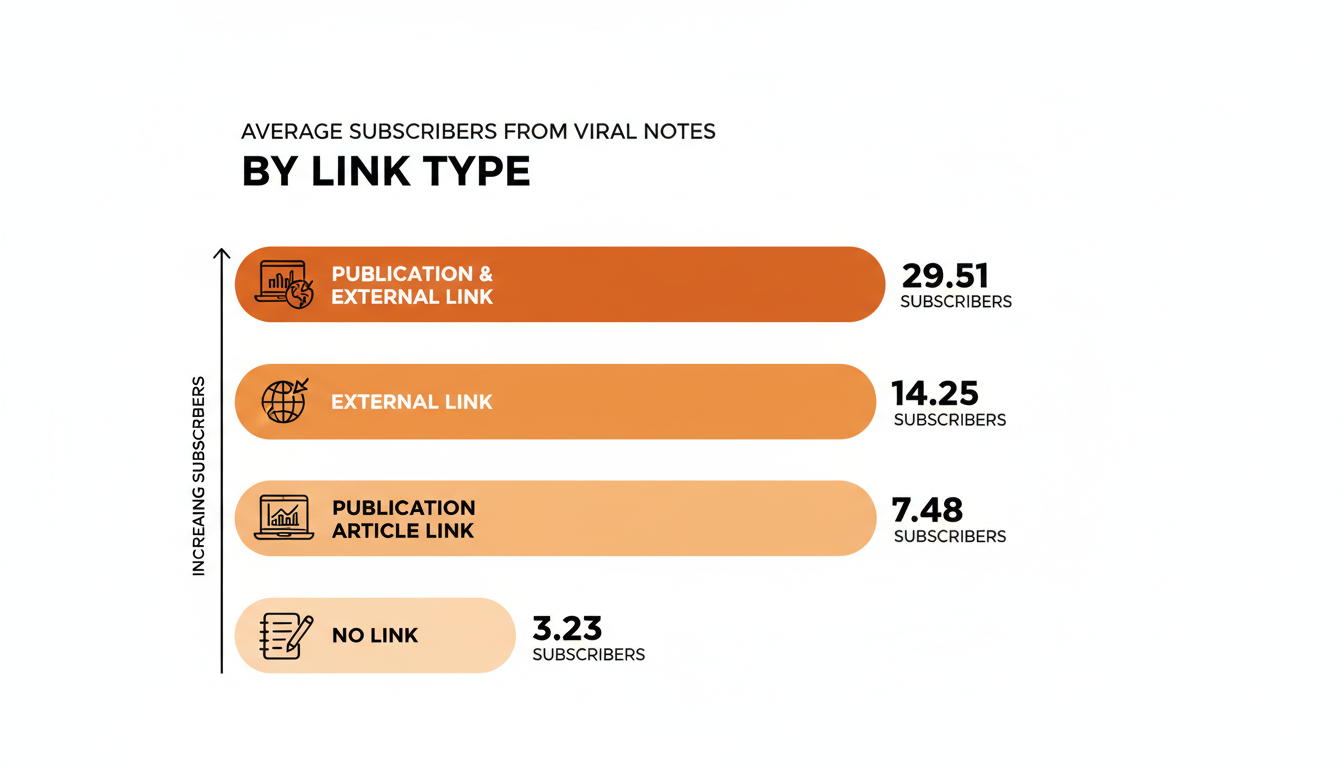
A link doesn't pull people off the platform. It gives them somewhere to go. Without a link, a viral Note is a complete unit: the reader laughs, taps the heart, scrolls on. With a link, the reader has a path to a longer piece of writing, and once they're inside a full article the subscribe prompt does most of the remaining work. The Note stops being the destination and becomes the trailhead instead.
The part people don't expect: subscribing requires the reader to project forward. They have to imagine future Notes from this person being worth receiving in their inbox. A 30-word standalone Note doesn't paint that picture. A link to a 1,500-word essay does, because the essay shows what the work actually looks like at scale, not just what a single good line looks like.
Converters Write 65% More Words
The other big gap between the cliff and the converters is length. Viral Notes that got zero subscribers averaged 43.85 words. Viral Notes that got 10 or more subscribers averaged 72.54 words, a paragraph longer.
Forty-three words is roughly the length of a tweet. Seventy-two words is the length of a short scene, long enough for a setup and a payoff. The cliff Notes are pure punchlines. The converters have a beginning, a middle, and just enough specificity to suggest the author has more where that came from.
One of the strongest top-converting viral Notes in the dataset (23,250 public likes) opens with a credential anchor, "I trained for 6 years at med school," then four parallel lines each starting with "Nobody," each naming a specific topic the author covers, ending on a beat that implies more content is coming. Fifty-two words. Identity, scope, promise, payoff, in that order. The whole structure reads as a pitch, not a punchline.
📅 Struggling to stay consistent on Substack?
WriteStack's Smart Scheduling lets you batch and queue Notes in minutes. Grow on Substack without burning out.
Explore Smart SchedulingPractical rule: the cliff Notes don't have a pitch. They have a moment, and the moment is enough to earn a like but not enough to earn a follow. Aim for 60 to 80 words, long enough to set up a hook, short enough to still read in a single glance on the feed.
The Five Types of Notes Living on the Cliff
Reading through the top viral, zero-subscriber Notes in the dataset, the same five patterns kept appearing. None of these are bad Notes. They just aren't growth Notes.
- The news-jack. A reaction to a real-world event, geopolitics, a political moment, breaking news in a niche. Likes are massive because the audience is reacting to the event, not to the author. The reader subscribes to the news, not to the writer.
- The borrowed aphorism. A four-word truth statement, or someone famous's quote pasted with attribution. One Note in the dataset got 6,508 likes for a four-word statement. Authorial value is close to zero because the value lives in the line, not in the person who typed it.
- The reactive comment. A response to someone else's Note or post. The reader who's intrigued follows the link inside the comment to the original creator, not to the commenter who replied to it.
- The universal relatable take. A parenting hot take, a relationship reframe, anything a large chunk of a demographic could have written. It lands because readers see themselves in it, but nobody converts because there's nothing the author offers beyond the recognition itself.
- The empty repost. A restack of someone else's content with no original commentary added. These get likes for the original work. The reposter stays invisible.
The common thread across all five: these Notes are complete in themselves. There's no implied next step. The reader gets the full payoff inside the feed, and the author gets nothing back for it.
Sleeper Hits: The Inverse of the Cliff
Inside the dataset, 245 Notes hit a strange profile: below the viral engagement threshold, but above 10 subscribers on conversion. Quiet on likes, loud on growth. Call them sleeper hits, and their profile is close to the exact inverse of a cliff Note.
Their link rate is 22.86%, close to four times the viral-zero-subscriber cohort's 6.05%. 16.73% link specifically to a publication article, most often their own, using the Note as a teaser for the full piece and letting the full piece do the actual converting. Average length is 67.68 words, almost identical to the viral converters. Average likes: just 18.65, three to four times fewer than the viral cliff Notes.
A representative sleeper hit, 30 public likes:
"Delaying Social Security looks like discipline until you run the numbers. You give up eight healthy years for a slightly bigger check. The math barely wins; the life you lose never comes back. [link to publication article]"
Specific niche, specific claim, specific reader, a link to the longer argument. Thirty likes, but the people who liked it were the right people, and a meaningful share of them subscribed. A sleeper hit isn't trying to reach everyone. It's trying to convert the few people who actually match the niche. Viral Notes tend to do the opposite: reach everyone, convert almost nobody.
How to Write a Note That Converts, Not Just Trends
The checklist this data actually supports:
- Stop optimizing for likes. Pure-text, high-like Notes are the worst-converting category in the entire dataset.
- Include a link when there's somewhere real to send someone. A publication article link lifts conversion 2.3x at the viral level. Most writers leave that lift on the table by default.
- Don't assume an external link kills conversion. It produced a 4.4x lift on average here. Send the reader somewhere concrete, even when it isn't the writer's own work.
- Aim for 60 to 80 words. The converters in this dataset consistently live in that zone.
- Make the Note feel incomplete on its own. A hook, a credential, a setup, then a path to more. The reader should finish it wanting the next thing, not feel like the loop already closed.
- Write for the niche, not the universal take. A 30-like Note that hits 25 specific people will consistently outperform a 5,000-like Note that means nothing to anyone in particular.
Write the next Note with this shape built in, not bolted on afterward. WriteStack's AI note generator drafts in a publication's existing voice and can build toward the structural pattern the data shows converts, the credential anchor, the setup, the link, the implied next step, instead of a generic template.
See which of your own Notes actually gained you subscribers, not just likes. WriteStack's engagement dashboard tracks that distinction across a publication's full Notes history, which matters given how far the two metrics can diverge, as this entire dataset shows.
Load a week of Notes built to convert, in twenty minutes. Set it up once instead of finding out two days later that last night's viral Note grew nothing.
Frequently Asked Questions
Why do viral Substack Notes sometimes get zero subscribers?
Because a like and a subscription are different kinds of commitment. Across 20,066 viral Notes, 40% converted zero subscribers, and 94% of them contained no link, meaning there was structurally no path from the like to a follow.
Does adding a link to a Note hurt its reach?
It can reduce likes somewhat, since a link introduces a choice the reader has to make. But it dramatically improves conversion. A publication article link lifted subscribers 2.3x in this dataset, and an external link lifted it 4.4x, both against a no-link baseline.
How long should a Note be if the goal is subscriber growth?
Around 60 to 80 words, based on this data. Viral Notes that converted 10 or more subscribers averaged 72.54 words, against 43.85 for viral Notes that converted nobody.
What's a "sleeper hit" Note?
A Note that stays below the viral engagement threshold but still converts well, averaging just 18.65 likes in this dataset against well over 100 for viral cliff Notes, while linking to a publication article roughly four times more often than a typical viral, zero-subscriber Note.
Is it worth writing for virality at all, then?
Not as the goal itself, based on this data. Virality and subscriber growth turned out to be close to independent outcomes in this dataset, and in some cases mildly opposed, since the Note types that reach the widest, unrelated audience (news-jacks, borrowed aphorisms, empty reposts) are consistently the ones that convert worst. A Note built for a specific reader with somewhere to go tends to out-earn a Note built to be liked by everyone.
The Actual Lesson
The Notes that grow a publication rarely try to be popular. They try to be useful to a specific person, and they give that person somewhere to go after reading. The Notes that don't grow anything are frequently the exact opposite: short, self-contained, frictionless, engineered for a like with no exit ramp built in. If last night's viral Note didn't move a subscriber count, the writing probably wasn't the problem. The structural shape of the Note was. Build the shape that converts into every Note before it ships instead of finding out after the fact which ones actually worked.