
The Real Difference Between Substack Notes and Twitter
I moved most of my daily posting from Twitter to Substack Notes about a year into running my newsletter, and the first thing that surprised me wasn't the algorithm. It was who was reading. On Twitter, a good post reached strangers who scrolled past in three seconds. On Notes, a good post reached strangers who were already reading other newsletters, which meant they stuck around long enough to click through to mine.
Is Substack Notes actually different from Twitter, or is it just a clone with a different name? Structurally, they look alike: short posts, likes, replies, a repost button called a restack instead of a retweet. The difference is the room you're posting into. Notes launched in April 2023, during a wave of writers leaving Twitter after the ownership change, and Substack built it specifically to surface people you've never heard of who write newsletters, not people who happen to be online right now (TechCrunch).
That single design choice changes almost everything else in this comparison: what gets rewarded, who you should expect to find you, and what a "good" post actually looks like on each platform. It also means the two platforms answer different questions. Twitter answers "how do I stay visible to people who already follow me." Notes answers "how does a stranger who has never heard of my newsletter find it today."
Table of Contents
- The Real Difference Between Substack Notes and Twitter
- How the Two Algorithms Actually Work
- What Actually Gets Rewarded on Each Platform
- Is Substack Notes Still Worth It in 2026
- Who Should Be Posting Where
- Moving Your Twitter Habits to Notes Without Losing Your Voice
- Building a Notes Rhythm That Compounds
- Common Mistakes When Treating Notes Like Twitter
- Tools That Make This Easier at Scale
One number worth having before you start: WriteStack has close to 100 verified reviews from Substack writers across multiple platforms. The other Substack scheduling tools we've checked have none that we could find anywhere.
How the Two Algorithms Actually Work
Twitter's feed is still mostly a follower graph with recommendations layered on top. If you don't already have followers, your reach ceiling is low no matter how good the post is. Notes works the other way. It's a discovery feed first, built to show your writing to people who don't follow you yet, based on what you post and how other writers engage with it.
That's the actual reason so many writers say Notes "grew their subscriber count faster than years on Twitter ever did." It's not that Notes content is better. It's that a mediocre Note on a good day gets shown to strangers, and a mediocre tweet on a good day gets shown to your same 400 followers again.
What this means for a newsletter specifically
A post on your Substack only reaches people who already subscribed. It doesn't matter how good it is, because it never leaves your existing list. A Note can reach someone who has never heard of your publication and end with them subscribing before they've read a single issue. If growth is the goal, Notes is doing a job Twitter structurally cannot do for a newsletter writer anymore, since Twitter has no concept of "subscriber" at all.
Practical rule: if the goal is subscriber growth, the discovery feed is where the growth actually happens. If the goal is staying in touch with people who already know you, a post does that job better than either platform.
What Actually Gets Rewarded on Each Platform
Most "Notes vs Twitter" advice is opinion dressed up as strategy. We pulled a sample of 20,000 recent Notes to see what actually correlates with engagement, rather than repeating what sounds true.
Two patterns held up:
- Multi-line Notes (more than one paragraph) averaged roughly 11% more reactions and about 28% more restacks than single-line Notes.
- Notes between 150 and 300 characters outperformed Notes under 50 characters by roughly a third on reactions, and by more on restacks.
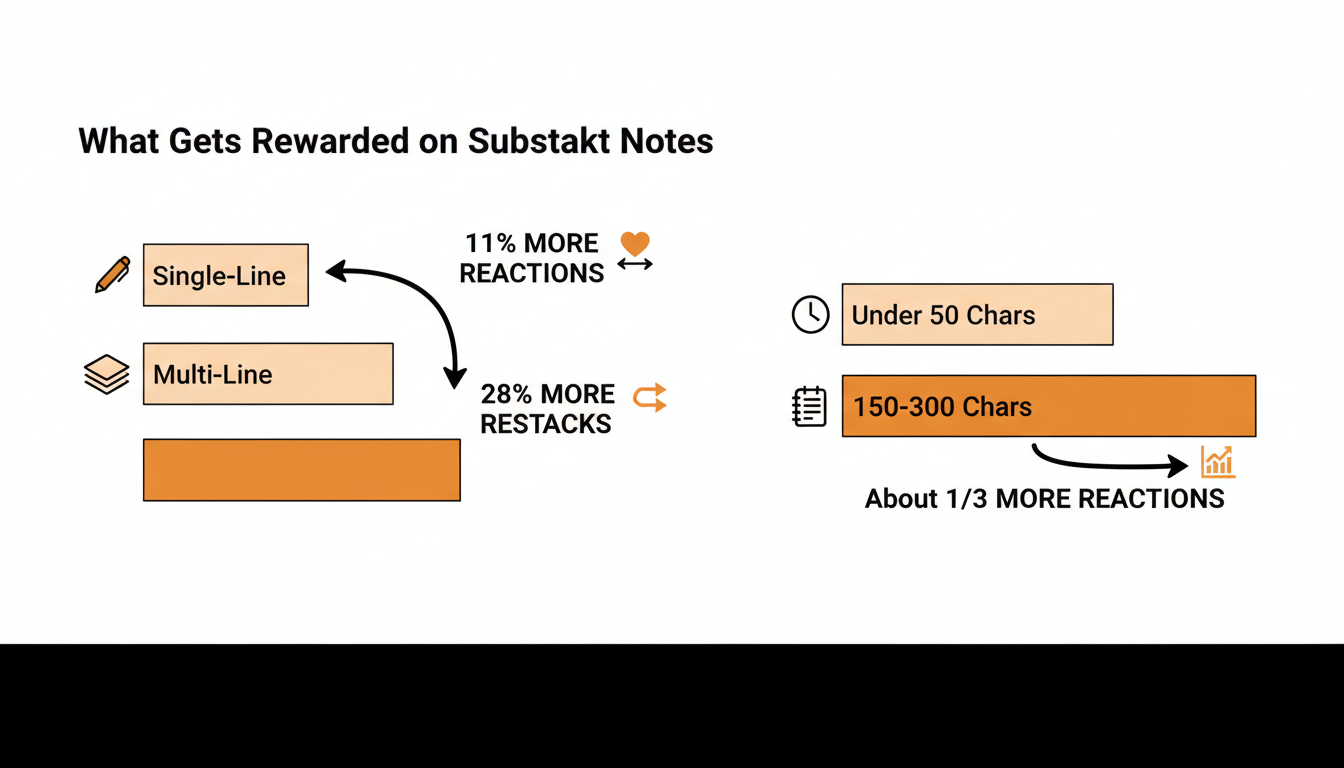
That's close to the opposite of what worked on Twitter, where the highest-performing format for years was the short, punchy one-liner built for a 280-character limit. Notes has no such limit, and the data says writers who use the extra room, without turning a Note into a full essay, do better than writers who post Twitter-length fragments out of habit.
Is Substack Notes Still Worth It in 2026
Notes has been live for a few years now, long enough that "is it still worth posting there" is a fair question. It launched as a fast follower to the Twitter exodus in 2023, and platforms built on a moment like that don't always keep the growth curve once the moment passes (Substack's own guide to getting started with Notes still describes it as an active, developing feature, not a legacy one).
What's actually changed since the early days is the crowd. Early Notes had less competition and almost anything got seen. Now there are more writers posting more often, so a Note has to work harder to stand out inside the discovery feed. That's a real shift, but it's the same shift every growing platform goes through, and it doesn't change the underlying mechanic: Notes is still the only one of the two platforms that puts your writing in front of people who've never subscribed, without you paying for an ad or already having an audience there.
Practical rule: more competition on Notes means format and consistency matter more than they did in 2023, not that the channel stopped working. The writers still growing there are the ones who treat it like a rhythm instead of a one-off post.
Who Should Be Posting Where
Neither platform is universally right, but the split isn't close once you're specific about the goal.
| Substack Notes | Twitter / X | |
|---|---|---|
| Best for | Reaching new readers who don't know you yet | Staying visible to an audience you already built there |
| Character limit | None | 280 (more with a paid tier) |
| Content types | Text, images, video | Text, images, video, GIFs, polls |
| Reward mechanism | Discovery feed shows content to non-followers | Mostly follower graph, some recommendations |
| Native path to a subscriber | One tap, inside the same app | None, requires an external link |
| Scheduling built into the platform | No native scheduler | Yes |
| Audience composition | Mostly other newsletter writers and readers | General, algorithm-driven, highly variable |
If you're starting a newsletter from zero and have no existing audience anywhere, Notes is the better first move. It's the only one of the two platforms with a direct, frictionless path from a stranger's screen to your subscriber list, and it's actively built to introduce you to people who've never heard of you. If you already built a following on Twitter over years and your newsletter exists mainly to serve that audience, keep posting there too, but treat Notes as the growth channel and Twitter as the retention channel.
Load a week of Notes into WriteStack and schedule them across the days that actually get seen instead of writing one under pressure every morning.
📅 Struggling to stay consistent on Substack?
WriteStack's Smart Scheduling lets you batch and queue Notes in minutes. Grow on Substack without burning out.
Explore Smart SchedulingMoving Your Twitter Habits to Notes Without Losing Your Voice
Writers who move from Twitter to Notes usually make the same first mistake: they keep writing Twitter-length fragments because that's the habit that's already built. The data above says that habit is working against them. A Note reads closer to the opening two lines of a newsletter post, written to stand alone, than to a tweet with extra characters bolted on.
A few adjustments that actually carry over:
Keep the hook, drop the thread format. Twitter rewarded splitting one idea across ten tweets. Notes rewards saying the same idea in one post with enough room to actually make the point, then stopping.
Write like the reader already respects long-form. Someone scrolling Notes is, by definition, someone who reads newsletters. You don't need to earn attention with the shock-opener style that works on a general social feed. A clear, specific first sentence does more work than a hook engineered for strangers with a nine-second attention span.
Reply like a writer, not like a brand account. The communal tone on Notes rewards writers who show up in other people's comment sections with real thoughts, not canned engagement-bait replies. That's closer to how newsletter comment sections work than how Twitter replies work.
Part people don't expect: WriteStack's AI drafting tool doesn't generate Notes from a blank prompt the way most AI writing tools do. It reads your own published Notes first, so a draft starts sounding like you before you've edited a single word, instead of arriving at your voice after three rounds of rewriting a generic first draft. Try the Note generator on a real topic and see what the first draft sounds like.
Building a Notes Rhythm That Compounds
The writers who actually see Notes work for growth aren't the ones who post something viral once. They're the ones who show up consistently enough that the discovery feed has a reason to keep surfacing them. A single great Note is a lottery ticket. A posting rhythm is a growth channel.
A workable weekly rhythm looks something like this:
- Batch a week of Notes in one sitting instead of writing them one at a time under pressure.
- Mix formats: a few single-line observations, a few multi-line Notes with the room the data above says performs better, and at least one reply-bait question.
- Schedule them across the week instead of posting in one burst, since the discovery feed rewards showing up regularly more than it rewards volume on one day.
- Check which Notes actually drove link clicks, not just reactions, and write more like the ones that did.
- Repeat, and let a month of data tell you what your specific audience responds to, since the 20,000-Note sample above is a starting point, not a rule for every publication.
Practical rule: a Note that gets reactions but never gets clicked isn't doing the job of a growth channel. Reactions are a vanity number until they're tied to a click.
That last step is the one most writers skip entirely, mainly because most tools don't show it. WriteStack's heatmap tracks which links inside which Notes actually got clicked, going back through your full posting history, not just the last week. Most competing tools stop at reaction counts.
Common Mistakes When Treating Notes Like Twitter
Posting Twitter-length fragments out of habit. Covered above, but worth repeating: this is the single most common transfer error and it's directly contradicted by what actually performs.
Treating restacks like retweets. A restack shows a Note to that person's own subscribers, which on Substack means it's shown to people already primed to read newsletters. A retweet shows a tweet to a general feed. Chasing restacks the way you'd chase retweets, with engagement-bait, tends to read as off-key to the writer-heavy Notes audience.
Ignoring replies because Twitter replies rarely mattered. On Twitter, replies mostly disappear into noise unless the original poster has a huge following. On Notes, a genuine reply from another writer is often how you get discovered by their subscribers in the first place. Skipping this because it "didn't matter on Twitter" costs real reach.
Posting once and disappearing for two weeks. The discovery feed has no memory of a writer who posted brilliantly once and then went quiet. Consistency matters more here than a single high-performing Note, which is the exact opposite of how a viral tweet used to work.
Never checking what actually converted. A Note with 200 reactions and zero link clicks taught you nothing about growth. WriteStack's analytics show which specific readers engaged and whether that engagement turned into a subscriber, not just a bigger reaction count on a screenshot.
Writing every Note as a pitch. A feed full of "subscribe to my newsletter" Notes reads the same way a Twitter timeline full of self-promotion does: people stop engaging. The writers who grow fastest on Notes mostly write about what they're thinking, not what they're selling, and the subscribe happens as a side effect of someone liking how they think.
Comparing your Notes only to your own past performance. A publication with 200 subscribers and one with 20,000 subscribers should not expect the same reaction counts, but most writers only ever check "is this Note doing better than my last one." Comparing against similar-sized publications is a better signal of whether a Note actually landed, which is the specific gap a per-account dashboard can't close on its own.
Tools That Make This Easier at Scale
None of the above requires a tool to do manually. It requires remembering to batch content, checking analytics that most dashboards don't expose, and not losing a week's worth of Notes to a busy Tuesday. That's the actual gap WriteStack fills.
WriteStack is the only Substack scheduling tool that schedules chat posts, not just Notes, which matters if part of your rhythm includes Substack Live or chat-based updates alongside your regular posting. It also tracks link clicks across your entire Notes history, not just the most recent posts, and benchmarks your engagement against other publications instead of only against your own last week, so "is this good?" has an actual answer instead of a guess.
Batch a week of Notes in twenty minutes using WriteStack's Note generator, which drafts from your own published writing instead of a blank prompt, schedule them across the week in one sitting, and let the analytics tell you which format your specific audience rewards instead of assuming the 20,000-Note averages above apply exactly to your publication.
The honest gap: WriteStack doesn't have a free-forever tier the way one or two competing tools do. The analytics layer, including the link-click history and cross-publication benchmarks, is most of the actual product, and it can't be meaningfully evaluated on a handful of free Notes a month. The 7-day trial gives access to all of it instead of a stripped-down sample.
Six weeks into scheduling instead of posting Notes live under pressure, the change most writers report isn't that they post more. It's that they stopped deciding, every single day, whether today was a Notes day. Start scheduling a week of Notes on WriteStack and see what a rhythm you don't have to think about actually does to a growth number you've been watching stall.