
You open your Substack dashboard and see a small notification: three readers have pledged $8 a month to support your newsletter. You never turned on paid subscriptions. Nobody charged them anything.
That's Substack Pledges, a feature that's been sitting on by default on most publications since 2022, quietly collecting signal that most writers never look at. It's a promise, not a payment. A raised hand, not a receipt. How you read it changes what you do next.
This guide walks through what pledges actually are, the default settings worth checking before you forget about them, what a pledge is actually worth once Substack and Stripe take their cut, how to read a pledge count as a real signal instead of a vanity number, and when the data suggests you should actually flip the switch on paid subscriptions.
Table of Contents
- What Substack Pledges Actually Are
- How the Pledge Flow Actually Works
- The Default Settings Most Writers Never Check
- Turning Pledges On, Off, or Adjusting the Amount
- Reading Your Pledge Count as a Signal
- When to Actually Flip the Switch on Paid Subscriptions
- What a Pledge Is Actually Worth After Fees
- Pledges vs Founding Member Tier vs Paywall Ratio
- Common Mistakes Writers Make With Pledges
What Substack Pledges Actually Are
A pledge is a reader's promise to pay for your newsletter once you turn on paid subscriptions. They pick an amount, enter a card, and can write an optional note about why they're pledging. Nothing gets charged the day they do this. The card sits on file, waiting on a decision that belongs entirely to you.
Substack's own explanation is straightforward: pledges let readers commit to a monthly or yearly subscription before a writer has activated paid subscriptions at all. It exists to test demand without asking anyone to actually hand over money yet, and without forcing the writer to commit to a price before they've seen any evidence people will pay it.
The reader-side mechanic
If a reader is logged into Substack and your publication only has free subscriptions enabled, they'll see a "Pledge your support" button in place of the usual "Subscribe" button, sitting right where a paid prompt would normally live. Clicking it walks them through picking a monthly or annual amount, entering payment details, and confirming. From their side, the flow feels a lot like subscribing for real. The difference is invisible to most readers unless they read the fine print: no charge happens until the writer turns on paid subscriptions.
Readers can pledge to as many publications as they want, and pledging doesn't require them to unsubscribe from anything or change their existing free subscription in any way. It runs alongside the normal reading experience without interrupting it.
Why Substack built it this way
Most writers who want to charge for their work face the same problem before they ever set a price: they don't know if anyone will pay, and picking a number out of the air feels like a guess with real consequences attached. Pledges solve that without forcing a binary decision. A writer can watch pledges accumulate for weeks or months, get a real number attached to real people willing to pay, and only then decide whether turning on paid subscriptions is worth the jump.
It also solves a quieter problem: writers who are scared to ask for money at all. A pledge button asks the question passively, in the background, without the writer having to write a single sentence pitching a paid tier. Some of the most useful pledge data comes in from publications where the writer never mentioned pledges once.
Practical rule: treat your pledge count as a demand signal, not a revenue number. It tells you who's willing to pay, not what you'll actually collect once billing starts.
How the Pledge Flow Actually Works
What happens to a reader's card
A pledge captures card details through Stripe, the same processor Substack uses for actual subscription billing, but doesn't run a charge against it. The card sits in an authorized-but-not-charged state indefinitely, for as long as the writer leaves paid subscriptions off. Readers can cancel or change their pledge at any time from their own account settings, the same way they'd manage a live subscription, and nothing about a pledge locks them in.
What happens when you flip on paid
This is the part that catches writers off guard: pledges convert automatically, with no second confirmation step from the reader. The moment a publication turns on paid subscriptions, every pledge sitting at or above the new subscription price becomes an active, billed subscription. If the monthly price is set to $8 and a reader pledged $8, they're charged on that same day. If a reader pledged $5 and the price is $8, that pledge sits frozen and won't convert until the writer either lowers the price or the reader manually upgrades to match it.
That single detail should shape how a writer sets pricing at launch. Setting the real subscription price above what most pledges came in at means leaving real, already-committed revenue sitting on the table the day paid subscriptions go live, since none of those lower pledges will convert on their own.
The Default Settings Most Writers Never Check
Pledges are turned on by default for every new Substack publication, free or paid, monetized or not. Most writers never open the settings page to look at what the default pricing actually is, which means every pledge collected so far has been priced by Substack, not by them.
| Setting | Default value | Platform minimum |
|---|---|---|
| Monthly pledge amount | $8/month | $5/month |
| Annual pledge amount | $80/year | $30/year |
| Pledges enabled | On by default | Can be toggled off |
| Card charged at pledge time | No | N/A |
If a publication has never touched this setting, every reader who has pledged so far did so at Substack's default $8/$80 pricing. That's a fine outcome if $8 a month is roughly where the writer would have priced themselves anyway. It becomes a real problem for a writer planning to launch at $15 or $20, because a pile of $8 pledges won't convert at that higher price, and the writer usually doesn't find out until launch day.
Practical rule: check pledge pricing before there are any pledges worth caring about, not after. Changing the amount later doesn't retroactively change what existing pledgers already agreed to.
Turning Pledges On, Off, or Adjusting the Amount
Making a change takes under a minute. From a publication's Settings page, scroll to the Payments section and find "Allow readers to pledge subscriptions." From there, a writer can:
📅 Struggling to stay consistent on Substack?
WriteStack's Smart Scheduling lets you batch and queue Notes in minutes. Grow on Substack without burning out.
Explore Smart Scheduling- Toggle pledges off entirely, which removes the pledge prompt from the publication and every post.
- Adjust the suggested monthly and yearly pledge amounts to match whatever price they'd actually charge.
- Leave pledges on at the default and revisit the amount later, understanding that existing pledges keep whatever price they were made at.
Some writers turn pledges off on purpose. If a publication isn't planning to monetize for a long time, or the writer would rather free readers never see a payment prompt at all, switching pledges off removes the button entirely and reverts to a plain "Subscribe" button. Substack's guidance on turning off paid subscriptions covers the related settings for writers who've gone further and want to unwind monetization completely, not just pause pledges.
Reading Your Pledge Count as a Signal
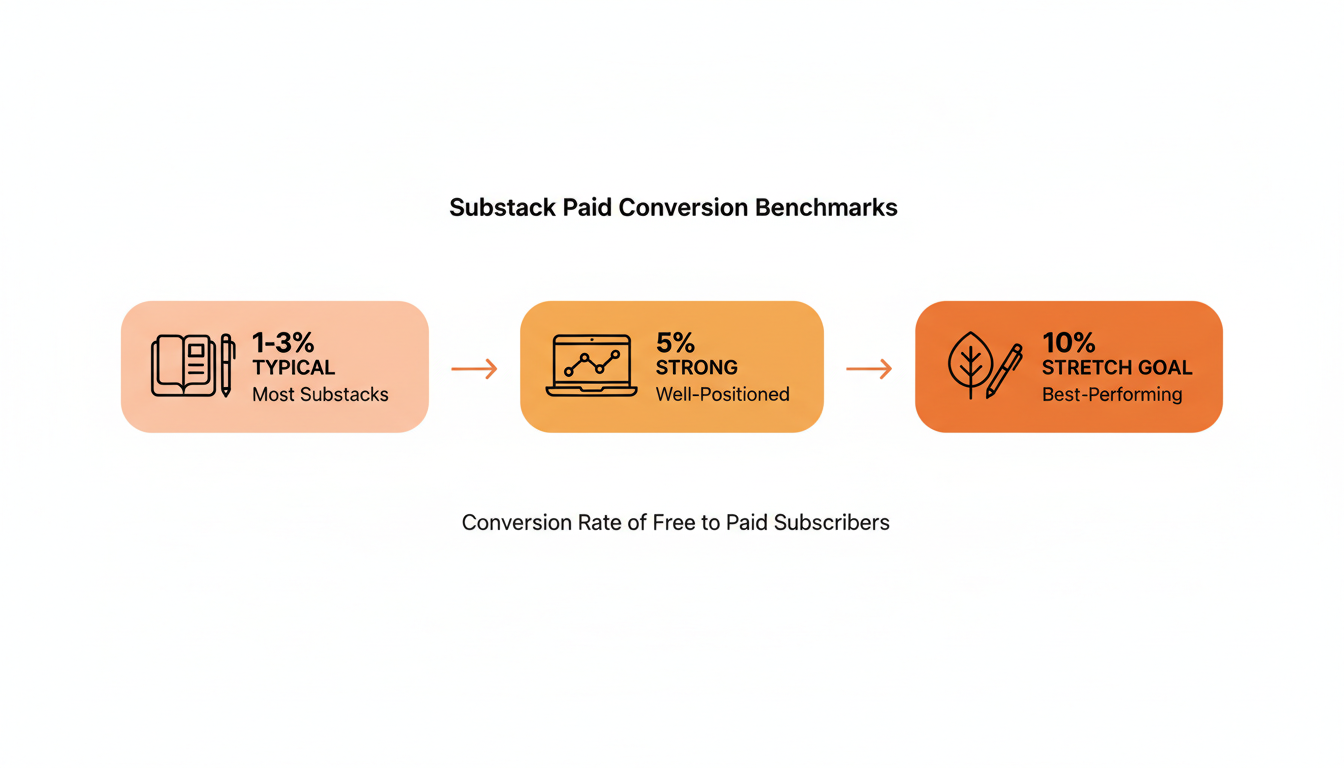
A pledge count of 20 out of 500 free subscribers isn't automatically good or a warning sign on its own. It needs a comparison point. Actual paid-conversion numbers, measured once subscriptions go live across many publications, tend to land in a fairly wide range. One analysis of publisher data from Really Good Business Ideas put typical conversion in the 1-3% range, with 5% considered a strong result and 10% treated as an outlier ceiling that most publications, even successful ones, never reach.
Pledges tend to run hotter than eventual paid conversion, since pledging costs a reader nothing today and carries none of the friction of an actual charge. Use that gap deliberately. A pledge rate sitting below 1% of the free list is a real signal to keep building trust and consistency before touching the paid toggle at all. A pledge rate well above 3% usually means there's room to price higher than the $8 default, or to move faster than originally planned, because the demand is already sitting there waiting to be collected.
Worth tracking alongside the raw count: how the pledge rate moves after specific posts. A spike in pledges after a particular piece is one of the clearest signals available for which topics or formats a publication's paid tier should actually be built around.
When to Actually Flip the Switch on Paid Subscriptions
Substack's own advice on timing leans toward not overthinking this decision: most writers benefit from turning on paid subscriptions earlier than they feel ready to, because the biggest driver of conversion tends to be total audience size and publishing consistency, not a perfectly validated pledge number sitting at some arbitrary threshold.
That guidance holds up, but three things are worth having in place first. A publishing history long enough that new readers can tell what they'd actually be pledging toward. At least a small base of pledges that validates the planned price point rather than guessing at it cold. And a clear, one-sentence answer to what paying subscribers get that free readers don't. None of these need to be impressive by any outside standard. They need to exist in a form the writer can point to.
Practical rule: don't wait for a "big enough" pledge count before turning on paid subscriptions. Wait until there's a one-sentence answer to what a paying subscriber gets that a free one doesn't.
What a Pledge Is Actually Worth After Fees
A pledge total looks like clean revenue sitting in a dashboard. It isn't. Once paid subscriptions go live and pledges convert, Substack and Stripe both take a cut before any of it reaches the writer, and the gap between the pledged amount and the actual deposit surprises a lot of first-time paid writers.
Per Substack's own fee breakdown, the platform takes 10% of every transaction. On top of that, Stripe charges a 2.9% + $0.30 credit card processing fee, plus a separate 0.7% billing fee for recurring subscriptions. None of these are hidden exactly, but none of them show up on the pledge screen a reader sees either.
| Pledge amount | Substack fee (10%) | Stripe fees (2.9% + $0.30 + 0.7% billing) | Approx. take-home |
|---|---|---|---|
| $8/month | $0.80 | $0.59 | ~$6.61 (83%) |
| $15/month | $1.50 | $0.84 | ~$12.66 (84%) |
| $80/year | $8.00 | $3.18 | ~$68.82 (86%) |
| $150/year | $15.00 | $5.70 | ~$129.30 (86%) |
The pattern holds across price points: a writer keeps roughly 83 to 86 cents of every pledged dollar, with monthly pledges losing slightly more to fees than annual ones because the flat $0.30 Stripe fee hits smaller transactions harder, proportionally, than larger ones.
Practical rule: when deciding whether a given pledge count justifies turning on paid, run the math on the after-fee number, not the pledged total. A hundred pledges at $8 a month is closer to $661 a month than $800.
Pledges vs Founding Member Tier vs Paywall Ratio
Pledges are one of three separate monetization levers Substack gives writers, and it's easy to conflate them because they all touch the same Payments settings page. Each one solves a different problem and matters at a different point in a publication's life.
| Lever | What it does | When it matters |
|---|---|---|
| Pledges | Lets free readers pre-commit to a price before paid subscriptions are live | Before a writer has turned on paid subscriptions at all |
| Founding member tier | An optional premium tier priced above the standard paid subscription, for the most committed supporters | After paid subscriptions are live and there's an established paid base |
| Paywall ratio | How much regular content sits behind the paywall versus stays free | Ongoing, for as long as paid subscriptions exist |
Writers sometimes try to skip straight to a founding member tier or an aggressive paywall ratio without ever validating demand through pledges first. That sequencing usually backfires. Pledges are the cheapest, lowest-risk way to find out if anyone wants to pay at all, before deciding how much of the work to lock away or how to price a premium tier on top of a subscription base that doesn't exist yet.
Common Mistakes Writers Make With Pledges
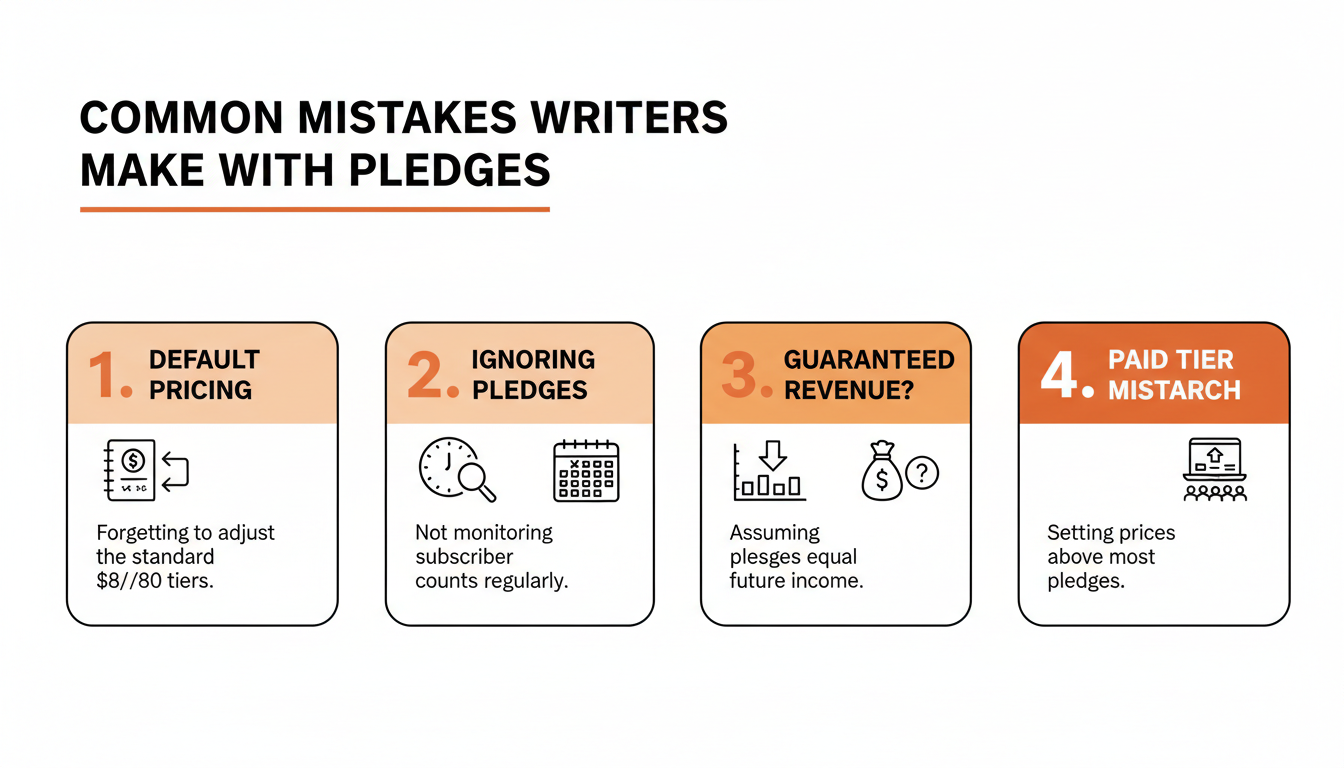
The same handful of mistakes show up repeatedly across writers who eventually reach out to Substack support confused about why their pledges "disappeared" or didn't convert the way they expected at launch.
Never checking the default pricing is the most common one, covered in detail above. Ignoring the pledge count for months at a time is close behind. It doesn't need daily attention, but a monthly glance gives a running read on demand instead of a surprise number showing up the day a writer finally decides to monetize. Treating pledge totals as guaranteed future revenue causes real planning problems, since some pledgers change their minds, close accounts, or let cards expire in the gap between pledging and eventual conversion. And pricing paid subscriptions above where most pledges came in wastes the entire signal pledges exist to provide in the first place.
Consistency matters here more than most writers expect. Publications that go quiet for weeks tend to see pledges stall out at whatever number they hit before the gap, since a pledge is a bet on a writer's future output, not just their past posts. A Substack Notes scheduler like WriteStack helps keep a publication visible between longer posts, which keeps new readers arriving steadily and gives existing pledgers a reason to stay pledged instead of quietly canceling. Writers who use WriteStack's note generator to turn a single post into a week of Notes tend to keep that visibility up without adding writing time, which matters more for pledge volume than any single high-performing post ever will. And for writers trying to figure out which subscribers are worth a direct, personal thank-you before flipping on paid, WriteStack's fan tracking surfaces the most engaged readers on a publication, often the same people who show up first in the pledge list.
Pledges are a small feature that most writers set once and forget entirely. Read correctly, and checked on a real schedule, they're one of the few honest previews Substack gives a writer of what their paid launch will actually look like before a single dollar changes hands.