
I priced my first paid tier at $5 a month because that's what the signup form suggested, and I never touched it again for eight months. Then I looked at what similar-sized newsletters were charging and realized I'd left roughly $3,000 a year on the table just by defaulting to the number Substack put in the box.
How much should you actually charge for a Substack subscription? The honest answer is a range, not a number, but the range is narrower than most writers think, and the mistakes that cap revenue are the same five mistakes over and over. This piece walks through what writers actually charge, what Substack's fees take out of that number before it reaches your bank account, what a founding member tier is really for, and a framework for picking a price you won't have to apologize for.
Most of this comes down to a handful of decisions made once and never revisited: the monthly number, the annual discount, whether a founding tier exists at all, and whether the price still matches the size of the audience a year later. Get those four right and pricing stops being a source of quiet anxiety and becomes one of the more mechanical parts of running a newsletter.
One number worth having before you start: WriteStack has close to 100 verified reviews from Substack writers across multiple platforms. Most Substack scheduling tools in this category have none that we could find anywhere.
Table of Contents
- What Most Substack Writers Actually Charge
- The Three Pricing Levers Substack Gives You
- What Substack's Fees Actually Take Out of Your Price
- What the Data Shows About Founding Member Tiers
- Pricing by Niche and Audience Trust
- Common Pricing Mistakes That Cap Your Revenue
- When and How to Raise Your Price
- A Simple Framework for Picking Your Price
What Most Substack Writers Actually Charge
Substack's default suggestion is $5 a month or $50 a year, and a large share of writers never move off it. But the writers actually earning a living on the platform cluster higher. Newsletters like Stratechery, Lenny's Newsletter, The Pragmatic Engineer, and Slow Boring all price in the $10-$15/month range, and most sustainable mid-size newsletters land somewhere between $5-$10/month or $50-$100/year, according to Substack's own guidance on how much it costs to run a publication.
Conversion from free to paid is the other half of the equation, and it's lower than most new writers expect: most Substack creators convert somewhere around 2-4% of free subscribers into paying ones. That means pricing isn't just about what a subscriber will pay, it's about what price makes the math work at your actual subscriber count. A newsletter with 2,000 free subscribers converting at 3% has 60 paying subscribers. At $8/month that's roughly $480/month before fees. At $15/month it's $900/month before fees, for the same audience and the same conversion rate.
That gap is why two newsletters with identical subscriber counts can have wildly different revenue, and why copying a competitor's price without knowing their conversion rate is a guess dressed up as research. If your conversion rate is closer to 1.5% because your free content already gives readers everything they need, no price increase fixes that on its own - the content strategy has to shift too.
Practical rule: Don't set your price to match what feels comfortable to charge. Set it to match what makes your actual subscriber count worth the time you're putting into the newsletter.
The Three Pricing Levers Substack Gives You
Substack gives every paid publication three separate levers, and most writers only ever touch one of them.
Monthly vs. Annual
You set a monthly price and Substack auto-calculates a suggested annual price at roughly a 17% discount (the classic "pay for 10 months, get 12" structure), though you can override it. Annual plans matter more than they look like they should: they lock in a full year of revenue up front, reduce the number of times a subscriber has to consciously decide to keep paying, and smooth out the churn that hits monthly plans every renewal cycle. A newsletter that pushes annual over monthly, even with a modest discount, tends to have meaningfully better retention over a 12-month window, since the subscriber only has to make the "is this worth it" decision once instead of twelve times.
Some writers go further and offer a slightly steeper annual discount than the Substack default, treating it as a deliberate cash-flow decision rather than a passive setting: a year of committed revenue up front is worth more to a solo writer than a marginally higher blended average price spread across monthly renewals that might lapse.
The Founding Member Tier
The third lever is the founding member tier, and it's the one most writers set up once and forget. It sits above your standard paid tier, usually priced anywhere from $100 to $500 a year, and it exists to let your most invested readers pay more without asking for more work from you. Some writers add real perks (a shoutout, early access, a name in the credits), and some writers leave it as-is: same content, just a way to say "I want to support this specifically."
The tier is also a signal, not just a revenue line. A reader deciding between a $5/month tier and a customized "Inner Circle" tier at $200/year is making an identity decision as much as a financial one, and the label you put on it either helps that decision or does nothing at all. It's worth knowing who those readers actually are before you decide what to offer them - a fan-level view of your subscribers makes it obvious which readers are already engaging like founding-tier material before you've even built the tier for them.
What Substack's Fees Actually Take Out of Your Price
The sticker price and the number that lands in your account are not the same number, and writers who don't account for the gap tend to underprice without realizing it. Substack takes a flat 10% platform fee, and Stripe (which processes every payment) takes its standard 2.9% + $0.30 per transaction on top of that, as broken down in this fee breakdown of Substack pricing.
| Monthly price | Substack's 10% cut | Stripe processing (~2.9% + $0.30) | You keep (approx.) |
|---|---|---|---|
| $5 | $0.50 | $0.45 | $4.05 |
| $8 | $0.80 | $0.53 | $6.67 |
| $10 | $1.00 | $0.59 | $8.41 |
| $15 | $1.50 | $0.74 | $12.76 |
| $20 | $2.00 | $0.88 | $17.12 |
Practical rule: Price with the fee math already subtracted in your head. If you need $10/month per subscriber to make the newsletter worth your time, the sticker price needs to be closer to $12, not $10.
This is a good place for the first of a few points on distribution, because pricing only matters if enough of your free readers actually see your work often enough to consider upgrading, and that's a distribution problem before it's a pricing problem. Writers using WriteStack's Notes scheduler to stay visible between long-form posts consistently report a larger pool of warm, primed free subscribers going into a paywall push - which is the input that makes any price point work at all. A perfectly priced tier in front of an audience that never sees your Notes converts at the same low rate as an underpriced one.
What the Data Shows About Founding Member Tiers
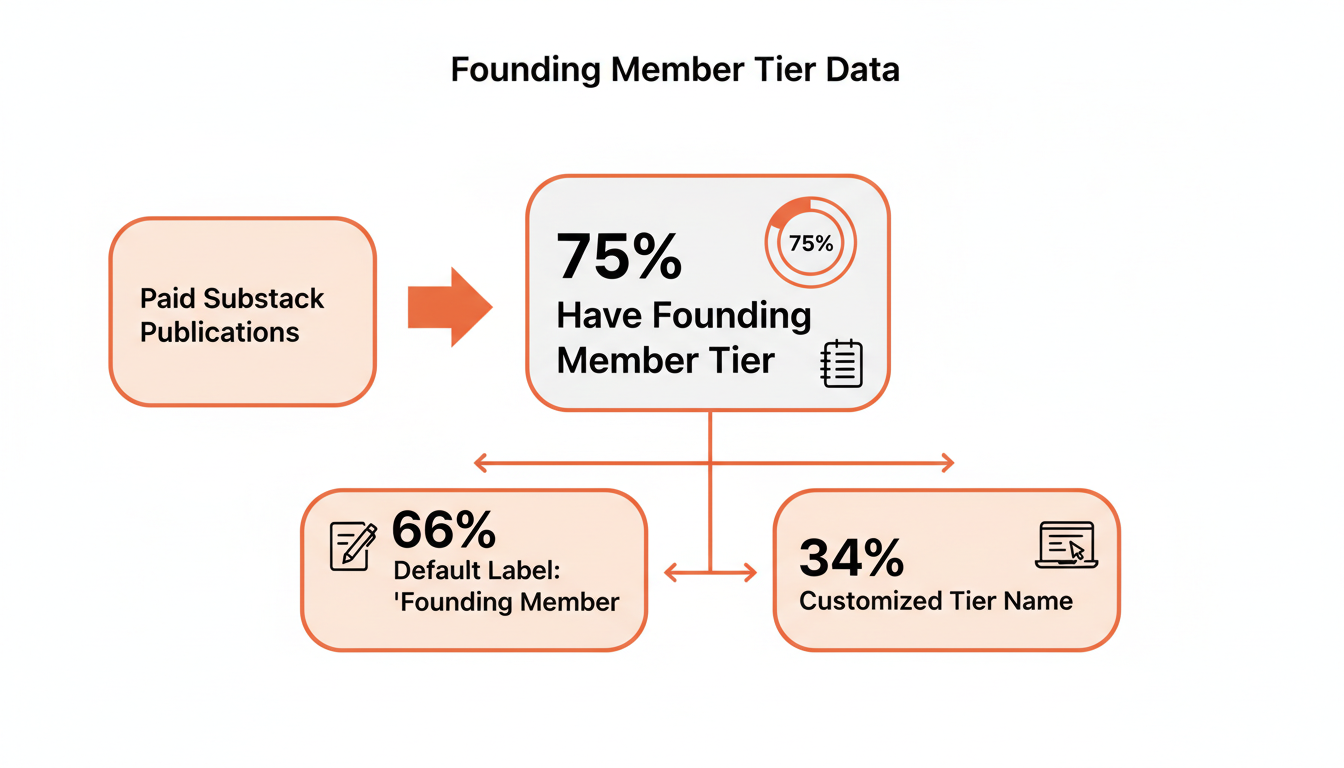
Rather than repeat the usual "set a founding tier, it's good practice" advice without evidence, we pulled real numbers from a dataset of Substack publications with paid subscriptions actively enabled. Of 861 publications with payments turned on, 649 - about 75% - have a founding member tier configured with an actual plan name set, rather than leaving that tier absent entirely. Founding tiers aren't a nice-to-have edge case; they're close to standard practice among writers who monetize seriously.
The more interesting number is inside that group. Of the 649 publications with a founding tier configured, 429 (roughly two-thirds) leave the tier named exactly "Founding Member" - Substack's own default label. Only about a third bother to rename it into something specific to their publication, like "Inner Circle," "Sponsor," or a name tied to the newsletter's own voice.
The part people don't expect: the founding tier is one of the few places on Substack where a five-minute edit (renaming a default label) visibly correlates with writers who treat their pricing as a deliberate business decision rather than a platform default they never revisited. It costs nothing and most people skip it anyway.
📅 Struggling to stay consistent on Substack?
WriteStack's Smart Scheduling lets you batch and queue Notes in minutes. Grow on Substack without burning out.
Explore Smart SchedulingThat gap is the actionable takeaway: a custom founding tier name is a tiny edit that a majority of monetized writers still haven't made, which means it's still a cheap way to signal that your newsletter is a specific thing worth supporting, not a generic Substack. If you're setting up a founding tier for the first time, spend the five minutes on the name before you spend any more time on the price.
Pricing by Niche and Audience Trust
There's no universal correct price, but there is a pattern by niche and by how much a reader trusts the writer to keep showing up.
Niche Sets the Ceiling
Newsletters that save the reader money or make them money directly - investing, business strategy, career advice, B2B SaaS analysis - support the highest prices, often $15-$25/month, because the reader can point to a dollar return on the subscription itself. A single actionable idea from a career or investing newsletter can be worth the annual price many times over, and readers in that category price accordingly.
Newsletters built on personal essay, culture commentary, or general interest tend to sit lower, often $5-$8/month, because the value is harder to attach a number to and the audience is larger and more price-sensitive. That's not a lesser category of writing, it's a different economic model: more subscribers at a lower price rather than fewer subscribers at a higher one. Knowing which model your niche supports before you set a number prevents both underpricing a high-value niche and overpricing a broad-appeal one.
Trust Sets How Close You Get to It
Trust matters as much as niche. A newsletter that's been consistent for two years can charge more than a newsletter three months old with the same subscriber count, because the reader has evidence the writer will keep showing up. Consistency is the actual asset being purchased in a lot of paid newsletter subscriptions - not just the content itself, but the confidence that more of it is coming on a predictable schedule.
If you're early, it's reasonable to price modestly and raise later once you have that evidence to point to. Trying to charge premium prices in month two, before there's a track record to justify them, tends to suppress conversion more than it grows revenue - see the section on raising your price below for when that changes.
Common Pricing Mistakes That Cap Your Revenue
Never revisiting the default. The single most common mistake is setting $5/month once at signup and never coming back to it, even after the newsletter has clearly outgrown that number in subscriber count, consistency, or reputation.
Pricing to match perceived guilt instead of value. Writers who feel awkward charging money tend to underprice as a way to avoid the discomfort of asking. The reader doesn't feel that discomfort; they just see a low price and, fairly, assume the content is worth a low price. Underpricing doesn't read as generous to a reader who has no context for what the number should be - it just reads as the number.
No founding tier, or a founding tier that's invisible. As the data above shows, a quarter of monetized publications skip it entirely, and most of the ones who do set it up never customize it, which leaves real revenue and real signaling value on the table.
Ignoring the fee math. Setting a price without accounting for Substack's 10% and Stripe's processing fee means quietly earning less than the number in your head every single month, compounding into a meaningful gap over a year.
Treating annual as an afterthought. Leaving the annual price at Substack's auto-calculated default instead of deciding deliberately whether annual should be discounted more aggressively to lock in retention, or left closer to the monthly rate if cash flow isn't the priority.
Practical rule: If you can't remember the last time you looked at your pricing page, that's the mistake. Set a recurring reminder to revisit it every six months.
When and How to Raise Your Price
The signals that it's time to raise your price are concrete: consistent publishing for six months or more, a free-to-paid conversion rate holding steady or climbing, direct reader feedback asking where to pay more, or simply a subscriber count that's grown enough that the original number was set for a much smaller, earlier-stage audience.
The mechanics are simple and Substack-native: existing subscribers keep their current price (this is the default behavior and it's worth confirming it's on before you make any change), and the new price only applies to new subscribers going forward. That means raising a price is close to risk-free - it doesn't punish anyone who's already supporting you, it only changes what new supporters pay from that point on.
How to Announce a Price Increase
Announce it once, briefly, tied to something concrete: an anniversary, a format change, a growth milestone, or a new benefit going live at the same time. Writers who over-explain or apologize at length for a price increase tend to invite more pushback than writers who state it plainly and move on, because a long justification signals uncertainty about whether the increase is deserved. If the newsletter has been consistent and useful, the increase doesn't need defending, it needs stating.
A Simple Framework for Picking Your Price
Work through four questions in order:
- What does a comparable newsletter in your niche charge? Pull three to five publications you'd consider peers and note their monthly price.
- What's your realistic free-to-paid conversion rate? Use 2-4% if you have no data yet, or your actual historical rate if you do.
- What monthly revenue would make the time worth it? Divide that number by (subscriber count × conversion rate) to get a target price before fees.
- Add back the fee gap. Roughly 13-15% between Substack and Stripe, so the sticker price needs to sit above your bare target, not exactly on it.
Run the numbers, round to a clean number, and set a founding tier at 8-15x the monthly price with a name that's actually yours, not the default.
Writers who batch this kind of planning work - pricing, positioning, the Notes that build the audience worth pricing in the first place - tend to do it in one sitting rather than spread across a dozen half-finished sessions. That's a workflow problem as much as a pricing problem, and it's the specific gap WriteStack is built to close: schedule a week of Notes that keep your free audience warm, then use WriteStack's benchmark data to see whether your posting rhythm is actually keeping pace with newsletters at your size before you touch the price at all.
Get the audience and the rhythm right first. The price is the easy part once the rest is working - start a WriteStack trial and get your Notes queue filled before your next pricing review.