
Substack vs Ghost
A writer with 400 free subscribers and 30 paying members messaged me last month asking if she should move her newsletter to Ghost. She'd read three blog posts about it and every one told her something different. One said Ghost saves you money. One said Substack's discovery network is worth more than any fee. One listed features and stopped short of a verdict, which is the least useful thing a comparison can do.
For almost every writer asking the Substack vs Ghost question right now, the answer is Substack, and the reason is one capability Ghost has no version of: an in-platform feed that puts your writing in front of people who have never heard of you. Ghost wins on ownership and on cost once you're earning past roughly $1,000 a month. Neither of those helps a publication that nobody is finding yet.
One number worth having before you start: WriteStack has close to 100 verified reviews from Substack writers across multiple platforms. The other tools built on top of Substack have none that we could find anywhere. That matters to this comparison, because picking Substack is only half the decision. What you run on top of it decides whether the discovery advantage actually shows up in your subscriber count.
Table of Contents
- What Substack Actually Is
- What Ghost Actually Is
- Discovery and Growth: The Row That Decides It
- Ownership, Design, and Control: Where Ghost Genuinely Wins
- Pricing: The 10 Percent Cut vs the Flat Fee
- Substack vs Ghost: Feature by Feature
- Switching Costs: What Migrating Actually Involves
- The Verdict: Substack, and the Checkable Reason
- What Changes Six Weeks In
What Substack Actually Is
Substack started as a simple idea: let writers charge for email newsletters without building a billing system themselves. Publishing is free no matter how many subscribers a writer has, and the platform now bundles a social layer on top, Notes, restacks, Chat, and Recommendations, that exists specifically to help new writers get found.
That social layer is the entire reason this comparison has a winner. A writer starting from zero on Substack isn't publishing into a void and hoping search engines notice. They're inside a network of readers and writers actively looking for new things to read, on a feed that rewards a good paragraph the same day you write it.
Practical rule: if you have fewer than a few hundred subscribers, the question isn't Substack vs Ghost yet. It's whether you're using Substack's discovery tools hard enough to find out if the audience is even there.
Getting started costs nothing and takes minutes. No server to configure, no theme to install, no billing setup unless you turn on paid subscriptions. That low barrier is why most writers testing an idea start here rather than on a platform that expects them to have already found their audience.
The second thing Substack has that Ghost does not is a tooling market. Because Notes are a growth channel, a whole category of products exists to make that channel systematic instead of accidental. WriteStack is one of them, built around the parts of Substack that Ghost has no counterpart for: queuing Notes ahead of time, drafting them from what you've already published, and tracking what each one did to your subscriber count. Start a free 7-day trial and load a week of Notes in one sitting.
What Ghost Actually Is
Ghost is a purpose-built CMS for creators who want a real website behind their newsletter rather than just an inbox presence. It's run by a non-profit foundation and has been shipping since a 2013 Kickstarter.
You can self-host Ghost for free and pay only for a server, or run Ghost(Pro), the hosted version, starting at $15 a month for a Starter plan that doesn't support paid subscriptions, up to $29 a month for the Publisher tier where paid subscriptions become available. A Business tier at $199 a month adds a 10,000-member cap.
The core pitch is ownership. Your design, your domain, your member list, your export file if you ever want to leave. No algorithm decides who sees your work, which is a genuine benefit and also the exact thing that leaves a new publication invisible.
Self-Hosting vs Ghost(Pro)
Self-hosting sounds like the cheaper path until the full bill shows up. Server hosting runs $6 to $50 a month depending on traffic, and self-hosted Ghost needs a separate email delivery provider like Mailgun, another $15 to $90 a month, since Ghost(Pro)'s hosted plans include email sending but the open-source version doesn't. Add the hours spent on security patches and backups, and a detailed cost breakdown puts realistic self-hosting costs around $72 a month, often more than paying for Ghost(Pro) Starter outright.
Practical rule: self-host only if you'd genuinely enjoy running a server. If that sentence made you tired, pay the $15 to $29 a month and skip the DevOps work.
Discovery and Growth: The Row That Decides It
This is the piece most Ghost comparisons skip, and the one that decides whether a new writer gets any readers at all.
Substack's Notes feed works like a distribution engine. Write something people react to, and it surfaces in front of readers who have never heard of your publication. A restack from an account with 20,000 subscribers can put a paragraph you wrote in eleven minutes in front of more people than a year of your archive did. Recommendations compound the same way: other writers point their audience at you, permanently, from inside the product.
Ghost has no equivalent. It has ActivityPub support for reaching people on Mastodon and Bluesky, which is a real feature, but it isn't an in-platform feed recommending your writing to strangers. On Ghost you arrive with an audience or you go find one somewhere else.
That asymmetry is why the pricing table further down matters less than it looks. Ghost saves a writer earning $2,000 a month about $53 a month. Substack's discovery layer is what got that writer to $2,000 a month in the first place.
How Much Growth Actually Comes From Notes
The scale of this is bigger than most writers assume. Substack has reported that its app drove 32 million free subscriptions and close to half a million paid subscriptions in a recent three-month stretch, and that the app is now the top source of subscriber and revenue growth for publishers on the platform, ahead of recommendations.
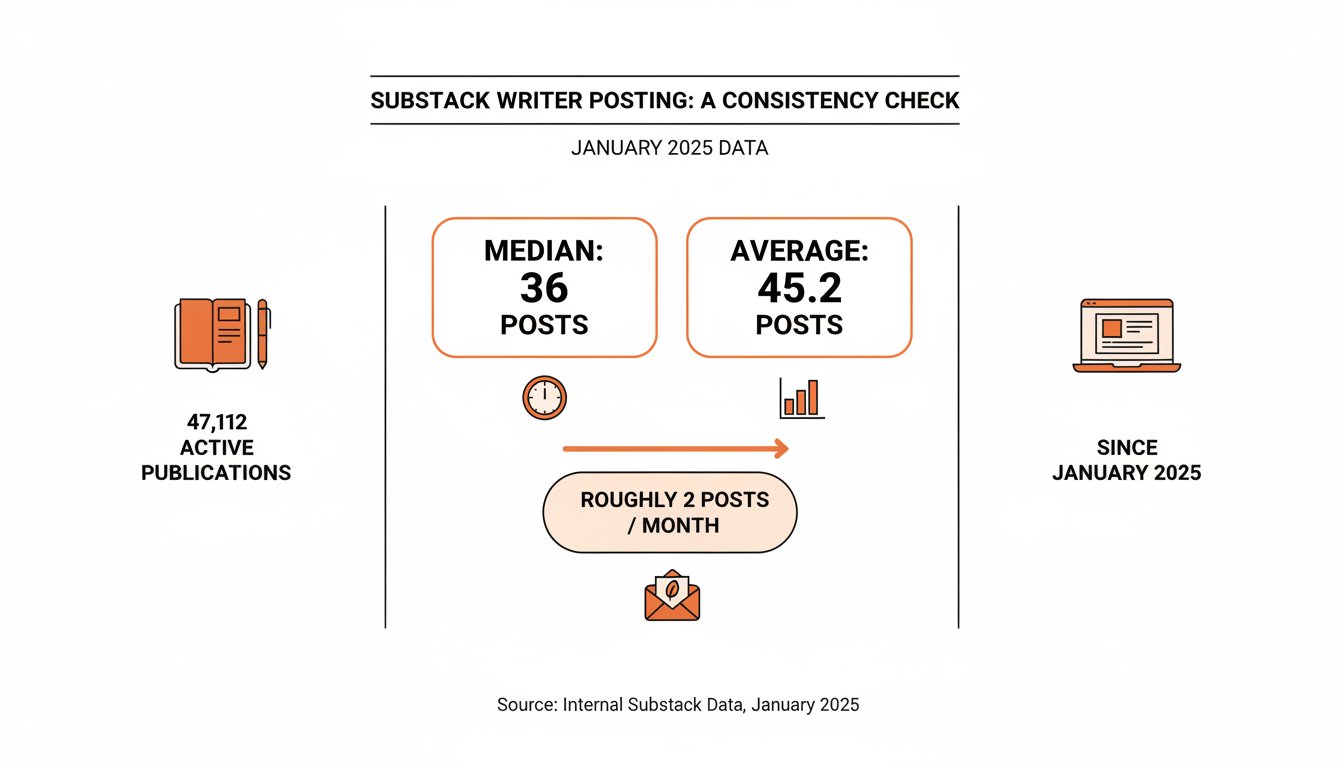
We pulled that from our own dataset rather than a survey, and it matters because a discovery engine only pays out if you feed it. The median publication posted 36 times across 18 months, about twice a month. That's enough to keep an email list warm and nowhere near enough to keep a Notes feed working for you. Writers who conclude "Substack's discovery didn't do anything for me" are almost always describing a posting rate, not a platform.
Making the Discovery Layer Systematic
Here is the honest gap in the pro-Substack argument. The discovery layer is real, and it also runs on your attention. Notes reward frequency and timing, and doing them by hand means writing when you happen to be at your desk, remembering what you posted last week by scrolling your own profile, and guessing at whether any of it worked.
That's the work WriteStack takes over, and it's why picking Substack in 2026 is a different decision than it was three years ago. You write several Notes in one sitting, assign each a publish time, and they go out through Substack's own native scheduler inside your browser session while you're doing something else. The Notes generator drafts from Notes and posts you've already published, so what lands in the queue starts in your voice instead of arriving at it after three rounds of editing, and if a draft misses you switch models rather than living with one fixed voice. The posting time heatmap shows when your audience is online, a timing decision worth making once instead of daily.
| Discovery task | Substack alone | Substack + WriteStack | Ghost |
|---|---|---|---|
| In-platform feed that shows your writing to strangers | Yes, Notes and restacks | Yes | No |
| Queue a full week of Notes in one sitting | Manual, one at a time | Yes, queue and calendar view | Not available |
| Schedule Substack chat posts | No | Yes, and no other tool does this at all | Not available |
| Link-click history across your full Notes archive | No | Yes, per link inside each Note | No |
| Benchmarks against other publications your size | No | Yes | No |
| Trend analysis month over month | No | Yes | No |
| AI drafting from your own published Notes | No | Yes, with model selection | No |
| Live inspiration feed from current Notes data | No | Yes | No |
| Cross-posting to other platforms via Buffer | No | Yes, 11 platforms | No |
| Verified reviews from writers | Not applicable | ~100 across multiple platforms | Not applicable |
The Ghost column in that table is empty for a structural reason, not a competitive one. Ghost has no Notes, so there is nothing to schedule, benchmark, or track clicks inside. That is the whole argument in one column.
Start your free trial. Fill next week's queue tonight, then open the dashboard and see which Note sent people to your archive.
Ownership, Design, and Control: Where Ghost Genuinely Wins
Flip the argument around and Ghost's case gets strong fast, and it would be dishonest to skip it. On Substack, your publication lives on Substack's domain (or a custom domain layered on top), your reader data lives in Substack's system, and your design options are limited to what Substack's editor allows. On Ghost, the site is yours. Custom themes, a full content API, your own domain without a connection fee, and a data export that isn't sitting behind anyone else's platform.
For a writer who has already proven the idea works, that ownership is worth real money even before the fee math tips in Ghost's favor. Ghost also takes nothing from your subscription revenue, which is a genuine structural advantage.
Practical rule: if losing platform access for a week would seriously hurt your business, and Substack has had outages before like every platform has, that's a sign you've outgrown a rented address.
Design and Branding
Substack's editor is deliberately simple. You get a handful of layout options, a logo, and a color, and that's roughly the ceiling. Ghost ships a full theme marketplace plus the ability to install custom code, so a publication can look like a standalone media brand rather than a templated newsletter. For a writer whose business depends on how the site looks to sponsors or paying members, that difference shows up in real revenue.
📅 Struggling to stay consistent on Substack?
WriteStack's Smart Scheduling lets you batch and queue Notes in minutes. Grow on Substack without burning out.
Explore Smart SchedulingSEO and Search Ownership
On Substack, your posts live on a subdomain or a custom domain layered over Substack's own infrastructure, and you have limited control over metadata, site structure, or how search engines crawl your archive. Ghost gives you a real content management system underneath, with full control over URL structure, page speed, and structured data. If organic search is meant to be a long-term subscriber channel rather than a side effect of Notes, Ghost's SEO ceiling is higher.
The counterweight is time. Search compounds over 18 to 36 months if you publish the right archive and do the technical work. Notes compound over an afternoon. Most writers asking this question do not have 18 months of runway to find out whether their SEO plan works.
Pricing: The 10 Percent Cut vs the Flat Fee
Here's the actual math, not the marketing version.
Substack takes 10% of every paid subscription, on top of standard Stripe processing (2.9% plus 30 cents per transaction, plus a small recurring billing fee), confirmed directly on Substack's own support page. There's no monthly fee. Publishing free content costs nothing, at any list size.
Ghost charges a flat monthly rate instead of a revenue cut. The Publisher tier, the minimum needed to accept paid subscriptions, runs $29 a month and takes 0% of what you earn beyond standard Stripe fees.
Where Ghost Gets Cheaper
| Monthly subscription revenue | Substack cost (10% + Stripe) | Ghost cost (Publisher + Stripe) | Cheaper platform |
|---|---|---|---|
| $300 | ~$30 + Stripe | ~$46.70 + Stripe | Substack |
| $500 | ~$50 + Stripe | ~$58.50 + Stripe | Substack |
| $1,000 | ~$100 + Stripe | ~$88 + Stripe | Ghost (+$12) |
| $2,000 | ~$200 + Stripe | ~$147 + Stripe | Ghost (+$53) |
| $5,000 | ~$500 + Stripe | ~$324 + Stripe | Ghost (+$176) |
That breakdown, sourced from a detailed Ghost pricing comparison, puts the break-even point somewhere around $700 to $1,000 a month in recurring subscription revenue. Below that, Substack's 10% costs less in absolute dollars than Ghost's $29 base fee. Above it, Ghost pulls ahead, and the gap widens: at $5,000 a month, the difference is more than $2,000 a year.
What the Break-Even Table Leaves Out
Two things, and both of them favor Substack.
The first is the member cap. Ghost's Publisher plan holds 1,000 total members, free and paid combined, before forcing an upgrade to the $199 Business tier. A publication with 4,000 free readers and 60 paying members is a normal shape, and it costs $199 a month on Ghost against roughly $30 on Substack. The table above quietly assumes a list small enough to fit, and most growing lists aren't.
The second is that the table prices a static publication. It compares what two platforms charge to serve the audience you already have, and says nothing about which one gets you the next thousand readers, which decides whether you're ever in the $5,000 row at all. A writer at $300 a month choosing Ghost to save on a fee they aren't paying yet has traded the growth engine for a discount on a bill that doesn't exist.
Practical rule: don't run the pricing comparison until you've had paid subscriptions live for at least three months. A single month of revenue tells you almost nothing about where you'll land in a year.
The part people don't expect
The Substack side of this comparison gets stronger the moment you stop running it by hand. WriteStack schedules Substack chat posts, which no other tool in this category does at all. It tracks which of the two links inside a Note got clicked, going back to your very first Note, so "that one did well" becomes "that one sent 40 people to the archive." And it benchmarks your restack rate against other publications your size, then shows the direction it's moving month over month. Open the dashboard on a Tuesday and see that the Note you almost didn't post drove 40 link clicks, and that your restack rate is running well above typical for a publication your size. Not better than last week. Better than the field. Ghost cannot produce any of those numbers, because Ghost has no feed to produce them from.
The live inspiration feed is the other piece. WriteStack's updates continuously from current Notes data, so what you see on a Tuesday reflects what is working on Substack that week rather than what worked whenever a list was last edited.
Substack vs Ghost: Feature by Feature
Put side by side, the tradeoff is consistent. Substack optimizes for getting found. Ghost optimizes for owning what you've already built.
| Feature | Substack | Ghost |
|---|---|---|
| Built-in discovery network | Yes (Notes, restacks, Recommendations) | No (ActivityPub only) |
| Native app with a reading feed | Yes, top source of new subscriptions | No |
| Third-party growth tooling | A full category, including WriteStack | Almost none |
| Member limit per plan | Unlimited on every plan | 1,000 (Starter/Publisher), 10,000 (Business) |
| Cost to start publishing | Free, any list size | Free self-hosted, or $15/mo Ghost(Pro) Starter |
| Setup effort | Minutes | Hours to days, more if self-hosting |
| Time to your first outside reader | Days, through Notes | Whenever search or an existing list delivers one |
| Custom themes and design | Limited | Full theme marketplace and custom code |
| Own your subscriber data | Partially | Fully |
| SEO and site structure control | Limited | Full |
| Cost to monetize | Free + 10% of revenue | $29/mo (Publisher) + 0% of revenue |
Six of the first seven rows go to Substack, and the three Ghost wins below them are versions of the same thing: control over an audience you already have. You give up design control and 10% of subscription revenue, and you get the only in-product distribution engine either platform has.
Switching Costs: What Migrating Actually Involves
Moving a newsletter isn't just a domain change. It's rebuilding parts of your business on new infrastructure, and it takes longer than most migration guides admit.
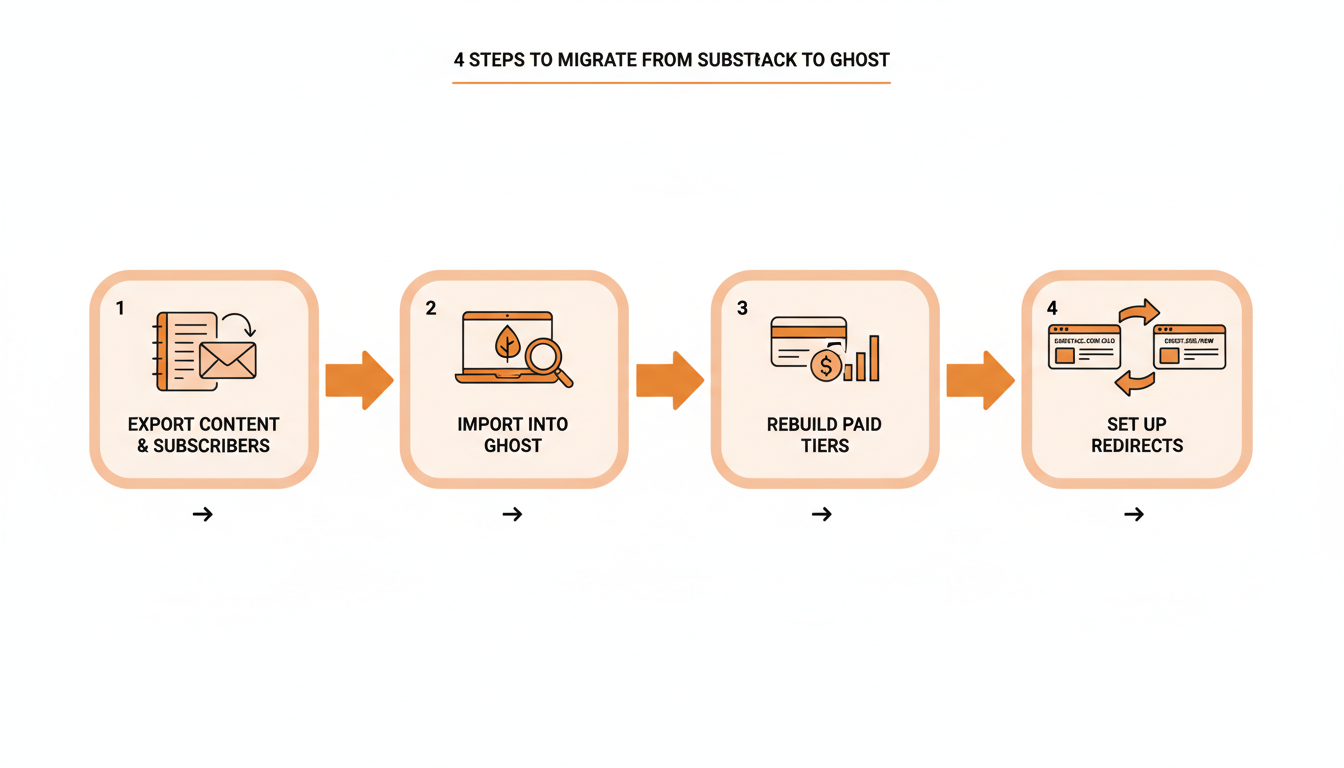
Ghost offers up to three weeks of migration help for paying customers, which says something about how involved the process is. Rushing it mid-stream, right when subscribers are used to a certain rhythm, is the fastest way to lose the people you moved everything to keep.
Practical rule: migrate between billing cycles, never mid-month, so no paying subscriber gets a double charge or a lapse in access.
What Actually Breaks During Migration
A few things won't transfer cleanly no matter how carefully you plan. Comment threads on old posts usually don't move, so years of reader discussion can disappear unless you archive it first. RSS subscribers on your old feed URL need that feed redirected too, or they silently stop getting new posts. Email deliverability reputation resets partially when you switch sending infrastructure, so open rates commonly dip for the first few sends.
The cost nobody prices in is the growth channel. The day you leave Substack, your Notes archive stops working for you, your Recommendations stop sending people your way, and every new subscriber has to come from search, social, or an ad. Writers who migrate at $1,200 a month to save $14 a month sometimes find their growth rate drops far enough to cost them more than the fee ever did.
The Verdict: Substack, and the Checkable Reason
Substack wins this comparison for almost everyone reading it, and the reason is checkable rather than rhetorical. Open Ghost's feature list and look for the in-product feed that shows your writing to people who don't subscribe to you. It isn't there. Open Substack's and look for the design control and the 0% revenue cut. Those aren't there either. One of those gaps costs you money you already have. The other costs you the money you haven't earned yet, and that one is bigger for every writer below the top of the market.
Ghost is the right call in a narrow set of cases, worth naming plainly: you're consistently earning past roughly $1,000 a month, your list is small enough or your budget large enough that the member cap isn't a problem, and your business depends on the site looking like a media brand. That's a real profile, and it's one you reach by growing somewhere first.
Everyone else should stay on Substack and get serious about the half of it that most writers leave idle. The discovery engine that makes Substack worth choosing is also the part that quietly stops running the week you get busy. WriteStack is what keeps that from happening: a week of Notes queued in one sitting, drafted from your own published writing, going out through Substack's own scheduler while you work on the next post. If you're comparing the tools that sit on top of Substack rather than the platform underneath, WriteStack's own platform comparison covers that side of the decision.
Practical rule: the writers who regret switching almost always switched too early, chasing ownership before they had an audience worth owning.
What Changes Six Weeks In
Track one week before you change anything. Write down every day you posted a Note, what time, and whether you meant to post then or remembered late. Almost every writer who does this finds the same shape: two strong days, a gap, a catch-up burst, another gap. That shape is what "Substack's discovery didn't work for me" looks like from the inside.
Six weeks into running a queue, the change isn't that you post more. It's that you stopped deciding. The Tuesday morning Note is already written, already scheduled, already gone by the time you sit down. The mental overhead of remembering, the part that actually breaks streaks, is off your plate. And the numbers stop being a mystery, because you can see which Note sent people to the archive, which links they clicked, and whether your restack rate is climbing against publications your size or sliding.
That is the version of Substack that beats Ghost by a distance that isn't close. Free publishing at any list size, an in-product feed Ghost has no answer for, and a queue that keeps feeding it on the weeks your life doesn't cooperate. Close to 100 verified reviews from Substack writers back that up, and no other tool in this category has any we could find anywhere.
Start a free 7-day trial. Queue a week of Notes in twenty minutes. Watch Substack's discovery layer do the work you were doing by hand.