
I opened Patreon's pricing page next to Substack's support docs last week, comparing them side by side the way anyone deciding where to put their paid subscription actually does. Both platforms let a writer charge readers directly. Neither one is obviously cheaper once you run the real numbers, and the fee gap is not why most creators end up picking one over the other.
Substack vs Patreon comes down to a different question: what are you actually publishing, and do you want a platform that finds readers for you or one you have to bring an audience to. A newsletter writer and a video creator running a Discord-adjacent membership are solving different problems, and the two platforms were built for different jobs.
This piece walks through fees, discovery, format, community, and switching costs using the platforms' own documentation, not marketing copy from either side.
Table of Contents
- Substack vs Patreon at a Glance
- How the Two Platforms Actually Work
- Fees: What You Actually Keep
- Discovery and Growth: Built-In Network vs. Starting From Scratch
- Content and Format: Newsletter-First vs. Membership-First
- Community: Comments and Notes vs. Posts and Tiers
- Switching Platforms: What You Can and Can't Take With You
- Which One Should You Actually Pick
- Growing Once You're on Substack
Substack vs Patreon at a Glance
For most people who write and want readers to find them without a marketing budget, Substack is the better starting point. Patreon still wins for creators whose work is naturally multi-format: video, audio, art, or a Discord-style community that needs tiered perks rather than a single subscription price. Here is the comparison that gets you there.
| Substack | Patreon | |
|---|---|---|
| Platform fee (new creators) | 10% flat | 10% standard plan (as of August 2025) |
| Legacy/lower-tier fees | Not applicable, one flat rate | 5% or 8% for creators who joined before the 2025 pricing change |
| Payment processing | Stripe, roughly 2.9% + $0.30, plus a 0.5% recurring billing fee | Bundled into the plan fee for most creators, varies by payout method |
| Free to start | Yes, publishing and email are free, fees only apply to paid subscriptions | Yes, no upfront cost, fees apply once you earn |
| Primary format | Written newsletter delivered by email, plus Notes and an app feed | Any format: video, audio, posts, livestreams, community chat |
| Built-in discovery | Recommendations network, category leaderboards, in-app browsing | Limited, mostly relies on the creator's existing following |
| Native community layer | Comments on posts, a Twitter-style Notes feed | Tiered posts, direct messages, community chat depending on plan |
| Custom domain | Yes, included | Available depending on plan and setup |
| List and revenue ownership | Full subscriber list export, Stripe Connect means the creator owns the payment relationship | Subscriber list export available, but perks and tier structure don't transfer to another platform |
Practical rule: if you can't answer "what format is my core content" in one word, you're not ready to pick a monetization platform yet. Answer that question first, then compare fees.
How the Two Platforms Actually Work
Substack is a newsletter platform with a payments layer bolted onto email publishing. You write a post, it goes to inboxes and to a public web page, and paid subscribers get whatever you've marked as behind the paywall. Notes, Substack's short-form feed, sits alongside the newsletter and functions the way a growth channel for the main publication would.
Patreon is a membership platform first. Creators build tiers, tiers get different perks, and content lives inside a members-only feed rather than an email inbox. A YouTuber running early access, a podcaster offering ad-free episodes, and an illustrator selling process videos all fit this model more naturally than a text-first one.
The distinction matters because it changes what "growth" means on each platform. On Substack, growth is largely about getting the newsletter itself in front of new readers, through recommendations, cross-posts, and Notes. On Patreon, growth usually means driving traffic in from somewhere else, since Patreon's own creator plans documentation describes tier and perk management but doesn't include a built-in discovery feed comparable to Substack's.
A quick way to think about it: pick the platform that matches your content's natural shape first, and worry about fees second. Fees are a rounding error next to picking a platform your content doesn't fit.
There's also a practical difference in how each platform treats the free tier. Substack expects most writers to run a mixed model, some posts free, some behind a paywall, with the free posts doing the work of attracting new readers who might eventually pay. Patreon's default assumption leans the other way: most of the good material sits behind a tier, and the free page functions more like a landing page than an ongoing publication. Neither approach is wrong, but building a Substack the way you'd build a Patreon page, locking almost everything behind the paywall from day one, tends to starve the discovery network of the free content it needs to recommend you in the first place.
Substack's newsletter-first structure is a large part of why we built WriteStack around Notes scheduling rather than a general social media queue. If your core content is written, the growth surface that matters most is the one built into the platform you're already publishing on.
Fees: What You Actually Keep
Substack's Fee Structure
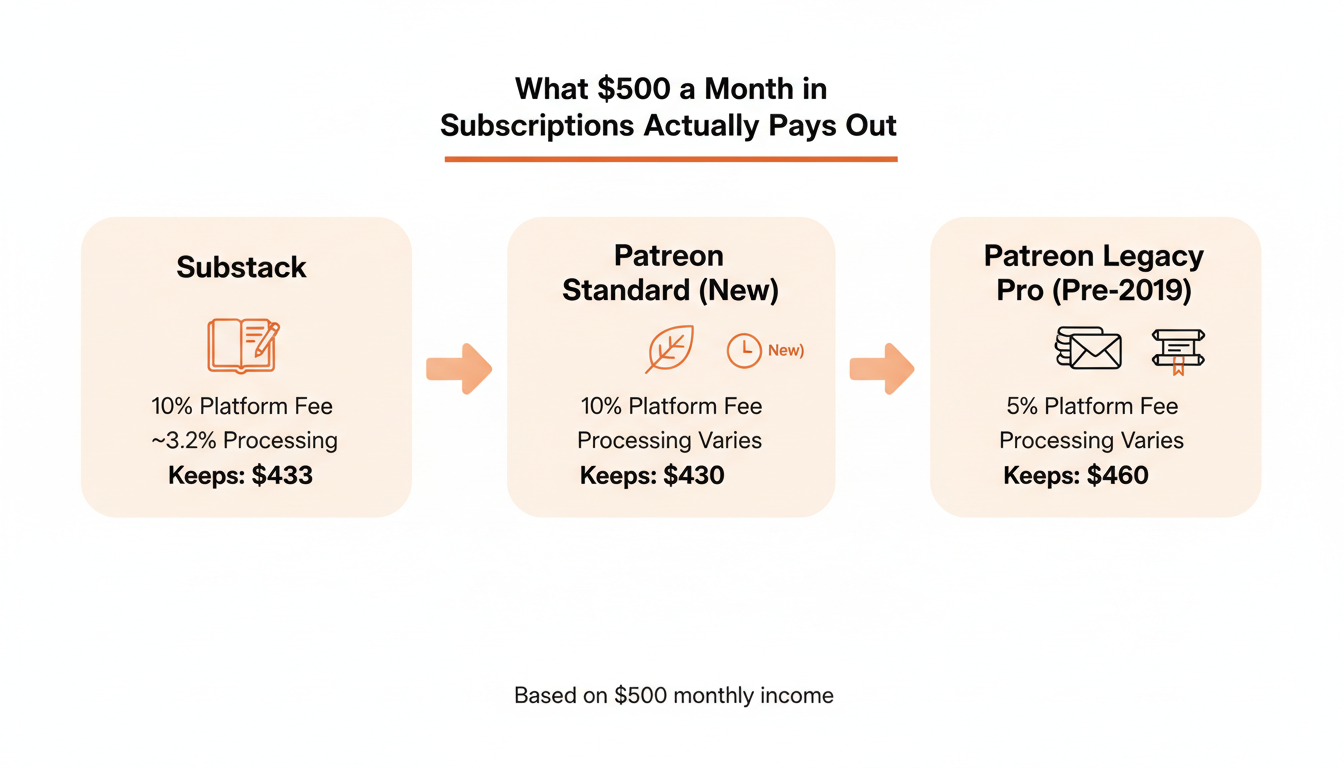
According to Substack's own support documentation, Substack takes a flat 10% of paid subscription revenue. On top of that, Stripe (Substack's payment processor) charges roughly 2.9% plus $0.30 per transaction, plus a 0.5% fee on recurring billing. Combined, a writer typically nets somewhere in the mid-80s percent of gross subscription revenue, and the exact number moves with subscription price and payment method.
There's no tiered plan to choose between. Every Substack writer pays the same 10%, regardless of how much they earn.
Patreon's Fee Structure
Patreon restructured its pricing in 2025. Per Patreon's creator fees overview, new creators launching after August 4, 2025 pay a standard 10% platform fee. Creators who joined earlier may still be on legacy plans at 5% (the original "Pro" rate for creators who joined before May 2019) or 8%, per Patreon's pricing plans page. Processing and payout fees apply on top of the platform fee and vary by region and payment method.
The practical result: a brand-new creator on either platform pays roughly the same 10% headline rate. The gap that used to make Patreon meaningfully cheaper mostly disappeared with the 2025 pricing change, except for creators who locked in a legacy plan before then.
Practical rule: don't choose a platform based on a 2-3 percentage point fee difference. At $500 a month in subscriber revenue, that's the price of a couple of coffees. Pick based on format and discovery, then treat fees as a tiebreaker.
Discovery and Growth: Built-In Network vs. Starting From Scratch
This is where the two platforms diverge the most, and it's a bigger factor than fees for most writers deciding between them.
Substack ships with a recommendations network: existing publications can recommend a new writer directly to their subscribers, and Substack surfaces newsletters through category leaderboards and its app. A brand-new Substack writer with zero external audience can still pick up subscribers through this network alone, something that shows up repeatedly in how Substack's own writers describe getting recommended.
Patreon has no equivalent discovery layer. It's built to support a following you already have somewhere else: YouTube, a podcast feed, Instagram, TikTok. Patreon's own help center focuses almost entirely on managing tiers, benefits, and payouts, not on finding new members. That's a reasonable design choice for a platform meant to sit downstream of an existing audience, but it means a creator starting from zero on Patreon alone is starting from zero, full stop.
The part people don't expect: Substack's Notes feed functions less like a comments section and more like a distribution channel in its own right. In a sample of roughly 20,000 recent Notes we analyzed, multi-line Notes averaged about 11% more reactions and 28% more restacks than single-line ones, and Notes between 150 and 300 characters outperformed Notes under 50 characters by roughly a third on reactions, and by more on restacks. Most writers treat Notes as an afterthought next to the newsletter itself, and that's exactly why it's underused as a growth lever.
If discovery matters more to you than any other factor on this list, that alone is a strong argument for Substack over Patreon, independent of what you're actually publishing.
📅 Struggling to stay consistent on Substack?
WriteStack's Smart Scheduling lets you batch and queue Notes in minutes. Grow on Substack without burning out.
Explore Smart SchedulingContent and Format: Newsletter-First vs. Membership-First
Substack is built around a single content type: the post, delivered as an email and archived on the web. You can attach audio, embed video, or run a podcast feed through Substack, but the platform's structure, the paywall, the comments, the Notes feed, assumes a written post is the unit of content.
Patreon has no default content type. A tier can give access to a video, a downloadable file, a livestream, a Discord invite, or nothing but a shoutout. That flexibility is Patreon's real strength for creators whose work spans formats or who want to bundle several kinds of content into one membership.
Neither structure is wrong, they're built for different jobs. A writer forcing a newsletter-first workflow to behave like a video membership platform will fight the tool the whole way. The reverse is just as true.
Community: Comments and Notes vs. Posts and Tiers
Substack's community layer is comments on individual posts, plus Notes, which behaves like a public, short-form feed shared across the whole Substack network rather than a private space for paying subscribers only. That means Notes can grow your audience even among people who never subscribe, since anyone browsing Substack can see them.
Patreon's community layer is built for paying members specifically: tiered posts, direct messages, and, on higher plans, community chat features closer to a private Discord. Nothing in a Patreon membership is designed to be discovered by someone who isn't already a member or a follower elsewhere. It's a closed loop by design, which is exactly what a lot of creators running paid communities actually want.
If part of your growth plan depends on free content pulling in paying subscribers over time, Substack's public Notes feed and open comment sections do that work. If you'd rather keep everything behind the paywall so free browsers never see the good stuff, Patreon's closed structure fits that instinct better.
WriteStack's fans view can show you which of your free readers are engaging the most, which is useful signal for deciding who's close to converting to paid, regardless of which platform you're running that funnel on.
Switching Platforms: What You Can and Can't Take With You
Both platforms let you export your subscriber list, so the audience itself isn't fully locked in on either one. The difference is what happens to the relationship and the revenue structure when you move.
On Substack, Stripe Connect means the creator, not Substack, owns the direct payment relationship with subscribers through their own Stripe account. That makes migrating paid subscribers to a new email platform more straightforward, since the billing relationship isn't tied exclusively to Substack's infrastructure the way some competitors' systems are.
On Patreon, membership tiers, perks, and posting history don't transfer anywhere else. A creator leaving Patreon effectively rebuilds their tier structure and their content archive from scratch on whatever they move to next. The subscriber list travels; the membership experience doesn't.
Neither platform makes leaving painless, but Substack's model leaves a writer with more portable infrastructure if a future move ever becomes necessary.
This is worth thinking about before you launch, not after you've built an audience. A writer who picks Substack and later decides the format isn't working can move a paid list to almost any other email-and-payments setup without renegotiating the entire subscriber relationship. A creator who builds a Patreon page around five perk tiers and later wants to switch tools has to rebuild the tier logic from scratch, because tiers aren't a portable concept outside Patreon's own system.
Which One Should You Actually Pick
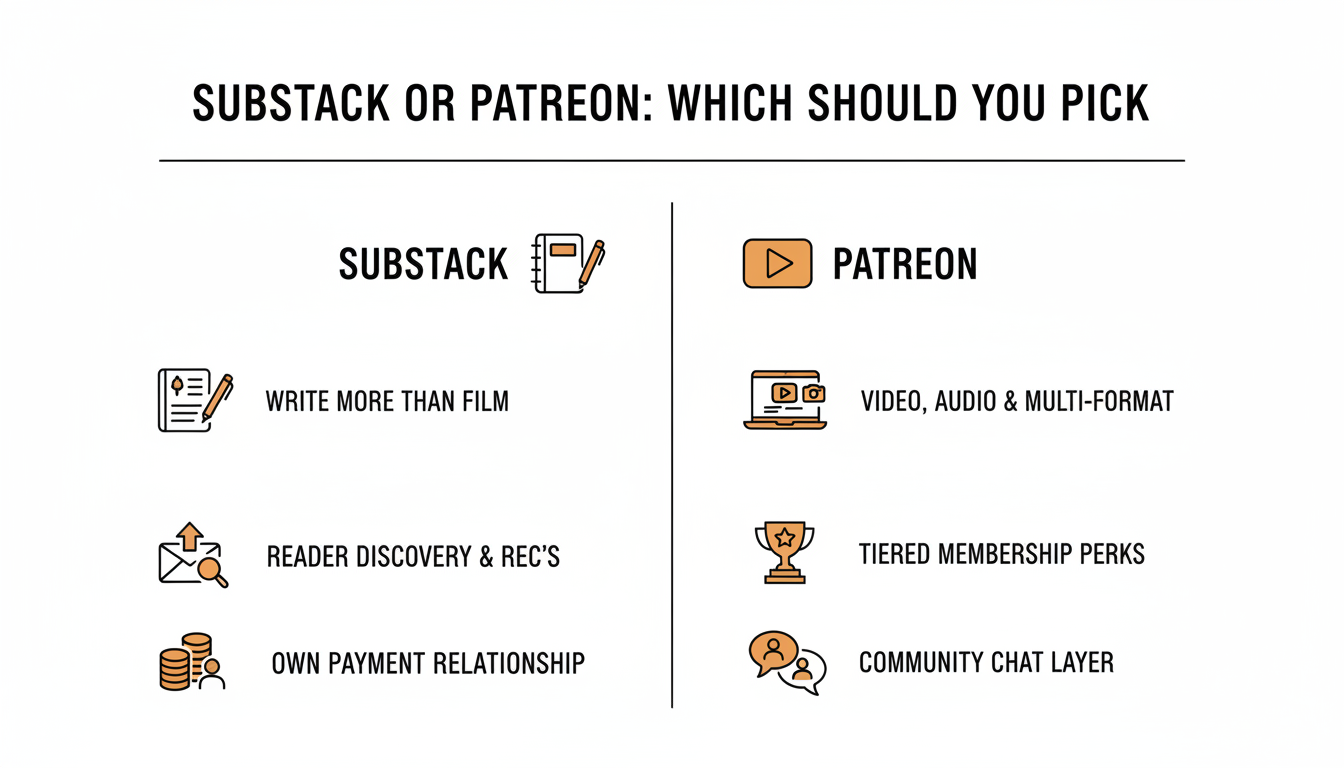
If You Write More Than You Film
Pick Substack. The newsletter format, the built-in recommendation network, and the flat, simple fee structure all favor a writer whose primary output is text. You'll also get Notes as a free distribution channel that a text-first creator can use the same way a video creator uses YouTube Shorts, short, frequent, and built to pull people toward the main content.
If You're a Video, Audio, or Multi-Format Creator
Pick Patreon. Tiered perks, native video and audio hosting, and a community structure built around ongoing member interaction all serve a creator whose content doesn't fit neatly into an email. Substack can technically host audio and video, but it's not what the platform, or its discovery tools, is optimized for.
If You're Not Sure Yet
Start on Substack. It costs nothing to publish, the fee only applies once you're actually earning, and the built-in discovery network means the downside of starting there and being wrong about your format later is lower than starting on Patreon with no audience and no discovery mechanism to fall back on. If you outgrow the newsletter format after a year of writing and realize your audience actually wants video, you can add a Patreon tier for that specific content later. Going the other direction, starting on Patreon and adding a newsletter after the fact, is a much harder retrofit, because you're building an email list and a discovery presence from a standing start no matter how big the Patreon membership already is.
Growing Once You're on Substack
Picking Substack over Patreon solves the platform question. It doesn't solve the harder one: how do you actually get from zero paid subscribers to a publication that supports itself. Discovery gets you visibility, but visibility only converts if you show up consistently, and that's where most writers lose momentum, not at signup.
Notes is the fastest way to stay visible between newsletter sends, and it's also the easiest habit to drop when a week gets busy. That's the specific problem WriteStack exists to solve: schedule a week of Notes in one sitting, and they go out on their own even on the weeks you don't open Substack at all. WriteStack's Notes generator can also draft new Notes directly from posts you've already published, so restarting a stalled streak doesn't mean staring at a blank box.
Once Notes are going out consistently, the heatmap view shows which days and times your specific audience actually engages, rather than a generic "best time to post" guess borrowed from someone else's publication. That's the difference between guessing at a schedule and running one based on your own numbers.
If you've made the call and you're building on Substack, start scheduling your Notes with WriteStack instead of trying to remember to post every day by hand. Six weeks in, the change isn't that you're publishing more content, it's that you stopped having to think about whether you'd published anything at all.