
Substack Notes vs Threads: Where Writers Should Post
You have twenty minutes free and a good idea. Post it as a Substack Note, or open Threads and type it there instead? Most writers answer this by gut feeling, then wonder six months later why one platform grew their subscriber list and the other grew nothing but a follower count they can't monetize.
Substack Notes vs Threads is really a question about where a writer's time is best spent, and the honest answer depends on what you're building. Notes exists inside the same app your subscribers already use to read you. Threads exists inside Meta's much larger, much noisier network, where almost nobody who sees your post has ever heard of your newsletter.
Both platforms changed meaningfully in the past year. Substack quietly rewired its Notes algorithm in late 2025. Threads crossed 500 million monthly users by mid-2026 and kept growing. Neither fact by itself settles where you should post. Together, they change the calculation enough that advice from 2024 is now out of date.
Table of Contents
- What Substack Notes Actually Does for Writers
- What Threads Actually Does for Writers
- How the Algorithms Compare in 2026
- Substack's late-2025 shift
- Threads' discovery-first feed
- Who's Actually on Each Platform
- The Growth Data: Which One Moves the Needle
- Format Differences That Actually Matter
- The Case for Posting on Both
- Running Both Without Doubling Your Work
- FAQ: Substack Notes vs Threads
What Substack Notes Actually Does for Writers
Notes is Substack's short-form feed, built directly into the app and website every subscriber already has open. A Note can be a single line, a quote pulled from someone else's post, an image, or a longer multi-paragraph thought. Anyone on Substack can see it, comment, restack it into their own feed, or click through to your publication, whether or not they subscribe to you yet.
The reason Notes matters for growth has nothing to do with vanity metrics. It's the one place on the internet where every single viewer is, by definition, already a newsletter reader. Nobody on Notes needs to be convinced that reading a Substack is a normal thing to do. That single fact removes the biggest barrier every other short-form platform makes you fight.
Practical rule: treat Notes as a distribution channel for ideas that don't deserve a full post yet, not a replacement for writing posts. The writers who get the most out of it publish Notes almost daily and full posts on a slower, separate schedule.
One number worth having before you start: WriteStack has close to 100 verified reviews from Substack writers across multiple platforms. Narrareach, StackSweller, and StackBuddy have none that we could find anywhere.
What Threads Actually Does for Writers
Threads is Meta's text-first app, launched as a Twitter competitor and now a real platform in its own right. It crossed 400 million monthly active users in late 2025 and reached roughly 500 million by June 2026, according to Backlinko's Threads user tracking. Daily active users sit around 141.5 million on mobile, which put it ahead of X in early 2026 by that same measure.
For a writer, Threads offers something Notes structurally cannot: a much bigger pool of people who have never heard of newsletters, Substack, or you. The app's discovery mechanism is built to surface content from accounts you don't follow, based on what you engage with, which means a good post can travel far outside your existing audience.
The tradeoff is that almost none of those people are primed to subscribe to anything. You're competing with meme accounts, brand pages, and general chatter for attention, and converting a Threads follower into a paying newsletter subscriber takes several more steps than converting a Notes reader.
Writers who do well on Threads tend to post the way the platform rewards: short, direct opinions or observations, replies to bigger accounts in their niche, and threads that read like a real conversation rather than a broadcast. The posts that flop are usually the ones written like a newsletter excerpt dropped into a feed built for something faster. If a Note reads well as a paragraph, the Threads version of the same idea usually needs to be cut down to its single sharpest sentence.
How the Algorithms Compare in 2026
Substack's late-2025 shift
Late in 2025, Substack changed how Notes gets distributed. The feed no longer leans mainly on people you already follow. Instead, most of what a reader sees now comes from writers they've never followed, matched by topic and by what they've engaged with recently, according to writer accounts documented in posts like Escape the Cubicle's breakdown of the change. Restacking someone else's Note, replying with something substantive, and showing up in threads that aren't your own now carry real weight in what gets amplified.
That's good news if your publication is small. Reach stopped being gated by an existing follower count. It's a real adjustment if your whole Notes strategy assumed a loyal following would always see your posts, because that assumption no longer holds.
Threads' discovery-first feed
Threads has run a discovery-first feed since launch. It ranks posts loosely and leans on recommendations rather than a strict chronological or follow-based order, which is part of why new accounts can get real reach quickly. The mechanism is closer to what Notes became in late 2025 than to what Notes used to be.
Practical rule: the two platforms now reward similar behavior, replying, engaging, showing up in other people's threads, more than either rewards simply having followers. If you're only posting and never engaging back, you're leaving reach on the table on both.
Who's Actually on Each Platform
This is where the two platforms diverge the most. Substack's userbase, and Notes by extension, skews toward people who already read or write newsletters. It's a smaller pool, but every person in it understands what a paid subscription is and has likely paid for one before.
Threads' 500 million monthly users are a general social media audience: photographers, brands, comedians, sports fans, people who followed a celebrity and never left. Writers are a niche inside that crowd, not the default user. Reaching a writer-curious audience there takes more filtering, more hashtag and topic targeting, and more patience before the algorithm learns what your content is and who wants it.
There is a real writer community forming on Threads, built partly through Instagram crossover, since Threads accounts connect to existing Instagram followings. A writer who already has an Instagram presence walks into Threads with a head start Notes can't offer, because Notes has no equivalent import from an existing audience elsewhere. A writer starting from zero on both platforms will usually find the writer community easier to reach on Notes first, simply because it's smaller and every account in it is already self-selected as someone who cares about writing.
| Substack Notes | Threads | |
|---|---|---|
| Core audience | Newsletter readers and writers | General social media users |
| Understands paid subscriptions | Yes, by default | Rarely, needs explaining |
| Discovery mechanism | Topic and engagement-based (as of late 2025) | Discovery-first since launch |
| Monthly active users | Not publicly disclosed by Substack | ~500 million (mid-2026) |
| Direct subscribe path | One tap, inside the same app | None, requires an outbound link |
| Character limit | None (short or long) | 500 characters per post |
| Native cross-posting to other platforms | No | No |
The Growth Data: Which One Moves the Needle
📅 Struggling to stay consistent on Substack?
WriteStack's Smart Scheduling lets you batch and queue Notes in minutes. Grow on Substack without burning out.
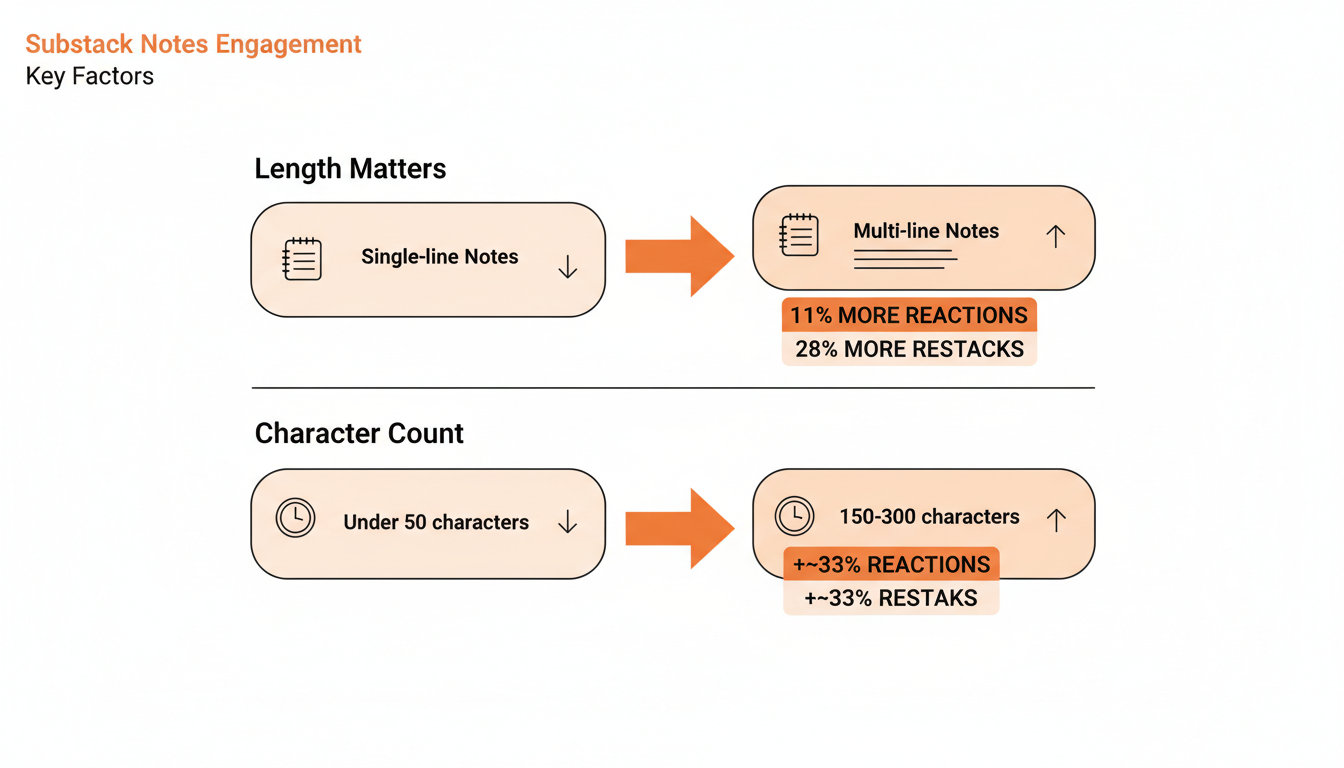
Explore Smart SchedulingWe pulled a sample of 20,000 recent Notes from WriteStack's own dataset to see what format actually performs. Multi-line Notes averaged about 11% more reactions and 28% more restacks than single-line Notes. Notes between 150 and 300 characters outperformed Notes under 50 characters by roughly a third on reactions, and by more on restacks.
That data only exists for Notes because Notes is where WriteStack's users write. Threads doesn't have an equivalent public benchmark that's been independently verified, which is itself telling. The tooling and analytics layer around Notes is more mature than what's available for tracking Threads performance as a writer specifically, separate from Meta's own creator dashboard.
What we can compare is opportunity cost. A Note takes roughly the same time to write as a Threads post. Posted to Notes, it reaches an audience that already converts to subscribers at a known rate. Posted to Threads, it reaches a much larger audience that converts at a rate almost nobody tracks well, because so few of those followers ever see a subscribe link.
Writers who've run both side by side for a full quarter tend to report the same pattern: Threads posts occasionally spike hard and bring a wave of profile visits, while Notes brings a steadier, smaller, but more convertible trickle. Neither result shows up after a week. Both take months to compound.
Substack's own growth curve after the late-2025 algorithm change follows a pattern several writers have now documented independently: minimal reach for the first one to three months, a noticeable uptick around months four to six, and much larger gains from months seven to twelve, on the same quality and frequency of content, as described in accounts like Not Exactly Ana's growth writeup. That timeline matters for the comparison, because it means judging either platform after a few weeks of posting tells you almost nothing. A writer who quits Notes after a month because "nothing happened" and moves entirely to Threads is judging the two platforms on different clocks, not on their actual merits.
Format Differences That Actually Matter
Threads caps posts at 500 characters and supports images, video, and polls, with reply threads that read closer to a conversation. Substack Notes has no hard character limit, so a Note can be a one-liner or a full paragraph, and it supports images, links, and quoted restacks of other people's posts and Notes.
The practical difference shows up in how each platform handles a link. Substack Notes surfaces a clickable preview of anything you link to, including your own posts, inline in the feed. Threads treats outbound links as a mild negative signal for reach, the same way most social platforms do, since a link sends someone away from the app.
That single mechanic explains a lot of writer behavior on Threads: posts that do well rarely link out directly, and instead build a following first, with a link to the newsletter tucked into a bio or a reply.
The Case for Posting on Both
Neither platform replaces the other, and treating this as an either-or choice is usually the wrong frame. Notes converts better per view because the audience is pre-qualified. Threads reaches further because the audience is larger and less saturated with newsletter pitches. A writer optimizing only for conversion rate ignores real reach. A writer optimizing only for reach ignores that most of it never turns into a subscriber.
The part people don't expect: WriteStack is the only Substack scheduling tool that also schedules Substack chat posts, tracks link clicks across your entire Notes history (not just the last 30 days), and benchmarks your account's Notes performance against other publications, not just against your own past week. Most writers never realize how much of their own history is sitting unanalyzed until they see it laid out.
The practical version of "post on both" is: write the idea once, post it to Notes in Notes' native voice, and adapt it slightly for Threads rather than copy-pasting identically. A Note that links directly to your latest post can be rewritten for Threads without the link, with the link moved to your bio or a follow-up reply instead.
Running Both Without Doubling Your Work
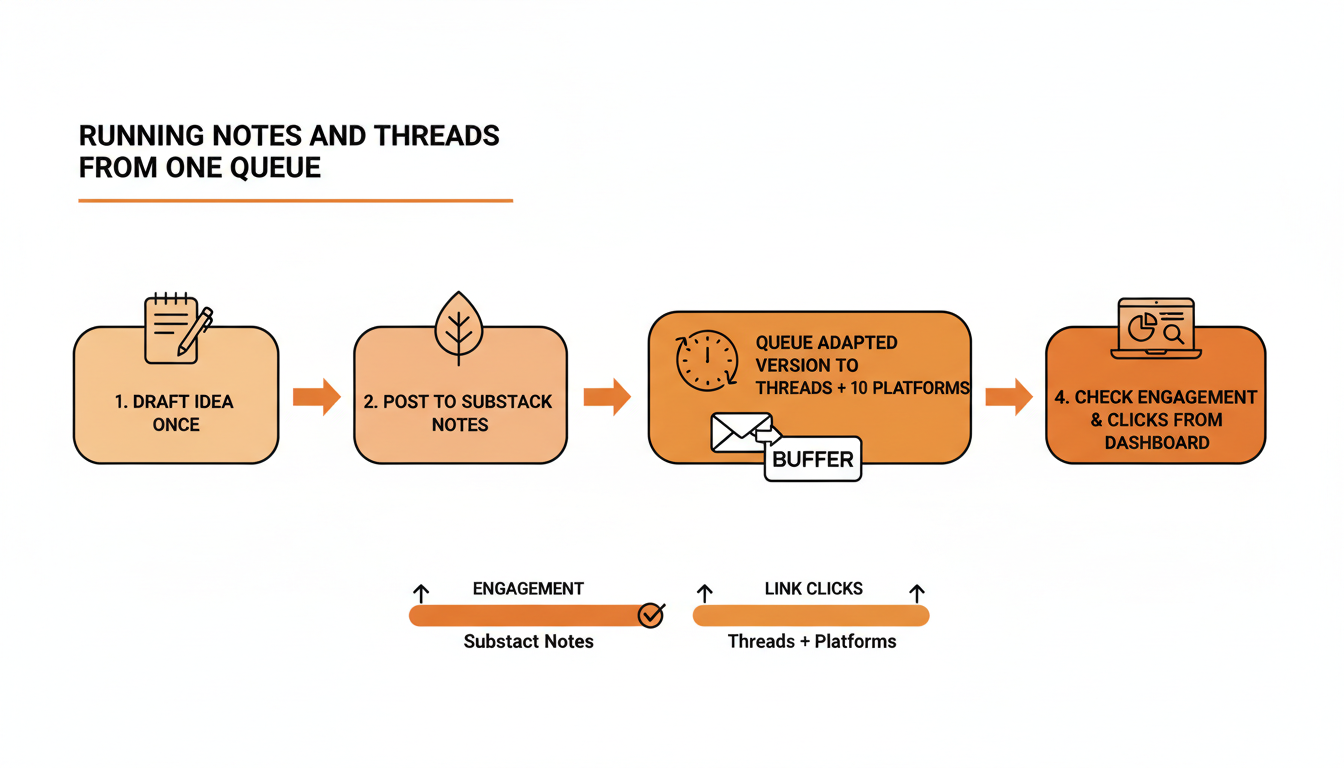
This is the part most Notes-vs-Threads debates skip entirely: you don't have to choose which app to open every time you have an idea. WriteStack's Notes scheduler lets you draft a batch of Notes in one sitting, in your own voice, then queue them to go out through the week without opening Substack again.
For Threads specifically, WriteStack cross-posts through a Buffer integration to eleven platforms, Threads included, so the same idea can go out natively on Substack Notes and adapted for Threads without retyping it twice. That's a real gap most single-purpose Notes tools don't close: Narrareach lists six native platforms with four more marked "coming soon," and neither StackSweller nor StackBuddy cross-posts to Threads at all as of this writing.
Once both are posting, the heatmap view shows which hour of which day actually gets read on Substack, so the posting schedule isn't a guess. And because WriteStack tracks link clicks across your full Notes history, not a rolling 30-day window, you can see months later which specific Note actually drove the subscribers who are still reading today.
Practical rule: don't cross-post identically. Adapt the link handling per platform, keep Notes native to Substack's audience, and treat Threads copy as a standalone post that happens to share an idea with your Note, not a mirror of it.
Six weeks into running both from one queue, the change most writers notice isn't that they're posting more. It's that they stopped spending twenty minutes a day deciding which app to open first.
FAQ: Substack Notes vs Threads
Is Threads worth it if I only write on Substack? Yes, as a reach channel, not a replacement for Notes. Threads' audience is bigger and less saturated with newsletter pitches, but it converts to subscribers far more slowly than Notes does, so it works best as a top-of-funnel addition rather than your primary channel.
Do I need to post identical content to both? No, and you shouldn't. Threads treats outbound links as a mild reach penalty, so a Note that links directly to your latest post should get its link removed or moved to a bio link when adapted for Threads.
Which one is better for a brand-new Substack with zero subscribers? Notes, because every viewer already understands what a paid subscription is. Threads can still help once you have a few posts worth linking to, but a brand-new writer usually gets a faster first hundred subscribers from Notes than from a general social platform.
Can I schedule both from the same place? Yes. WriteStack schedules Substack Notes natively and cross-posts to Threads and ten other platforms through its Buffer integration, so you're drafting once instead of managing two separate apps and two separate posting habits.
Most writers don't actually need to pick a side in the Notes vs Threads debate. They need a way to stop the two platforms from eating separate chunks of their week. Load a week of Notes into WriteStack, queue the Threads versions alongside them, and watch both go out without reopening either app.