
I started tracking my own posting habits after I noticed something uncomfortable: I dreaded opening the Substack editor on days I used to look forward to writing. That feeling is the first real warning sign of Substack writer burnout, and it shows up long before anyone actually quits.
Burnout on Substack rarely comes from writing too much in an absolute sense. It comes from the shape of the work: writing, formatting, scheduling, and promoting a piece all happen in one unbroken sitting, over and over, with no buffer. The question worth answering is not "how do I write more," it's "how do I keep writing without the process wearing me down."
This matters more now than it did a few years ago. Substack has added Notes, Chat, and a Discover feed that all reward frequent activity, on top of the original weekly-newsletter format. Writers who joined for one kind of publishing rhythm now feel pressure to maintain three or four rhythms at once, often without adjusting their process to match.
Table of Contents
- Why Substack Writers Burn Out
- The Real Cost of Constant Context-Switching
- Signs You're Heading Toward Burnout
- Consistency Beats Frequency: What the Data Shows
- Batch Your Content in One Sitting
- Build a Sustainable Publishing Schedule
- Automate the Repetitive Parts
- When to Take a Break Without Losing Momentum
Why Substack Writers Burn Out
Most writers frame burnout as a motivation problem. It's usually a workflow problem instead. Every Substack post asks you to do four separate jobs: think of the idea, draft it, edit and format it, then publish and promote it on Notes. Doing all four in a single session, on publish day, under a self-imposed deadline, is what drains people.
Add the newer expectation that writers also post Notes daily to stay visible in Substack's Discover feed, and the workload compounds. A writer who used to publish one post a week now feels responsible for a post plus five to seven Notes, written cold, right before or after the long-form piece goes out.
Comparison culture adds a second layer of pressure on top of the workload itself. Substack surfaces bestseller badges, subscriber counts, and restack activity everywhere, which makes it easy to measure your week against writers who have been publishing for years or who write in a format that suits daily output better than yours does. That comparison rarely changes the work that needs doing, but it does add a layer of anxiety to a process that was already tiring.
There's also a slower-burning cause: unclear return on effort in the first several months. New writers often can't tell whether a quiet week hurt their growth or whether a strong week helped it, because subscriber counts move slowly and unevenly. Without a way to see what's actually working, it's tempting to respond to uncertainty by publishing more, which accelerates burnout instead of solving the underlying problem.
Practical rule: if writing and scheduling happen in the same sitting, on the same day, every week, you're building a workflow that has no room for a bad week.
The Real Cost of Constant Context-Switching
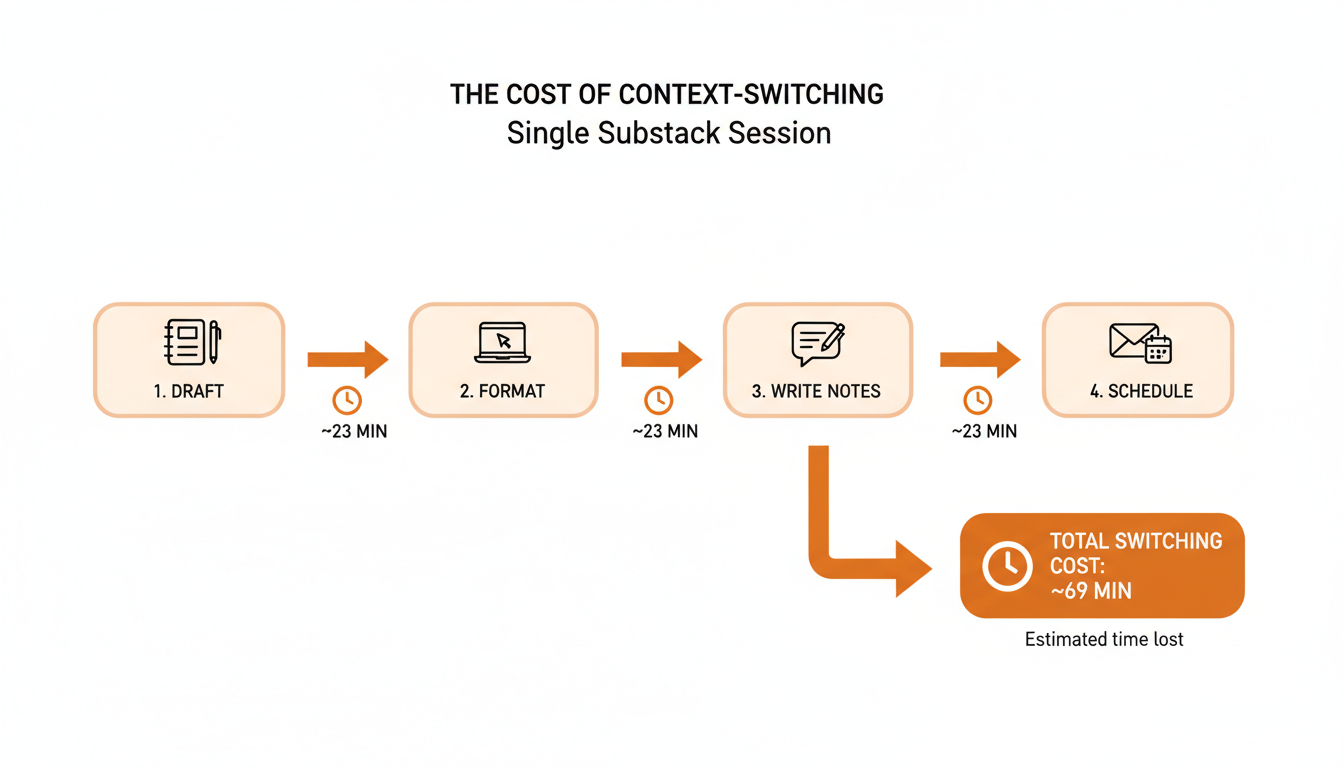
Writers underestimate how expensive it is to switch between drafting, editing, formatting, and platform admin inside one sitting. Gloria Mark's research group at UC Irvine tracked office workers across full workdays and found that after a single interruption, it took an average of over 23 minutes to return to the original task at the same level of focus, because people typically complete two other tasks before circling back (Mark, Gudith & Klocke, 2008).
Writing a Substack post is not one task. It's drafting, then switching to image selection, then switching to the Substack editor's formatting quirks, then switching to writing Notes, then switching to scheduling. Every one of those switches carries a real recovery cost, and none of it feels like "real writing," which is exactly why it drains people faster than the writing itself does.
This cost compounds specifically for Substack writers because the platform bundles writing and distribution into the same workspace. A blogger writing in a separate editor at least gets to finish a full draft before switching contexts. A Substack writer working directly in the platform's editor is more likely to bounce between composing a paragraph, checking how it renders, adjusting an image, and glancing at Notes, all inside one continuous session.
None of this means the writing itself takes longer than it used to. It means the total time spent producing a single post includes far more switching overhead than the word count alone would suggest, and that overhead is what people describe as feeling "tired of Substack" even on weeks when they didn't write very much.
Signs You're Heading Toward Burnout
The warning signs show up in the workflow before they show up in the writing quality. Watch for a growing gap between when you finish a draft and when you actually publish it, because that gap is usually procrastination caused by dreading the formatting and scheduling steps, not the writing itself.
Watch for Notes turning into an afterthought you write in the ten minutes before a post goes out, since rushed Notes tend to get less engagement, which then makes the whole platform feel less rewarding. A writer who used to enjoy Notes as a quick, low-stakes format starts experiencing them as one more chore attached to publish day.
Watch for treating every missed week as a failure instead of a normal part of a sustainable schedule, because that mindset is what turns one missed week into a permanent hiatus. Writers rarely quit Substack after a single bad week. They quit a few weeks later, after the guilt from that first missed week made the second and third weeks feel even harder to start.
A few smaller signals are worth tracking too. Re-reading your own drafts more times than usual before you feel comfortable publishing is often a sign of dropping confidence rather than declining quality. Checking subscriber counts or Notes engagement significantly more often than you used to is a sign the process has started to feel like performance rather than writing. And feeling relief rather than satisfaction after hitting publish, relief that the task is over rather than pride in the piece, is one of the clearest indicators that the workflow itself needs to change.
Practical rule: track the gap between "draft finished" and "post published." A growing gap is an earlier warning sign than a missed week.
Consistency Beats Frequency: What the Data Shows
There's a common assumption that growth requires posting daily. The data on this is more specific than that. An analysis of 2.3 million posts across 13,534 Substack writers found that writing one additional post per week correlated with dramatically better subscriber outcomes, described by the researcher as the difference between 10x growth trajectories (Finn Tropy, "What 13,844 Newsletters Reveal About Growing on Substack," 2025). The gain came from adding one predictable post, not from publishing every day.
That distinction matters for burnout specifically. Going from one post a week to two, on a schedule you can actually sustain, is a manageable increase in workload. Going from one post a week to seven pieces of content across posts and Notes, written under time pressure, is a different kind of commitment entirely, and it's the kind that tends to produce a burst of growth followed by a long silence.
| Posting pattern | Typical outcome | Burnout risk |
|---|---|---|
| Daily posts, no schedule buffer | Fast early growth, frequent multi-week gaps later | High |
| 2-3 posts/week, written same-day | Moderate growth, inconsistent quality | Medium-high |
| 1-2 posts/week, batched a week ahead | Slower but steady growth, fewer gaps | Low |
| Sporadic bursts around launches only | Spikes with long silent stretches | Very high |
The pattern that survives long enough to compound is the batched, moderate-frequency one. It trades a slightly slower start for a schedule that doesn't collapse the first time life gets busy. Writers comparing their own growth to someone posting daily are often comparing an early sprint to a pace that isn't actually built to last, and a fair comparison should account for whether that faster-growing account is still publishing consistently a year later.
📅 Struggling to stay consistent on Substack?
WriteStack's Smart Scheduling lets you batch and queue Notes in minutes. Grow on Substack without burning out.
Explore Smart SchedulingBatch Your Content in One Sitting
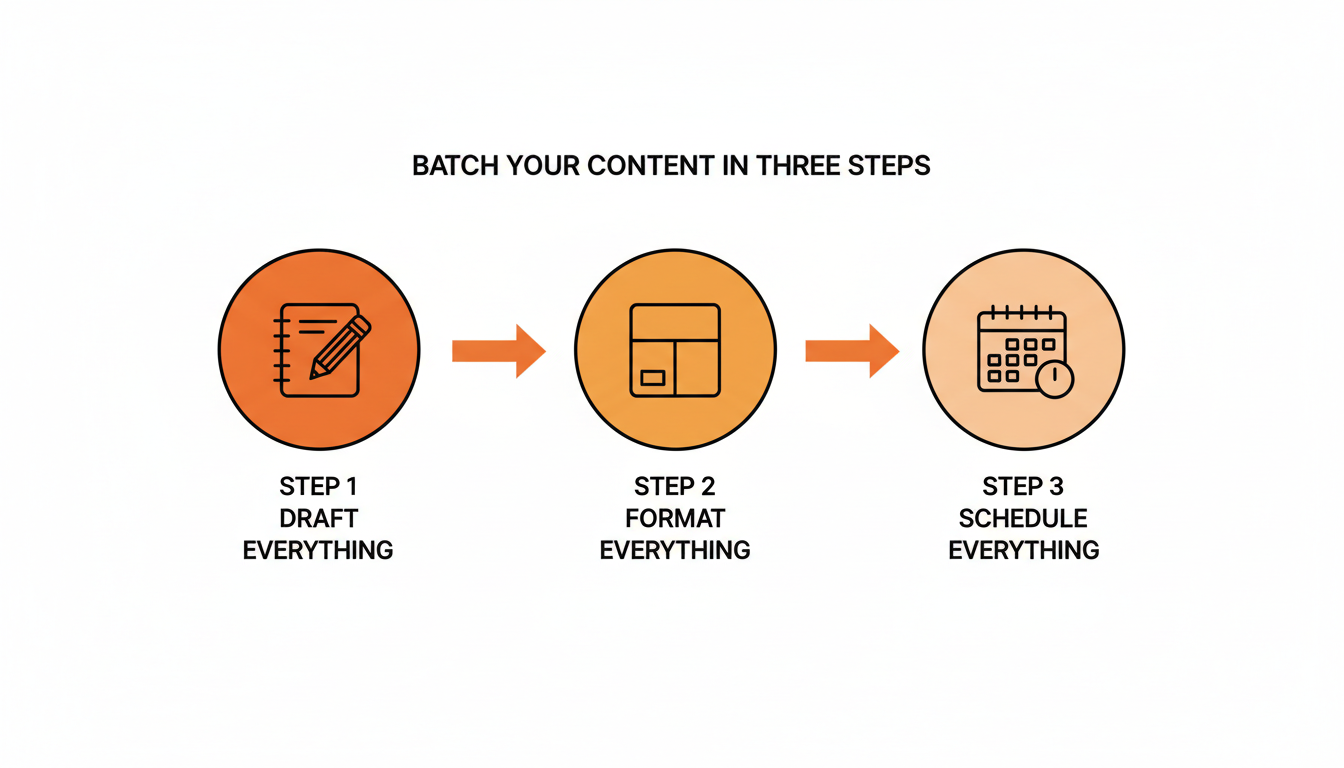
Batching means separating "generate ideas and draft" from "format and schedule" into two different sessions, ideally on two different days. This single change removes most of the context-switching cost described above, because each session only asks your brain to do one kind of work.
A simple batching sequence for a week of Substack content looks like this. First, spend one session generating and roughly drafting every piece you plan to publish that week, posts and Notes together, without touching formatting or images, since mixing idea generation with formatting decisions is exactly the kind of switch that slows people down. Second, spend a separate session polishing and formatting each draft, since editing with fresh eyes catches more than editing right after writing does. Third, schedule everything for the week in one final session, so publish days become "hit send," not "write, format, and publish" all at once.
Most writers who try batching for the first time are surprised by how much faster the drafting session goes once formatting and scheduling are removed from it. A batch of five Notes drafted back to back, with no formatting decisions in between, typically takes far less time in total than writing five separate Notes across five separate days, because each of those daily sessions carries its own startup cost of remembering what you were going to write about.
WriteStack's Notes generator makes the first step faster, since it gives you a starting batch to edit rather than a blank page for every single Note.
Build a Sustainable Publishing Schedule
A sustainable schedule is one you could keep running during a bad week, not just a good one. That means picking a cadence you can hit at 70% effort, not the cadence you can hit when everything goes right. Most writers build their schedule around their best week and then feel like they're failing every week that isn't their best.
A Weekly Cadence Template
A workable starting template for most solo writers: one long-form post per week, four to five Notes spread across the week rather than clustered on publish day, and one fixed day reserved for batching next week's drafts. This is close to the cadence the 13,534-writer analysis above associates with steady, compounding growth, rather than the daily-posting cadence that tends to produce early spikes and later silence.
Writers with more capacity can add a second post per week once the one-post cadence feels comfortable rather than effortful. Adding frequency before the base cadence feels sustainable is one of the most common ways a workable schedule turns into a burnout schedule within a few months.
Buffer Weeks for Life Events
Build in buffer weeks on purpose, roughly one lighter week every six to eight weeks, where you pre-schedule shorter content or a lighter Notes cadence in advance. A planned lighter week does not read as inconsistency to subscribers. An unplanned three-week silence does.
Practical rule: schedule your buffer weeks before you need them. Deciding to take a break mid-burnout usually turns into an open-ended hiatus.
Automate the Repetitive Parts
The parts of publishing that cause the most fatigue are usually the most repetitive ones: retyping the same Notes format, manually checking what time your audience is actually online, and re-scheduling posts one at a time. None of that work makes the writing better, so it's the first place to remove friction.
Tools that generate a batch of on-voice Notes from your recent posts cut the blank-page problem down to an editing pass rather than a from-scratch writing task for every single Note. That difference alone removes a meaningful share of the daily willpower Notes otherwise require.
A heatmap of when your specific audience engages, rather than a generic "best time to post" rule, removes the guesswork from scheduling. WriteStack's audience heatmap is built for exactly this, so you schedule around your readers instead of a generic industry average that may not match your niche or time zone at all.
Batch scheduling tools that let you queue a week or a month of Notes in one sitting solve the third source of friction directly, since the alternative, manually posting each Note at the right time on the right day, reintroduces the daily task that batching was supposed to eliminate in the first place.
When to Take a Break Without Losing Momentum
Taking a real break without losing subscribers comes down to timing and communication, not avoiding breaks altogether. Announce a lighter week in advance rather than disappearing silently, since readers tolerate a stated pause far better than an unexplained one. A short note saying you're taking a week off and will be back on a specific date reads as normal, professional behavior. A publication that simply goes quiet with no explanation reads as abandoned, even after just two or three weeks.
Pre-schedule at least one piece to go out during the break, even something shorter than usual, so the publication doesn't go fully dark. A single scheduled Note or a short post keeps the account active in Substack's Discover feed and keeps subscribers from wondering whether you've stopped writing altogether.
Check which subscribers engage most consistently before and after a break, since a drop limited to casual readers is normal, while a drop among your most engaged readers is a signal to adjust the schedule, not just push through it. Use WriteStack's fan tracking before and after a planned break to see whether your core audience actually noticed, instead of guessing.
Burnout on Substack is a workflow failure more often than a motivation failure. Separate drafting from formatting and scheduling, pick a cadence you can sustain on a bad week, and use tools that remove the repetitive parts of publishing instead of adding more manual steps. Start scheduling a sustainable week of Substack content with WriteStack and see what publishing looks like when the process isn't the thing wearing you out.