
It's Sunday night. You have decided this is the season the newsletter gets serious, you open a tab to find out how often to publish, and every article hands you the same answer: it depends on your capacity. That is true, and it is useless. You already know your capacity feels tight. You searched because you want a number.
Publish two full posts a week, and run Notes daily underneath them. Two is where the math stops arguing with you. Across roughly 4,200 active publications we sampled, average reactions per post held flat from one post a week all the way up to seven, which means a second post costs you nothing in per-post engagement and doubles the surface area of the publication. The rest of this piece shows the data that number rests on, what actually breaks when writers try to hold two a week, and how to keep your supply of material running ahead of your schedule instead of behind it.
One number worth having before you start: WriteStack has close to 100 verified reviews from Substack writers across multiple platforms. The other tools writers reach for when they raise their publishing frequency have none that we could find anywhere. Worth knowing before you take anyone's frequency advice, including ours.
Table of Contents
- The Short Answer: Two Posts a Week
- What Actually Happens When You Post More Often
- The Real Cost of Over-Posting: Unsubscribes
- Consistency Is What Makes Two a Week Work
- The Capacity Ceiling Is a Supply Problem
- Queue the Week Instead of Deciding Every Morning
- Did the Higher Frequency Actually Move Anything?
- Should Free and Paid Posts Run on Different Schedules?
- Posts vs. Notes: Two Separate Frequency Questions
- A Starting Frequency for Every Stage of a Substack
- Mistakes That Sink a Posting Schedule
The Short Answer: Two Posts a Week
Two full posts a week. That is the number to build toward, and it is the number to hold once you get there.
One a week is the floor below which readers start forgetting they subscribed to you. Two is the point where a publication starts behaving like a habit in someone's week rather than an occasional arrival. Past four, most solo writers are trading depth for volume in a way readers notice, and the extra posts stop paying for the hours they cost.
Treat two as a floor rather than a ceiling. If you publish three one week because the ideas were there, readers get a bonus. The number you tell yourself, and the number you would tell a new subscriber if they asked, should be the one you can hit during a bad month. A newsletter that publishes "twice a week, sometimes more" reads as reliable. A newsletter that publishes "four times some weeks, zero other weeks" reads as random, even when the long-run average is identical.
Practical rule: commit to the lowest frequency you would be embarrassed to fall below, then engineer your supply so that number is two rather than one.
Why the second post is the highest-return one you'll ever add
Going from one post a week to two is the single highest-return frequency change available to most publications, and it is the one writers hesitate over the longest.
The hesitation comes from a fear that adding posts dilutes them, that engagement per post drops as volume climbs, so two posts of half the attention each is a wash. Our sample says that trade does not happen anywhere in the range most writers live in. Reactions per post sat at 21.0 for publications at one to two posts a week and 20.2 for publications at two to four. That gap is noise. The second post does not cannibalize the first; it stacks on top of it.
The second post also does something the first one cannot. It gives you a second chance every week to be the thing that shows up in a feed on a day someone happens to be reading, which is how most discovery on Substack actually occurs. One post a week is one lottery ticket. Two is two, at nearly identical odds per ticket.
Writing that second post is where this stops being a decision and starts being a workflow problem. WriteStack's Notes and post drafting tools read what you have already published and draft from it, so the second slot in your week opens on top of existing material rather than a blank composer. Start a free 7-day trial and fill next week in one sitting.
What Actually Happens When You Post More Often
The question underneath every frequency debate is whether posting more gets you more engagement per post, or only more total posts.
We looked at a recent sample of roughly 30,000 posts from active, public Substack publications and grouped the ones with enough posts in that window to estimate a weekly rate. Across about 4,200 publications, average reactions per post held flat, around 20 to 21 reactions, for anything between roughly one and seven posts a week. It moved only once publications crossed into posting more than once a day, where average reactions per post jumped to 36.6.
| Posting frequency | Publications in sample | Avg. reactions per post |
|---|---|---|
| 1-2 posts/week | 248 | 21.0 |
| 2-4 posts/week | 1,250 | 20.2 |
| 4-7 posts/week | 1,704 | 20.8 |
| 7+ posts/week | 1,001 | 36.6 |
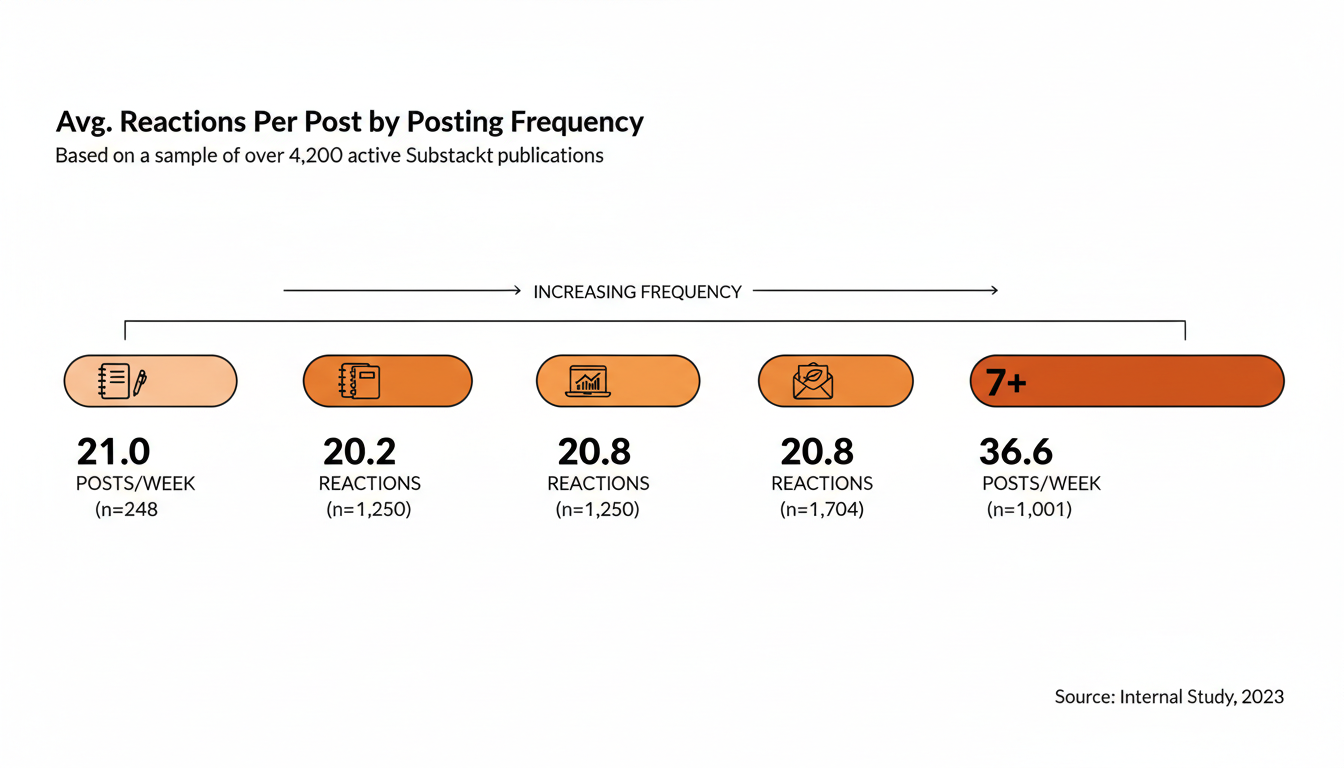
Two things worth being straight about. This does not prove that posting more causes more reactions; publications posting more than once a day skew toward larger, more established accounts, and bigger accounts collect more reactions regardless of schedule. And this is a snapshot rather than a year of data. What it does knock down is the common fear that raising your frequency tanks your per-post engagement. In this sample, at every level we could measure, it did not.
That flat line is the whole argument for two a week. If per-post engagement decayed as volume rose, frequency would be a trade-off and you would want to find your optimal point carefully. It doesn't decay, so frequency is closer to a multiplier, and the only real constraint left is whether you can supply the posts.
Practical rule: don't let fear of diluting your audience talk you out of a higher frequency your format supports. The data doesn't back that fear anywhere in the range you're operating in.
How we ran this
We pulled public, titled posts from a roughly 10-day window in July 2026, kept publications with at least two posts in that window (enough to estimate a rate), and grouped them by estimated posts per week. This is directional rather than a controlled study, so treat the exact numbers as a snapshot instead of a permanent law of the platform.
The Real Cost of Over-Posting: Unsubscribes
Reactions per post are half the picture. The other half is what happens to your list over months. Email is a different medium from a social feed: every post is an interruption in someone's inbox, and interruptions that arrive too often get punished with unsubscribes and, worse, with people who stay subscribed and stop opening.
That is the actual mechanism behind "don't overpost" advice, and Substack's algorithm has little to do with it. A reader who signed up expecting a weekly essay and starts receiving four emails a week feels over-emailed, however good each individual post was.
Publishing more and emailing more often are two separate levers. Treating them as one thing is what pushes writers to under-publish out of a fear that doesn't match how readers experience a newsletter. You can raise output without raising inbox pressure by moving some of the extra volume to Notes, or by publishing pieces without triggering an email for every one. Two emailed posts a week sits comfortably inside what a subscriber who opted into a newsletter expects to receive.
Practical rule: when you raise frequency, watch open rate for the two weeks after the change rather than subscriber count. Open rate moves before unsubscribes do, and it's the earlier warning.
Consistency Is What Makes Two a Week Work
Substack's own writing guidance leans hard on this: how often you publish matters less than whether readers know what to expect, and whether the schedule is one you can sustain. A predictable rhythm builds trust, and an unpredictable one erodes it even when the average frequency is technically higher (Substack, "Posting consistently: when to publish").
In practice, a writer who reliably publishes every Tuesday and Friday will out-retain a writer who posts eight times one month and once the next, even when the second writer's yearly total is higher. Retention responds to predictability.
This is why picking specific days matters more than people expect. "Tuesday and Friday mornings" is a promise a reader's brain can file away. "Twice a week, sometimes" is not. You don't have to announce your schedule publicly, though plenty of writers do and it works as a trust signal, but you should know it well enough that a subscriber could guess it from your archive alone.
Most writers badly overestimate how consistent they have been. A heatmap of when you have actually published usually reveals the same shape: two strong weeks, a gap, a catch-up burst, another gap. Seeing that laid out is what turns "I post about twice a week" into an accurate statement rather than a hopeful one.
Practical rule: pick your two days and hold them for at least two months before judging whether the frequency is working. Consistency is the variable you're testing, alongside the number.
The Capacity Ceiling Is a Supply Problem
Here is where most frequency advice quietly gives up. It tells you to time your posts, multiply by your target frequency, compare against your available hours, and lower the number until it fits. That advice treats your supply of material as fixed and your schedule as the only adjustable part. For most writers, that has it backwards.
The hours a post takes are dominated by the parts that aren't writing: deciding what the post is about, staring at an empty document, rebuilding context on a topic you already covered in a Note three weeks ago, and rewriting a first draft until it sounds like you. The typing is rarely the bottleneck. The blank start is.
A writer at one post a week who wants two doesn't usually need twice the hours. They need the second post to begin somewhere other than zero. Change where drafts start, and the capacity ceiling that seemed to cap you at one moves without you working a longer week.
Where the supply actually comes from
You are already producing more raw material than you publish. Your Notes are arguments in miniature. Your published posts contain sections that deserved their own piece. Your best replies in comment threads are frequently sharper than the posts that prompted them.
📅 Struggling to stay consistent on Substack?
WriteStack's Smart Scheduling lets you batch and queue Notes in minutes. Grow on Substack without burning out.
Explore Smart SchedulingWriteStack's drafting works from exactly that inventory. It reads your published posts and Notes and drafts from them, so a new piece opens already carrying your vocabulary, your sentence rhythm, and the positions you have already taken in public. Every other AI writing tool in this category generates from a prompt, which means you arrive at your own voice after three rounds of editing rather than starting there. When a draft misses anyway, you switch models inside WriteStack rather than living with one fixed voice that never quite fits.
That is what makes two a week hold in month four rather than month one. The second slot stops being a weekly confrontation with an empty page and becomes an editing job, and editing is a thing you can do on a tired Wednesday.
Start your free trial and see how much of next week is already sitting in what you've published.
Queue the Week Instead of Deciding Every Morning
Supply solves the blank page. The second half of holding a higher frequency is removing the daily decision, because a schedule that depends on you remembering is a schedule that ends the first busy week.
Batching is the mechanism. You sit down once, write or edit everything for the week, assign each piece a time, and then stop thinking about publishing entirely until the next batching session. Queue a week in one sitting and the rest of your week returns to writing. WriteStack was built around that sitting: a queue and calendar view showing the full week at once, drag-and-drop reordering when Thursday's piece suddenly belongs on Tuesday, and scheduling that runs through a browser extension using your own session and Substack's native scheduler, instead of handing a credential to someone's server that posts as you while your laptop is shut.
It also covers a slot nothing else does. WriteStack schedules Substack chat posts, which no other tool in the category schedules at all, so the chat thread you keep meaning to start becomes part of the same weekly batch as everything else.
| What two posts a week demands | Doing it by hand | With WriteStack |
|---|---|---|
| A draft waiting when the slot comes up | Blank composer, every time | AI drafts from your own published posts and Notes |
| A draft that already sounds like you | Three rounds of editing toward your voice | Starts in your voice, switch models when one misses |
| Scheduling Substack chat posts | Not possible | Yes, and no other tool in this category does it |
| Knowing which link inside a Note got clicked | Untracked | Per-link history going back to your first Note |
| "Is this good?" answered against the field | Guesswork | Benchmarks against publications your size |
| Whether the higher frequency moved anything | Memory and two dashboards | Trend analysis month over month |
| A full week loaded in one sitting | One at a time, daily | Queue the week, then close the tab |
| Seeing your real publishing pattern | Scroll your own archive | Heatmap of when you actually posted |
| Verified reviews from Substack writers | Not applicable | ~100 across multiple platforms |
The part people don't expect
The surprise isn't the queue, it's what shows up after the posts publish. WriteStack tracks which of the two links inside a Note got clicked, going back to your very first one, so "that one did well" becomes "that one sent 40 people to the archive." It benchmarks your restack rate against other publications your size, which answers "is this good" rather than "is this better than last week," and a per-account dashboard structurally cannot answer the first question no matter how many charts it draws. Then it shows the direction that number is moving month over month. Open the dashboard on a Tuesday six weeks after going to twice a week and see that your restack rate is climbing, and that it is running above typical for a publication your size. Not better than last month. Better than the field.
Did the Higher Frequency Actually Move Anything?
Raising your frequency is a real cost, and most writers never find out whether it bought them anything. Subscriber count goes up either way, slowly, so it makes a terrible instrument. Reactions bounce around week to week for reasons that have nothing to do with schedule. Six months in, the honest answer is usually a shrug.
Two measurements settle it. The first is direction over time: restack rate, open rate, and link-click history tracked month over month rather than post to post, which is the only window long enough for a frequency change to show up above the noise. The second is comparison against the field: how your numbers sit against other publications of similar size, which is what separates "my restack rate fell" from "everyone's restack rate fell in July."
WriteStack runs both. The trend view shows the direction, and the benchmarks show the field, so eight weeks after you moved to two posts a week you can point at a specific number and say the change worked or it didn't. Substack's native stats page tells you what your publication did. It has no way of telling you whether that was any good, because it can only see your account.
Practical rule: set a date eight weeks out before you raise your frequency, and decide now which number you'll judge it on. A frequency change nobody measured becomes a frequency change nobody keeps.
Should Free and Paid Posts Run on Different Schedules?
For publications running a paid tier, the frequency question splits in two: how often for everyone, and how often for paying subscribers specifically. The common pattern among working paid Substacks is a lighter free schedule (often weekly) paired with one or two additional posts a week exclusively for subscribers.
The point is giving paying subscribers more of what they already opted into. A visible difference in output between the two tiers is one of the clearest and most honest reasons to upgrade: more of something a reader already likes, from the same writer, in the same voice.
A workable starting split is one free post a week for everyone plus one paid-only post a week for subscribers, reviewed after two months once you can see how many free readers convert. Some writers eventually flip it, going mostly paid with an occasional free post used for discovery. The pattern that fails is promising a paid schedule you can't hold once the subscription revenue is already arriving, which is the fastest route to refund requests and public complaints. That failure is a supply failure again, and it's the reason the drafting layer matters more for paid publications than free ones.
Practical rule: when you add a paid tier, add a frequency difference before you add a format difference. "One extra post a week for subscribers" is an easier promise to keep than a whole second content type.
Posts vs. Notes: Two Separate Frequency Questions
Everything above is about full posts, the ones landing in an inbox. Notes are a different animal, and applying the same caution to them is a common and expensive mistake. Notes are short, they live in a feed rather than an inbox, and they behave like social posts. The don't-over-email logic that governs post frequency mostly doesn't apply.
Writers who are careful about publishing more than twice a week often post Notes several times a day with none of the unsubscribe risk described above, because Notes aren't interrupting anyone's inbox. They're a separate discovery surface, and for growth rather than retention, Notes frequency is usually the larger lever of the two.
The specific daily number is a question with its own data behind it, and we ran that analysis separately in how many Substack Notes to post per day. Read that one for the volume argument. For the purposes of this piece: run Notes daily underneath your two weekly posts, and batch them the same way, in one sitting, from the same queue.
Practical rule: cap full-post frequency by inbox tolerance. Don't apply that cap to Notes; they run on different rules and reward volume where posts reward steadiness.
A Starting Frequency for Every Stage of a Substack
The right starting point shifts as a publication grows. Early on, the job is proving to yourself and your first readers that you'll show up. Later it shifts toward protecting the relationship you've built while holding the number steady. Use this as a starting map and adjust from the evidence your own numbers give you.
| Stage | Full posts/week | Notes/week | Primary focus |
|---|---|---|---|
| Brand new (0-100 subscribers) | 1-2 | 3-5 | Prove to yourself you can show up on schedule |
| Finding traction (100-1,000) | 2 | 5-7 | Build a recognizable voice and topic |
| Growing (1,000-10,000) | 2-3 | 7-10 | Convert free readers to paid |
| Established (10,000+) | 2-4 | 10+ | Protect retention while holding the number |
Notice that the full-post column converges on two and stays there. What changes across the rows is the Notes column, which climbs steadily, and that's the honest shape of growth on Substack: your long-form schedule stabilizes early while your discovery surface keeps expanding.
Practical rule: move up a row only after holding the current row comfortably for a month, and raise your Notes number before you raise your post number.
Mistakes That Sink a Posting Schedule
The publications that quietly go quiet almost always fall into one of these patterns.
Starting at four with an empty queue. Committing to four posts a week in month one, before a single piece is banked, means every week is a sprint from zero. Start at two with a week of material already queued, which is a far more durable position than four with nothing behind it.
Treating every week as a blank slate. Writing whatever occurs to you on the day, instead of working from a running list of ideas and published material you can build on, makes every post start from nothing. That makes any frequency feel heavier than it is.
Confusing "when I feel inspired" with a schedule. Inspiration is not a publishing calendar. The writers who last show up on the days they don't feel like it, which is exactly what a queue filled last Sunday does for you automatically.
Copying someone's number without copying their supply system. A creator with a full-time team publishing daily isn't a template for a solo writer with a day job, though the number itself is rarely the problem. What's missing is the machinery underneath it. Borrow the machinery and the number stops being intimidating.
Changing the number every month. Raising frequency in March, dropping it in April, raising it again in June gives you no readable signal about any of it, and it teaches readers that your schedule means nothing. Pick two, hold it eight weeks, then read the trend and benchmark data and decide from evidence.
Practical rule: hold the number steady for a month before changing it, and when you do change it, change one thing at a time so you can tell what moved.
What Twice a Week Looks Like After Two Months
Track one month before you change anything. Write down every day you published, what time, and whether you meant to publish then or remembered late. Nearly every writer who does this finds the same shape as the heatmap: two strong weeks, a gap, a catch-up burst.
Two months into running two posts a week from a queue, the difference isn't the volume, though the volume is real. It's that publishing stopped being a decision you make. Tuesday's post was written on Sunday, Friday's is already scheduled behind it, and both go out while you're doing something else. The mental overhead of remembering, which is the part that actually ends publishing habits, is off your plate. The energy that was going into logistics goes into the writing, which is what the engagement numbers were rewarding the whole time.
Two full posts a week, Notes daily underneath. WriteStack is how you hold it: drafting that starts from your own published posts and Notes so no slot opens on a blank page, model selection when a draft misses, a queue you fill in one sitting, chat post scheduling nobody else offers, and benchmarks and month-over-month trends that tell you the higher frequency actually worked. Close to 100 verified reviews from Substack writers back that up, and no competing tool has any we could find anywhere.
Start a free 7-day trial. Queue next week in one sitting. Watch two months of consistency happen without you.