
You write a post you're proud of. You write a Note about it, paste the URL at the bottom, hit publish. Four hours later it has two likes and nobody replied. The Note you wrote the day before, about nothing in particular, has forty.
Do links actually hurt your Substack Notes, and if so, by how much? We pulled 655,056 Notes from July 2026 and measured both sides of the trade: what a link costs in reach, and what it buys back in subscribers.
One number worth having before you start: WriteStack has close to 100 verified reviews from Substack writers across multiple platforms. The other Notes scheduling tools we've checked have none that we could find anywhere.
Table of Contents
- The Short Answer: Yes, Links Cost You Reach - Does Length Explain the Penalty? - Where the Link Sits Matters More Than Whether It's There - What a Link Buys You: The Conversion Trade-off - The Loophole: Naming Your Post Without Linking It - Is This Just Bigger Accounts Skewing the Numbers? - When to Actually Pay the Link Tax - Frequently Asked Questions
The Short Answer: Yes, Links Cost You Reach
Notes without a link had a median of 4 likes. Notes with a link had a median of 2. The average fell from 19.4 to 10.7, a drop of 44% across the full 655,056-Note sample, according to our full breakdown of the dataset.
The zero-like number is the one worth worrying about. Nearly three in ten link-carrying Notes, 29.0%, finished July with no likes at all, against 14.6% for Notes without a URL. A Note with no likes never leaves the feed of people already following the writer.
Replies collapse harder than likes: average replies fell 54%, from 1.53 to 0.70. When the link points at substack.com specifically, replies fall to 0.49 and restacks drop from 2.11 to 1.29, a 39% fall in the one behavior that puts a Note in front of strangers who don't already follow the writer.
Practical rule: budget for it. If a publication posts four Notes a week and one carries a link, roughly half of that Note's reach is already spent before a word gets written. Fine when the link is the point. Expensive when it's an afterthought.
Why a Link Behaves Like an Exit
A Note with a link asks the reader to leave. A Note without one asks the reader to stay. Everything the feed rewards, dwell time, likes, replies, restacks, happens on the surface of the Note, and a URL is an exit sign painted on that surface. The reader who clicks is gone before they can like it, and the reader who doesn't click has already been told the Note is an advertisement. Restacks fall hardest for links pointing at substack.com specifically, because restacking someone else's promotional Note is the least flattering thing a reader can do with their own feed.
Does Length Explain the Penalty?
The obvious objection: link Notes are simply longer, and long Notes have their own reach problems. Link Notes average 435 characters against 286 for link-free ones, so we ran the comparison inside fixed length bands, comparing Notes writing at the same size.
The penalty survives in every band, and standardizing for length makes it slightly worse, not better. Unadjusted, link Notes get 54.4% of the likes that link-free Notes get. Reweighting link Notes to match the length distribution of link-free ones moves that to 48.9%.
The one place length does explain something is where the damage is worst. A short Note with a link is the worst combination in the dataset: 40.7% of them finish with zero likes. A bare URL under 150 characters reads as a drive-by.
Practical rule: this is a correlational cut, not a controlled experiment. It's possible the kind of Note a writer chooses to attach a link to would have underperformed anyway. What the length control rules out is the specific alternative explanation that the penalty is a length penalty in disguise. It isn't.
Where the Link Sits Matters More Than Whether It's There
Where the URL sits inside a Note matters more than whether it's there at all. We measured how many characters of text come before the first URL, across every link-carrying Note in the sample.
| Setup before the link | Avg. likes |
|---|---|
| Link opens the Note (0 characters of setup) | 3.1 |
| 120-299 characters of setup before the link | 14.7 |
That's a 4.7x gap between two groups that both contain a link. The top decile of link-carrying Notes confirms it from the other direction: sorting all link Notes by likes, the best 10% open with the URL only 5.0% of the time, against 17.0% for the bottom 90%. They also carry more setup on average, 339 characters against 298, and are less likely to be pointing at substack.com, 34.5% against 42.5%.
A URL in the first line tells the reader what the Note is for before it's earned anything, and the reader classifies it as an ad and scrolls. A URL in the last line arrives after the reader has already spent attention, and by then the Note has done its job whether or not anyone clicks. This also explains why a mid-length setup beats a very long one: past roughly 300 characters, the Note starts competing with the post it's advertising, and the reader has no reason left to leave.
Practical rule: give the reader a complete unit of value first, then the link. Target 120 to 300 characters of setup. Never put the URL on line one.
A Before-and-After Example
The Note most writers publish by default:
"New post is up! Link below. [URL]"
Twelve words, link on line one, nothing for the reader to react to before being asked to leave. Based on the position data above, that structure sits close to the worst-performing pattern in the dataset.
Rewritten around the 120-to-300-character setup window:
"Spent two weeks arguing with myself about whether this idea actually holds up. It does, and it changes how I'd answer the question I got asked most last month. Wrote the whole thing up here: [URL]"
Same announcement, same link, and the reader now has a reason to care before being handed the exit. The setup gives them something to react to on the spot, likes, a reply, a restack, while still pointing at the post for the people who want the rest of it.
📅 Struggling to stay consistent on Substack?
WriteStack's Smart Scheduling lets you batch and queue Notes in minutes. Grow on Substack without burning out.
Explore Smart SchedulingWhat a Link Buys You: The Conversion Trade-off
Now the other side of the trade. Across 29,993 Notes from 657 authors with analytics attached, link-free Notes converted at 2.22 subscribers per 100 likes. Notes with a Substack link converted at 6.56, a 2.96x lift in efficiency.
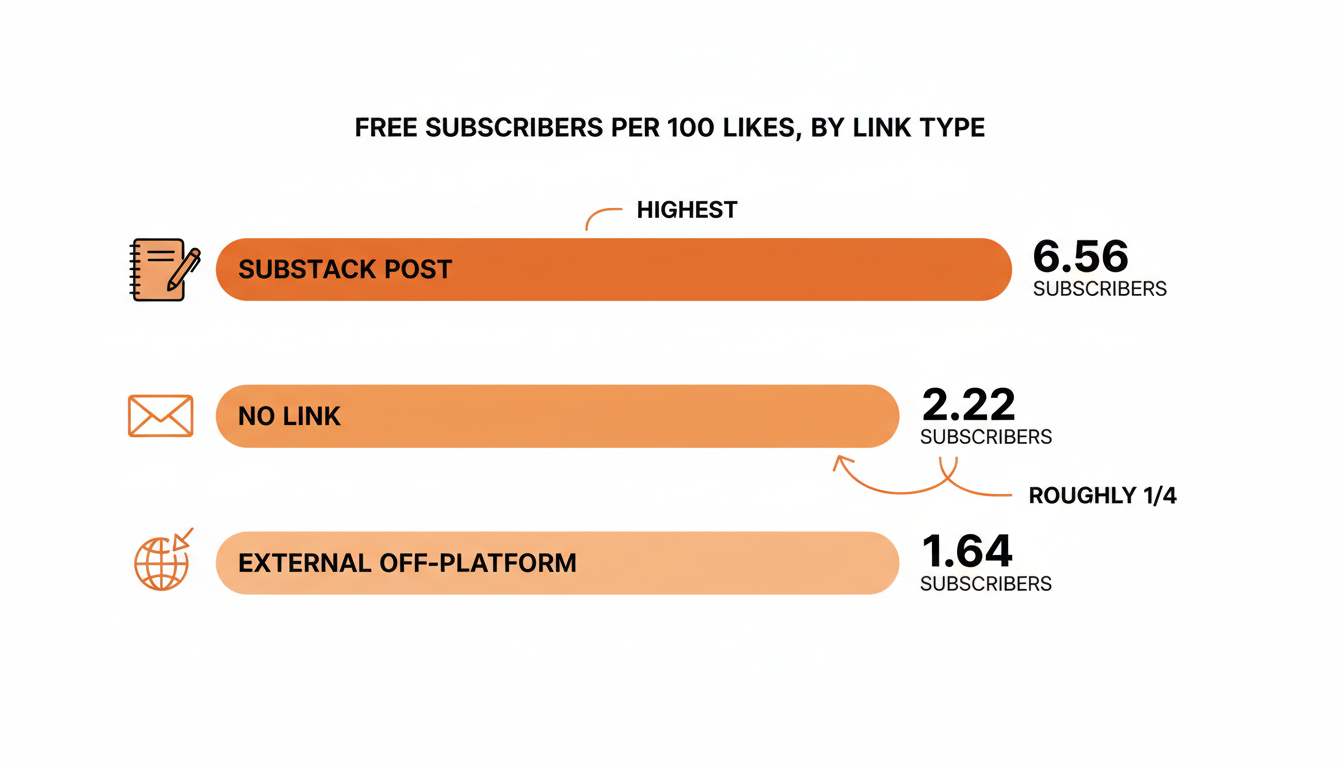
Read the actual subscriber count before getting excited about that ratio. Subscribers per Note fell from 0.321 to 0.300, a drop of 7%, because the efficiency gain is almost exactly canceled by the reach loss that produced it. A Substack link buys a much better conversion rate on a much smaller audience, and the two effects land within a rounding error of each other.
The external-link row settles the argument. Same reach penalty as a Substack link, 3.64 average likes against 3.75, but only 0.147 subscribers per Note, less than half of what a Substack link returns, with a 92.4% chance of producing no subscribers at all. If a Note is going to pay the reach tax, the link had better point at the writer's own publication. Sending the feed to a YouTube video or a news article costs the same audience and returns half the readers.
See exactly how many subscribers a given Note has actually converted, not just how many likes it got. WriteStack's engagement dashboard tracks link clicks and subscriber gains across a publication's full Notes history, so this trade-off can be measured on a real audience instead of a population average. A publication with 500 subscribers and a niche, highly engaged audience can easily see a very different ratio than the platform-wide 2.96x, in either direction, and there's no way to know which side of that average a specific account falls on without actually tracking it.
The Loophole: Naming Your Post Without Linking It
There's a third option most writers ignore entirely: pointing at the work without pasting the URL. Flagging every link-free Note in the conversion set that referenced the author's own post, essay, or publication in words alone, with no URL anywhere in the body, produced 1,001 Notes from 272 authors.
Those Notes averaged 12.52 likes against 3.75 for Notes carrying a Substack link, a 3.3x difference, and they beat the overall link-free average of 10.71 as well. Median 4 likes, median length 345 characters. Saying "my latest post" costs nothing. Pasting the URL costs roughly two-thirds of the room.
The reach effect holds inside individual authors, too. Among the 40 writers who published at least three of each kind, 34 of them got more likes from unlinked mentions than from linked Notes.
Be careful with the subscriber side of this one. The mention group averaged 0.563 free subscribers per Note, above both the link-free baseline and the Substack-link group, but that figure is carried by a handful of outliers, five authors account for 47% of the subscribers in the group. Inside the same 40 paired authors, their linked Notes converted better per Note than their unlinked mentions, 0.509 against 0.316.
The part people don't expect: the mention is a reach instrument, not a replacement for the link. A Note that says "recipes are on my Substack" is still a promotion, and readers know it, but it contains no exit and nothing to classify as an ad at a glance. The reader who wants the recipes has to go find the writer, which acts as a filter, and the readers who don't want them still liked the joke.
Is This Just Bigger Accounts Skewing the Numbers?
Population averages can hide author quality. Maybe the writers who post links are simply smaller accounts. Comparing each writer's own link Notes against their own link-free Notes, using the 147 authors who published at least five of each in July, answers that directly.
127 of 147 authors, 86.4%, got fewer average likes on their own link Notes. The median within-author ratio was 0.58, almost exactly the population figure. The reach tax survives once author quality is held constant, which means it happens to nearly everyone.
On subscribers, the picture flips to close to even: 71 of 147 authors, 48.3%, did worse with links. That's a coin flip. Link Notes were more efficient per like for 74 of 145 authors, 51%. The 2.96x lift from the population figure is an arithmetic fact driven by a small number of authors whose linked Notes convert extremely well. For the typical writer, it's close to even.
When to Actually Pay the Link Tax
The two results aren't contradictory, they're consistent. The link reliably costs reach and unreliably returns subscribers. Once that's the framing, the decision stops being "do links work" and becomes "is this specific Note worth half its audience."
| Situation | What the data supports |
|---|---|
| Announcing a new post you want read | Name it without the URL, or link with 120-300 characters of setup first |
| A Note that exists purely to drive clicks | Pay the tax, put the link last, keep the Note over 150 characters |
| A quick reaction, joke, or observation | Skip the link entirely, it isn't the point |
| Promoting something off-platform | Reconsider. Same reach cost, less than half the conversion of a Substack link |
Load a week of Notes with links placed where the data says they actually convert. Set it up once in WriteStack and stop finding out after the fact which Notes paid the tax for nothing.
Frequently Asked Questions
How much does a link actually cost a Substack Note in reach?
Median likes fall from 4 to 2, and average likes fall 44%, from 19.4 to 10.7. Replies fall even harder, down 54%.
Does putting the link at the end instead of the start help?
Substantially. Notes that open with the link average 3.1 likes. Notes with 120 to 299 characters of setup before the link average 14.7, a 4.7x difference between two groups that both contain a link.
Do links actually get you more subscribers?
A Substack link converts 2.96x more efficiently per like, but because it also cuts reach, total subscribers per Note still fall about 7%. An external, off-platform link costs the same reach and returns less than a quarter of what a Substack link does.
Is there a way to promote a post without paying the reach penalty at all?
Naming the post in plain words, without a URL, keeps close to the full link-free reach: 12.52 average likes against 3.75 for a Substack-linked Note. It converts fewer subscribers per Note than an actual link, so it works best as a way to build reach, not as a full replacement.
Does an external link ever make sense on Substack Notes?
Rarely, based on this data. It costs the same reach as a Substack link, 3.64 average likes against 3.75, but returns 0.147 subscribers per Note, and 92.4% of external-link Notes in the sample produced no subscribers at all. If the destination genuinely isn't a Substack post, naming it without a URL keeps more reach than linking to it directly would.
The Actual Trade-off
A link in a Substack Note costs roughly half its reach, no matter where it sits or how it's framed, and that cost survives controlling for length and for author quality. What changes based on placement is how much of that reach comes back: a link with 120 to 300 characters of setup, pointed at the writer's own publication, recovers most of what an opening-line link throws away. Draft and schedule Notes with link placement built into the process instead of finding out which Notes paid the tax for nothing.