
How do you actually get a Substack subscriber out of a TikTok view? Most writers who try this get the order backwards. They post a few clips, link their Substack in the bio, wait, and conclude TikTok "doesn't work for newsletters." It's not that it doesn't work. It's that posting a clip and hoping is not a strategy, it's a lottery ticket.
I've watched this play out across enough Substack writers trying the same experiment to see the actual pattern: the ones who get subscribers out of TikTok treat it as a funnel with specific, repeatable steps, not a place to cross-post. The ones who don't treat it as a vibe and quit after three weeks.
This is the version with the steps: how to set up a profile that sends traffic instead of just views, how to turn a newsletter post into a script without hiring an editor, which formats actually convert, and what a reasonable first month looks like.
One number worth having before you start: WriteStack has close to 100 verified reviews from Substack writers across multiple platforms. The scheduling tools built specifically for Substack that we checked have none that we could find anywhere.
Table of Contents
- Why TikTok Is the Most Underused Channel for Substack Writers
- Set Up a TikTok Profile That Actually Sends Traffic
- Turn Newsletter Posts Into TikTok Scripts
- Content Formats That Convert Views Into Subscribers
- The Call-to-Action That Actually Works
- Your First 30 Days: A Posting Schedule That Doesn't Burn You Out
- Tracking What Actually Converts
- Mistakes That Waste TikTok Effort
- Real Numbers From Writers Who Made It Work
Why TikTok Is the Most Underused Channel for Substack Writers
Substack's own team has written about this directly, naming writers like Nara Smith, Aaron Parnas, and Tini Younger who built audiences on TikTok first and brought them to Substack after, in Substack's own account of the TikTok-to-Substack migration. The pattern is public and it's been working for a while. What's missing from most of that coverage is the mechanics: how a writer without 100,000 followers actually builds the funnel.
The Stat That Shows the Gap
We pulled a random sample of over 70,000 posts from WriteStack's own dataset of Substack publications and checked how many even mention TikTok anywhere in the body text. The answer: about 0.18%, roughly 1 in 560 posts. Scaled across the full dataset of 3.5 million posts, that's a channel almost nobody is writing about to their own audience, let alone using on purpose.
That's not proof TikTok converts better than anything else. It's proof the field is wide open. When a tactic is this undersaturated among the people who'd benefit most from it, the ceiling isn't competition, it's execution.
Practical rule: don't ask "does TikTok work for newsletters." Ask "has anyone my size actually tried the funnel properly." For most niches, the honest answer is no.
Set Up a TikTok Profile That Actually Sends Traffic
A TikTok profile that exists to promote a newsletter needs to look different from a personal account. The bio, the pinned videos, and the first three posts someone sees after clicking your name all need to answer one question fast: why would I give this person my email address.
Bio and Link-in-Bio Setup
TikTok allows one clickable link in a free account's bio. Point it at your Substack directly if you only have one offer, or at a simple link-in-bio page if you want to route people to a lead magnet, your archive, and your Substack separately. Either way, the bio text above the link should state the specific reason to subscribe, not a vague description of what you write about. "Weekly breakdowns of [specific topic], free" converts better than "writer, thinker, coffee enthusiast."
Pick Content Pillars Before You Post
Before recording anything, decide on two or so recurring angles your account will be known for, pulled straight from the newsletter's actual beats. An algorithm (and a human scrolling) rewards accounts that are legible fast. A profile that jumps between six unrelated topics gives the algorithm nothing consistent to show to new viewers, and gives a profile visitor no reason to think "I know what I'd get if I subscribed."
Practical rule: if you can't describe your TikTok content in one sentence that matches your newsletter's actual subject, a stranger definitely can't either.
Turn Newsletter Posts Into TikTok Scripts
This is where most writers lose the most time, trying to summarize an entire 1,500-word post into 30 seconds. That's the wrong unit. The right unit is one idea.
The One-Idea Extraction Method
Pull the single most surprising, most specific, or most useful line from a published post and build the whole video around that line alone, not the article's full argument. One practical breakdown of this approach uses a retirement-planning example: instead of covering five common myths from the original piece, the video opens with "the biggest mistake I see experts make is believing this ONE thing," and the video is entirely about that single myth, start to finish. Everything else in the newsletter post stays in the newsletter, where someone who wants the full argument can subscribe to read it.
This is also where WriteStack's AI Note generator is useful for the opposite direction of the same problem: feed it a published post and it drafts a handful of short-form angles pulled from your own writing voice instead of a generic prompt, which gives you a faster first pass at picking the one line worth building a script around. Open a week of post ideas, pull three candidate lines for video scripts, and you've skipped the part where you reread your own 2,000-word post three times looking for the hook.
This is usually the point where writers decide the whole thing is too much production work on top of an already full posting schedule. It doesn't have to be. Load a week of Notes into WriteStack in twenty minutes, let them go out on autopilot, and the only thing left on your plate is filming one video and pointing it at a subscribe link that already works.
Hook Formulas That Hold Attention
The first three seconds decide whether anyone sees the rest. Two formats that hold up across a lot of writers' accounts: open on a bold, specific claim stated flatly ("Substack's algorithm rewards one metric almost nobody optimizes for"), or open on a direct question the viewer is already asking themselves. Avoid generic curiosity bait with no specific claim in it. "You won't believe what happened" has no information in it and the algorithm increasingly treats it as a weak signal.
Practical rule: if you can't finish the hook sentence with a real, checkable claim, it's not a hook, it's filler.
Content Formats That Convert Views Into Subscribers
Not every format that gets views gets subscribers. A dance trend might get reach, but it attracts an audience with zero relationship to your writing. These formats specifically carry newsletter content well because they let the writing itself be the hook.
| Format | Best for | Typical length | Subscriber intent |
|---|---|---|---|
| Talking head, direct to camera | Opinion takes, hot takes from a recent post | 30-60 sec | High, feels personal |
| Text-overlay reading an excerpt | Quoting your sharpest paragraph verbatim | 15-30 sec | High, proves the writing quality |
| Narrated slideshow / Canva-style | Multi-step breakdowns, numbered lists | 45-90 sec | Medium, good for saves/shares |
| Series with a cliffhanger | Serialized fiction or multi-part arguments | 30-45 sec, repeated | Very high, built-in reason to follow across episodes |
A series format deserves special mention. One writer serialized a full book on Substack over five months while posting short video excerpts on TikTok and Instagram as teasers, and documented the exact numbers from that run: starting from roughly 175,000 TikTok followers and 35,000 Instagram followers, the serialization converted to 350 paid Substack subscribers over the five months, with most of those paid subscribers coming from TikTok and Instagram specifically, while most free subscribers came through Notes on Substack itself. Posting frequency dropped from 1 to 3 times a day during the pre-launch push down to about twice a week once the serialization was running, which matters for anyone assuming this requires posting constantly forever.
📅 Struggling to stay consistent on Substack?
WriteStack's Smart Scheduling lets you batch and queue Notes in minutes. Grow on Substack without burning out.
Explore Smart SchedulingPractical rule: if your newsletter already has a narrative or recurring structure, a cliffhanger series on TikTok will outperform one-off clips almost every time, because the follow becomes necessary instead of optional.
A series format only works if the Notes tied to each episode actually go out on schedule, episode after episode, without you remembering to do it manually every single time. WriteStack queues a full run of Notes in one sitting and lets them publish on their own, so a five-month serialization doesn't quietly fall apart in month three because real life got in the way of posting manually.
The Call-to-Action That Actually Works
A video that ends on "check out my Substack" converts worse than one that gives a specific, immediate reason tied to that exact video. "The full breakdown, with the three examples I didn't have time for here, is linked in my bio" beats a generic sign-off because it promises something concrete that only exists in the newsletter.
Pinned Comments and Comment-to-DM
Pin a comment on every video restating the specific thing someone gets by subscribing, since many viewers scroll comments before checking a bio. A comment-to-DM funnel, where you ask viewers to comment a keyword to get a link sent automatically, converts well because it adds a second micro-commitment before the click, but it only works if you're actually equipped to follow up. Don't set one up you won't maintain.
This isn't what most writers expect going in: the highest-converting CTA isn't "subscribe," it's a specific promise the current video already proved you can deliver on.
Your First 30 Days: A Posting Schedule That Doesn't Burn You Out
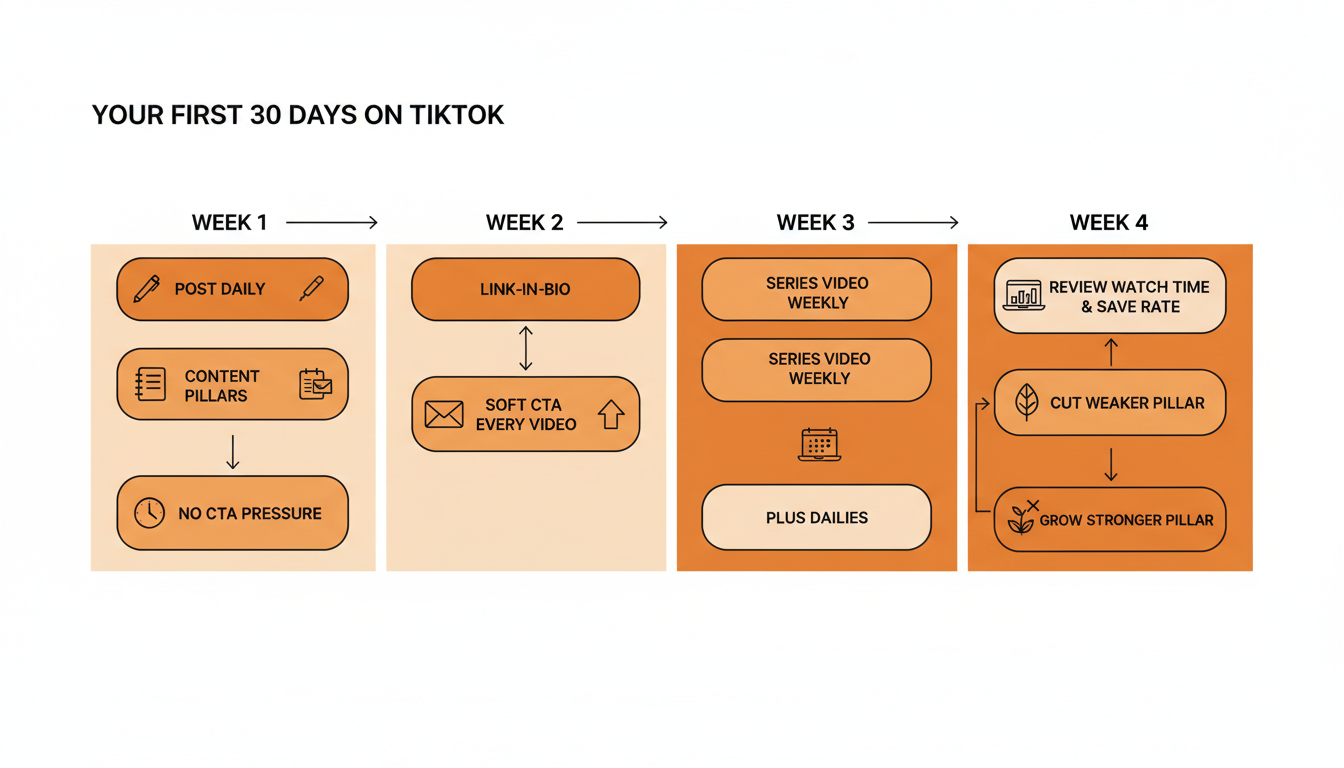
Trying to post daily forever from day one is how most accounts burn out by week three. A realistic ramp: spend the first week finding your content pillars without worrying about conversion at all, add the link-in-bio and a direct CTA once you have a baseline of videos to study, then introduce a series format once a week to build a reason for repeat viewers to come back specifically for your account.
Practical rule: don't judge a TikTok strategy on 30 days of view counts. Judge it on whether your Substack subscriber graph has a visible kink in it that lines up with when you started.
If week four's review turns up a TikTok spike that doesn't show up anywhere in your Substack numbers, the leak is usually on the Substack side, not the TikTok side: a Note that should have gone out the same day sat in drafts, or a profile that hasn't posted in five days doesn't look active to someone who just clicked through. Start scheduling Notes on WriteStack so your Substack side is never the reason a good TikTok week doesn't convert.
Tracking What Actually Converts
Views and likes tell you almost nothing about subscriber conversion. The metrics that matter: link-in-bio click-through rate (available in most link-in-bio tools), the ratio of profile visits to video views (shown in TikTok's own analytics, and a strong signal that a video made people curious enough to check who posted it), and actual subscriber growth on the days you post versus the days you don't.
This is the part of the workflow WriteStack covers once someone actually subscribes from TikTok and starts engaging on Substack. The heatmap view shows which days and times your restacks and link clicks actually spike, so if a TikTok video goes up on a Tuesday and Wednesday's Notes engagement jumps, that's visible instead of buried in a weekly digest email.
Three things about this most writers trying TikTok-to-Substack don't expect going in: WriteStack tracks link-click history across your entire Notes archive, not just the current week, so you can trace which specific Note a TikTok-driven subscriber engaged with first. It also benchmarks your engagement against other publications your size, which answers "is this actually good" instead of only "is this better than last week." And its AI drafting tool reads from Notes you've already published, so a script idea pulled from a TikTok-performing post starts in your own voice instead of a generic prompt's.
Practical rule: if you can't point to the specific day your subscriber count moved and name what you posted that day, you're not tracking conversion, you're tracking vibes.
Mistakes That Waste TikTok Effort
The most common failure is treating TikTok as a megaphone for the newsletter instead of its own format. A video that's just a screen recording of the newsletter post, read aloud, performs worse than one built natively for short-form attention spans, because it ignores the first-three-seconds problem entirely.
The second most common failure is disappearing after a video does well. A video that gets unexpected reach brings a wave of profile visitors within hours, and if the two most recent posts on the profile are months old, that visitor has no reason to believe you're still active. Consistency doesn't need to mean daily, but it does need to mean recent.
The third is skipping the CTA because it feels like begging. A video with zero CTA converts at zero regardless of how good the content is, because viewers don't guess that a newsletter exists unless told.
Practical rule: every single video needs a CTA, even a soft one. The algorithm doesn't punish asking. Silence just produces silence.
Real Numbers From Writers Who Made It Work
The serialization case above is the clearest public example with real numbers attached: 175,000+ TikTok followers and 35,000+ Instagram followers converting to 350 paid subscribers over a five-month run, with paid subscribers concentrated from the social side and free subscribers concentrated from Substack's own Notes feed. That split matters. It means TikTok and Instagram did the harder job of earning the first, highest-commitment conversion, while Substack's internal discovery tools did the easier job of growing the free list once the account already existed there.
That's consistent with what this guide has been building toward: TikTok's job isn't to replace your Substack growth tactics, it's to feed the top of the funnel with people who'd never have found you through Substack's own Notes feed or recommendations in the first place.
Practical rule: judge the whole funnel by the harder conversion, not the easier one. Free subscribers from your existing Substack audience were always going to show up eventually. Paid subscribers who found you on a platform that's never heard of your newsletter are the number that proves the channel is worth the time.
If you're running this funnel for more than a few weeks, keeping it going without losing a week to a bad schedule is the actual bottleneck, not the content ideas. WriteStack schedules the Notes that catch TikTok-driven traffic in advance, so a video going unexpectedly viral on a Thursday doesn't require you to be online that Thursday to capitalize on it. Load a week of Notes in twenty minutes, point your TikTok CTA at your Substack, and let the two run on their own schedules instead of both depending on you remembering to post at the right moment.
The writers who make this funnel work aren't the ones with the best single video. They're the ones still posting in month four.