
We pulled every publication in our research corpus that has published at least 20 posts since January 2024. That gave us 41,623 active Substacks. More than half of them, 53.5%, have never paywalled a single post.
How to monetize a Substack comes down to four decisions: when to turn paid subscriptions on, what to charge, how much of your work to lock, and how fast your free list grows. Only one of those four moves the revenue number much, and it is the last one. This guide covers all four with real numbers, then spends most of its time on the one that pays.
One number worth having before you start: WriteStack has close to 100 verified reviews from Substack writers across multiple platforms. The other tools writers use to grow a Substack funnel have none that we could find anywhere. That matters here, because most of what follows depends on measuring a funnel accurately rather than guessing at it.
Table of Contents
- What monetizing a Substack actually means
- What 41,623 publications reveal about paywalls
- When to turn on paid subscriptions
- Pricing your subscription
- How much can you actually earn
- Paid conversion is a top-of-funnel problem
- The free-to-paid split that converts
- Keeping the paid subscribers you convert
- Beyond subscriptions
- Common monetization mistakes
- What changes six weeks in
What monetizing a Substack actually means
Substack is free to publish on. There is no platform fee, and you pay nothing until readers pay you, so your only costs are a percentage of revenue you actually earn.
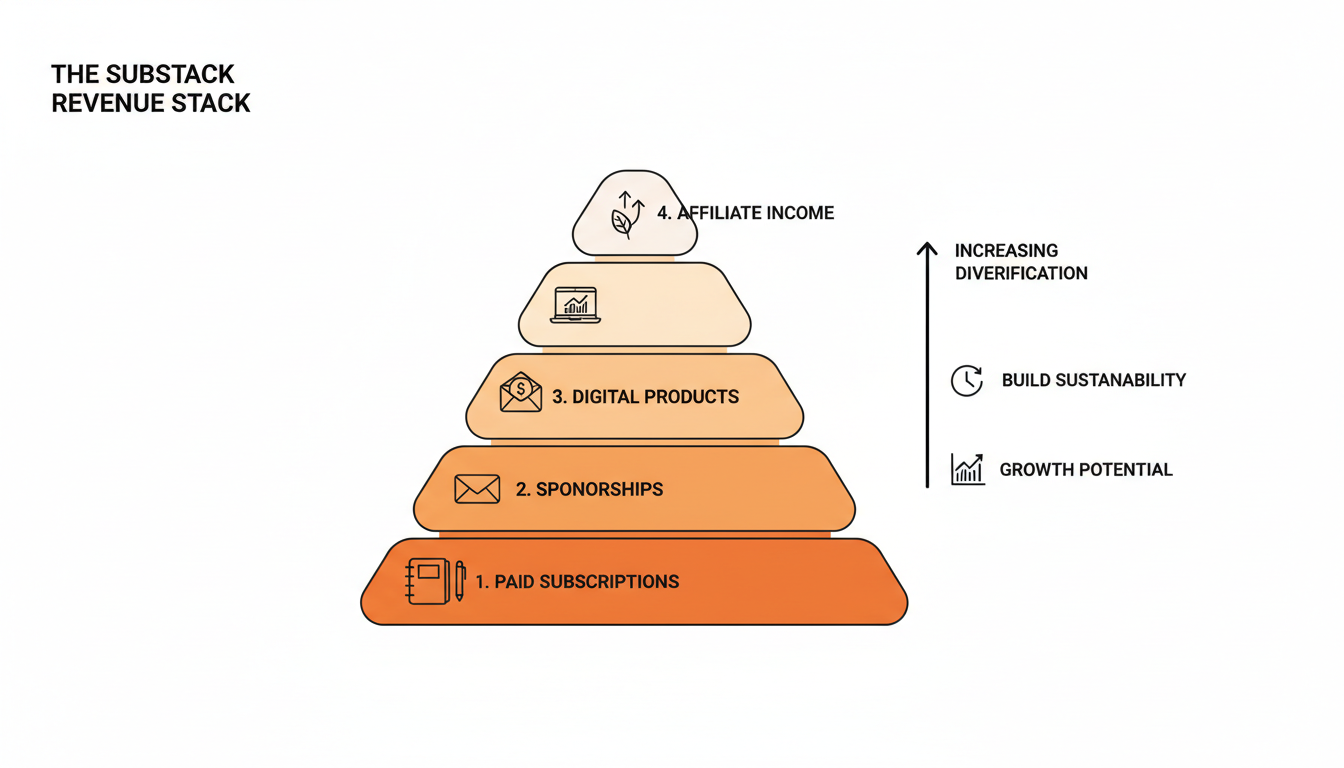
The main income streams
Writers earning from a Substack today are drawing on some combination of these:
- Paid subscriptions. Readers pay monthly or annually for access to some or all of your posts. This is the native model and the one Substack's tooling is built around.
- Sponsorships. A brand pays to appear in your newsletter. Works once your list is engaged and clearly defined, even at modest size.
- Digital products. Courses, ebooks, templates, and paid workshops sold to the audience your free posts built.
- Affiliate income. Commissions on tools you already use and recommend.
Why paid subscriptions come first
Subscriptions are recurring, so one conversion keeps paying you every month. Substack handles the billing, the paywall, and the subscriber management, which makes the operational cost of turning them on close to zero. Every other stream requires you to sell something new each time or negotiate each deal by hand.
Practical rule: treat paid subscriptions as the foundation and everything else as a layer on top. A sponsorship pipeline built on 400 engaged free readers is fragile. The same pipeline built on 400 free readers plus 40 paying ones is a business.
Every number in the rest of this guide traces back to how many people see your work each week. Start a free 7-day trial of WriteStack and put that half of the job on a schedule.
What 41,623 publications reveal about paywalls
We looked at every publication in our corpus with at least 20 posts published since January 2024, which filters out abandoned and hobby accounts. For each of the 41,623 that remain, we measured what share of its posts were set to paid-subscribers-only.
| Share of posts paywalled | Publications | % of active Substacks |
|---|---|---|
| 0% (fully free) | 22,287 | 53.5% |
| 1-25% | 7,926 | 19.0% |
| 26-50% | 3,615 | 8.7% |
| 51-75% | 2,661 | 6.4% |
| 76-100% | 5,134 | 12.3% |
Two things stand out. First, the majority of active writers have no paywall at all, so the field competing for paying readers is thinner than the income screenshots suggest.
Second, among the 19,336 publications that do paywall something, the distribution is a barbell. The most common strategy is a light paywall, with 41% of monetizing publications locking a quarter of their posts or less. The second most common is the opposite extreme: 27% lock more than three quarters of everything they publish. The middle bands are the least populated.
What the median hides
The average paywall share across all active publications is 20.3%, but the median is 0%. Averages here are dragged around by the hard-paywall minority. When you read advice like "paywall about a fifth of your content," almost nobody actually publishes at that ratio. Writers cluster at the extremes because the two strategies serve different businesses.
Practical rule: do not average your way to a paywall strategy. Pick a lane deliberately: mostly free with a paid layer, or mostly paid with a free shop window.
When to turn on paid subscriptions
Substack puts no gate on this. You can enable paid subscriptions on day one, and Substack's own going paid guide encourages writers to launch paid earlier than feels natural, on the logic that your most committed readers want a way to support you.
Our data supports a sharper version of that advice. Turn paid on now. It costs nothing and gives early superfans a button to press. What you should delay is the paywall itself: locking content before you have a discovery engine mostly means hiding your best work from the readers who would have shared it.
Signals you are ready
From working with Substack writers inside WriteStack, the publications that convert well when they start paywalling share a profile: two to three months of consistent publishing, posts that get replies and restacks rather than silence, and a few readers who have already asked how to support the writer. Subscriber count matters less than engagement depth. A list of 800 readers who open everything beats 5,000 who drifted in from one viral post.
Practical rule: enable paid the day you feel even slightly embarrassed doing it. Start paywalling only once your free posts are reliably bringing in new subscribers every week.
Pricing your subscription
Most writers price between $5 and $10 per month. That decision matters more than it looks, because the fee structure quietly punishes the low end.
The fee math
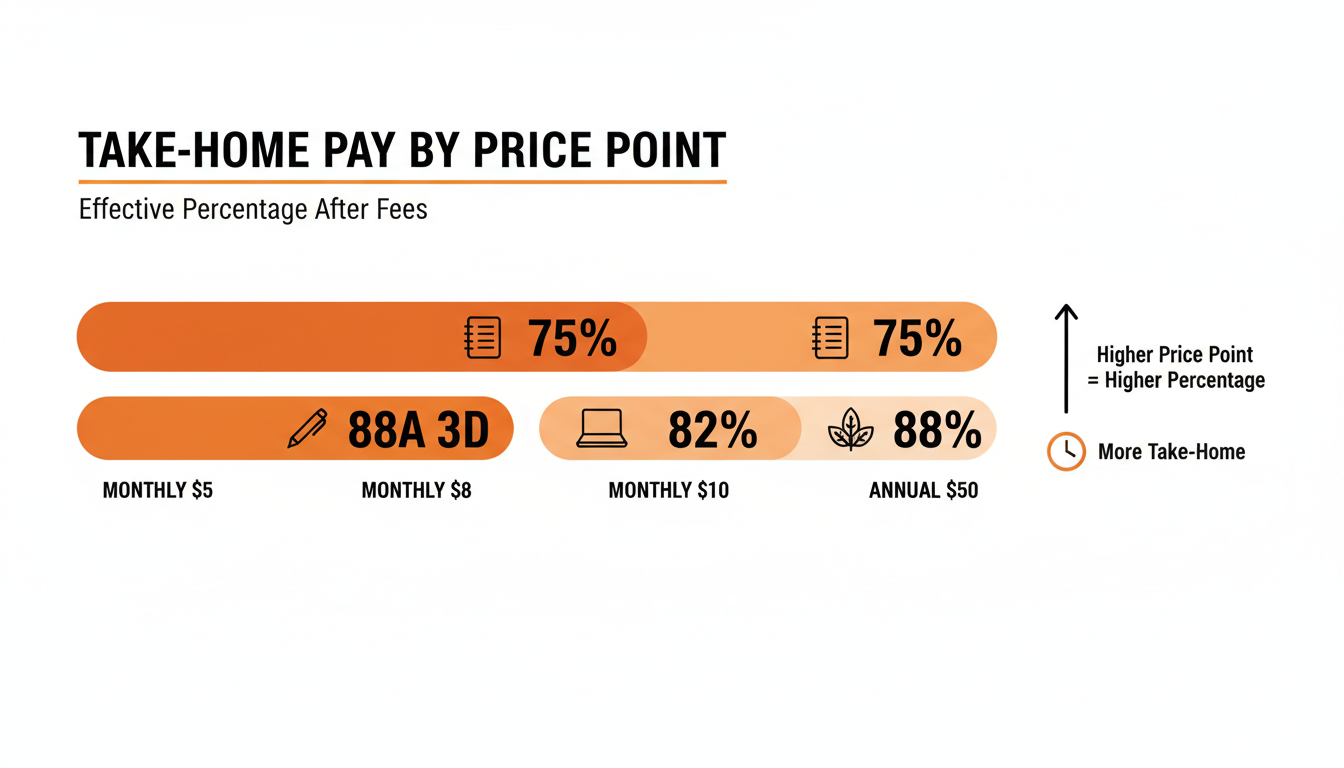
Substack takes 10% of subscription revenue, and payment processing runs through Stripe, which adds a card fee of 2.9% plus $0.30 per transaction and a 0.7% recurring-billing fee, per Substack's official pricing page. The percentages scale with price. The $0.30 does not, and that flat fee is what makes cheap monthly plans expensive to run.
| Monthly price | Substack (10%) | Stripe (2.9% + $0.30 + 0.7%) | You keep | Effective take-home |
|---|---|---|---|---|
| $5 | $0.50 | $0.48 | $4.02 | 80.4% |
| $8 | $0.80 | $0.59 | $6.61 | 82.6% |
| $10 | $1.00 | $0.66 | $8.34 | 83.4% |
| $50/year (one charge) | $5.00 | $2.10 | $42.90 | 85.8% |
At $5 a month you hand over nearly a fifth of every payment. At $10 a month or on an annual plan, the fixed fee dilutes and your take-home improves by several points without a single new subscriber.
Annual vs monthly
Annual plans win on two fronts: one Stripe transaction per year instead of twelve, and a year of committed revenue that cannot churn month to month. The convention is to price annual at roughly ten times monthly, giving two months free. Push readers toward annual in your launch post and your renewal notes.
Practical rule: charge $8 to $10 a month, not $5, and make the annual plan the visually default option. Fee math and churn both move in your favor, and no reader has ever unsubscribed over three dollars.
How much can you actually earn
Income screenshots dominate this topic, and they are the wrong reference point. Substack revenue is a chain: free subscribers, times the share who go paid, times your price, times your take-home after fees. Each link is a lever you control, and each compounds with the others.
The conversion math
Run the arithmetic at an $8 monthly price with the 82.6% take-home from the fee table above. With 1,000 free subscribers, converting 2% to paid earns about $132 a month. At 5% it is about $330, and at 10% about $661. Grow the same list to 5,000 and those figures multiply by five.
Notice which lever moved the number most. Going from 2% to 5% conversion more than doubled revenue. Growing the list five times multiplied it five times. Price increases help at the margin, and the paywall ratio barely registers next to either.
A realistic first-year shape
The pattern we see among writers using WriteStack is that revenue arrives in steps rather than a slope. A launch bump from your most loyal readers when you first enable paid, a long flat stretch while the free list grows, then a second lift when you introduce an annual plan or a paid-only series. Writers who quit tend to quit in the flat stretch. Writers who earn treat it as the part of the job where the funnel gets built.
📅 Struggling to stay consistent on Substack?
WriteStack's Smart Scheduling lets you batch and queue Notes in minutes. Grow on Substack without burning out.
Explore Smart SchedulingPaid conversion is a top-of-funnel problem
Here is the part that reorders everything above it. When a writer says their conversion rate is stuck at 1.5%, the instinct is to redesign the subscribe page, rewrite the paid pitch, or move the paywall. Those are real levers and they are small ones. The much larger variable is who is arriving in the first place.
A reader who found you through a Note that made them think, followed you, read three more posts, and then hit a paywall converts at a completely different rate than a reader who arrived from a link aggregator and never came back. Same subscribe page. Same price. Same paywall ratio. The difference is upstream, and on today's Substack the upstream is Notes.
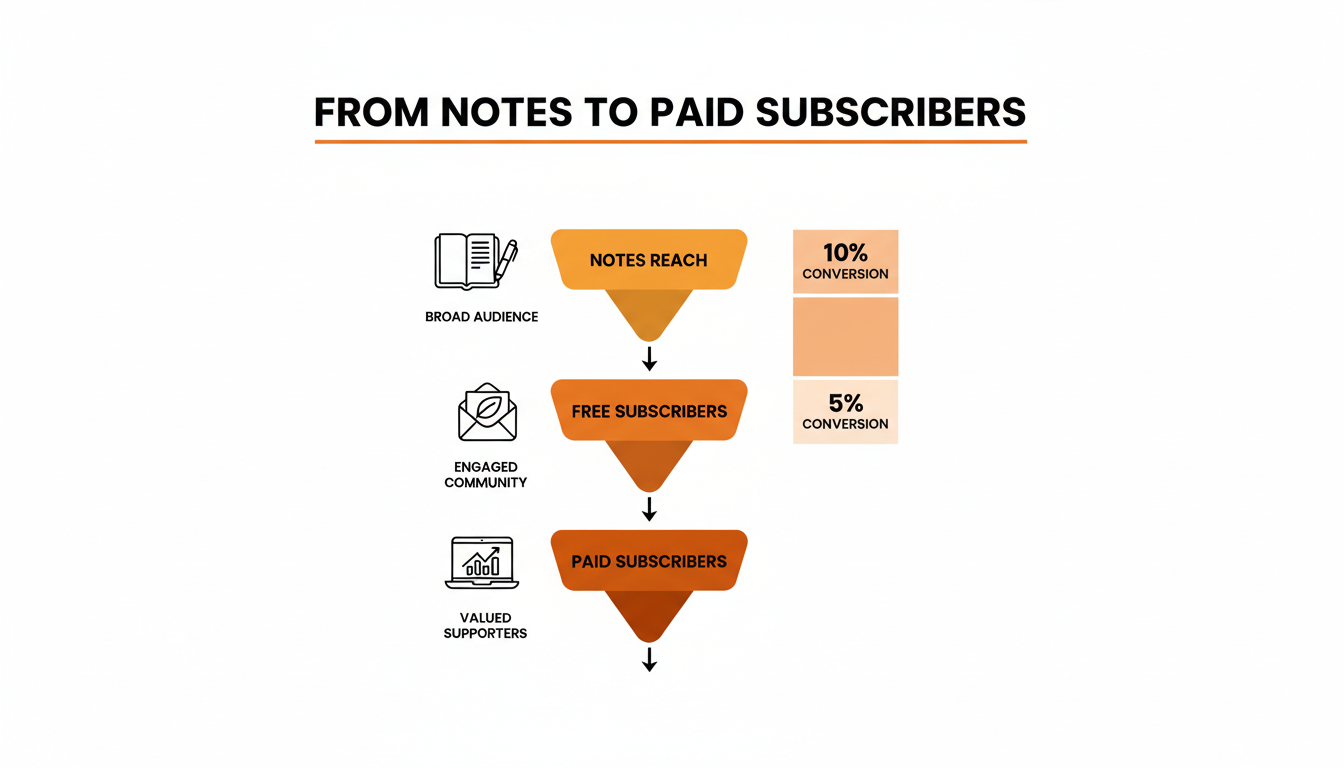
Notes is the platform's short-form feed, where readers who have never heard of your publication encounter you. A fraction of them subscribe free, and a fraction of those eventually pay. That is the whole funnel, and its first stage is the one most writers run on instinct.
The problem is consistency. Writers show up daily for two weeks, stall, and their reach resets to zero. This is the gap WriteStack exists to close. You batch a week of Notes in one sitting with the Notes generator, which drafts from what you have already published rather than from a cold prompt, so the output starts in your voice instead of arriving at it after three rounds of editing. They go out on the schedule you set once, and the engagement heatmap shows when your audience is actually reading, which is usually not when you feel like posting.
Which Notes actually sent readers to your subscribe page
Posting consistently is the first half. The second half is knowing which Notes did the work, and this is where Substack's own numbers run out. You get likes, restacks, and replies. What you do not get is attribution: which Note sent a reader to your subscribe page.
Without that, "post more" stays a superstition. You cannot tell the Note that collected 200 likes from strangers who never clicked apart from the quiet Note that sent 40 people to your archive, two of whom now pay you $8 a month. Both look like engagement. Only one is revenue.
WriteStack tracks link clicks across your full Notes history, per link inside each Note, going back to your very first one. Two links in the same Note report separately. That turns a year of posting into a record of what converted, and turns "I should post more" into a decision about what kind of Note to post more of.
The part people don't expect
Most writers shopping for a Substack growth tool are comparing queue sizes. The layer that changes monetization is measurement. WriteStack tracks which of the two links inside a Note got clicked, going back to your first Note, so a year of posting becomes a record of what actually drove readers to your subscribe page. It benchmarks your conversion and engagement against other publications your size, which answers "is this good" rather than "is this better than last week." It shows the direction those numbers are moving month over month instead of a single snapshot. And it schedules Substack chat posts, which no other tool in this category does at all, so the retention thread you promised paying subscribers goes out on a Thursday whether or not you remember it.
Is your conversion rate normal for a publication your size
The second question that decides your strategy is one a per-account dashboard structurally cannot answer. You know your free-to-paid conversion is 2.1%. You do not know whether 2.1% is strong for a publication your size, or whether writers around you run at 5% and you have a positioning problem rather than a traffic problem.
Those two diagnoses lead to opposite decisions. If 2.1% is above the field, grow the list and keep the pitch. If 2.1% is half the field, growing the list five times just multiplies a leak. Substack's stats page cannot tell you which situation you are in, because it only ever compares you to yourself.
WriteStack benchmarks your numbers against other publications rather than against last week, and its trend analysis shows whether the line is climbing or sliding across months. A single snapshot says nothing about direction. A month-over-month trend tells you whether the changes you made in March did anything by May.
| Question your monetization depends on | Substack's own stats | WriteStack |
|---|---|---|
| Which Note sent readers to your subscribe page | No link attribution on Notes | Yes, per link, across your full Notes history |
| Is my free-to-paid conversion normal for my size | No, your account only | Yes, benchmarked against other publications |
| Is my engagement climbing or sliding month over month | Snapshot only | Yes, trend analysis over time |
| Schedule a chat post for paying subscribers | No | Yes, and no other tool in the category does |
| Batch a week of Notes in one sitting | Manual, one at a time | Built for this |
| Draft Notes from what you have already published | No | Yes, with model selection |
| See when your audience is actually reading | Limited | Yes, engagement heatmap |
| Verified reviews from Substack writers | Not applicable | ~100 across multiple platforms |
| Price | Included with the platform | From $19.99/month, 7-day free trial |
Start your free 7-day trial and find out which of your Notes have been earning you subscribers.
The free-to-paid split that converts
The barbell in our data is not an accident. The two crowded bands map to two coherent businesses, and the empty middle maps to an incoherent one.
The light paywall (1-25%)
The most common monetizing strategy in the dataset, used by 7,926 publications. Most posts stay free and keep doing discovery work: getting restacked, ranking in search, converting new readers. The paid layer is a bonus tier, often subscriber Q&As, extra posts, archives, or chat threads. It suits writers whose growth still depends on reach, which is most writers.
The hard paywall (76-100%)
Used by 5,134 publications, this is the specialist model. The writer serves a niche where the information itself is the product, commonly finance, trading, and professional analysis. Free posts exist only as a shop window. It converts a much higher share of readers but grows slowly, because almost nothing circulates.
The middle bands, locking a third to two thirds of your work, are the worst of both: enough paywall to choke discovery, not enough exclusivity to justify a specialist price. Writers have largely figured that out on their own, since only 15.1% of active publications sit there.
Practical rule: default to the light paywall until your subscriber growth no longer depends on posts circulating. Move toward a hard paywall only when your niche pays for the information itself.
Keeping the paid subscribers you convert
Conversion gets the attention. Churn quietly decides what your revenue looks like in year two. A subscriber who pays $8 a month for four months and leaves is worth $26 after fees. The same subscriber who stays fourteen months is worth $92. Nothing about the acquisition changed, only what happened after the charge went through.
Substack gives you a few tools for the after part, and chat is the one writers use least well. A chat thread is visible to your paying subscribers, invites replies rather than clicks, and makes a paid subscription feel like a room instead of a receipt. Writers who run a weekly paid thread see renewals hold up better than writers whose entire paid experience is an emailed post twice a month.
The reason most writers do not run one is scheduling. Chat posts happen when you remember them, which means they happen for three weeks and then stop, exactly the pattern that makes a paid tier feel abandoned. Substack does not schedule chat posts natively, and no other tool in this category schedules them either. WriteStack does, so the Thursday thread for paying subscribers is queued on Sunday alongside your Notes and goes out without you.
Practical rule: decide what your paying subscribers get every week, then put it in a queue. A paid tier that shows up on a rhythm renews. One that shows up when you have time does not.
Beyond subscriptions
Once subscriptions run steadily, other streams stack on top of the same audience. Shopify's guide to making money on Substack covers the options: sponsorships suit writers with an engaged list in a defined niche, and you can start with one sponsored section from a brand you already use. Digital products convert best when they package something your free posts already proved readers want. Affiliate income is the smallest lift, a commission on tools you would recommend anyway.
The sequencing matters more than the menu. Every one of these streams sells to the readership your newsletter built, so each multiplies an audience rather than replacing the work of building one. That is the same audience your Notes bring in, measured the same way. Add one stream at a time, and only after the previous one runs without daily attention.
Common monetization mistakes
Paywalling your best work too early. Your strongest posts are your growth engine. Locking them before you have steady free growth trades long-term compounding for short-term revenue.
Pricing at the minimum. As the fee table shows, $5 a month is the most expensive price you can charge in percentage terms. Price on value to your niche, not on modesty.
Ignoring the annual plan. Writers who never mention their annual option leave their most committed readers on the churniest plan.
Treating monetization as a launch event. Going paid is a system: steady free output, a clear paid promise, and a funnel that refills itself. The launch post is one day. The system is the business.
Guessing at what your Notes did. Posting into a feed and reading the like count is the most common measurement failure in this category. Likes are not clicks and clicks are not subscribers. WriteStack's link-click history and cross-publication benchmarks exist because those three numbers diverge, and only the last one pays.
What changes six weeks in
Track one week before you change anything. Write down every day you posted a Note and whether you meant to post then or remembered late. Almost every writer who does this finds the same shape: two strong days, a gap, a catch-up burst, another gap. That shape is what a 1.5% conversion rate looks like from the top.
Six weeks into running a queue with real attribution behind it, the change is not that you post more. It is that you stopped guessing. Sunday afternoon fills the week, the Thursday chat thread for paying subscribers is already written, and the dashboard on a Tuesday tells you the Note you almost did not publish sent 40 people to your archive and that your conversion is running above typical for a publication your size. Not better than last week. Better than the field. The pricing decisions in this guide take an afternoon. The funnel underneath them turns $132 a month into $661, and it gets built one queued week at a time.
Start a free 7-day trial of WriteStack. Queue a week of Notes, schedule the chat thread your paying subscribers renew for, and watch the funnel that pays for everything else keep moving while you write.