
Every December, a wave of Substack writers post some version of the same note: "Gift a subscription to someone who needs this newsletter." Most of them are guessing at how the mechanic actually works, when to push it, and whether it's worth the discount they're implicitly offering.
Gift subscriptions are one of the few growth levers built directly into Substack's checkout flow, not bolted on through a third-party tool. That makes them cheap to run and easy to get wrong. Writers either forget the feature exists outside of December, or they run a gift push at a random moment and wonder why conversion was flat.
This piece covers exactly how gift subscriptions work on Substack, what they cost, when they actually convert, and how they compare to running a discount or leaning on your referral program instead.
Table of Contents
What a Substack gift subscription actually is
A gift subscription is a paid subscription that one person buys on behalf of someone else. The buyer pays for the first term, usually a year, and the recipient gets full access to paid content immediately, without touching their own card. According to Substack's own support documentation, if the recipient doesn't already have a Substack account, one is created for them automatically the moment they claim the gift.
It's a native checkout option, not a workaround. Every publication that offers paid subscriptions has a gift option sitting one click away, at a URL you can hand out directly: yoursubdomain.substack.com/gift.
That matters for a practical reason: because it's built into Substack's own checkout, a gift purchase doesn't require the buyer to create a new account, hand over a separate payment method for someone else, or route through any third-party gifting service. It's the same Stripe-backed checkout your regular subscribers already use, just pointed at a different recipient. For a reader who's on the fence about buying you a "present," that low-friction path is the difference between them actually doing it and closing the tab.
It also means gift subscriptions show up in your subscriber list the same way any paid subscriber does, tagged so you can tell they arrived as a gift. You don't need a separate dashboard or export to track them.
Practical rule: if you write for a paid audience and you've never mentioned the
/giftURL in a post or note, you're leaving a conversion path completely unused. It costs nothing to mention.
How to send a Substack gift subscription
Sending one gift right now
A reader who wants to gift your publication goes to yoursubdomain.substack.com/gift, enters the recipient's email and an optional personal note, and pays for the term. Per Substack's setup guide, the recipient gets an email with a claim link, and once they click it, their paid access starts right away.
Scheduling a gift for later
The checkbox most people miss is "Schedule for later." A gift can be bought today and set to arrive on a specific date, which is the entire mechanic behind "surprise them on Christmas morning" posts. The purchase is locked in immediately; only the delivery email is delayed.
Practical rule: if you're running a holiday push, tell readers explicitly that scheduling exists. Most people assume gifting is instant-only and skip it rather than plan ahead.
Funded gifts and group gift links
How funded gifts work
Substack also runs funded gifts, a program where Substack itself covers the cost of gift subscriptions for a limited pool of new readers on select publications, usually as part of a platform-wide promotion. Writers don't set this up themselves; it's something Substack extends to eligible publications, and it shows up as gift subscriptions in your subscriber list without a corresponding charge to a reader.
Group gift links for bigger pushes
For writer-initiated bulk gifting, the tool is the discount and gift-link system described in Substack's guide to gift subscriptions and special offers. You can generate a link tied to a specific offer (a discounted or free trial period) and drop it into a note, a post, or an email, letting many readers claim through the same link rather than you buying individual gifts one at a time.
This is the version most writers actually want when they say they're "running a gift campaign." You're not personally purchasing dozens of gifts out of your own pocket. You're creating one offer, generating one link, and letting your existing paying readers decide whether to use it on someone they know. The writer's job shifts from buyer to distributor: write the note, pick the channel, and repeat the mention across the week the offer is live rather than posting it once and moving on.
What a gift subscription actually costs
Who ends up paying
The buyer pays the full price of whatever term they select, at your publication's standard rate, unless you've attached a discount. There's no separate "gift price" baked into Substack's platform. If your annual plan is $50, a one-year gift is $50, full stop, minus Substack's standard payment processing fee that applies to every paid subscription regardless of how it was purchased.
That's a meaningfully different model from how gift subscriptions work on most consumer subscription products, where a gift tier is sometimes priced or bundled differently from a self-serve plan. On Substack, the recipient gets exactly what a self-paying subscriber gets, for exactly what a self-paying subscriber would have paid. Writers don't have a lever to make gifting artificially cheaper for the buyer without touching their general discount settings, which is the reason the next distinction matters.
Gift pricing vs. discount pricing
Where the pricing conversation actually gets interesting is when you stack a discount on top of a gift link. Substack lets you offer a discount as a percentage off for a set duration, and that discount can apply to a gift purchase exactly the same way it applies to a self-purchase.
| Scenario | Who pays | What the recipient gets | Typical use case |
|---|---|---|---|
| Standard gift, full price | Buyer, 100% of list price | Immediate paid access, full term | One-off "I think you'd like this" gift |
| Gift + discount link | Buyer, discounted rate | Immediate paid access, full term | Group pushes, launch promos |
| Funded gift | Substack (platform-covered) | Immediate paid access, full term | Platform-side new-reader promotions |
| Scheduled gift | Buyer, at time of purchase | Delayed delivery, same access once claimed | Holidays, birthdays, planned surprises |
Practical rule: if you're going to discount a gift push, decide the percentage before you announce it. Changing the number mid-campaign after people have already shared the link creates confusion and support requests you don't need.
Struggling to stay consistent on Substack?
Batch and queue your Substack Notes in minutes, track which Notes convert subscribers, and grow without burning out.
When to run a gift push
Calendar moments that work
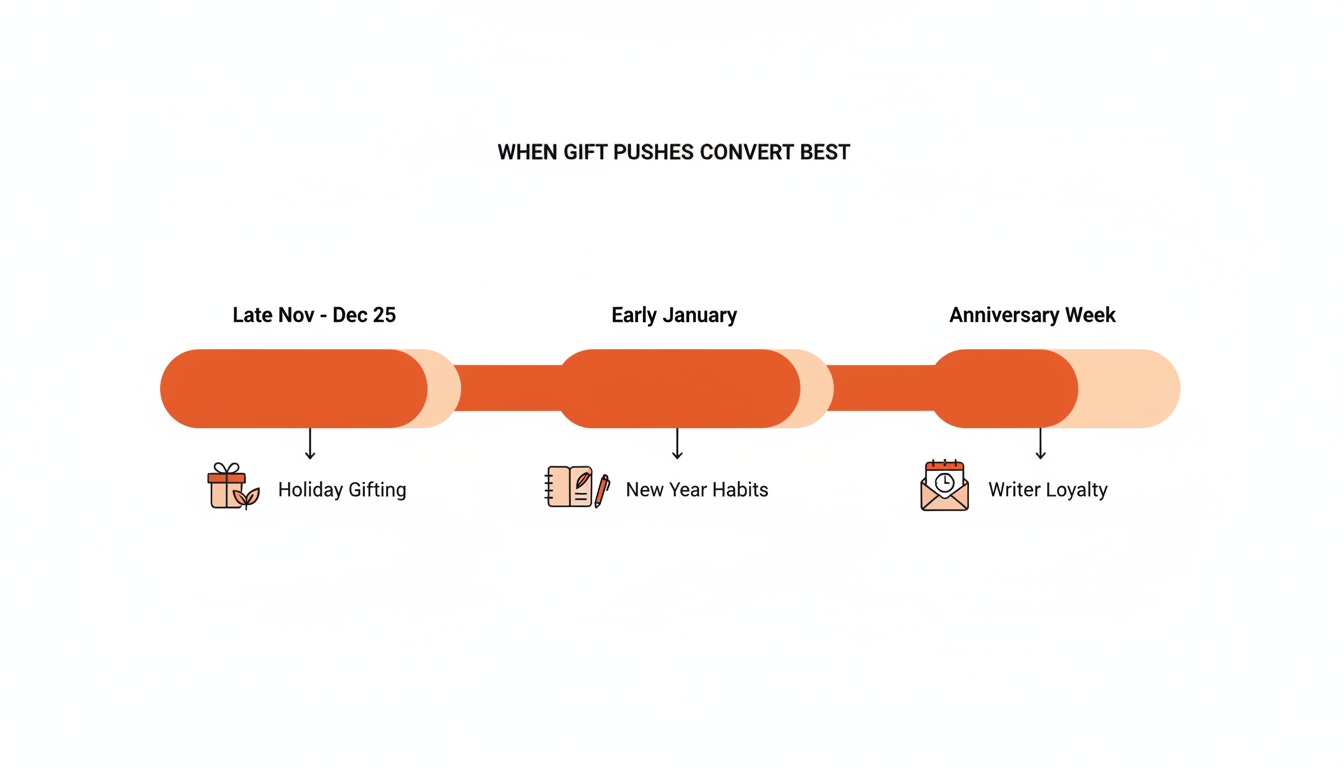
The holiday window is the obvious one, and it's obvious because it works: people are already buying gifts, and "a subscription to a newsletter you already love" is a low-effort, high-relevance idea. But two other windows get ignored. The first two weeks of January catch people setting reading and learning goals for the year, which makes a gift a strange but effective framing even as a self-purchase prompt ("gift yourself a year of X"). The week around your publication's own anniversary gives you a natural, non-generic reason to mention gifting that isn't tied to a retail calendar everyone else is also shouting into.
Milestone-based gifting
Subscriber-count milestones (1,000 subscribers, 10,000 subscribers) are a quieter but reliable moment to mention gifting, because you're already writing a "thank you" post that has naturally high open rates. Attaching a gift link to a milestone post converts better than attaching it to an ordinary Tuesday post, simply because the audience is already emotionally engaged with your growth story.
The same logic applies to launch anniversaries of a specific series or a paid-tier launch: any moment where you're already telling readers a story about growth or gratitude is a moment where "help someone else join this" lands as a natural next line, not a hard sell bolted onto unrelated content.
Practical rule: never launch a gift push on the same day as a regular content post competing for the same inbox slot. Give it its own send, even if that send is short.
Gifts vs. discounts vs. referrals
These three levers get lumped together, but they solve different problems and pull different levers on your existing audience versus new readers.
| Lever | Who takes the action | Best for | Weakness |
|---|---|---|---|
| Gift subscription | An existing reader, on behalf of someone new | Converting a friend/family/colleague who wouldn't subscribe on their own | Depends entirely on your current readers' willingness to spend on someone else |
| Discount | A prospective subscriber, for themselves | Nudging fence-sitters who were already close to converting | Trains part of your audience to wait for the next discount |
| Referral program | An existing reader, earning a reward for referring | Turning your most engaged readers into a distribution channel | Slower to compound; requires an incentive worth sharing for |
Gifting is the only one of the three where the person paying and the person reading are different people, which is exactly why it works best at emotionally loaded moments (holidays, milestones) rather than as a standing, always-on offer.
Most writers pick one of these levers and stick with it out of habit rather than deliberately choosing based on what their audience actually responds to. A publication with a highly engaged but price-sensitive readership will usually see more from a well-timed discount than a gift push, since the friction for a discount is lower: it only requires one person to act, not two. A publication with a small but devoted core of readers who talk about the newsletter to friends offline is a much better fit for gifting, since that dynamic already exists; the gift link just gives it a checkout button. Referral programs sit somewhere in between and reward the behavior you'd want to see happen anyway, which makes them the slowest to show results but the cheapest to leave running in the background indefinitely.
What happens when the gift ends
Renewal reminders
Substack sends the recipient reminder emails before the gift term ends, typically about a week out and again the day before, giving them the option to continue as a paying subscriber or drop to the free tier if one exists.
If they don't renew
If the recipient doesn't convert to a paying subscription, their access reverts, usually to free-tier access if you offer one, or to no access at all if your publication is fully paid. This is a normal, expected outcome, not a sign the gift "failed." Plenty of readers who don't renew immediately still stay on as free subscribers and convert later, once they've had a full year of the paid version to miss.
Practical rule: treat every unrenewed gift recipient as a warm lead for a future discount offer, not a lost cause. They already read a full year of your best material.
Common mistakes writers make with gift campaigns
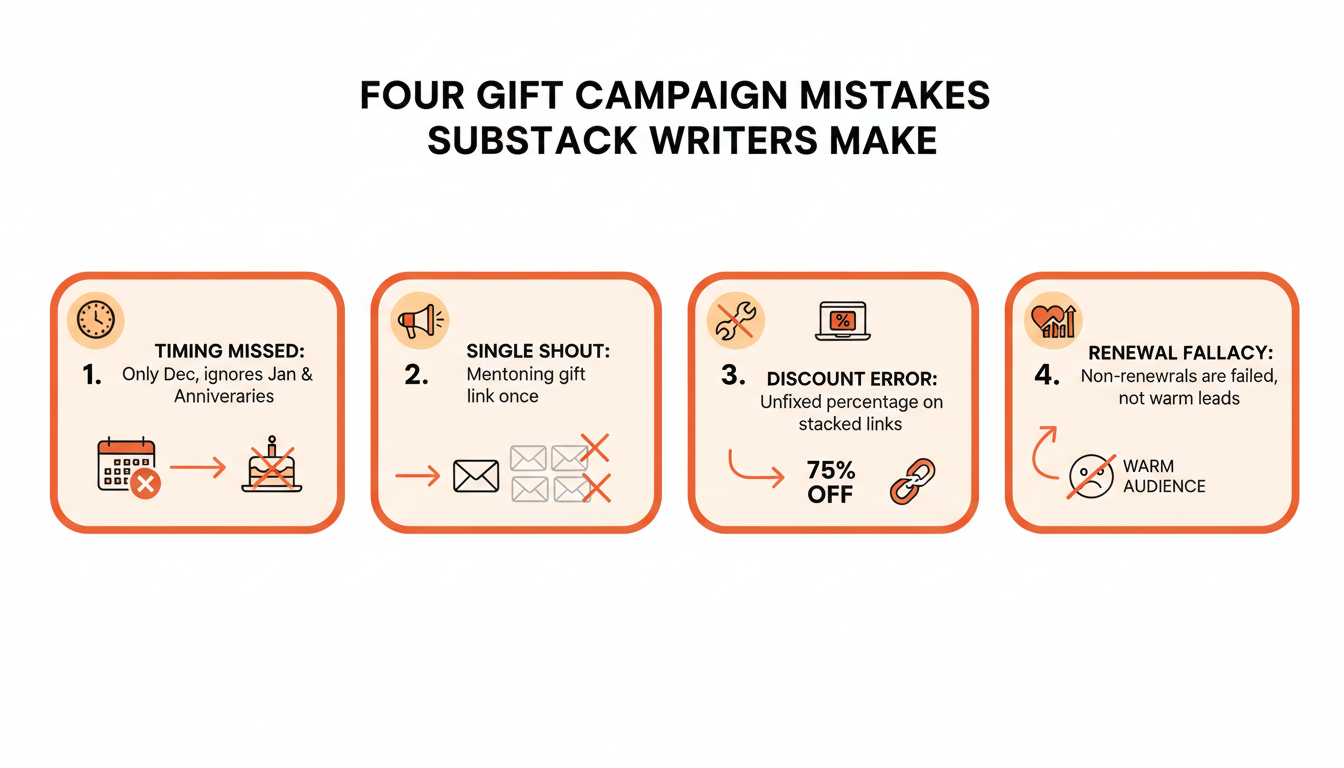
The most common mistake is treating gifting as a December-only feature. The mechanic is available year-round, and the anniversary and January windows above convert for reasons that have nothing to do with the holiday calendar.
The second is mentioning the gift link exactly once, in one post, and never again. A gift link buried in a single archived post gets almost no ongoing traffic. It needs to live somewhere reachable: a pinned note, your about page, or a recurring mention in a welcome sequence.
The third is not deciding on a discount percentage before sharing a group gift link, which forces an awkward correction after readers have already started sharing the original terms.
The fourth is writing off recipients who don't renew. A reader who spent a full year with your paid tier for free is not the same as a cold prospect; they're a warm audience for a well-timed discount later.
A less obvious fifth mistake is running a gift push without telling the buyer what happens next. Readers who've never bought a gift subscription before don't automatically know that the recipient gets immediate access, that they can schedule delivery, or that a personal note is an option. Spelling out the mechanics in the same post where you link to /gift removes the hesitation that comes from not knowing what you're actually clicking into.
Where gifting fits in your growth plan
Gift subscriptions work best as a scheduled, repeated push tied to specific moments, not a one-time mention you forget about after the holidays. That means the real bottleneck usually isn't the feature itself, it's remembering to write and send the notes and posts that mention it at the right time.
That's the part WriteStack is built for: planning and scheduling the Substack Notes and posts around your gift, discount, and milestone pushes so they go out on the calendar windows that actually convert, instead of whenever you happen to remember. If you're building out a gifting campaign, WriteStack's Note Generator can draft the announcement notes for you, and the engagement heatmap shows you when your specific audience is actually reading, so you're not guessing at send times even during a high-stakes holiday week.
Run your next gift push on a schedule instead of a memory, and it stops being a once-a-year afterthought.