
Substack's Notes feed decides who sees your work before a single reader finds your newsletter through search or word of mouth. Most writers treat that decision as a black box, something to guess at through trial and error, a screenshot of someone else's viral note, a rumor about posting three times a day.
In late 2025, Substack's own team stood in front of a room of writers in New York and explained, in plain language, how the feed works. Co-founder Hamish McKenzie and head of machine learning Mike Cohen laid out what the Substack algorithm rewards, what it ignores, and why it was built differently from Twitter, Instagram, or LinkedIn's feeds. This piece covers what they said, the patterns visible across 20,000 recent Notes, and what to change once the mechanics stop being a mystery.
One number worth having before you start: WriteStack has close to 100 verified reviews from Substack writers across multiple platforms. The other tools writing about this feed have none that we could find anywhere. Every claim below is sourced either to Substack's own published words or to Notes data you can check against your own account.
Table of Contents
- What the Substack Algorithm Actually Optimizes For
- How the Feed Decides What Lands in Front of You
- What Actually Makes a Note Get Seen
- The Real Numbers Behind Substack's Notes Push
- What 20,000 Notes Show About Shape and Length
- Five Things That Actually Move the Algorithm
- What Doesn't Work Anymore
- You Cannot Reason About a Feed You Cannot Measure
- Does the Algorithm Work If You're Starting From Zero?
- A Weekly Notes Routine Built Around How the Algorithm Actually Works
What the Substack Algorithm Actually Optimizes For
Every recommendation system has to decide what it's rewarding. Twitter's feed rewards time on the app. Instagram's feed rewards the same thing dressed up in photos. Substack built its feed around a different number.
Mike Cohen, Substack's head of machine learning, said it directly in a Q&A published on Substack's own blog: "The goal is to get people to discover, subscribe, and ideally pay. That's how we built the feed and how we continue to iterate to make sure that we're driving subscriptions up."
That sentence explains most of what confuses writers about Notes. A note can pull in hundreds of likes and move zero subscribers. A quiet, specific note about what a newsletter actually covers can convert dozens of new subscribers while barely showing engagement on the surface. The feed isn't scoring for attention. It's scoring for what happens after the attention.
Why This Is the Opposite of Twitter or Instagram
"Other social feeds are largely based around time spent," Cohen said. "You scroll the feed, and the more time you spend, the more ads you see." Hamish McKenzie put it more bluntly in a transcript of his October 2025 talk to Substack writers: "They need you to never leave the app. They don't want you to go find a long-form story or build trust with a writer. They just want you to keep scrolling."
Practical rule: stop judging a note's performance by likes alone. Check whether it's followed by new subscribers or replies from people outside your existing audience. That's closer to what the algorithm is actually measuring.
Substack's own stats screen shows likes, restacks, and replies on a single Note, then stops. It will not tell you which link inside that Note got clicked, or how your restack rate compares to other publications your size. WriteStack closes that gap, with link-click history across your full Notes archive and benchmarks that answer "is this good" instead of "is this different from Tuesday."
Start a free 7-day trial and see which Notes actually moved subscribers.
How the Feed Decides What Lands in Front of You
The mechanics are less mysterious than the word "algorithm" makes them sound. Cohen described the starting point plainly: "We take a look at who you are as an individual opening the Substack app, where you are in the world, what language you speak, what things you're subscribed to, who you follow, and what interests you've specified, among other things. We try to turn that into a numerical representation so that we can compare it to things that you might want to load in your feed."
Every reader gets a feed built from several signals instead of a single follow list. Location and language narrow the pool, subscriptions and follows anchor it, and stated interests fill the gaps for readers who haven't subscribed to much yet.
Audience Overlap and the Virtuous Cycle
The part that matters most for growth is what happens next. "If we see overlaps between audiences of different publications, that becomes a virtuous cycle that feeds back into what other people who are similar might enjoy," Cohen said.
That's why restacking, quoting, and replying carry more weight than they look like they should. Each of those actions happens on Substack itself, so the platform can trace it end to end. Sharing a note to Twitter tells Substack nothing about your readers. Restacking it inside Substack says two audiences might overlap, and that signal is what puts a writer's work in front of people who have never heard of them.
Practical rule: restack and reply inside Substack itself, not just off-platform. The algorithm can only learn from behavior it can see, and it can only see what happens on Substack.
Overlap is the one input a writer can work on deliberately rather than wait for. WriteStack's audience overlap view shows which publications your audience already shares ground with, turning "engage with people in your niche" into a short list of accounts worth replying to this week.
What Actually Makes a Note Get Seen
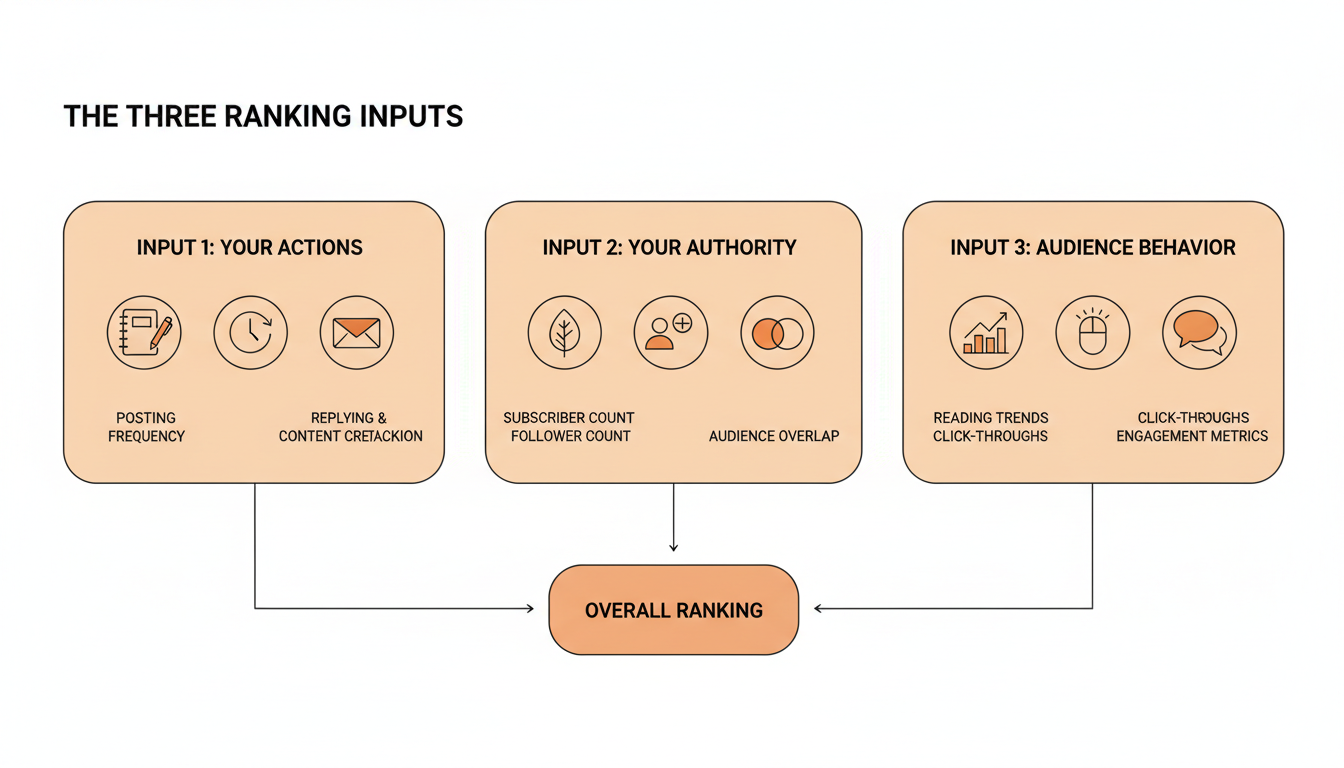
Reach on a given note comes down to three overlapping inputs, based on how Substack's team described the system.
The Three Ranking Inputs
The first is behavior: how often a writer posts, replies, and restacks inside Substack. The second is standing: subscriber count, follower count, and how much a writer's audience overlaps with larger, already-popular publications. The third is context: what other users on Substack are reading, clicking, and engaging with in that moment.
That second input explains a pattern a lot of writers notice and can't quite name. Karen Cherry, a Substack writer who covers publication strategy, pointed out that writers who cover Substack growth itself have a built-in advantage on Notes, because a huge share of active Substack users are already interested in that exact topic. A food writer or a fiction writer starting from zero doesn't have that ready-made overlap, and posting frequency alone never fully closes the gap. Two writers can post identical volume in the same week and land in front of completely different sized pools of people who might already care.
Practical rule: don't benchmark your reach against a "growth guru" account. Their topic overlaps with a much larger share of the Substack user base than most niches ever will.
The third input, context, is the one writers almost never look at, because it changes weekly and no native screen reports it. WriteStack's live inspiration feed pulls continuously from live Notes data, so what you see on a Tuesday is what the feed is rewarding that Tuesday rather than a list somebody assembled last quarter. Narrareach's equivalent is a static list, which was accurate on their live page as of July 2026.
The Real Numbers Behind Substack's Notes Push
Substack has been unusually direct about how much of its subscriber growth now runs through the Notes feed rather than search, social sharing, or recommendations. The numbers, all reported by Substack itself in October 2025, are worth sitting with.
| Metric | Number | Source |
|---|---|---|
| Free subscriptions driven by the app (trailing 3 months) | 32 million | Substack |
| Paid subscriptions driven by the app (same period) | Nearly 500,000 | Substack, same report |
| How much more likely app subscribers are to share, like, comment, or restack | 7x | Hamish McKenzie |
| Posts discovered per day through the app | 1 million+ | Hamish McKenzie |
McKenzie also said the app is now "the top source of subscriber and revenue growth for Substack publishers, even higher than recommendations." For a platform that built its reputation on recommendations as the main growth lever, that's a real shift in where a writer's time is best spent.
Real Notes, Real Subscriber Counts
Substack's writeup gave named examples instead of vague averages. Julie Fratantoni's note explaining who she is and why she's on Substack drove 32,535 new subscribers and a $4,546 revenue increase. Anna Lena Feunekes picked up nearly 4,000 subscribers from one note pairing illustrations with a crisp explanation of what her newsletter delivers. Food creator Olivia Noceda brought in 437 subscribers and $480 in revenue from a short cooking video. Fashion writer Viv Chen has seen roughly 30% of her total subscribers come directly from notes, built through steady posting rather than viral hits.
None of those four are the same format. What they share is a clear, specific value proposition rather than a generic pitch.
What 20,000 Notes Show About Shape and Length
Substack's team explained the objective. They did not publish a style guide, and there isn't one. What is available is the output side: what happened to Notes people posted. We pulled a sample of 20,000 recent Notes through WriteStack and looked at engagement by shape and by length. Two patterns came out clearly enough to act on.
📅 Struggling to stay consistent on Substack?
WriteStack's Smart Scheduling lets you batch and queue Notes in minutes. Grow on Substack without burning out.
Explore Smart SchedulingMulti-line Notes outperformed single-line Notes. Across the sample, Notes broken into multiple lines averaged about 11% more reactions and about 28% more restacks. The restack gap is the interesting half, because restacks are the on-platform action Cohen described as feeding the audience-overlap cycle. A Note with room to breathe gets passed along more often, and passing along is what puts a writer in front of strangers.
Length has a floor. Notes in the 150 to 300 character range beat Notes under 50 characters by roughly a third on reactions, and by more on restacks. One-line hot takes are cheap to write and they underperform. A Note long enough to make a point and short enough to read in one glance sits in a band most writers miss in one direction or the other without ever knowing it.
Those numbers are observed, not asserted: this is what happened to real Notes, measured after the fact, not a claim about what Substack's ranking code does internally. Nobody outside Substack can tell you what the model weights, and any article that says otherwise is guessing at you with confidence. What Notes data can tell you is which shapes and lengths kept getting restacked, and that is the part you act on Monday morning.
They are also field averages, not your averages. Your niche may run longer or shorter, which is exactly where a per-account stats screen runs out of road. WriteStack compares your restack rate against other publications instead of only against your own last month, so the question stops being "did this week beat last week" and becomes "is this good."
Start your free trial and benchmark your Notes against the field, not against yourself.
Five Things That Actually Move the Algorithm
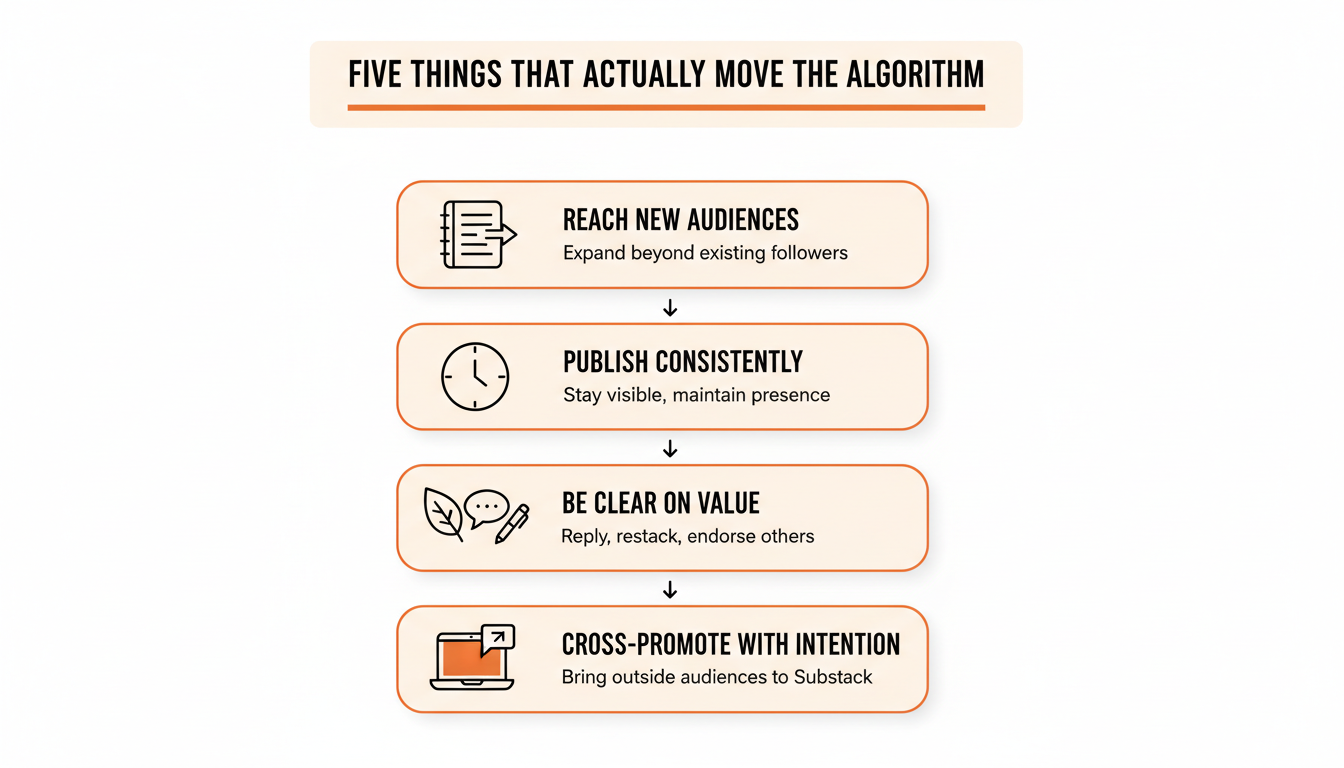
Substack's own recommendations to publishers, published alongside the algorithm explanation, come down to five habits.
Write every note as if it might be the first thing a stranger ever reads from you. Show up on a predictable basis instead of in bursts, since the algorithm reads consistency as a signal a writer is worth continuing to show to people. State plainly what a reader gets from subscribing. Reply to and restack other writers' notes instead of only posting your own, since Substack can only trace audience overlap through actions on its own platform. Bring outside audiences in, since writers who share notes to LinkedIn or Instagram with real intent tend to convert that attention into subscribers.
Practical rule: treat replying and restacking as growth activity, not just community courtesy. Substack's own data ties it directly to reach.
Consistency is the habit on that list that fails first, because it depends on being at your desk with an idea at the right hour. Writing four Notes on a Sunday and letting them go out across the week is the version that survives a bad month, and it's what a Notes scheduler is for. WriteStack queues through a browser extension that hands each Note to Substack's own native scheduler, so your session never leaves your browser and nothing publishes from someone else's server while you're logged out.
The off-platform half comes with a caveat. The algorithm can't see LinkedIn or Instagram, so sharing a note there doesn't feed the ranking system the way restacking does. What it does is bring warm readers back to Substack, where their first actions generate the same on-platform signals as everyone else. WriteStack pushes that traffic out through Buffer to 11 platforms, with Medium as the one honest gap in the list.
What Doesn't Work Anymore
The clearest public account of what stopped working comes from a writer who tracked it in his own numbers. Substack creator Wes Pearce documented a stretch where his most-liked notes brought in two or three subscribers each, while his more personal, story-based notes brought in ten or more every time, even with fewer likes. "Engagement and likes weren't driving growth," he wrote. "Something else was."
That lines up with what Substack's team said about the feed's objective. Likes are a weak proxy for the thing the algorithm is optimized for, which is a reader deciding to subscribe. A note that racks up reactions from people who already follow a writer says very little about whether it would work on someone new.
Vanity Metrics vs. High-Signal Engagement
Chasing a high like count on Notes is closer to chasing pageviews on a post that never converts a reader. What moves the needle is a reply from a stranger who genuinely connected with the note, or a restack that puts it in front of an overlapping audience.
Practical rule: if a note gets a lot of likes but no new subscribers or replies from unfamiliar accounts, treat that as a signal to try a more specific note next time, not proof the format works.
You Cannot Reason About a Feed You Cannot Measure
Everything above argues for measuring one thing: what happened to a Note after it published, compared against something other than your own previous week. Pearce found his pattern because he tracked subscribers per note by hand for weeks. Most writers never do that, so they keep writing to a theory instead of to evidence.
Substack's native stats tell you a Note did better or worse than another Note of yours. They do not tell you whether your restack rate is good, whether it's climbing or sliding across a quarter, or which of the two links you put inside a Note is the one people clicked.
The part people don't expect
WriteStack benchmarks your restack rate against other publications rather than only against your own history, so "is this good" becomes an answerable question instead of a feeling. It tracks which specific link inside a Note got clicked, going back to your very first Note, so "that one performed well" becomes "that one sent 40 people to the archive." And it schedules Substack chat posts, which no other tool in this category does at all. Open the dashboard on a Tuesday and see that the Note you almost didn't post drove 40 link clicks, and that your restack rate is running well above typical for a publication your size. Not better than last week. Better than the field.
Trend analysis is the piece that changes behavior fastest. A snapshot tells you Tuesday was fine. A month-over-month line tells you your restack rate has been sliding since you shifted to shorter Notes, which nobody notices from inside a single week. A per-account dashboard structurally cannot give you the direction or the comparison.
| The question you actually have | Substack's native stats | WriteStack |
|---|---|---|
| Which link inside a Note got clicked, going back to my first Note | No | Yes, per link, full history |
| Is my restack rate good, or just different from last week | No | Benchmarked against other publications |
| Is my reach climbing or sliding month over month | No | Trend analysis over time |
| What is the feed rewarding this week | No | Live inspiration feed, updated continuously from live Notes data |
| Schedule a Substack chat post | No | Yes, and no other tool in the category does |
| Draft new Notes from what I've already published | No | Yes, with model selection if a draft misses |
| Where the gaps in my posting actually are | No | Posting heatmap |
| Verified reviews from Substack writers | Not applicable | ~100 across multiple platforms |
We built WriteStack. We also sourced every claim in this article to Substack's own published words or to Notes data, so you can check all of it yourself.
Does the Algorithm Work If You're Starting From Zero?
Yes, with a caveat worth being honest about. The algorithm doesn't require an existing following to show a note to new people, since it weighs behavior and audience overlap rather than raw subscriber count. A writer with zero subscribers and zero posting history simply has nothing yet for it to learn from.
What Realistic Growth Looks Like Early On
Pearce's account of his first weeks is a useful check against the "one note, ten thousand subscribers" stories that circulate in Substack advice content. He described plateauing at two to three subscribers a day early on, then shifting toward more personal, story-based notes and consistent daily posting, which moved him toward ten or more a day over time. That's a slower curve than most Notes advice implies, and it matches what Substack's team described: the algorithm needs behavior and engagement history before it can confidently show a writer's work to strangers.
Starting from zero is also when drafting is hardest, because there's no rhythm yet and every Note feels like it has to justify itself. WriteStack's Notes generator drafts from what you've already published rather than from a cold prompt, so the output starts in your voice instead of arriving at it after three rounds of editing, and you switch models when a draft misses.
A Weekly Notes Routine Built Around How the Algorithm Actually Works
Everything above points toward the same habits: post regularly, engage inside Substack, write Notes long enough to earn a restack, and measure what happened against the field instead of against last Tuesday. Turning that into a weekly routine is where most writers stall out, not because the advice is unclear, but because it's hard to track manually.
Daily vs. Weekly Posting Plan
| Frequency | What to do | Why it matters to the algorithm |
|---|---|---|
| Daily | Post one note, reply to two or three others, restack anything genuinely worth sharing | Keeps behavior signals fresh and visible |
| 2-3x per week | Post one multi-line note in the 150 to 300 character range that states a clear value proposition or tells a specific story | Matches the shape that drew ~28% more restacks across 20,000 Notes |
| Weekly | Check link clicks, restack rate against the field, and the direction it moved, not likes | Tells a writer what to repeat and what to drop |
That routine runs on two things a native Substack screen doesn't give you: a queue that holds a week of Notes so consistency stops depending on memory, and an analytics layer that answers "is this good." WriteStack ships both. The Activity Center puts replies and restacks in one place instead of five browser tabs, which is what makes the daily engagement half of the routine survive a busy week.
The feed rewards subscriptions rather than attention, and restacking, replying, and consistent posting are the actions it can trace back to that goal. That part came from the people who built the system, so it's no longer guesswork. The rest, what shape of Note earns a restack and whether your own numbers are good, is measurable, and 20,000 Notes' worth of it already sits behind the dashboard.
Six weeks into running Notes this way, the change isn't that you post more. It's that you stopped guessing. The Monday Note is already written and already queued. The Note that quietly drove 40 clicks to your archive is a number you can point at instead of a hunch. Your restack rate has a direction and a comparison, and when it slides you find out that week rather than three months later. Close to 100 verified reviews from Substack writers back that up, and no other tool in this category has any we could find.
Start a free 7-day trial. Queue a week of Notes in twenty minutes. Stop guessing what the feed rewards.