
I used to open Substack Notes, stare at the empty box for a minute, close the tab, and tell myself I'd post later. Later usually meant never that day. The problem was never a lack of things to say. It was that I had no system for finding them.
That's the actual fix. Not more motivation, not a better opening line. A library of Substack Notes ideas organized by type, plus a real look at which ones perform, so the ten minutes you spend on Notes each day go toward something that moves the needle instead of something that vanishes into the feed unread.
This is that library: six categories of Substack Notes ideas, real examples inside each one, and a look at what a sample of 20,000 scheduled Notes shows about what actually gets clicked, followed, and subscribed to.
Table of Contents
- Why You Run Out of Substack Notes Ideas
- What Actually Drives Clicks and Follows on Substack Notes
- Behind-the-Scenes and Process Notes
- Opinions, Takes, and Disagreements
- Personal Story and Lesson Notes
- List and Number Notes
- Recommendation and Community Notes
- Repurposed Notes: One Idea, Five Notes
- A Simple Weekly System So You Never Run Dry
Why You Run Out of Substack Notes Ideas
Substack built Notes as a shared feed across the network, not a private log attached to your own publication. As Substack's own guide to getting started with Notes explains, a Note can be seen and restacked by anyone on the network, not just your existing subscribers, which is what makes it a real discovery channel and not just a status update box. That's also why the ideas below are grouped by what they do for a stranger scrolling past, not just what they say about you.
We built the WriteStack AI note generator because most writers don't need more inspiration content telling them to "just be authentic." They need a reliable source of drafts that already sound like them, five minutes before their queue runs empty. Close to 100 verified reviews from Substack writers, across multiple review platforms, say it does that. We haven't found a competitor with review counts anywhere close.
Practical rule: Keep a running list of ideas sorted into categories, not one long undifferentiated notes file. A category you're low on is visible at a glance instead of hiding in a wall of text.
What Actually Drives Clicks and Follows on Substack Notes
Before the idea categories, here's what the data says about execution, because the best idea in the world still underperforms if it's written the wrong length or shaped the wrong way.
We pulled a sample of 20,000 Notes scheduled through WriteStack over the past six months and split them by word count.
| Note length | Avg. clicks per Note | Free subscribers per 100 Notes |
|---|---|---|
| Under 15 words | 103 | 59 |
| 15–40 words | 37 | 27 |
| 40–80 words | 46 | 38 |
| 80+ words | 115 | 41 |
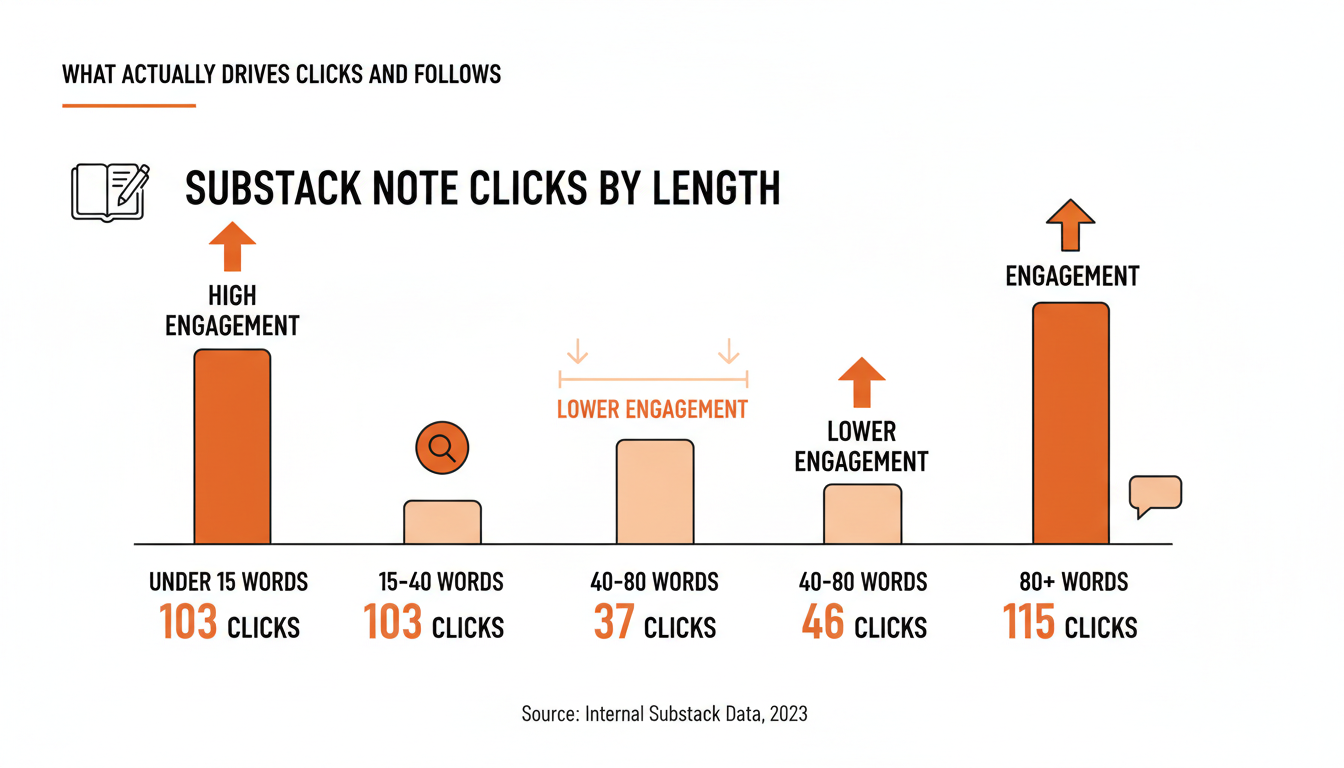
The middle length loses on every metric. A Note that's 15 to 40 words is too long to land as a quick hit and too short to actually tell a story, and it shows up in the numbers as the weakest performer in the whole set. The fix isn't "write more" or "write less." It's pick a lane: short and punchy, or long enough to earn the read.
Two more patterns held up across the same sample:
Notes that end with a question mark got 29 average clicks and 0.8 follows per 100 Notes. Notes that end as a plain statement got 64 average clicks and 2.5 follows per 100, more than double on both. Asking the reader something feels like an engagement tactic, but in this data it reads as hedging, and hedging doesn't convert.
Notes that open with a number, "3 things I changed about my writing this year" instead of "Here's what I changed," saw 85 average clicks against 61 for everything else, and nearly double the free-subscriber conversion, 71 per 100 Notes versus 37. That's a smaller slice of the sample, 221 Notes, but the direction was consistent across clicks, follows, and subscriptions.
Practical rule: Before you write a Note, decide on purpose whether it's a short hit or a long one. Anything landing in the 15-to-40-word gap by accident is the one length to actively avoid.
Behind-the-Scenes and Process Notes
This is the easiest category to run dry on because it feels like you need something dramatic to show. You don't. The process itself is the content. Readers who already read newsletters are curious about how the sausage gets made in a way people outside that world usually aren't.
The trick is specificity. "Writing is hard sometimes" is not a process Note. "I cut the first 400 words of today's post because the real piece started on paragraph six" is.
Practical rule: Screenshot your own draft, your own outline, or your own analytics dashboard before you write the Note. A real artifact beats a description of one almost every time.
Process Note Ideas to Steal
- What your outline looked like before you cut it in half
- The sentence you deleted and why it didn't earn its place
- How long a specific piece actually took to write, start to finish
- A screenshot of your drafts folder and what's stuck in it
- The research rabbit hole that ate your afternoon
- What time of day you actually write, and why that time
- The tool or app you use for a specific step, and what it replaced
- A before-and-after of a headline you rewrote
- What you do when a piece isn't working
- The one line of feedback that changed how you write now
Opinions, Takes, and Disagreements
Substack readers followed you instead of a faceless publication because you have a point of view. Notes are the fastest place to prove that, faster than a full post, lower stakes than a debate in someone else's comments.
The failure mode here isn't being too opinionated. It's being opinionated about nothing anyone cares about. A hot take on a topic your readers don't have a stake in just sits there.
Practical rule: Write the opinion in one sentence first, no qualifiers. Add the nuance in the replies if someone pushes back, not in the Note itself.
Opinion Note Ideas to Steal
- A piece of common advice in your niche that you think is wrong
- Something everyone in your space agrees on that you don't
- A prediction about where your industry is headed
- The trend you're deliberately not following, and why
- A tool, book, or method you think is overrated
- Something you changed your mind about this year
- A rule you broke on purpose and it worked
- The advice you'd give your past self before starting
- A take on something in the news that touches your niche
- Where you disagree with someone else's popular post, tagged respectfully
📅 Struggling to stay consistent on Substack?
WriteStack's Smart Scheduling lets you batch and queue Notes in minutes. Grow on Substack without burning out.
Explore Smart SchedulingPersonal Story and Lesson Notes
These are the Notes that turn readers into subscribers because they show a person instead of a content strategy. They're also the category writers avoid the longest, because a real story feels riskier to post than an opinion.
It doesn't need to be dramatic. A small, specific moment with an actual lesson attached beats a big vague story about "the journey" every time.
Practical rule: End the story with what changed, not with "and that taught me a lot." Name the actual change in one sentence.
Story Note Ideas to Steal
- The moment you almost quit, and what stopped you
- A mistake with a client, reader, or project, and what it cost you
- The first time someone paid you for your writing
- A comment or email that changed how you think about your work
- Something you were wrong about publicly, and how you found out
- The worst piece of advice you ever followed
- A skill you had to unlearn
- What your work looked like a year ago compared to now
- The moment a small win meant more than it should have
- A conversation that reshaped an entire piece you were writing
List and Number Notes
The data above showed numbered openers converting best, and this category is where that shows up naturally, because a list is already built around a number.
Lists work because they promise a shape before the reader commits to reading. "3 tools I stopped paying for" tells someone exactly what they're getting into, which is part of why it clicks better than an open-ended statement covering the same ground.
Practical rule: Cap the list at what you can actually make specific. Five specific items beats ten vague ones, and the number in the opener should match the number you deliver.
List Note Ideas to Steal
- Tools or subscriptions you canceled and don't miss
- Books that changed how you write, not just what you write about
- Questions you ask before publishing anything
- Things you'd tell someone starting your niche from zero
- Habits that actually moved your numbers, not the ones you assumed would
- Newsletters you read every single issue of, and why
- Mistakes you see beginners in your space make on repeat
- Small changes that had an outsized effect on your work
- Signs a piece isn't ready to publish yet
- Things that got easier after your first year
Recommendation and Community Notes
This is the category that builds the network effect Notes was actually built for. A recommendation Note does two things at once: it gives your reader something useful, and it puts you in front of that other writer's audience when they see it.
It works best specific and personal, not a generic "check this out." Say what the piece did for you, not just that you liked it.
Practical rule: Tag the writer and say the specific thing that landed. "This line stopped me" gets read by the writer and their audience. "Great post" gets skipped by both.
Recommendation Note Ideas to Steal
- A newsletter you'd recommend to your own readers by name
- A specific line from someone else's post that stuck with you
- A fellow writer whose growth you've watched and what they did right
- A piece that changed how you think about your own topic
- Someone in your niche who deserves more subscribers than they have
- A comment thread on someone else's Note worth pointing people toward
- A publication outside your niche you read anyway
- Crediting where an idea in your own post actually came from
- A question from your community of readers worth answering publicly
- Highlighting a reader's comment that added something you missed
Repurposed Notes: One Idea, Five Notes
Most writers treat every Note as something they have to invent from nothing. The faster path is pulling from what you've already written, which is also where a real idea library beats generic inspiration content: it starts from your own voice instead of a stranger's template.
One published post can become a pull quote Note, a "here's the part I almost cut" Note, a counterpoint Note responding to your own piece, a one-line takeaway Note, and a "what readers said" Note built from the comments. Five Notes, one piece of original thinking, none of it invented on the spot.
The part people don't expect: WriteStack's note generator doesn't work from a blank prompt the way most AI writing tools do. It reads what you've already published on Substack and drafts new Notes in that voice, so the output starts sounding like you instead of arriving there after three rounds of rewriting. It also tracks which specific link inside a Note got clicked, going back through your full history, not just this week's numbers. That's the difference between "did this get clicks" and "which sentence caused them."
Practical rule: Every time you finish a post, pull one line worth quoting before you move on. That's tomorrow's Note, already written.
Repurposing Note Ideas to Steal
- A pull quote from your latest post, posted on its own
- The line you almost cut from a post, with why you kept it
- A counterpoint to your own published argument
- The single takeaway from a post, compressed to one sentence
- A reader comment that added something your original post missed
- An old post's core point, restated for someone who never saw it
- A stat or example from a post that deserves its own spotlight
- The question a post didn't answer, opened up for discussion
- Turning a post's subheading into a standalone claim
- A "one year later" update on something you wrote before
A Simple Weekly System So You Never Run Dry
Ideas alone don't fix an empty queue. A system does. Here's the version that actually holds up over a busy month, not just a motivated Tuesday.
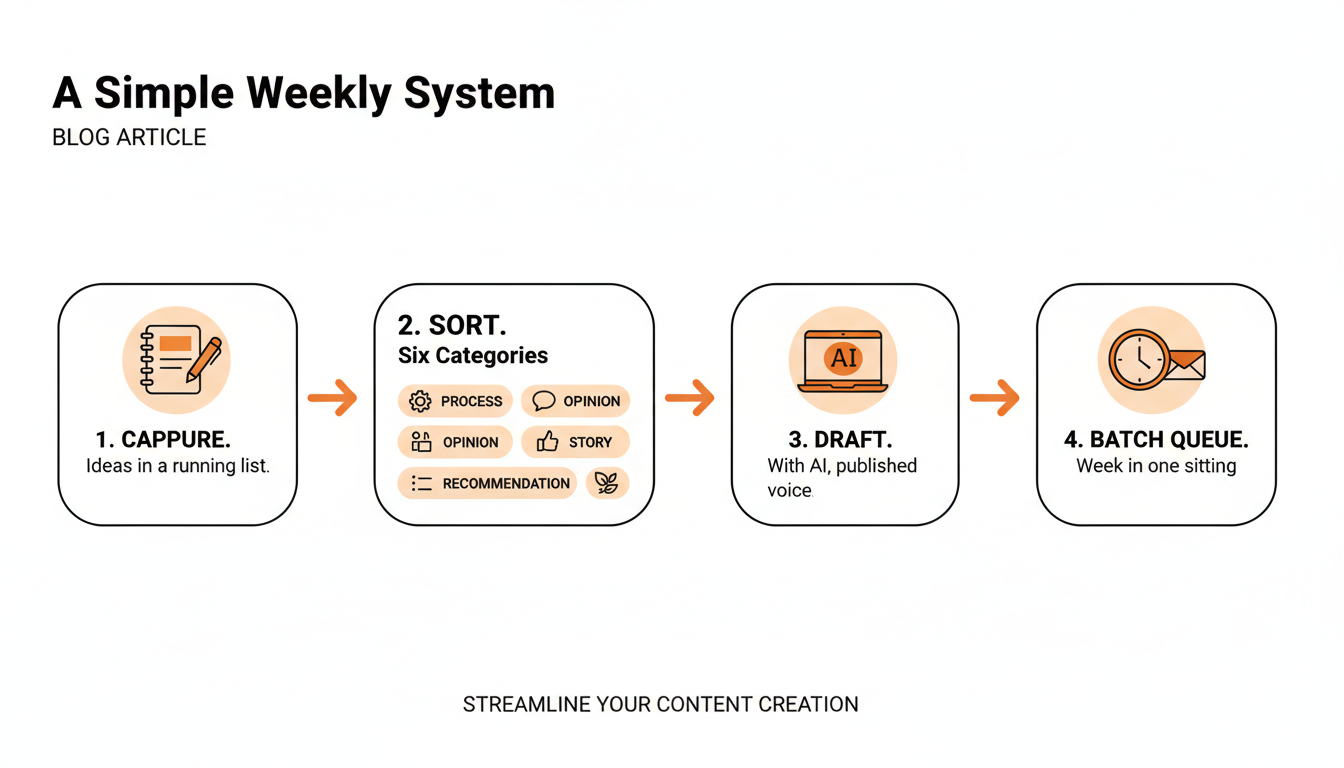
Capture ideas the moment they happen, in whatever note app is already open, not in Substack itself. Once a week, sort what you captured into the six categories above so you can see which ones are thin and need attention. Draft from your own past writing instead of a blank box. Then queue the whole week at once instead of posting one Note a day under pressure.
Practical rule: If a week goes by with nothing captured, that's the signal to skim your own published posts for repurposing material rather than waiting for a fresh idea to appear on its own.
That last step is where most systems quietly fall apart, because "I'll post one every morning" depends on every morning going to plan. Load a week of Notes into WriteStack in twenty minutes on a Sunday and they go out without you, at the times your own posting heatmap shows your specific audience is actually online, not a generic best-practice hour.
Six categories, sixty examples, and the two structural rules the data backs up: avoid the 15-to-40-word middle, and end on a statement instead of a question more often than not. That's more raw material than most writers use in a month. Open WriteStack and turn today's list into a week's worth of Notes that go out without you having to remember to post them.