
A writer I know checked her Substack dashboard one Tuesday morning and found forty new subscribers she couldn't explain. No new post that day, no ad spend, no viral Note. She dug through her referral sources and found the answer: a publication three times her size had cross-posted one of her essays the night before, and her byline rode along with it into thousands of new inboxes.
That's cross-posting working the way it's supposed to. Most Substack writers know the feature exists in some vague sense, but few use it on purpose. Substack cross-posting is the feature that hands another writer's full free post to your own subscriber list, byline and credit intact, and it runs in two directions most writers never connect: posts moving between Substack publications, and your own writing moving out to the platforms where the rest of your readers spend their day.
This piece covers the mechanics, who gets credit, the real data on how many writers already lean on it, the etiquette that keeps it from feeling spammy, how to push the same post off Substack to eleven other platforms, and how to fold all of it into a repeatable system.
One number worth having before you start: WriteStack has close to 100 verified reviews from Substack writers across multiple platforms. The other tools that handle Substack distribution have none that we could find anywhere. That is a wide gap in a category where most products launched in the last eighteen months.
Table of Contents
- What Substack Cross-Posting Actually Is
- How to Cross-Post a Post on Substack
- Who Can Cross-Post and Who Gets Credit
- Cross-Posting Permissions and Limitations
- Why Writers Use Cross-Posting to Grow
- Cross-Posting Etiquette: How to Do It Well
- Cross-Posting vs. Guest Posts vs. Recommendations
- The Other Cross-Posting: Getting Your Substack Off Substack
- Common Cross-Posting Mistakes to Avoid
- Making Cross-Posting Part of Your Growth System
What Substack Cross-Posting Actually Is
Cross-posting is a native Substack feature that lets one publication share another publication's free post directly with its own subscriber list. Instead of linking out to someone else's essay in a Note or a footer mention, cross-posting delivers the full post into your subscribers' inboxes, styled as your own send, with a short blurb from you explaining why you're sharing it.
The original writer keeps their byline. Substack's own support documentation confirms that ownership and engagement stay with the original author, meaning likes, comments, and any new subscribers the post generates count for the writer who made it, not the one who shared it. The publication doing the sharing gets the goodwill of introducing something good to its list. The publication being shared gets exposed to an entirely new audience with no extra writing required.
Most newsletter platforms treat sharing as an export problem: forward the email, copy the link, post it to social media and hope someone clicks. Substack built cross-posting as a native, in-network action instead, which is why it behaves more like a second publish than a referral link. The post lands inside the subscriber's normal inbox flow rather than as an outbound click to a site they've never seen, and that's a big part of why cross-posted posts get read instead of ignored.
The timing question shows up immediately. A cross-post arriving at 2am in your list's time zone does none of the work you sent it to do. WriteStack's heatmap shows the hours your audience is actually opening and engaging, which turns "I'll send this cross-post now" into a scheduled slot on the day it has the best chance of being read. Start a free 7-day trial and put your next cross-post in the hour your list is awake.
Cross-Posting vs. Recommendations vs. Mentions
It helps to separate cross-posting from two features it gets confused with. A recommendation is a standing arrangement where one publication appears on another's subscription page and after-signup screen, running continuously in the background. A mention is a lighter, inline reference to another publication inside a post or Note, closer to a citation than a share. Cross-posting is a one-time event tied to a specific piece: you are handing an entire post to your list. Substack rolled cross-posting and mentions out together, and its announcement post walks through how the two relate.
Practical rule: if you want an ongoing growth partnership, use recommendations. If you found one specific post you want your list to read today, cross-post it.
How to Cross-Post a Post on Substack
The mechanics are short. Open the post you want to share (it has to be a free post from a publication other than your own), click the three dots in the top corner, and select "Cross post." A composer window opens where you write a blurb explaining to your subscribers why you're sharing it. That blurb is the only original writing involved, and it's also the part most writers rush.
From there you choose who receives it: everyone, paid subscribers only, or founding members only. You can publish immediately or schedule it for later, and there's a checkbox for whether the cross-post also appears on your own site as a public page.
Sending to everyone gives the piece its widest reach. Restricting it to paid or founding members works better when the blurb is doing relationship-building, telling your most invested readers why this outside piece belongs in their inbox rather than blasting it to people who signed up two days ago and don't know your taste yet. Scheduling matters more than most writers give it credit for, since a cross-post sent the moment you find a good post competes with whatever is already sitting unread from earlier that day.
What You Can and Can't Cross-Post
A few limits matter here. You can only cross-post free posts, never paywalled ones, so a great subscriber-only essay isn't eligible no matter how much you want to share it. You need to be an admin on your own publication to cross-post at all, which matters for multi-writer Substacks with restricted roles. And the original publication has to have cross-posting turned on, since it's an opt-in setting on both ends.
Who Can Cross-Post and Who Gets Credit
Every Substack publication has a toggle for this under Settings, then Privacy, next to "Allow cross-posting." It's on by default for most publications, which is part of why cross-posting shows up in the wild more often than writers realize until they go looking.
Credit is unambiguous. The byline, the subscribe prompts inside the post, and every reaction or comment belong to the original writer. The publication doing the sharing gets a notification setting under its own Settings, Notifications section, so they know when someone returns the favor. Nothing about credit is split. That's one reason cross-posting reads as more generous than a typical shoutout swap: the writer being featured keeps a hundred percent of the upside.
Opting Out of Being Cross-Posted
Turning cross-posting off is a single toggle in the same Privacy panel. Writers who cover sensitive topics, or who don't want their essays appearing inside someone else's brand context, use this fairly often. There's no penalty or visibility loss inside Substack's algorithm for opting out, it just removes you from other publications' cross-posting options.
Cross-Posting Permissions and Limitations
Beyond the free-post-only rule, a few smaller limits shape how useful cross-posting is day to day. You can't cross-post something already cross-posted by someone else, since the feature only pulls from an original publication. Cross-posted content also doesn't count toward your own post count or land in your archive the way an original post does, unless you check the box to publish it to your site as well.
None of this makes cross-posting complicated. It stays narrow on purpose. A feature that only works on free, original, opted-in posts is low-risk for everyone involved, which is likely why Substack left the default turned on instead of making writers hunt it down.
The free-posts-only rule also shapes how paid publications use it. A paid Substack can't hand its subscriber-only essays to another list, but it can cross-post a strong free post as a preview of its range, which works as a soft on-ramp toward the paywall without giving away anything behind it. Writers who build their free posts to be genuinely shareable get cross-posted more often, simply because there's more worth sharing sitting in front of the paywall.
Why Writers Use Cross-Posting to Grow
We pulled a sample of roughly 3 million Substack posts from our own dataset and searched for writers explicitly discussing cross-posting as a tactic, not just using the feature quietly in the background. We found 178 posts across 89 distinct publications where the writer was talking directly about cross-posting, either explaining how they use it or asking their readers to try it.
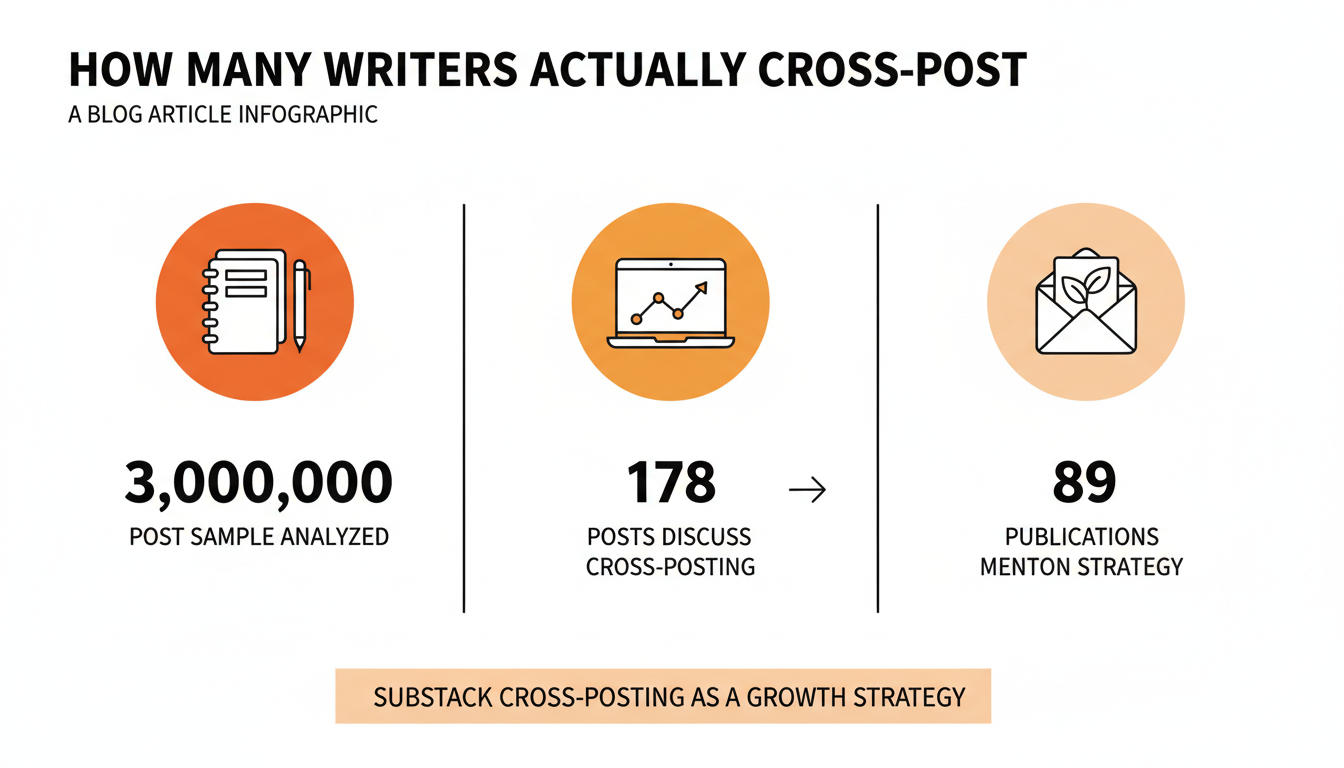
Read that number as a floor. It counts writers who wrote a post about cross-posting, and most writers who cross-post never stop to write about doing it. The practice is wider than the conversation around it, which is what you'd expect from a feature sitting one click deep in a menu that's already switched on.
From the same sample: posts that mention cross-posting directly ran a bit longer on average (about 1,175 words) than the broader dataset average (around 1,134 words). A small gap, and it fits a pattern. Writers who treat cross-posting as a distribution strategy tend to put more care into the underlying post, since a thin, rushed piece isn't something anyone wants to hand to a friend's audience.
Practical rule: treat cross-posting as a distribution channel worth checking weekly, not a favor you wait to be offered.
Cross-Posting Etiquette: How to Do It Well
The fastest way to make cross-posting feel like spam is to share something your list has no reason to care about, with a blurb that reads like an afterthought. Writers who get repeat cross-posts follow the same handful of habits. They only cross-post something they'd genuinely recommend to a friend, not whatever's newest from a publication they want to network with. They say exactly why the post is worth a reader's time, in specific terms, instead of a generic "check this out." And they space cross-posts out, since a list that starts seeing more of other people's content than yours will notice.
There's a quieter form of etiquette around who you cross-post. Sharing a much larger publication's post gives your list something good but does little for a writer who already has reach. Sharing a smaller or newer writer's strong post is where cross-posting does the most good for everyone: your list meets someone they'd never have found, and the smaller writer gets a boost that actually moves their numbers. Both directions are worth doing. Only ever sharing up toward bigger names reads eventually as networking rather than recommendation.
📅 Struggling to stay consistent on Substack?
WriteStack's Smart Scheduling lets you batch and queue Notes in minutes. Grow on Substack without burning out.
Explore Smart SchedulingWriting a Blurb That Gets Opened
The blurb is short, usually two or three sentences, and it's doing real work: setting expectations before someone clicks into a post written in a voice that isn't yours. A strong blurb names the specific idea or line that made you want to share it, says who it's for in one clause, and gets out of the way. A blurb that says the writer is great and you love their work gives a reader nothing to click toward.
Pair the cross-post with a Note pointing at the same piece and one good find gets two chances to land. WriteStack's Note generator drafts that companion Note from posts and Notes you've already published, so it sounds like you wrote it rather than like a caption generated from a prompt.
Cross-Posting vs. Guest Posts vs. Recommendations
These three get lumped together constantly, and picking the right one depends on what you're trying to do.
| Feature | What it is | Who writes it | Where credit goes | Best for |
|---|---|---|---|---|
| Cross-post | Sharing another writer's full free post to your list, one time | Original author | Original author | Introducing your readers to one specific piece you admire |
| Guest post | Someone else writes a post that publishes under your own publication | Guest writer, published on your feed | Split, depends on framing | Filling a content gap, swapping audiences directly |
| Recommendation | An ongoing listing of another publication shown to your new subscribers | Neither, it's a standing feature, not content | Recommended publication | Long-term audience-sharing partnerships |
Practical rule: use cross-posting for a single great piece, guest posts for filling a specific gap in your schedule, and recommendations for partnerships you want running in the background indefinitely.
The Other Cross-Posting: Getting Your Substack Off Substack
Everything above happens inside Substack's network, where the audience is already made of newsletter readers. The second meaning of cross-posting is the one most writers reach a few months in: taking a post you already published and putting a version of it in front of people who will never open a newsletter but will read a thread, a carousel, or two paragraphs in a feed.
That's a different job with a different failure mode. The in-network version costs you three sentences of blurb. The off-Substack version, done by hand, costs you an evening of opening each platform, reformatting, trimming to a character limit, uploading, and repeating until the post is live in eight places and you've lost the appetite to write the next one.
WriteStack handles this through Buffer, which puts eleven platforms behind one publish action inside the same tool you're already using to schedule Notes. It sits on the Standard plan at $24.99/month alongside 150 AI credits, 100 queued Notes, and Claude MCP access. The connection routes through your existing Buffer channels, so the roster you can reach is Buffer's channel support rather than a list WriteStack maintains by hand.
Open Platform List vs. Fixed Platform List
That routing detail changes what the platform number means over time, which is why it's worth understanding before you compare tools on a feature checklist.
Narrareach publishes to six native platforms, with four more listed as "coming soon" on their live page as of July 2026. Those numbers are quoted from their own site so you can check the current state yourself. It's a fixed roster: the platforms they've built connectors for are the platforms you get, and a new network arrives in your account when it arrives on their roadmap.
WriteStack's roster moves with Buffer's. Buffer maintains those connectors as a core part of its own product, so a channel added there becomes available to you without waiting for a WriteStack release cycle. Eleven today is the current count, not a ceiling.
One gap, stated plainly, because you'd find it in ten minutes anyway: Medium is not in WriteStack's Buffer list, and Narrareach does support Medium natively. If republishing to Medium is a fixed requirement in your workflow, that's a genuine point in their column and you should weigh it.
| Capability | WriteStack | Narrareach |
|---|---|---|
| Cross-posting destinations | 11 via Buffer, open list that grows with Buffer's channels | 6 native, plus 4 listed "coming soon" |
| AI drafting from your own published posts and Notes | Yes, drafts start in your voice | Generates from a prompt |
| Switch AI models when a draft misses | Yes | One fixed voice |
| Link-click tracking across your full Notes history | Yes, per link inside each Note | No |
| Benchmarks against other publications your size | Yes | No |
| Trend analysis month over month | Yes | No |
| Substack chat post scheduling | Yes, and no other tool does it at all | No |
| Publishing mechanism | Browser extension handing off to Substack's own scheduler | Cloud dashboard publishing from their servers |
| Medium as a destination | Not in the Buffer list | Yes, natively |
| Verified reviews from Substack writers | ~100 across multiple platforms | None we could find |
| Pricing | $19.99 to $79.99/month, 7-day trial on all tiers | From $19/month |
We built WriteStack. We also linked every claim about Narrareach to Narrareach's own live page and dated the check, so you can verify all of it yourself in about five minutes.
Start your free 7-day trial and publish one post to eleven places from one screen.
Writing One Post for Eleven Different Rooms
Reach across eleven platforms is worth very little if the same block of text lands identically in all of them. A LinkedIn audience reads a Substack essay excerpt differently than an X audience does, and the paste-everywhere approach produces posts that fit none of those rooms particularly well.
This is where the drafting layer stops being a nice extra. WriteStack's AI reads posts and Notes you have already published and drafts from those, so the version going to each platform starts in your voice rather than arriving at it after three rounds of editing. When a draft misses, you switch models and generate again instead of rewriting a paragraph that was never going to sound like you. Most tools in this category ship one voice and one model and ask you to live with both.
The part people don't expect
WriteStack tracks which of the two links inside a Note got clicked, going back to your very first Note, so a cross-post promotion stops being "that seemed to land" and becomes "that sent 62 people to the archive, and 41 of them came from the Thursday post." It benchmarks your restack rate against other publications your size, which answers "is this good" instead of "is this better than last week." And it schedules Substack chat posts, which no other tool in this category does at all, so the room where your most engaged readers already sit gets the same planning as your main feed. Open the dashboard on a Tuesday and see that the cross-post you almost skipped drove more archive traffic than the essay it was promoting.
Knowing Which Platform Actually Sent Readers Back
Cross-posting off Substack creates a measurement problem the in-network version doesn't have. Substack tells you a post got views. It does not tell you that eleven of those readers came from a Thursday LinkedIn excerpt and two came from the same text posted to a network you've been maintaining out of habit for a year.
Link-click history across your full Notes archive closes that loop. Every link inside every Note is tracked individually and permanently, so the destination that keeps sending readers back becomes visible instead of inferred. Cross-posting turns into a channel you can point at: more effort into the two platforms doing the work, less into the ones that were never going to. WriteStack's fans view sits next to it and shows which subscribers engage most often, and those are usually the same readers who click into a cross-post and stay.
Common Cross-Posting Mistakes to Avoid
Most cross-posting mistakes come down to treating the feature as free promotion instead of a genuine editorial choice.
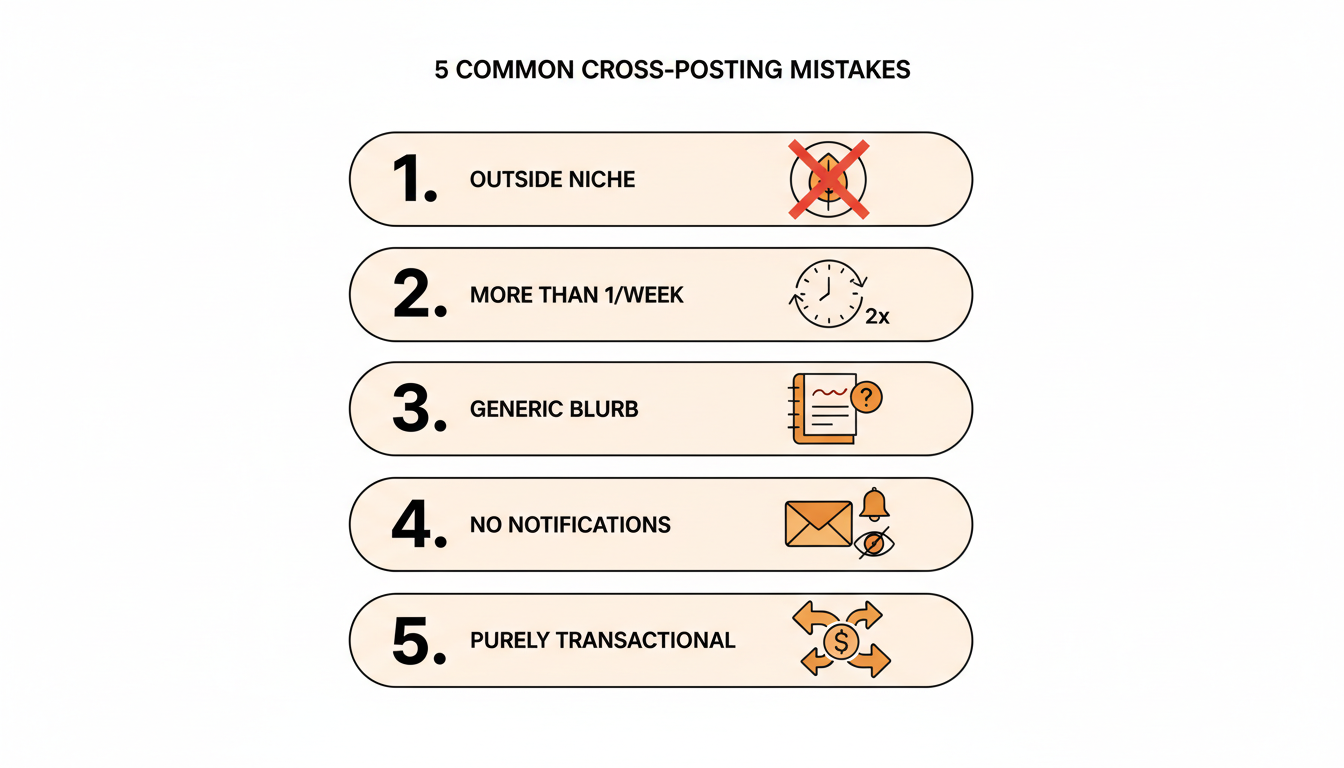
The one worth calling out specifically: writers who cross-post as a transaction, expecting one back, get resentful when the trade doesn't happen on their timeline. Cross-posting works best as a genuine editorial recommendation first. The reciprocity, when it comes, comes because the post was good, not because a deal was struck.
The off-Substack equivalent of that mistake is posting the same paragraph to eleven platforms on a Monday, watching nothing happen anywhere, and concluding that distribution doesn't work for your niche. What failed there was the pasting, not the channel.
Making Cross-Posting Part of Your Growth System
Cross-posting compounds only when it becomes a habit instead of something you remember once a quarter. That means building it into whatever routine already governs your Notes and posting schedule. A short weekly check of what you've read and genuinely liked from other Substack writers, followed by one well-written blurb, does more for a list over a year than an occasional burst of five cross-posts in a single week.
A simple version of that routine: read normally through the week, keep a running note of anything you'd want to hand to your own list, then pick the single best one on a fixed day, write a real blurb, and schedule it into the hour your heatmap says your list is awake. Two cross-posts a month, done with care, will do more for a publication's standing in its niche than a dozen done carelessly.
The outbound half runs on the same weekly rhythm. Your latest post gets drafted into platform-appropriate versions, those go out through Buffer to eleven destinations on a schedule, and the link-click data comes back telling you which two of those eleven are worth keeping.
Three months in, the difference isn't that you cross-post more. It's that cross-posting stopped being something that happens to you. The inbound side runs on a weekly reading habit, the outbound side runs from one screen to eleven platforms, and the numbers coming back tell you where to spend the next month. Forty surprise subscribers on a random Tuesday becomes a line on a chart you can plan against, and close to 100 verified reviews from Substack writers say that's what happens once the system is running.
Start a free 7-day trial of WriteStack. Schedule your next cross-post for the hour your list opens email, push the same post to eleven platforms from one screen, and find out which one sent readers back.