
Substack Lead Magnets: What Actually Converts
A lead magnet only does one job: it turns a stranger's curiosity into an email address. On Substack, that job is easier and harder than on a normal landing page at the same time. Easier because you already have distribution built in through Notes, recommendations, and the app's discovery surfaces. Harder because your reader is standing in front of a subscribe button that already promises free content, so a generic PDF checklist rarely moves the needle.
I want to walk through what actually works on this platform specifically, not generic lead magnet advice ported over from a SaaS landing page. The mechanics of Substack change what converts, where you place the offer, and how you measure whether it worked.
Table of Contents
- What a lead magnet has to do on Substack
- Why generic lead magnet playbooks underperform here
- Lead magnet formats that convert on Substack
- Picking a topic that's actually worth building
- Building a lead magnet without leaving Substack
- Where to place the offer
- Promoting it without looking like spam
- Measuring whether it's working
- Common mistakes that kill conversion
- Start with the offer, not the funnel
What a lead magnet has to do on Substack
Most creators think of a lead magnet as an acquisition tool: something you run ads to, or drop in a bio link, to capture emails before they ever see your writing. On Substack the sequence is usually reversed. A reader lands on a post, a Note, or your About page first, and the lead magnet's job is to convert that already-warm attention into a subscription rather than cold traffic into a lead.
That distinction matters because it changes what "conversion" means. A landing page lead magnet is judged against visitors who've never heard of you. A Substack lead magnet is judged against visitors who already read one piece of your writing and are deciding whether it's worth a recurring relationship. The bar is lower, but the offer still has to be specific enough that it doesn't feel like a generic gate in front of content they'd have subscribed to anyway.
Practical rule: if your lead magnet would work equally well bolted onto any newsletter in your niche, it isn't specific enough to move a Substack reader who's already deciding between you and ten other writers in their inbox.
Why generic lead magnet playbooks underperform here
Most lead magnet advice online was written for SaaS marketing funnels: gated ebooks, webinar registrations, calculator tools sitting behind a form on a dedicated landing page. Those numbers do not transfer cleanly to a newsletter platform, and the data on the format itself has moved against the classic PDF.
The average conversion rate for gated eBooks dropped below 0.9% in 2024, while interactive tools including quizzes and templates converted at 5.2% or higher, according to a 2024 HubSpot report cited in aggregated lead magnet benchmark data. That's a six-times gap between the format most creators default to and the formats actually converting in the current environment. Substack readers, who are already skeptical of anything that smells like a marketing funnel bolted onto a writer's newsletter, are if anything more sensitive to that gap than a typical B2B landing page visitor.
The second thing generic advice gets wrong is channel assumption. Most lead magnet guides assume you're driving paid or organic search traffic to a dedicated page. On Substack, your highest-intent channel is your own existing free subscriber base and the discovery surfaces native to the platform, which behave more like an owned audience than a cold funnel.
Lead magnet formats that convert on Substack
Three formats consistently work better than a generic downloadable guide, for writers specifically:
A companion resource tied to a specific post. Not "10 Tips for Newsletter Growth," but the exact template, swipe file, or dataset referenced in the post someone just finished reading. The specificity does the conversion work because the reader already validated they care about that exact topic.
A short structured series delivered by email. A five-day mini-course format converts better than a single download because it gives you five separate touchpoints to build the case for a paid subscription, instead of one download that gets forgotten in a downloads folder.
A gated archive or backlist. For writers with a year or more of posts, bundling your best five to ten pieces into a themed collection ("everything I've written about freelance pricing") works because it's assembled from content you already wrote, and it demonstrates depth rather than promising it.
The format conversion gap
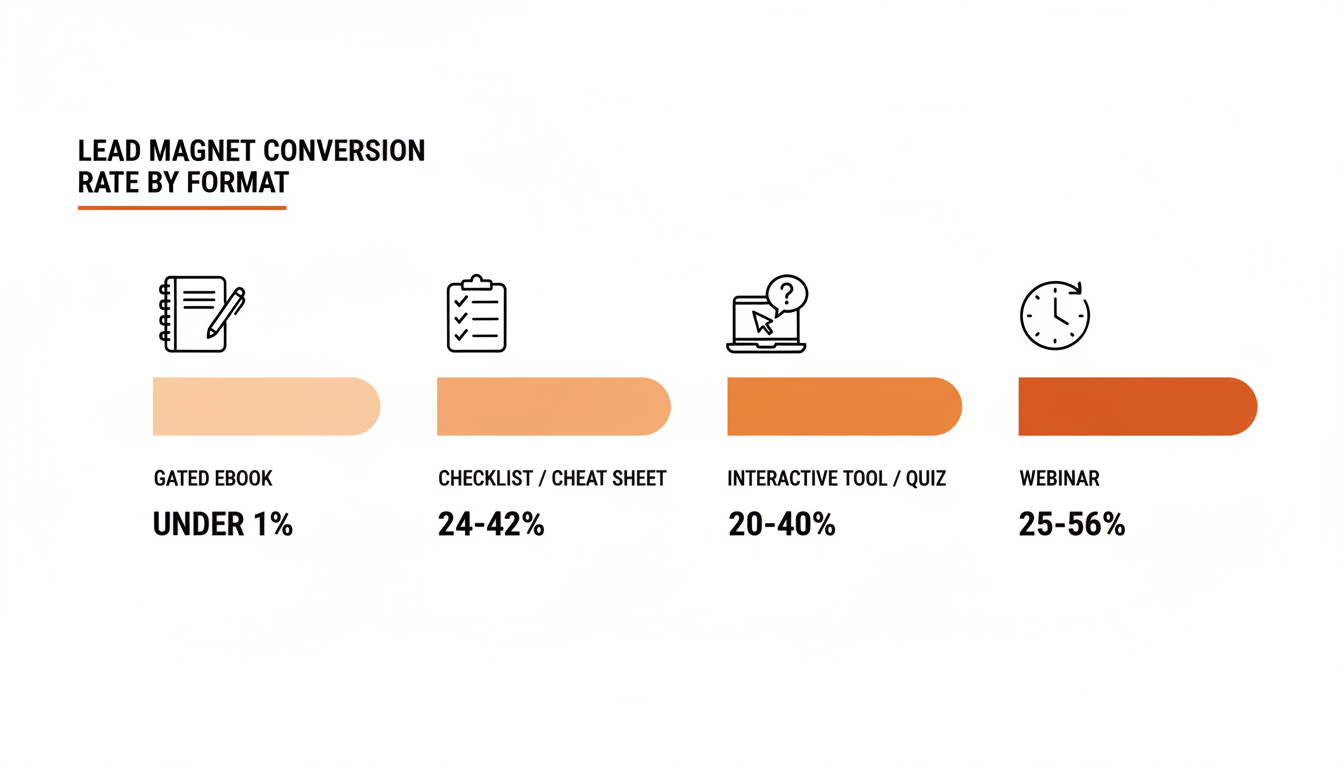
| Format | Typical conversion rate | Best fit for Substack writers |
|---|---|---|
| Gated ebook / long PDF | Below 0.9% | Rarely worth building from scratch |
| Checklist or cheat sheet | 24%–42% | Strong fit, fast to produce from existing posts |
| Interactive tool or quiz | 20%–40% | Strong fit if your niche supports a calculator or assessment |
| Webinar or live session | 25%–56% | Works well paired with a Substack Live session |
| Coupon or discount | Up to 82% | Best for paid-tier conversion, not free-to-paid acquisition |
Source: aggregated 2025–2026 lead magnet benchmark data compiled by Shno.co.
Practical rule: if you only have time to build one lead magnet, build a checklist or short structured series pulled directly from posts you've already written. It costs the least to produce and sits in the highest-converting format bracket.
Picking a topic that's actually worth building
Before picking a format, look at what your own archive already tells you people want. Open your published posts and sort by reaction count and comment count. The posts that pulled the most engagement are showing you, in plain sight, which specific problem your readers care enough about to respond to. That's the raw material for a lead magnet, not a brand-new idea you invent from scratch.
A simple filter helps here: does the topic solve a problem someone has this week, or is it interesting-but-not-urgent? "How I think about pricing" is interesting. "The exact pricing email template I sent to convert a hesitant client" is urgent, because someone facing that decision right now can use it immediately. Urgent topics convert better because the reader's motivation to trade an email address is tied to a problem they're actively trying to solve, not one they might get around to someday.
Avoid picking a topic that's really just a preview of your paid tier with the good parts removed. That approach optimizes for looking generous while actually training readers to expect thin free content, which works against the paid conversion you're trying to build toward later. The lead magnet should be genuinely complete on its own terms, useful even to someone who never becomes a paying subscriber, while your paid tier stays a distinct and separately compelling offer rather than "the rest of this."
Practical rule: if you can't finish the sentence "this solves [specific problem] for someone who is trying to [specific action] this week," the topic needs another pass before you start building.
Building a lead magnet without leaving Substack
You don't need a separate landing page tool to run this. Substack's audience-specific content feature lets you write a single post where non-subscribers see a pitch for the free resource, and the moment they subscribe, the resource itself appears in its place. That keeps the entire offer, pitch, and delivery inside one post instead of routing readers off-platform to a form, which is where most of the drop-off in a traditional funnel happens.
This matters more than it sounds. Every extra click between "interested" and "subscribed" costs you readers, and a lead magnet hosted on a separate landing page builder adds at least two: the click to leave Substack, and the click to come back and actually subscribe once they've downloaded the file. Keeping the whole exchange inside a single post removes both.
📅 Struggling to stay consistent on Substack?
WriteStack's Smart Scheduling lets you batch and queue Notes in minutes. Grow on Substack without burning out.
Explore Smart SchedulingThe practical build looks like this. Write the lead magnet content as a normal post. Use the audience-specific content block to hide the payoff behind a subscribe wall, with the free-reader-visible portion doing the selling: state exactly what's inside, how long it takes to use, and why it's different from a subscription they can get anywhere else. Keep that visible pitch under 150 words. Readers deciding whether to trade an email address don't want a sales page, they want three or four sentences that make the yes decision easy.
If your resource is something readers will want to return to, like a template or swipe file, consider also linking it from your About page and pinning a Note that walks through what's inside. WriteStack's note generator can help you draft a Note that teases the resource without just repeating the pitch verbatim, which keeps it useful even to people who've already seen the post version.
Where to place the offer
Placement determines whether a well-built lead magnet actually gets seen. Four spots do most of the work.
The welcome email is the highest-intent moment you get. Someone just subscribed, meaning they've already crossed the trust threshold that a cold lead magnet is trying to establish. Reference the lead magnet in your welcome sequence with a direct link, not buried three paragraphs down.
The About page is the second-highest-intent spot, because it's where undecided visitors go specifically to evaluate whether you're worth subscribing to. A resource preview here does double duty: it proves you produce useful things and gives visitors a reason to subscribe now instead of bookmarking for later.
A pinned post or Note keeps the offer visible to anyone browsing your profile without you having to re-promote it every week. Substack Notes function as a discovery layer separate from your main feed, and a pinned Note with a clear preview of what the resource contains performs like evergreen inventory.
The bottom of high-performing posts is the fourth spot. If a post is already getting strong engagement, a one-line callout to a related lead magnet converts better there than in a low-traffic post, because you're compounding on attention that's already proven itself.
Promoting it without looking like spam
The failure mode most writers hit is treating the lead magnet like a product launch: one big push, then silence. Substack rewards steady, low-friction mentions over campaign spikes, mostly because Notes and recommendations work on an ongoing discovery loop rather than a one-time blast.
Space out mentions across formats instead of repeating the same Note. Reference the resource once in a regular post as a natural aside, once as a standalone Note framed around the problem it solves rather than the resource itself, and once in a reply to a relevant comment thread where someone is already describing the exact problem your resource addresses. That third placement converts disproportionately well because it's contextual rather than promotional.
WriteStack's note generator can help generate several angles on the same resource so you're not reusing identical copy every time you mention it, which is one of the fastest ways a promotional Note starts reading as spam to regular readers of your feed.
Practical rule: if you've mentioned the same lead magnet with the same wording more than twice in a week, you're past the point of diminishing returns and into the point of active annoyance.
Measuring whether it's working
The benchmark numbers to compare against
Two numbers matter here and they're easy to confuse. The first is your free-to-subscriber conversion rate on the lead magnet itself, meaning what share of people who see the offer actually subscribe to get it. The second is your subscriber-to-paid conversion rate downstream, which the lead magnet only indirectly influences.
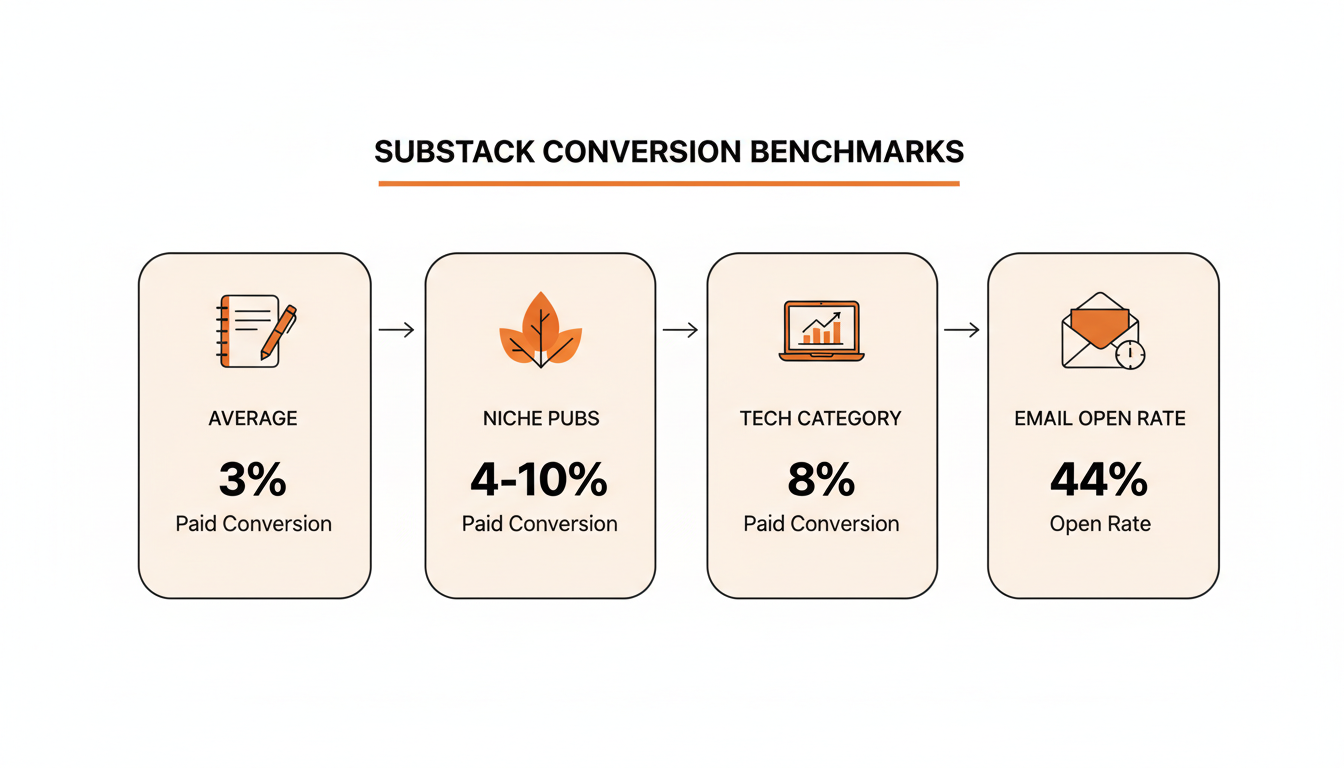
For the second number, the average paid subscriber conversion rate on Substack sits around 3%, meaning roughly 3 out of every 100 free subscribers eventually pay, while specialized or niche publications convert at 4% to 10%, and the tech category leads at roughly 8%, according to platform statistics compiled by Best Writing. If your lead magnet is bringing in subscribers but your paid conversion still sits well under 3% after a few months, the problem usually isn't the lead magnet, it's the gap between what the resource promised and what your paid tier actually delivers.
Substack's average email open rate of 44%, roughly double general email marketing benchmarks, according to the same data, gives you a fast diagnostic. If subscribers who joined through your lead magnet open at meaningfully below that average, the resource attracted the wrong audience rather than the right one, which is a targeting problem, not a promotion problem.
Common mistakes that kill conversion
The gate is wider than the payoff. Promising "the complete guide" and delivering three paragraphs erodes trust faster than having no lead magnet at all, because it signals the newsletter itself might be similarly overstated.
The resource has no natural expiration or reason to act now. Static resources with no urgency get bookmarked and forgotten. A resource tied to something time-bound, like a live cohort, a seasonal template, or a monthly refreshed dataset, converts better because delay has a visible cost.
The offer is generic enough to belong to any newsletter in the niche. If you could swap your name for a competitor's and the pitch would read identically, the specificity that makes Substack readers act is missing.
There's no plan for what happens after the subscribe. A lead magnet that isn't followed by a welcome sequence, a related post, or a reason to open the next email wastes the highest-intent moment you'll get with that reader. WriteStack's heatmap can show whether lead-magnet subscribers are opening and engaging with what comes next, not just whether they signed up. It's also worth checking whether the subscribers you're gaining resemble your most engaged existing readers or a different, less committed audience, which WriteStack's fans view can surface directly.
Start with the offer, not the funnel
The instinct when a lead magnet underperforms is to fix the funnel: better landing page copy, a slicker delivery sequence, more promotion. On Substack, the fix is almost always upstream of the funnel, in the specificity and format of the offer itself. A checklist pulled from your three best posts, gated behind Substack's native audience-specific content block, promoted in three different contexts across a week, will outperform a generic ebook backed by a perfectly optimized funnel every time.
Start with one resource, built from content you've already written, placed in your welcome email and About page this week. Measure it against the benchmarks above after your first fifty new subscribers, and adjust the format before you touch the promotion. WriteStack can handle the promotional cadence once the offer itself is right, so the resource doesn't quietly go stale in a pinned Note nobody's refreshed since launch.