

You've been posting consistently for nine months. You edit and re-edit every piece to make sure it actually reads well. The ideas feel fresh to you. And your subscriber count has been frozen at 112 for weeks.
Why does a Substack stall out even when you're doing everything the advice says to do? The uncomfortable answer: great writing alone doesn't build an audience, and the specific thing most stuck writers are missing isn't more content. It's what happens after the content goes out.
One number worth having before you start: WriteStack has close to 100 verified reviews from Substack writers across multiple platforms. The other Notes scheduling tools we've checked have none that we could find anywhere.
Table of Contents
- The Real Reason "Post More" Isn't Fixing This - You're Post-and-Ghosting - Fix #1: Reply to Everyone Who Engages - Fix #2: Post When Your Specific Audience Is Online - Fix #3: Reuse What Already Worked - What Doesn't Actually Move the Needle - A Realistic Month of Fixing This - Frequently Asked Questions
The Real Reason "Post More" Isn't Fixing This
Most advice aimed at a stalled Substack says some version of "write more Notes." That's not wrong exactly, a sweet spot of 2 to 3 Notes a day tends to work, not so much that it's unsustainable, not so little that consistency breaks down. But volume of Notes was never the actual bottleneck for most stuck writers. The bottleneck is the amount of real engagement each Note produces, and that's a completely different problem from how often you hit publish.
This distinction matters because it's checkable against real numbers, not just intuition. Our analysis of 655,000 Substack Notes found that 61.8% get zero replies, and our analysis of 20,066 viral Notes found that 40% of them, Notes that actually performed well by likes and restacks, still converted zero subscribers. Posting consistently and posting Notes that produce real engagement are two different skills, and a writer can be doing the first one perfectly while never developing the second.
Practical rule: if the subscriber count has been flat for months despite consistent posting, the diagnosis almost never turns out to be "not enough content." It turns out to be "not enough of what happens after the content."
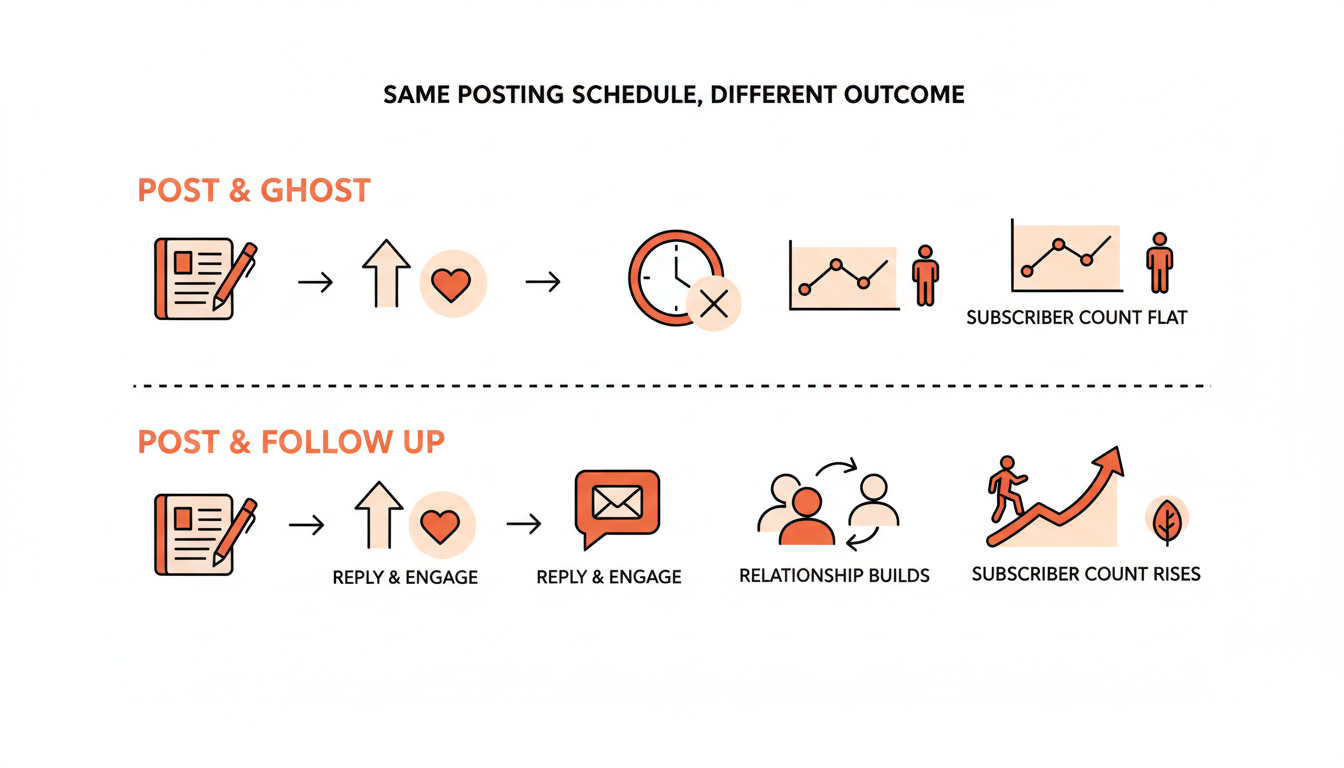
You're Post-and-Ghosting
Here's the pattern behind most stalled accounts: you put in the effort, post a daily Note and a weekly article, put real time into perfecting both, and you're still invisible. Nobody likes the Notes. People rarely open the emails. It feels like doing all this for nothing.
There's a simple, specific reason, and it's not talent or luck. It's what amounts to posting and ghosting. A group of people likes a Note, which is genuinely motivating and pushes toward posting the next one, but that's where it stops. The writer never follows up with the people who showed interest. Publishing becomes the entire activity, and everything that could turn a like into a relationship never happens.
This is an easy trap to fall into precisely because publishing feels like the productive part of the work. It's visible, it's measurable, and it produces a dopamine hit when something lands. Following up with individual readers feels slower and less like "real work," even though it's the step that actually converts attention into a relationship.
It's also worth being specific about what "invisible" actually looks like from the inside. It's not usually zero engagement. It's a handful of the same few people liking most Notes, week after week, without the circle ever widening. That's a symptom of the exact same pattern: those few people are the ones who'd respond to direct outreach, and the writer who never reaches out to them is leaving the one lever available at that size of audience completely untouched.
Fix #1: Reply to Everyone Who Engages
This is the single most important fix, and it's the one almost every stuck writer skips. Make an effort to engage with every person who liked, commented on, or restacked anything published recently. Send them a direct message. Ask how they're doing. Start an actual conversation. Offer help if there's an obvious way to.
This produces two things at once. It builds a real relationship with someone who already showed interest, which is a far more effective use of time than trying to reach a stranger who's never seen the work. And it signals, to that specific reader, that there's an actual person on the other end of the publication, which is exactly the thing that turns a passive like into someone who opens every email.
Don't worry about volume here. Reaching out to a dozen or two dozen people a week who already engaged isn't spam, it's acknowledging that real people spent real attention on the work. Most writers never do this at all, which is precisely why it's disproportionately effective for the ones who do.
See exactly who liked, commented, or restacked something recently, in one place, instead of hunting across the app. WriteStack's Fans view surfaces a publication's most engaged readers so this step doesn't require remembering who reacted to what.
There's a version of this that's worth doing even before the reply, which is simply reading who's engaging. A pattern that shows up often at this stage: the same 15 or 20 names appear across most Notes and posts, month after month, without much overlap with new subscribers. That's not a discouraging sign, it's useful information. Those 15 or 20 people are the actual, already-proven audience for this specific publication, and they're the highest-return group to invest direct attention in before spending any effort trying to reach people who've never heard of the work at all.
Fix #2: Post When Your Specific Audience Is Online
Strategic timing is the second lever. Find when a specific audience is actually active, not when generic "best time to post" advice claims everyone is online, and post the bulk of Notes then, so there's a real chance of being seen rather than posting into an empty room.
This matters more than it sounds like it should, because a Note that would have performed reasonably well at the right hour can underperform badly at the wrong one, especially for a smaller account without much of an existing following to notify people directly. A publication under 200 subscribers doesn't have the volume to overcome bad timing the way a larger account can.
📅 Struggling to stay consistent on Substack?
WriteStack's Smart Scheduling lets you batch and queue Notes in minutes. Grow on Substack without burning out.
Explore Smart SchedulingGeneric platform-wide timing advice is a reasonable starting point when there's no data yet, but it stops being useful once a publication has a few weeks of its own history to look at. A specific audience's actual active hours can diverge meaningfully from the platform average, especially for niches with a strong regional or professional skew, and that gap only becomes visible by tracking a specific account's own numbers rather than defaulting to a general recommendation indefinitely.
Fix #3: Reuse What Already Worked
Did any Note, even relative to a small audience, clearly outperform the rest? Restack it, or write a new Note built around the same underlying idea. Reusing an idea that already resonated is not a creative failure, it's paying attention to a real signal instead of discarding it out of a vague feeling that repeating yourself is lazy.
Worth being honest about the reaction to this. Roughly 90% of people will simply ignore a repeated idea, under 9% will engage with it again, and maybe 1% will be annoyed by it. That trade is worth making every time, because the cost of the 1% is nothing compared to the value of reaching the 9% who missed it the first time and the 90% who wouldn't have cared either way.
Practical rule: treat your own best-performing Notes as a shortlist to draw from, not a one-time event. An idea that worked once for a specific audience is likely to work again in a slightly different form.
What Doesn't Actually Move the Needle
Three things that feel like progress but consistently don't fix a stalled subscriber count:
| Doesn't work | Why |
|---|---|
| Writing more | Volume was never the bottleneck if engagement per Note is already low |
| Posting daily alone | Consistency without follow-up produces the same post-and-ghost pattern, just more often |
| Hoping to be discovered | Substack's discovery surfaces reward accounts that are already engaging actively, not passively waiting |
And three things that reliably do:
- Writing genuinely good material. This is the floor, not the differentiator. It has to be true, but it was probably already true for most stuck writers.
- Posting at the actual right time for a specific audience, not a generic platform-wide recommendation.
- Actually talking to the people who show up, and doubling down, specifically, on whatever format or topic already worked once.
A Realistic Month of Fixing This
None of these three fixes require doing more writing than before. They require redirecting time that's currently going entirely into producing new content toward following up on the content that already exists.
A realistic version: keep the existing posting rhythm, 2 to 3 Notes a day and a weekly article, and add fifteen to twenty minutes a day specifically for replying to and messaging people who engaged. Once a week, look back at which Note performed best relative to the rest and either restack it or write a variation. That's the entire system. It's not more work, it's the same work redirected toward the step most stuck accounts have been skipping.
Run this without the logistics eating the fifteen minutes meant for actual conversations. WriteStack queues a week of Notes in one sitting, surfaces which readers engaged so outreach doesn't require manual digging, and keeps replies in one Activity Center instead of scattered across the app, so the time saved on logistics goes into the conversations that actually move a stalled account.
Do this consistently for a month and the results tend to show up, not because anything about the underlying writing changed, but because the writer started closing the loop that publishing alone was always going to leave open.
A useful way to check whether this is actually happening, rather than staying a good intention, is to count it directly. At the end of a week, how many direct messages actually went out to engaged readers? How many of the week's Notes were deliberately timed rather than posted whenever there was a spare five minutes? How many times was an old, well-performing idea deliberately reused rather than every Note being written from scratch? A writer who can answer those three questions with real numbers is doing something meaningfully different from a writer who's simply posting more and hoping the count moves.
Frequently Asked Questions
Why is my Substack not growing even though I post every day?
Posting frequency and post quality are rarely the actual constraint for a stalled account. The far more common cause is a lack of direct engagement with readers who already interact with the content, since a like or comment with no follow-up produces no relationship and no reason for that reader to actively recommend the publication.
How many subscribers is normal after nine months?
There's no single normal number, it depends heavily on niche and starting audience, but a flat count over an extended period, regardless of the specific number, is the signal worth acting on, not the raw count itself.
Should I DM every single person who likes my Notes?
Not literally every one if the volume gets too high to be genuine, but the habit of regularly reaching out to recently engaged readers, weekly at minimum, is the highest-impact single change available to a stuck account, based on this pattern.
Is it bad to repeat an idea I've already posted about?
No. Most of a Substack audience never sees any individual Note, so reusing an idea that clearly resonated reaches people who missed it the first time. The typical reaction breaks down to roughly 90% ignoring the repeat, under 9% engaging again, and a small remainder being mildly annoyed, a trade worth making consistently.
How long before these fixes actually show up in the subscriber count?
Based on this pattern, weeks rather than months, mainly because the fixes work on the readers who already exist rather than requiring new discovery to happen first. Direct outreach converts people who are already paying attention, which tends to move faster than any strategy that depends on reaching brand-new readers from zero.
The Actual Fix
A stalled Substack after months of consistent posting is almost never a writing problem. It's a follow-up problem: Notes and posts go out, a handful of people react, and nothing happens after that reaction. The fix isn't writing more, it's replying to the people who are already there, posting when they're actually around to see it, and reusing the ideas that already proved themselves. Keep the posting rhythm running while the follow-up finally gets the attention it was missing, and a stalled count usually starts moving within weeks, not months.