
If you've searched for how much of your Substack should be free, you've probably landed on the same answer everyone repeats: keep three posts free for every one you paywall. It shows up in dozens of newsletter-growth guides, almost always with no source attached.
I wanted to know if that number holds up. So instead of repeating it, I pulled the actual free-versus-paid post ratio from 488 real Substack publications that have paid subscriptions turned on, using a database of roughly 3 million Substack posts. The 3:1 rule turned out to be closer to a rough average than a rule, and the real pattern underneath it is more useful than the ratio itself.
This piece walks through what those 488 publications actually do, the four paywall models Substack itself describes, and how to figure out where your own newsletter should sit instead of copying a number that doesn't fit your audience. None of this requires guessing. The data is sitting in Substack's own post history, publication by publication, and once you look at enough of it, a much clearer picture shows up than a single quoted ratio ever could.
Table of contents
- The 3:1 rule everyone quotes (and where it breaks down)
- What 488 paid Substacks actually do
- The four paywall models Substack describes
- Why "almost all free" is the biggest group, not the paywall-heavy group
- Why some publications paywall almost everything and still grow
- How to pick your own ratio
- Common mistakes when setting your paywall split
- How WriteStack fits into the free vs. paid decision
The 3:1 rule everyone quotes (and where it breaks down)
The 3:1 ratio, three free posts for every paid one, gets cited as if Substack published it as an official recommendation. Substack hasn't. What Substack actually publishes is looser: a guide describing four different ways writers split free and paid content, with no fixed ratio attached to any of them (Substack: How to convert subscribers from free to paid).
The 3:1 number is a decent rough average, but it hides two very different groups of writers: those who paywall almost nothing and monetize through goodwill and perks, and those who paywall almost everything and monetize through utility. Averaging those two groups together produces a ratio that describes neither of them well.
Practical rule: treat any ratio you read online, including this one, as a starting point to test against your own numbers, not a target to hit.
What 488 paid Substacks actually do
I looked at every publication in the corpus with paid subscriptions turned on and at least 10 published posts, 488 publications in total, and calculated what share of each one's posts were fully free ("everyone") versus paywalled ("only paid").
The average free share across all 488 publications is 71.5%, which lines up reasonably well with the popular 3:1 heuristic. But the average hides the real shape of the data. The median publication is 84.8% free, meaningfully higher than the average, because a smaller group of heavily-paywalled publications drags the average down.
Breaking it into buckets makes the pattern clearer:
| Free-post share | Publications | % of sample (n=488) |
|---|---|---|
| 90-100% free | 214 | 43.9% |
| 70-89% free (closest to the "3:1" range) | 89 | 18.2% |
| 50-69% free | 68 | 13.9% |
| 30-49% free | 44 | 9.0% |
| Under 30% free | 73 | 15.0% |
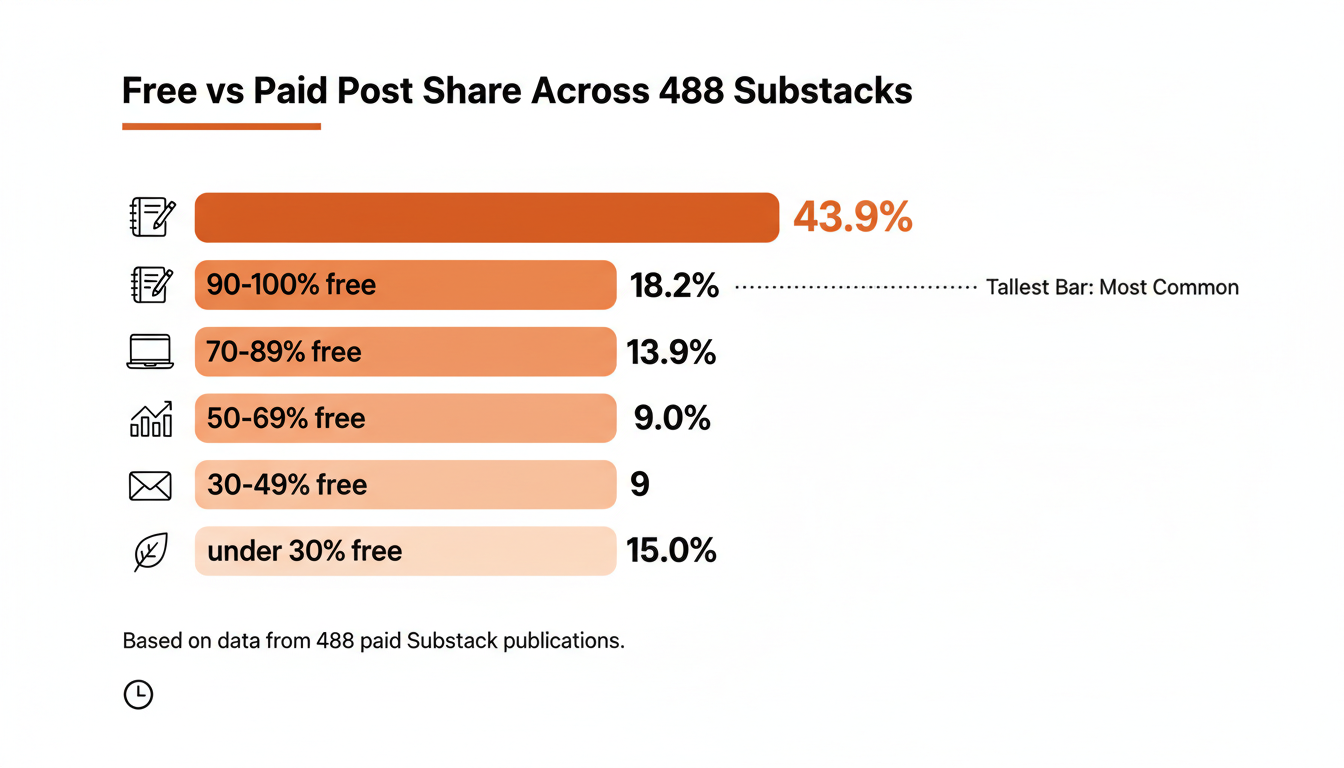
Only 18.2% of paid Substacks actually sit in the range the 3:1 rule describes. The single biggest group, 43.9%, publishes almost everything free and paywalls almost nothing.
Practical rule: if your free share is anywhere between 50% and 100%, you're inside the normal range for a paid Substack. Under 30% free is the outlier zone, not the default.
The four paywall models Substack describes
Substack's own writer guidance skips ratios entirely and instead names four models by how clearly the free/paid line is drawn, not by percentage (on.substack.com/p/free-vs-paid). Mapping our data onto these four models is more useful than the ratio table above.
All free and loosely defined
"All free" is what it sounds like: every post is free, and paid subscriptions exist to fund the work rather than give access to more of it. Substack recommends this for writers just starting out, and for publications built around advocacy or a cause, where the goal is reach rather than exclusivity. This maps closest to our 90-100% free bucket, the largest group in the data at 43.9%, and it also tends to describe younger publications: average total post count in that bucket is 79.2, the lowest of any group in the sample.
"Loosely defined" is the next step: free and paid posts both exist, but there's no rigid rule for which is which. A writer decides post by post whether something feels like a paid-only "backstage pass." This is a flexible middle ground, and it's likely where a good chunk of our 70-89% and 50-69% buckets actually sit, even though the exact split varies week to week.
The appeal of the loosely defined model is that it doesn't force a commitment before you know what your paid subscribers actually value. You can paywall a post because it took unusually long to write, or because early readers reacted to something similar, and adjust the next time based on what happened. The cost is that free readers can't predict what they're going to get, which is fine early on and can start to feel inconsistent once a publication has a larger, more established free list expecting a routine.
Clearly defined and all paid
"Clearly defined" means subscribers know exactly what's behind the paywall before they hit it, a weekly deep-dive, a monthly roundup, an archive. This tends to correlate with a lower free share, since the paid tier needs enough substance to justify a defined boundary.
"All paid" locks everything, and Substack specifically notes this works best in categories like investing, business, and other work-related niches where subscribers can expense the cost or where the content substitutes for their job. Our under-30%-free bucket, 15% of the sample, is the closest match, and niche composition explains a lot of it.
Practical rule: don't pick a model because it's popular. Pick it based on why people already pay you, not why you think they should.
Why "almost all free" is the biggest group, not the paywall-heavy group
The most common setup by far, 43.9% of paid Substacks, keeps nearly everything free. That's the opposite of what the 3:1 rule implies, which frames free content as the funnel and paid content as the destination.
In practice, a lot of successful paid Substacks use the paid tier for things that aren't gated posts at all: comment access, community threads, an archive, or simply the option to say thanks. Substack's own guidance calls this out directly, noting that some of the most effective pitches are about supporting the work, not gaining access to more of it.
This matters for a writer deciding what to build first. If your paid tier is entirely dependent on locking content behind a wall, you're competing with your own free posts for attention, since every gated post is one less piece of writing available to pull in new free readers. If your paid tier is about access and community layered on top of free writing, the two reinforce each other instead: the free posts keep bringing readers in, and the paid tier gives your most engaged readers somewhere to go once they arrive.
📅 Struggling to stay consistent on Substack?
WriteStack's Smart Scheduling lets you batch and queue Notes in minutes. Grow on Substack without burning out.
Explore Smart SchedulingIt's worth noting that engagement per post doesn't fall off a cliff as publications lean more free. Average reaction counts per post across the five buckets in the sample are 18.9, 17.1, 14.9, 25.4, and 14.9 respectively, moving from the most-free bucket to the least-free one. There's no clean straight line here, engagement depends far more on niche and writer than on paywall placement, and that's itself a useful finding: your ratio decision should be driven by what you want the paid tier to do, not by a fear that giving more away will tank engagement on what remains free.
Why some publications paywall almost everything and still grow
The under-30%-free group, 15% of the sample, isn't failing. It's a different business model built on categories where free samples matter less than ongoing utility. A trading newsletter or a legal-updates publication sells information that has to stay current and specific to be worth anything, so there's less incentive to give the good stuff away.
The tradeoff is growth speed. A heavily paywalled Substack has less free content circulating for search and social discovery, so it typically needs an existing audience, built elsewhere or built earlier as a free publication, before flipping the switch. The data backs this up directly: publications in the under-30%-free bucket have published an average of 148.3 total posts, nearly double the 79.2 average for the 90-100%-free bucket. Total post count is a rough proxy for how long a publication has been running, and the pattern is consistent, the more a publication paywalls, the longer it's typically been around, which lines up with starting free and tightening the paywall only after an audience already exists.
That ordering matters more than the ratio itself. A brand-new Substack that paywalls 70% of its output from day one isn't following the same playbook as a five-year-old publication with the same ratio. The second one earned that ratio through years of free posts that built the list; the first one is just making it harder for anyone new to find a reason to subscribe at all.
Practical rule: heavy paywalling works when your content replaces something subscribers already pay for elsewhere, a subscription, a tool, a consultant. It works less well when it just replaces other free newsletters.
How to pick your own ratio
Instead of adopting a ratio, work backward from your subscriber count and your reason for charging.
If you have under 1,000 free subscribers
Stay close to the "all free" or "loosely defined" end. You don't have enough free reach yet for paywalled posts to pay off, and every gated post is one fewer piece of content available to convert new readers. Substack's own advice for new writers is the same: keep the majority of the work free and let paid subscriptions run as optional support rather than the price of admission.
This is also the stage where consistency matters more than the ratio. A publication that posts three times a week for free but skips weeks at random will grow slower than one that posts once a week reliably, regardless of what's paywalled. If you're still building the free side of the list, put your energy into a schedule you can actually hold before you touch the paywall at all.
If you already have a real free audience
Test a defined split before committing to one. Pick a single recurring feature, a weekly analysis, a monthly deep dive, and paywall only that, consistently, for a month. Then look at two numbers: how many free subscribers converted, and whether your free subscriber growth rate slowed down. If growth didn't slow and conversions came in, you have room to paywall more. If growth stalled, pull back.
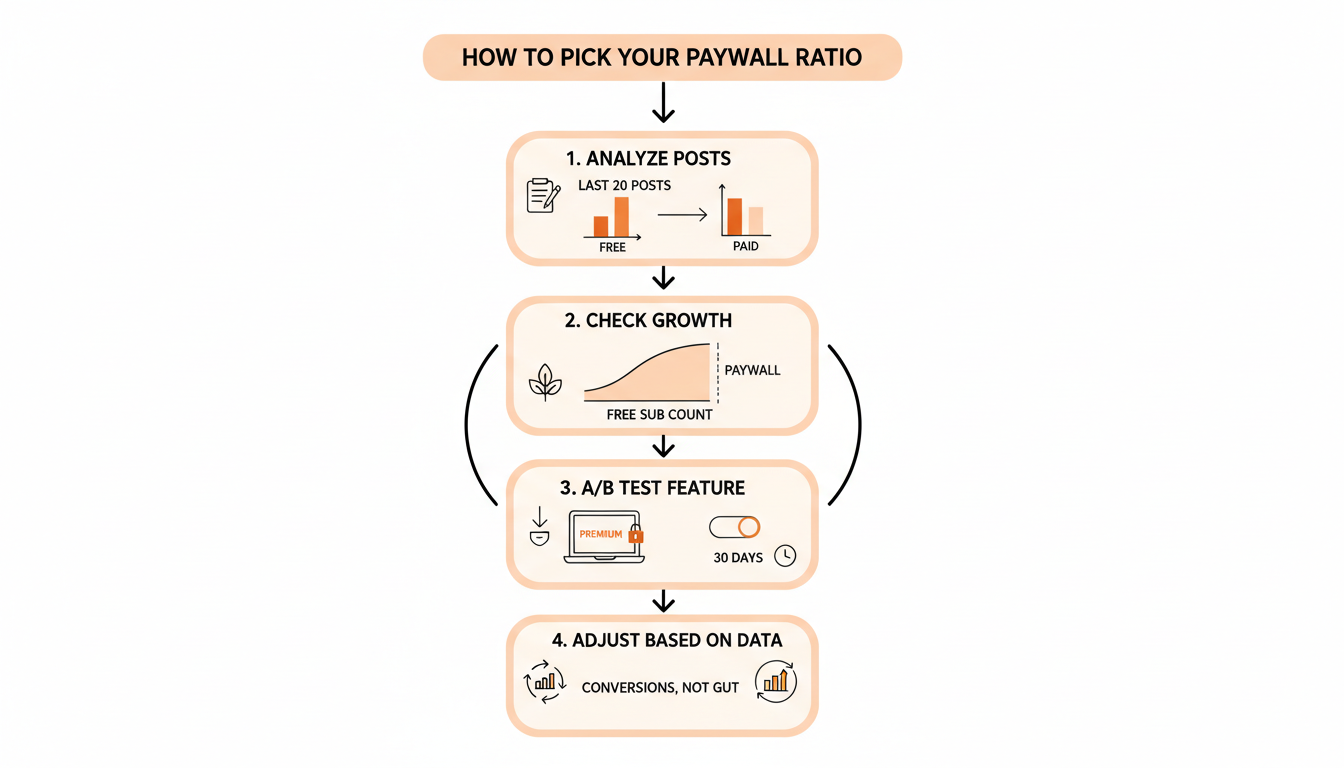
Practical rule: change one variable at a time. If you paywall more content and change your pricing in the same month, you won't know which decision moved the number.
Common mistakes when setting your paywall split
The most common mistake is copying a ratio from a creator in a completely different niche. A ratio that works for a culture-and-commentary newsletter with a large free reach doesn't transfer to a niche B2B newsletter with a smaller, higher-intent list, and vice versa.
The second mistake is treating the free/paid split as fixed once decided. The data shows publications across every bucket from 90% free to under 30% free, which means the split is something writers actively adjust over time, not a setting picked once at launch.
The third is paywalling inconsistently without telling readers why. Substack's guidance is specific here: readers respond better to a clear pitch for why paid support matters than to an unexplained paywall showing up on a random post.
A fourth mistake worth naming separately: judging the ratio decision by a single month of data. Free subscriber growth is noisy week to week, and a slow month right after you introduce a paid tier doesn't automatically mean the paywall caused it. Give any change at least six to eight weeks, and compare against your own trailing average rather than against a single prior month, before deciding whether to adjust again.
Practical rule: whatever ratio you land on, write down the reason for it. If you can't explain why a specific post is paywalled, your readers can't either.
How WriteStack fits into the free vs. paid decision
Getting this right depends on posting consistently enough on the free side to have real data to react to. WriteStack helps here by keeping your free Notes and posts scheduled and shipping on a steady cadence instead of in bursts, so a slowdown in free engagement is actually a signal about your paywall, not just a symptom of inconsistent publishing.
WriteStack's heatmap shows when your free content actually lands with readers, which matters if you're testing whether a paywalled feature is cannibalizing your best free-posting slots. And the fans view surfaces your most engaged free readers, the exact group Substack's own guidance says to study before you write your paid subscription pitch.
If you're still deciding whether a scheduling tool is worth adding to the mix at all, WriteStack vs Substackulous breaks down how WriteStack's approach compares to the alternative.
Your free-to-paid ratio isn't a number to copy from a blog post, including this one. It's a decision you get to keep testing as your audience changes, and the 488 publications behind this data prove there's no single right answer, just a range of setups that each work for a different stage and a different niche. Start from where your subscriber count and your reason for charging actually put you, not from 3:1, and let your own numbers move the ratio from there.
The one thing every bucket in this data has in common is that none of them got there by accident. Someone looked at what their readers responded to and adjusted, more than once, over months or years. That's the part worth copying, not the ratio itself. If you want your free posting cadence solid enough to actually trust the data you collect on it, that's what WriteStack is built for.