

You spend three hours on a post and four minutes on the title. Then you refresh the reaction count and try to work out which one was the problem. There is no way to check, so the next post gets the same reflexes: add a number, add a colon, turn it into a question. Most title advice is copywriting folklore passed hand to hand, never checked against a single Substack post.
So I pulled title text and reaction counts for 2.7 million Substack posts published since the start of 2024. What makes a Substack post title work? The data disagrees with a good chunk of standard advice, and several of the tactics that supposedly help either barely move the needle or actively cost you reactions.
One number worth having before you start: WriteStack has close to 100 verified reviews from Substack writers across multiple platforms. The other tools promising to help you write and test Substack headlines have none that we could find anywhere.
This is the same question I run into every week planning WriteStack's own posts. I used to default to the copywriting playbook: numbers, questions, colons. Some of that turned out to be working against me.
Table of Contents
- Substack Post Titles: What 2.7 Million Posts Actually Show
- The Character Count Sweet Spot
- Why Titles With Numbers Underperform
- "How To" Titles Have a Real Edge
- Questions and Colons: Weaker Than You'd Think
- What 20,000 Notes Say About the Shape of a Hook
- How This Compares to Email Subject Line Advice
- Title Formulas That Match the Data
- How to Test a Title Before You Commit It to a Post
- Building a Title Habit That Holds Up
Substack Post Titles: What 2.7 Million Posts Actually Show
We pulled title text and public reaction counts for every post in a corpus of roughly 3 million scraped Substack posts, filtered to the 2,738,289 posts published from January 2024 onward with a recorded title and reaction count. Then we grouped titles by length and by the presence of common patterns (numbers, question marks, colons, and titles that open with "how") and compared average reactions across each group.
The short version: character count has a real, fairly narrow sweet spot, one of the most common title tactics (adding a number) correlates with lower engagement rather than higher, and "how"-style titles carry a real advantage even accounting for the fact that a few of them went viral.
Practical rule: treat every title tactic you've picked up from generic copywriting advice as a hypothesis to test against your own niche, not a rule. Several of them don't hold up in Substack-specific data.
Where This Data Comes From
The sample is aggregate behavior across a wide mix of niches, publication sizes, and posting frequencies, not one writer's experience or an A/B test. Reaction counts are a public Substack metric visible on any post, so they're a reasonable proxy for what got read and reacted to, but they don't measure open rate or subscriber conversion directly. A title that pulls reactions from an already-engaged audience isn't necessarily the same title that would pull a cold click from Google or Notes. Keep that gap in mind as a limitation, not a reason to dismiss the pattern.
Platform averages set your defaults. Your own numbers decide. Start a free 7-day trial of WriteStack and put your next title in front of readers as a Note before you commit it to a post.
The Character Count Sweet Spot
Grouping titles into seven length buckets shows a clear rise-then-flatten pattern through the middle of the range, followed by a jump at the extreme long end.
| Title length | Posts in sample | Avg. reactions |
|---|---|---|
| Under 30 characters | 1,086,362 | 18.1 |
| 30–39 characters | 537,369 | 21.2 |
| 40–49 characters | 380,308 | 23.3 |
| 50–59 characters | 254,563 | 23.6 |
| 60–69 characters | 180,601 | 22.4 |
| 70–89 characters | 191,475 | 22.8 |
| 90+ characters | 107,611 | 38.6 |
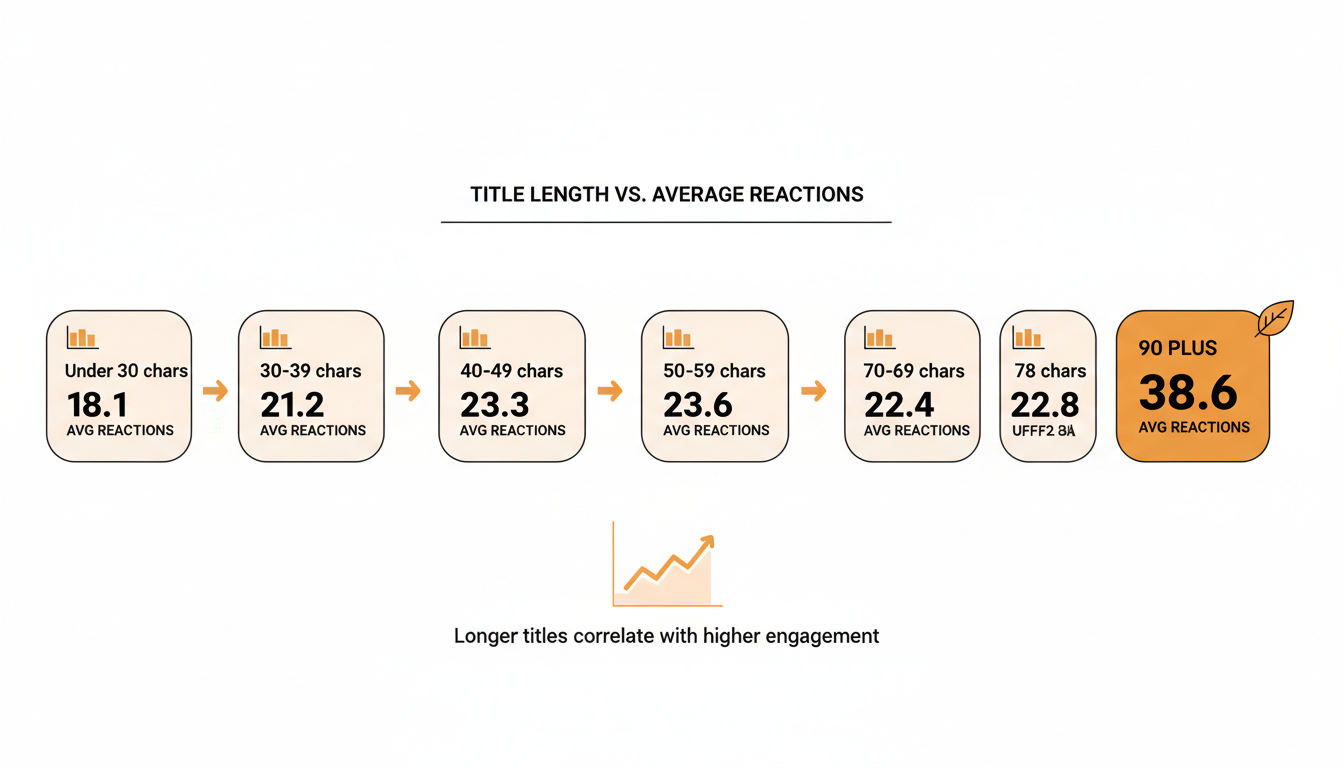
Titles under 30 characters are the weakest performers in the set, averaging 18.1 reactions. Engagement climbs steadily through the 40-to-59-character range, which is where the highest averages in the normal range land, then dips slightly in the 60-to-89 range before spiking at 90-plus characters.
That last jump is worth treating carefully. The 90-plus bucket has the smallest sample of the seven (107,611 posts, still a large number in absolute terms, but the smallest share of the total), and very long titles tend to belong to a specific kind of post: detailed listicles, full announcements, or posts that already had an established, engaged audience willing to read a long headline. It's less "long titles cause high engagement" and more "the posts that use long titles tend to come from writers or formats that already pull strong engagement." Don't read this bucket as permission to pad every title to 100 characters.
Practical rule: aim for 40 to 59 characters as your default. That's the range with the best combination of sample size and consistent performance, not a fluke driven by a handful of outliers.
Why Titles With Numbers Underperform
Generic copywriting advice treats numbers in headlines as close to a guaranteed lift: "7 Ways to..." or "The 5 Substack Mistakes..." The Substack data runs the other way.
| Pattern | Posts in sample | Avg. reactions |
|---|---|---|
| Title contains a number | 655,388 | 14.8 |
| Title has no number | 2,082,901 | 23.4 |
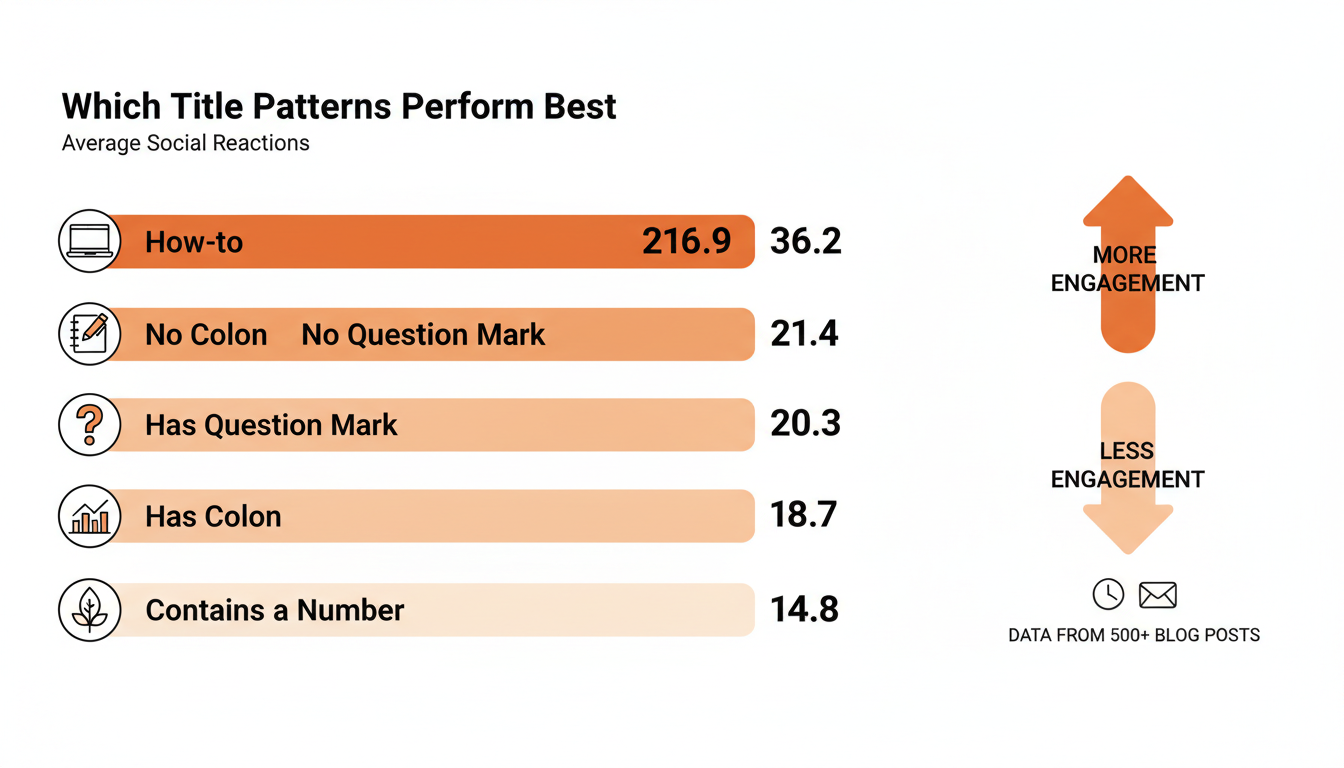
Titles with a number in them average 14.8 reactions, well below the 23.4 average for titles with no number at all. That's not a small gap. It's roughly a 37% difference in the wrong direction from what standard advice predicts.
A likely explanation: number-led titles read as listicle format, and listicles are a saturated pattern on Substack the same way they are everywhere else on the internet. A reader who has seen a thousand "5 Tips For..." headlines has learned to scroll past them. On a platform built around a writer's individual voice and judgment, a formulaic listicle title may signal generic content before the reader ever opens the post.
Practical rule: don't default to a number to make a title feel more concrete. Specificity works better when it's a real detail (a name, a result, a timeframe) rather than a count.
"How To" Titles Have a Real Edge
Titles that open with "how" (case-insensitive, so this covers "How to," "How I," and "how I finally") average 36.2 reactions against 21.1 for every other title in the sample, a gap wider than anything else we measured.
Why "How" Titles Work
Part of that gap is genuine outlier pull. The highest-reacted "how" titles in the sample are personal, specific, and promise a concrete transformation ("How to Start Researching as a Hobby," "How to Remember Everything You Read," "How to Become Friends With Literally Anyone"), and a handful of posts like that pulled tens of thousands of reactions each, which drags the group average up. That's worth being upfront about: averages get skewed by viral outliers, and "how" titles have their share of them. The format carries a higher ceiling when the post underneath it delivers on the promise, without any guarantee that a "how" title alone will produce that result.
The pattern still holds directionally even accounting for that. "How" titles promise a process, not just a topic. They tell the reader exactly what they'll walk away knowing how to do, which sets a clearer expectation than a topic-only title. A title like "Substack Growth Tips" describes a subject. A title like "How I Grew to 10,000 Subscribers Without Notes" describes an outcome and implies a path to get there. The second version gives the reader a reason to click that the first doesn't.
Practical rule: when a post genuinely walks through a process or a personal path to a result, say so directly in the title with "how." Don't force it onto posts that are opinion pieces or announcements, where it will feel misleading.
Questions and Colons: Weaker Than You'd Think
Two more common headline tactics, asking a question and using a colon to add a subtitle-style clause, both show a small negative correlation with engagement in this data.
| Pattern | Posts in sample | Avg. reactions |
|---|---|---|
| Title contains a question mark | 199,083 | 20.3 |
| No question mark | 2,539,206 | 21.4 |
| Title contains a colon | 485,817 | 18.7 |
| No colon | 2,252,472 | 21.9 |
Neither gap is as dramatic as the number pattern, but both run counter to the usual advice that a question mark creates curiosity or that a colon adds useful specificity. Colons show the bigger drop of the two: titles with one average 18.7 reactions against 21.9 for titles without.
A reasonable read: a colon often signals a title that's doing two jobs at once, a broad hook followed by a clarifying subtitle, and that structure can end up feeling like hedging rather than a clear promise. "The Truth About Substack Growth: Why Most Writers Quit in Month Three" is really two ideas stapled together. Picking one clear idea and stating it directly tends to outperform trying to cover both angles in a single title.
Practical rule: if a title needs a colon to explain what the first half means, the first half probably isn't specific enough on its own. Cut it down to one clear idea.
📅 Struggling to stay consistent on Substack?
WriteStack's Smart Scheduling lets you batch and queue Notes in minutes. Grow on Substack without burning out.
Explore Smart SchedulingPut every pattern from this article side by side and the ranking is consistent: "how" titles lead by a wide margin, plain titles with no gimmick beat both numbers and colons, and question marks land in the middle.
What 20,000 Notes Say About the Shape of a Hook
Post titles are the hardest hook to measure, because you only ever ship one version of each. Notes are the other place you write a hook, and there the sample is large enough to say something specific.
We pulled 20,000 recent Substack Notes and grouped them by length and by shape, the same way we grouped titles above.
| Note pattern | Compared with | Difference |
|---|---|---|
| Notes of 150–300 characters | Notes under 50 characters | Roughly a third more reactions, and a wider gap on restacks |
| Multi-line Notes | Single-line Notes | About 11% more reactions, about 28% more restacks |
Those are findings about Notes. They are not findings about post titles, and stretching them into title rules would be exactly the kind of borrowed advice this article has spent 2.7 million posts arguing against. What they are is the closest thing anyone has published to measured evidence about the shape of a Substack hook: how much room an opening idea needs before it stops earning attention, and what happens when you give it a second line to breathe. A one-line, under-50-character hook is the cheapest thing to write and the weakest thing on the page, in Notes and, based on the title table above, in titles too.
The useful part is not the numbers themselves. It's that Notes are measurable and titles are not, and that asymmetry is what makes a title testable at all. How to run that test is further down.
The part people don't expect
WriteStack tracks which of the two links inside a Note got clicked, going back to your very first Note, so "that framing did well" becomes "that framing sent 40 people to the post." It drafts new angles by reading your published Notes and posts rather than a prompt, and if a draft misses you switch models instead of living with one fixed voice. It also benchmarks your restack rate against other publications your size and shows the direction it's moving month over month. Open the dashboard on a Tuesday and see that the version of the hook you almost didn't post is the one that actually moved people, and that your restack rate is running well above typical for a publication your size. Not better than last week. Better than the field.
How This Compares to Email Subject Line Advice
General email marketing research points to a different length range than what shows up in this Substack-specific data. Analysis of subject lines across more than 7 billion emails found that subject lines under 21 characters generated a 31% higher-than-average open rate, even though they make up a small share of all subject lines sent.
That's a meaningfully shorter sweet spot than the 40-to-59-character range that performs best in the Substack post title data above. The likely reason is that the two are measuring different things. General email subject line studies mostly measure open rate on cold or semi-cold sends, often marketing or transactional email, where brevity and mobile-preview visibility dominate. The Substack data here measures reaction counts on posts, which is closer to engaged-reader behavior after the open than to the open decision itself, and a Substack post title also works as a headline on the web and inside Notes, not just as an inbox subject line.
Practical rule: don't import inbox subject line advice wholesale into your Substack post title. The two are optimizing for different moments in the reader's attention, even though they look like the same kind of text.
Title Formulas That Match the Data
Putting the patterns above together gives a small set of formulas worth defaulting to, rather than a single rule.
The How-To Promise
"How I [specific result] [specific constraint or timeframe]." Example: "How I Post Three Times a Week Without Burning Out." This format earns the "how" advantage from the data above and stays inside the 40-to-59-character sweet spot when you keep the result and constraint concrete instead of vague.
The Specific Outcome
A direct statement of what happened or what the reader will get, with a real detail standing in for a number. Instead of "5 Lessons From My First Year on Substack," try "What My First Year on Substack Actually Taught Me." Same topic, no listicle signal, same rough length.
The Named Constraint
A number still has a place, just not as the headline device. Instead of leading with a count, name the specific constraint the number describes: a deadline, a budget, an audience size at the time. "How I Grew to 10,000 Subscribers" reads differently than "10 Subscriber Growth Tips," even though both contain a number, because the first is a specific claim about one writer's path and the second reads as a generic list. If a number is genuinely central to the post's argument, work it into a how-to or outcome title rather than putting it at the front as a list count.
Practical rule: write three versions of every title before publishing: one with a number, one starting with "how," and one as a direct statement. Pick between the last two by default, and only keep the number version if it's genuinely the clearest way to state the idea.
Writing three versions is the easy half. WriteStack's Notes and post generator drafts variations from what you have already published, so the angles come back in your voice instead of in a generator's. When one misses, you switch models rather than rewriting it by hand. Start your free trial and get three usable angles out of your last post in about five minutes.
How to Test a Title Before You Commit It to a Post
A title only gets tested if people see it. On Substack, a post title gets seen once, by your existing list, at the moment you hit publish. There is no second draw and no control group. Whatever the reaction count says, you cannot separate the title from the piece, the send time, or the week you happened to publish in.
The cheapest test available is putting the angle out as a Note before you commit it to a post. Same promise, same claim, written as a hook instead of a headline. Notes cost you a few minutes, they reach beyond your own list, and they produce numbers you can compare against each other because you can run three framings of the same idea across a week and watch which one pulls.
WriteStack is built for exactly that loop. The Notes generator drafts the variations from your published work, so each angle arrives already sounding like you. The queue holds all three so they go out across the week without you sitting at the composer. Then link-click tracking across your full Notes history tells you which framing actually sent people to the post, which is a different question from which one collected likes, and the only real title test Substack offers.
| What testing a title requires | Substack native | WriteStack |
|---|---|---|
| Link-click tracking across your full Notes history | No | Yes, per link inside each Note |
| Benchmarks against other publications your size | No | Yes |
| Trend analysis month over month | No | Yes |
| AI drafts written from your own published Notes | No | Yes, with model selection |
| Queue several title angles as Notes in one sitting | Manual, one at a time | Built for this |
| Heatmap of when your own posts and Notes landed | No | Yes |
| Live inspiration feed from current Notes data | No | Yes |
| Schedule Substack chat posts | No | Yes, and no other tool in the category does |
| Verified reviews from Substack writers | Not applicable | ~100 across multiple platforms |
A newsletter about parenting and a newsletter about crypto trading can have completely different title patterns even when both sit in the how-to format, because the readers who subscribed came for different reasons. WriteStack's heatmap shows which of your own posts and Notes drove engagement over time, so you can check the "how" and length patterns above against your specific audience instead of inheriting them.
Practical rule: run the angle as a Note first. Judge it on link clicks rather than likes, then write the title from the framing that actually moved people.
Building a Title Habit That Holds Up
The expensive mistake here isn't picking a weak title once. It's spending an hour agonizing over a headline with no information, then reaching for a number or a colon out of habit because generic advice says to, and never finding out whether either one works on your readers.
Six weeks into running titles through Notes first, the change isn't that your headlines get cleverer. It's that you stop guessing. The angle for Thursday's post already went out as a Note on Monday, it pulled 60 link clicks against 12 for the version you preferred, and the title writes itself from there. The hour you used to spend staring at a blank headline field goes back into the post.
Platform-wide data gives you the starting defaults: 40 to 59 characters, lead with "how" when the post earns it, drop the number and the colon. Your own click history gives you the answer. WriteStack drafts the angles from what you've already published, queues them as Notes, and tracks which links inside each one got clicked, going back to your first Note. Close to 100 verified reviews from Substack writers back that up, and no other tool in this category has any we could find.
Start a free 7-day trial. Draft three angles from your last post, put them out as Notes this week, and let the click data name your title.