
Open your subscriber dashboard and sort by source. If you have been on Substack for more than a few months, there is a decent chance one channel quietly outperforms your Notes activity and your social media promotion put together: recommendations from other writers.
Most writers set up Substack recommendations once, pick two or four publications they vaguely like, and never touch the feature again. That is leaving subscribers on the table, because this is the most valuable five minutes in the entire Substack settings panel. Substack's own numbers back that up, and we will get to them below.
One number worth having before you start: WriteStack has close to 100 verified reviews from Substack writers across multiple platforms. The other tools built for Substack growth have none that we could find anywhere. That matters here because everything below depends on other writers deciding your work is worth vouching for, and vouching is the one thing you cannot fake.
This guide covers how the feature actually works, how to get other writers to recommend you back, what a blurb that converts looks like, and how to tell whether any of it is paying off.
Table of Contents
- How Substack Recommendations Work
- The Numbers Behind the Feature
- How to Set Up Recommendations in Five Minutes
- How to Get Recommended Back
- The Notes Habit That Earns Recommendations
- Blurbs That Convert vs. Blurbs That Get Ignored
- Tracking Your Recommendation Results
- Five Mistakes That Stall Recommendation Growth
- Substack Recommendations FAQ
- Where Recommendations Fit in Your Growth System
How Substack Recommendations Work
Recommendations are Substack's built-in cross-promotion system. You endorse publications you like, and when a reader subscribes to your Substack, they see those publications and can subscribe to them in one tap. Other writers can do the same for you. Substack introduced the feature in 2022, describing it as simple cross-promotion for writers, and it has since become the platform's main discovery engine.
The mechanic matters because of when it fires. A reader who just subscribed is at peak enthusiasm. They made a decision, they trust the writer they picked, and a suggestion from that writer at that exact moment carries far more weight than a random ad or a cold social post ever could.
Where readers actually see them
Your recommendations surface in a few specific places, and knowing them helps you understand why blurbs matter so much:
| Placement | When the reader sees it | What shows |
|---|---|---|
| Subscribe flow | Right after subscribing to a publication | A list of recommended publications with one-tap subscribe |
| Welcome page | When browsing a publication's landing page | Recommendations with blurbs get featured placement |
| Welcome email | After joining, if the writer includes them | Links to recommended publications |
| Substack app | During onboarding and in the feed | Suggested publications and profiles to follow |
Substack expanded the subscribe-flow screen in a February 2024 upgrade. Readers used to see a maximum of three recommended publications there. Now they see the full list a writer recommends, which raised the ceiling on how much traffic the feature can move.
Incoming vs. outgoing
Outgoing recommendations are the publications you endorse. Incoming recommendations are writers endorsing you, and they are the ones that grow your list. You control outgoing directly. Incoming you can only earn, and the rest of this article is largely about how to earn more of them.
Earning them comes down to being visible to peer writers week after week, which on Substack means Notes. WriteStack exists for that half of the job: schedule a week of Notes in one sitting so the visibility that earns recommendations keeps running while you write. Start a free 7-day trial and load your first week today.
Practical rule: Treat outgoing recommendations as a lever, not a favor. Every publication you recommend is a writer who now has a concrete reason to look at your work and consider recommending you back.
The Numbers Behind the Feature
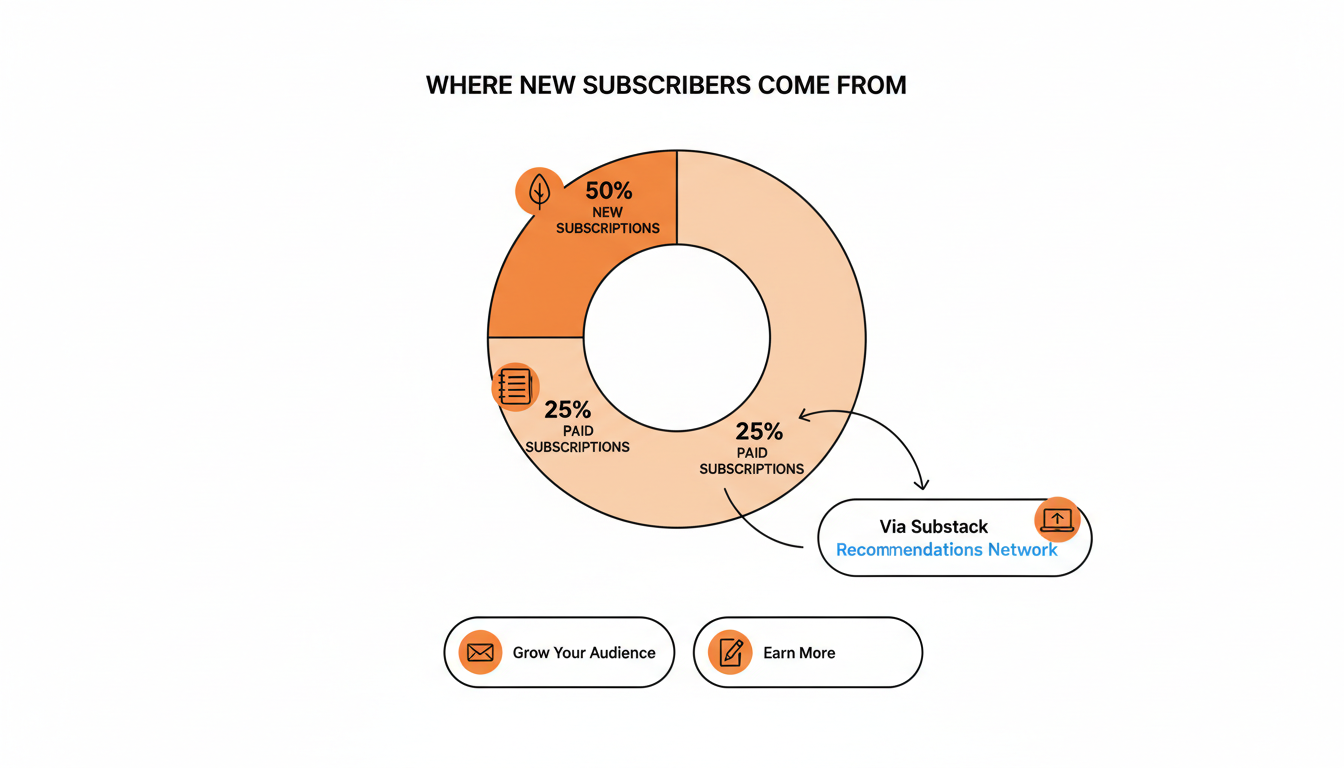
Substack has published real numbers on this, which is rare for platform growth features. As of early 2024, Recommendations together with the Substack app power a network that drives 50% of all new subscriptions and 25% of new paid subscriptions across the platform. Half of every new subscription on the platform arrives through the network rather than through anything writers do off-platform.
Lenny Rachitsky, who runs the top publication in Substack's Business category, credits Recommendations as one of the most impactful growth features he has seen, and he built a list of hundreds of thousands of subscribers with it as a major channel.
Two things follow from those numbers. First, if you have zero incoming recommendations, you are cut off from the platform's largest subscriber source. Second, the feature compounds: every new incoming recommendation is a permanent pipe that keeps delivering as the recommending publication grows.
Practical rule: Judge recommendation effort against its permanence. A viral Note spikes and fades within days. An incoming recommendation from an active publication keeps sending subscribers every single week without any further work from you.
How to Set Up Recommendations in Five Minutes
The mechanics are quick, per Substack's own help documentation. The strategy is where most writers underinvest.
Adding your first recommendation
From your publication dashboard, open the Recommendations tab in the navigation bar and click Add Recommendation. Search for the publication and select it, and you are done at the minimum level. The writer you recommended gets notified, which is exactly the point.
Start with four to six publications you actually read. Authenticity is detectable here. Readers who subscribe through your recommendation and find a publication that has nothing to do with why they followed you will trust your next endorsement less.
Writing a blurb that gets displayed
When you add a recommendation, Substack offers an optional blurb field, a sentence or two on why you recommend the publication. Most writers skip it. Do not skip it, for one structural reason: a recommendation with a blurb can be displayed on the recommended publication's welcome page with a link back to your Substack, while a blurb-less recommendation stays buried. The blurb is what turns your endorsement into a visible, reciprocal asset.
A good blurb is specific. "Great newsletter" tells a reader nothing. "The only writer who explains pricing strategy with real revenue numbers from her own business" tells them exactly who should subscribe.
Practical rule: Write every blurb for the reader deciding whether to click, not for the writer you are complimenting. Specificity converts, flattery does not.
How to Get Recommended Back
Incoming recommendations grow your list, and you cannot buy them or toggle them on. Here is what reliably earns them.
Recommend first, ask never
The sequence that works starts with recommending a publication and writing a thoughtful blurb. Then engage with the writer's posts and Notes over a few weeks so your name becomes familiar, and let the reciprocation happen on its own. Substack notifies writers when they get recommended, and most curious writers will check out whoever endorsed them. If your publication is a genuine fit for their audience, a meaningful share will recommend you back without being asked.
Cold-asking strangers for recommendations mostly fails, and it burns goodwill you may want later. A recommendation is a public endorsement to someone's own audience. Writers protect that, as they should.
If you already have a real relationship with a writer, a direct conversation about mutual recommendations is completely fine. The rule is about strangers, not peers.
Picking publications with real overlap
Audience fit beats audience size. A 900-subscriber publication whose readers are exactly your target reader will send you more subscribers than a 50,000-subscriber publication in an adjacent niche, because conversion on the subscribe-flow screen depends on the reader recognizing your one-line description as relevant to them.
Size asymmetry also affects who reciprocates. Writers at 100x your size rarely recommend down, and there is no resentment in that, their endorsement bar is just higher. Your best targets are publications between roughly half and five times your size, in your niche, that post actively. Active matters: an incoming recommendation from a dormant publication delivers almost nothing because no new readers flow through it.
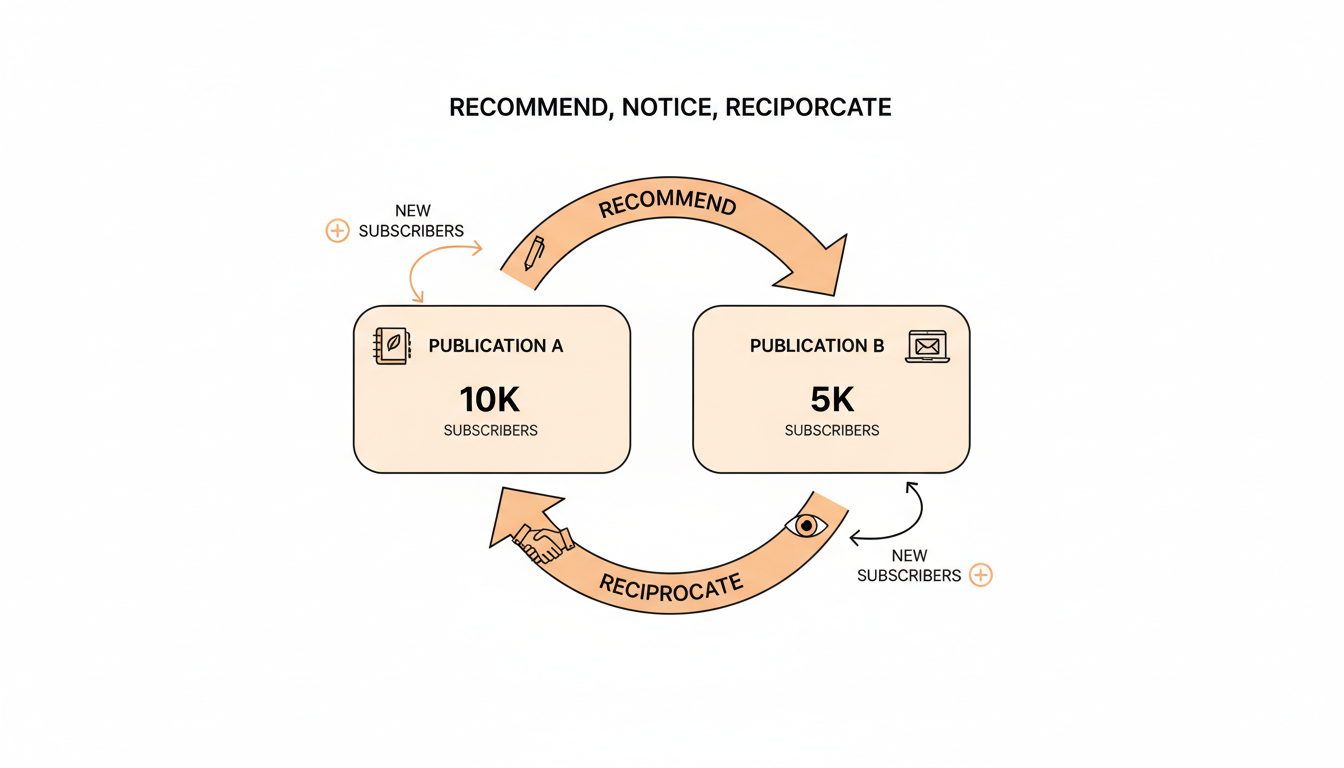
Practical rule: Build a shortlist of ten publications in your niche between 0.5x and 5x your size that posted in the last two weeks. Recommend the four or five you honestly read. That shortlist is worth more than any growth hack on this platform.
The Notes Habit That Earns Recommendations
Nobody recommends a stranger. Every incoming recommendation you will ever get comes from a writer who already knows your work well enough to put their own audience behind it, and on Substack the place that recognition forms is Notes. A writer sees your name restacking their piece in March, replying with something worth reading in April, and posting Notes in their niche all through both months. By May, recommending you is an easy decision instead of a risk.
That is the honest bridge between the two halves of this article. Outgoing recommendations open the door. Showing up in the same feed as those writers, consistently, week after week, is what makes them walk through it.
Why the engagement half is a queue problem
Restacking and replying to other writers consistently sounds like a soft skill. In practice it is a scheduling problem with a hard failure mode. You have a good engagement day, work eats the next four, and the writers you were building toward forget you existed. Substack's own interface does not help: you end up with your notifications in one tab, a writer's profile in another, their latest Note in a third, your own drafts in a fourth, and your queue nowhere at all.
WriteStack's Activity Center pulls that workflow into one place. Your engagement, your replies, and the writers you are tracking sit in a single view instead of five browser tabs, so the daily pass takes minutes rather than becoming the thing you skip. The Notes side runs on the same queue: batch a week of Notes when the ideas show up, and they publish on the schedule you set through the browser extension, using Substack's own native scheduler, so your session never leaves your browser.
📅 Struggling to stay consistent on Substack?
WriteStack's Smart Scheduling lets you batch and queue Notes in minutes. Grow on Substack without burning out.
Explore Smart Scheduling| What earning recommendations requires | Doing it manually | WriteStack |
|---|---|---|
| Finding active writers in your niche this week | Scroll the feed and hope | Live inspiration feed, updating continuously from live Notes data |
| Keeping engagement consistent through a busy week | Memory, five browser tabs | Activity Center, one view |
| Staying visible in your niche's feed daily | Post when you happen to be online | Batch a week, publish on schedule |
| Knowing which Notes got you noticed | No signal at all | Link-click history across your full Notes archive |
| Knowing if your restack rate is any good | Compare to your own last week | Benchmarks against other publications your size |
| Drafting Notes that sound like you | Write each one from scratch | AI that drafts from your published Notes, with model selection |
| Verified reviews from Substack writers | Not applicable | ~100 across multiple platforms |
Finding the writers worth engaging this week
The shortlist from the last section goes stale fast. Publications go quiet, new writers in your niche start posting, and the conversation your peers are having this week is not the one they were having in the spring. A list you built in March is a list of who mattered in March.
WriteStack's inspiration feed updates continuously from live Notes data, so what you see on a Tuesday reflects what is actually moving on Substack that week and which writers in your niche are driving it. Narrareach's equivalent is a static list, which was accurate on their live page as of July 2026. The difference decides whether your engagement lands on writers who are active enough to reciprocate.
We built WriteStack. We also linked every claim about every competitor to that competitor's own live page, so you can check all of it yourself.
Start your free trial and run a full week of Notes and engagement from one queue.
Blurbs That Convert vs. Blurbs That Get Ignored
Since blurbs earn welcome-page placement and drive the click decision, they deserve more than a throwaway line. The pattern that works names the target reader and what makes the writer different, in one or two sentences.
| Weak blurb | Stronger blurb | Why it works |
|---|---|---|
| "Great writing, highly recommend." | "If you write online and your open rate embarrasses you, Sarah's teardowns show exactly what she changed to fix hers." | Names the reader and a measurable outcome |
| "One of my favorite newsletters." | "The only fiction-craft newsletter I have read that uses published bestsellers as before-and-after editing examples." | States a concrete differentiator |
| "Smart takes on tech." | "Marco spent 12 years inside chip companies, and it shows every time he covers a semiconductor story the mainstream press gets wrong." | Credibility anchor plus a reason to trust |
Notice the pattern in the stronger column: each one could only have been written about that specific publication. If your blurb could apply to a hundred newsletters, it will convert like it applies to none.
Practical rule: Before saving a blurb, ask whether it would still make sense attached to a random other publication. If yes, rewrite it until it would not.
Tracking Your Recommendation Results
Substack recommendations are measurable, which makes them one of the few growth channels on the platform you can manage by the numbers instead of by feel.
The Recommendations tab
The Recommendations tab in your dashboard shows every recommendation relationship in both directions, along with the number of free subscriptions each one has generated. Since the 2024 network upgrade, Substack also surfaces how many subscriptions and follows you have driven for the people in your network, which is useful social capital when a writer checks what your endorsement has done for them.
Check it monthly. You are looking for two things: incoming recommendations that produce actual subscribers, and outgoing recommendations you send meaningful traffic to, because those writers have the strongest data-backed reason to reciprocate if they have not already.
The measurement gap Substack leaves open
Substack tells you how many subscribers a recommendation sent. It does not tell you which of your Notes made that writer notice you in the first place, and that is the number you would actually change your behavior over. The recommendation is the last step of a chain that started with a Note somebody read in February. Substack shows you the last step.
The part people don't expect
WriteStack tracks which of the two links inside a Note got clicked, going back to your very first Note, so the Note that earned you a relationship stops being a guess. It benchmarks your restack rate against other publications your size, which answers "is this good" rather than "is this better than last week," and a per-account dashboard structurally cannot answer the first question. And its inspiration feed updates continuously from live Notes data, so the writers you engage with this week are the ones actually posting this week. Open the dashboard on a Tuesday and see that the Note you almost didn't post drove 40 link clicks, three of them from a writer who recommended you six weeks later. Not better than last week. Better than the field.
Run that backwards a few times and the pattern in your own archive gets obvious. The Notes that earn you relationships are rarely the ones that got the most likes. They are the ones specific enough that another writer in your niche wanted to argue with them or pass them on.
What a healthy return looks like
There is no official benchmark from Substack, so set your own baseline the practical way: note your incoming-recommendation subscriber count today, then again in 30 days. For small publications, even two or four steady incoming recommendations from active same-niche writers typically become a visible slice of monthly growth. If a recommending publication sends you nothing across a full month, the audiences do not overlap, and your effort is better spent building a new relationship than maintaining that one.
Pair that monthly check with your Notes numbers. WriteStack's trend analysis shows the direction your restack and engagement rates are moving month over month, and a rising line there is the leading indicator for incoming recommendations that arrive a month or two later.
Practical rule: Review the Recommendations tab on the first of each month. Thank whoever sent you the most subscribers, and quietly replace your lowest-performing outgoing slot with a fresher, better-fitting publication.
Five Mistakes That Stall Recommendation Growth
The feature has been around since 2022, so the failure patterns are well documented by now.
Recommending twenty publications at once. The subscribe-flow screen now shows your full list, and a reader offered twenty options picks none. Endorsement value is inversely related to how freely you hand it out. Stay in the range of four to eight.
Recommending only mega-publications. Recommending Lenny or Heather Cox Richardson does nothing for your growth. They will not notice, and your readers already know them. Spend your slots on peers where reciprocity is achievable.
Skipping blurbs. Covered above, but it is the single most common miss: no blurb means no welcome-page placement and a weaker signal to the writer you endorsed.
Treating it as set-and-forget. Publications go dormant and audiences shift, on both sides of the relationship. A quarterly pass to prune and replace keeps your list pulling its weight.
Going quiet between recommendation rounds. This is the one that costs the most and gets diagnosed the least. You recommend six writers in January, engage for two weeks, then disappear from Notes until March. The window where those writers were deciding about you closes while you are gone. A queue running in the background keeps you in their feed through the weeks you are heads-down on a post, which is the entire reason WriteStack's scheduling and Activity Center sit in the same product.
Chasing swap arrangements with mismatched audiences. A recommendation swap with a publication whose readers have no reason to want yours produces subscriber counts that look fine and open rates that do not. Subscribers who never open your emails drag down your engagement rates over time, and inbox providers use those rates to decide whether your next post lands in the inbox or the promotions folder.
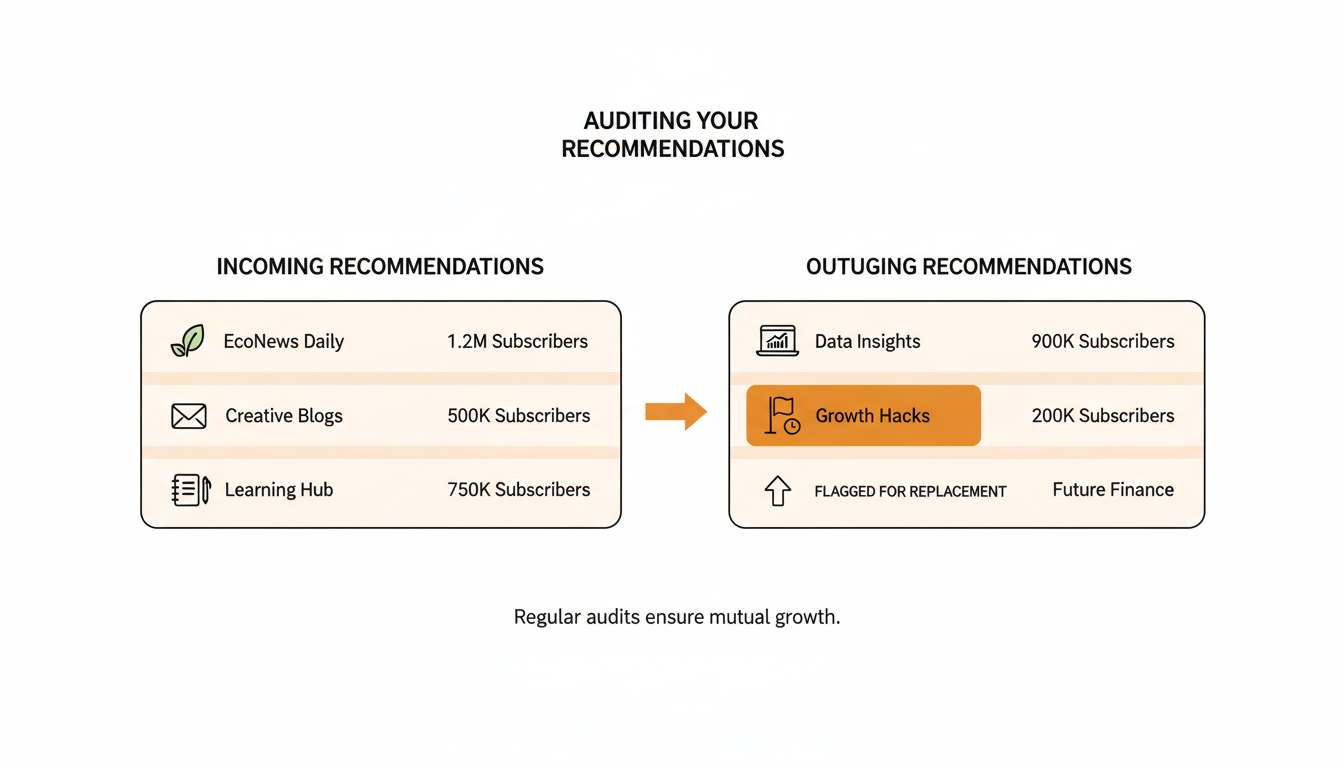
Practical rule: Your recommendation list is a portfolio. Prune it on a schedule the way you would prune anything else you expect returns from.
Substack Recommendations FAQ
Do recommendations cost anything? No. The feature is free on every Substack plan, for both free and paid publications. That is part of why skipping it makes so little sense.
Can readers tell when a recommendation is reciprocal? Not directly, and mutual recommendations between two writers who genuinely rate each other are normal and healthy. What readers do notice is fit. A recommendation that clearly belongs next to the publication they just subscribed to reads as taste. One that does not reads as a trade.
Does recommending other publications shrink my own list? This worry keeps a lot of writers from using the feature, and the platform data points the other way. Readers on Substack subscribe to many publications at once, so sending a reader to a peer does not remove them from your list. Meanwhile the reciprocal endorsements you earn bring in readers you had no path to otherwise.
Can I remove or edit a recommendation later? Yes, at any time from the Recommendations tab, and the same applies to blurbs. Nothing here is permanent, which is exactly why the monthly review habit works.
How many subscribers do I need before recommendations matter? There is no gate. Even a brand-new publication can recommend others from day one, and doing so is one of the few discovery signals available to a list of zero. Incoming recommendations tend to arrive once other writers can see a real publication behind your name, so pairing early outgoing recommendations with a consistent posting record shortens the wait.
How long does it take to earn an incoming recommendation? For most writers it runs six to twelve weeks from the first recommendation and the first round of genuine engagement. The variable is consistency, not talent. Writers who show up in their niche's Notes four or five times a week compress that window considerably, which is the practical argument for scheduling Notes ahead instead of posting when you remember.
Do recommendations work for paid subscriptions too? Yes, though less directly. The network drives 25% of new paid subscriptions platform-wide, mostly by bringing in free subscribers who convert later through your own writing.
Where Recommendations Fit in Your Growth System
Track one month before you change anything. Write down which writers you engaged with, which Notes you published, and which recommendations arrived. Almost every writer who does this finds the same shape: a burst of activity, a three-week gap, another burst, and incoming recommendations that arrive only after the stretches where they stayed visible.
Six months into running the loop properly, the change is not that you send more recommendation requests. You stopped sending them entirely. Writers in your niche see your Notes several times a week, they recognize your name in their restacks, and the endorsements start arriving on their own. The Recommendations tab becomes a report you read rather than a lever you push. The writing energy that was going into outreach goes into the posts.
Substack gives you the tab and the notification. Getting into the feed daily, engaging without losing a week to a busy stretch, finding the writers worth engaging this week, and seeing which Notes actually earned you a relationship are the layer around it, and WriteStack is the one tool that ships all of them together. Close to 100 verified reviews from Substack writers back that up, and no competing tool has any we could find.
Start a free 7-day trial. Queue a week of Notes in twenty minutes. Let the writers who recommend you find you while you write.